
Translated material
The limits of the humanitarian action
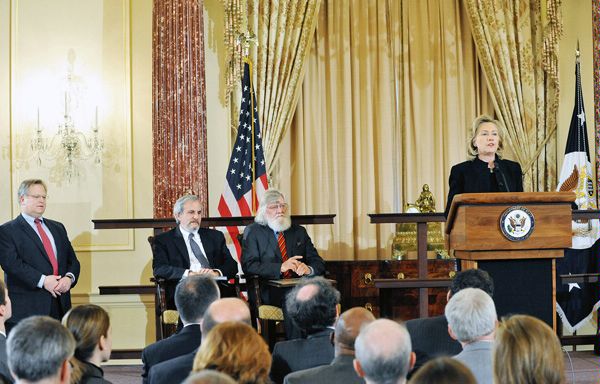
Vladimir Abarinov: Elizabeth Ferris worked for 20 years in one of the largest international non -governmental humanitarian organizations - the World Council of Churches. As the director of the global program to help refugees, she coordinated the actions of charitable organizations in hot spots and accumulated rich experience in this area, allowing her to write a book, which one of the participants in the discussion called "provocative". Elizabeth Ferris begins with a historical excursion on the laws and customs of war. According to her, the first international agreement on protection in armed conflicts of women and children appeared in the 10th century. Over the past 20 years, we have witnessed a number of humanitarian disasters, each of which contributed to the development of this direction of international humanitarian law.
Elizabeth Ferris: In the 90s in Somalia, Bosnia and Rwanda, employees of humanitarian organizations faced a terrible dilemma, trying to protect people who had the opportunity to intervene, stop violence, genocide or massacres, were absent, or did not want to take measures, or took them too late. This, if you like, was a monstrous problem of choice. For example, you help someone to run and thus save your life, even if you do it contribute to ethnic purge. I remember the young man whom I cheerfully advised in March 1994 at all costs to go to a small beautiful country Rwanda. He went there as a UN volunteer, and the next month genocide began there. He ultimately began to work for the management of the UN Supreme Commissar for Refugees, and I remember tears in his eyes and trembling in his voice when he told me: “You know, I was near the Kisangani with a group of management officers. We were on the opposite bank of the river and heard the cries, groans and cries of hundreds of destroyed people. We could not stop it. Refugees, but we could not prevent this battle, could not protect people. " Therefore, I must be happy that these days everyone is engaged in protection. In my world, the world of humanitarian activities, there are instructions, guidelines and reference books, there are training courses, standards and indicators, and all this is wonderful. When you cease to engage in humanitarian activities, protection comes to the fore. In 2000, the UN Security Council said that the protection of civilians is the main task of everything we are doing. With the only exception, each operation to maintain the world had a mandate to protect civilians as part of its mandate. A lot of time passed before the concept of responsibility to protect and understands that the international community is obliged to operate when the government of the state is not able to show responsibility.
Vladimir Abarinov: However, Elizabeth Ferris is convinced that there is an invisible but clear line between humanitarian activities and the protection of the civilian population.
Elizabeth Ferris: The word "protection" is a good word. This is a noble word. He has a slight patronizing shade: strong protect the weak. But when it is combined with the principles of humanitarian work, it happens that it is difficult to protect people and remain neutral. I often use analogies, and here is one of them. A woman with a broken hand comes to the doctor. She was beaten by her husband. She is a victim of domestic violence. The hand is broken. The doctor helps her. This is a neutral humanitarian act. But then the doctor tells her: "Have you thought about going to court? There is safe housing here. Or, perhaps, you must do something to eliminate the causes of this violence." At that moment when he tried to protect her, and not just cure her hand, he crossed the border of the neutrality. It is no longer neutral. He took her side. This is a dilemma, which in thousands of variations occurs today in humanitarian work.
Vladimir Abarinov: One of the new directions of humanitarian law was the international protection of the population who suffered from natural disaster.
Elizabeth Ferris: Sometimes it is very difficult for people who are most in need of protection and assistance, and attempts to gain access to them pose the greatest threat to employees of humanitarian organizations. I took a separate chapter protection in the zones of natural disasters. This is a relatively new field of activity. It did not actually exist before the 2004 tsunami, when we began to understand that people who were forced to abandon the places of permanent residence or affected by natural disasters also need protection.
Vladimir Abarinov: Elizabeth Ferris emphasizes that protracted conflicts are no longer an exception, but the rule. Even after the conflict is considered officially regulated, the conflictogenic potential remains, and humanitarian organizations have to work in an atmosphere of hostility and distrust.
Elizabeth Ferris: Finally, I am considering some future problems. One of them is a change in the nature of conflicts. Most conflicts today differ in duration and will probably be so in the future. I think the era of short wars, if they ever existed, came to an end. Most employees of humanitarian organizations act much better in emergency situations than in those when refugees and internally displaced faces are left without a shelter for decades. About two years ago, someone calculated that the refugee remains a refugee on average 17 years. Here, Palestinians who have been in the situation of refugees have been taken into account for more than 60 years. The corresponding figures for internally displaced persons are not collected, because they are very difficult to count, but, of course, data on them will be the same order. We are increasingly seeing that groups come into conflicts, the actions of which are motivated by economic benefit. There have always been gangs and people who are trying to make money in conflict situations, but the difference is, perhaps, that today it is exclusively criminal gangs. These are not those who kidnap people to get money and continue to fight. These are those who kidnap people for money.
Vladimir Abarinov: The US ambiguous position regarding the civil conflict in Libya, Washington’s stubborn reluctance to take on the role of the leader about how much the White House is ready to comply with his own declarations.
- One of the pillars of American foreign policy is to protect and encourage human rights around the world. Several American presidents defended this concept. Clinton said that the United States is ready to protect people everywhere. Nevertheless, Srebrenitsa, Rwanda and Eastern Timor occurred during his stay at the post. Bush also talked about this, but Darfur happened with him. Now President Obama said only a few weeks ago, and the Obama doctrine became a winged expression in international relations that the United States is ready to intervene where there is a large -scale violation of human rights, even if American national interests are not affected, but American values are affected. Do you think that the United States is really ready to become a leader in humanitarian interventions? Because all these years, starting from the 90s, have still abandoned this obligation.
Elizabeth Ferris: If you look at the development of the concept of humanitarian intervention from the beginning of the 90s, from the Somali crisis, and to the World Summit of 2005, when the concept of responsibility for protection was approved, you will see the transfer of responsibility. With humanitarian intervention, responsibility lies with those who intervene. Responsibility for protection lies with national governments, and the international community is responsible for supporting governments trying to protect their citizens, and for the use of all funds if governments do not protect their citizens. Unfortunately, attention is mainly focused on military intervention. I think that this is partly to blame for the UN and some supporters of the “defense responsibility” concept - they do not consider the full range of measures that can be taken before the forces of the troops. If you look at the criteria, which are due to the "responsibility for protection", we will see that almost all of them take place in the case of Libya. If the situation meets the criteria, the question goes to the operational level. I think that it was at this level that miscalculations were made, and not at the level of the decision, whether the international community should have done something in Benghazi.
Vladimir Abarinov: Another important problem is the work of humanitarian organizations in zones controlled by anti -American and anti -Western forces. Should the employees of these organizations sign an “contract with the devil” for help to those in need? Elizabeth Ferris is convinced that they should.
- After the disaster of the hurricane, Katrina Kuba proposed one and a half thousand doctors whom the American government refused to accept. And at the same time, we see how in Afghanistan international non -governmental organizations financed by the Bill and Melinda Gates Foundation work with the Taliban to eradicate poliomyelitis. What ethical problems arise when solving the issue of cooperation, and is it possible to isolate humanitarian activities from politics?
Elizabeth Ferris: Working with non -state partners is a real problem. In accordance with international humanitarian law, they have certain obligations. Non -state partners are all: from the Taliban and drug dealers to groups that enjoy certain legitimacy at the local level. Hamas and Hezbollah are known in the places as social services that direct huge resources for these purposes, sometimes in volumes inaccessible to others. The International Red Cross Committee says: we communicate with all aspects of the conflict, for us there are no good and bad guys. We do not express points of view, although it is difficult for many of us to not express them when you see what political tasks they set for themselves.
Vladimir Abarinov: This is precisely the “provocative” of the book by Elizabeth Ferris - in the assertion that there should not be bad and good partners for humanitarian organizations. The principle of neutrality must be observed, even if our conscience opposes this.