What birds can speak, I understood as a child. They had not only their own language, but also their own bird currency: "Piastra". And they had their own writers. One of them, a little bird named Bianchi, carefully watched her own life from a small height of her flight and described everything in detail in a forest newspaper. I still remember the announcement of Squorses: "We are looking for an apartment." After, when my childhood ended, I with the same passion with which I loved the birds, fell in love with poetry. But I did not forget the birds: I especially liked the intersections where poets and birds met. I very well understood the romance of Persia Bisha Shelley, who compared the poet with a nightingale, singing in the darkness, in order to delight his loneliness with harmonious trills.
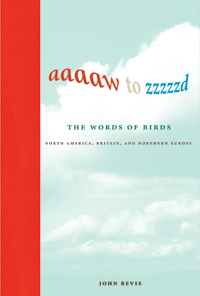
I remembered Shelley and the birds, reading the book of the modern English poet John Bevis "From Au-au to Yau-Yau-Yau. The Words of Birds." John Bevis is practical to birds. He overhears them, and then transfers trolls, gogot, dolling, cooing, chatter, groaning, screaming with the help of an English alphabet. In English there is such a word - Birdwatching. This is an established concept: it can be found in dictionaries and encyclopedias. It can be translated into Russian as "observation of birds." John Bevis was a short Birdwatching course at Devon's Devon's Devonian College of Arts. But even before that, he carefully watched birds in parks, gardens, marshy areas, in cemeteries and wastelands. Here is what he advises novice fans-naturalists: "In the process of work, you should sneak up and do not pace. Consider yourself a private detective, hold on in the shade, harsh movements or noise can scare the prey. And if you are taken, you can see the prey before she sees you and gets to flight." In his book, John Bevis included the language of more than 1,200 birds of North America, Great Britain and Northern Europe: from black vodor and talovka foam to Gogol and Zelenushka. Of the 143 pages of the book 75, the vocabulary itself occupies. Other sections are devoted to the acoustic hunt for birds in the field, the features of the transcription of bird voices, the comparison of music and bird singing (Bevis considers the unsurpassed master of reproduction of bird singing Richard Wagner), imitators (from selfish poultry to the masters of puffs and whistles), charming and scarves (especially for the authors Books Picture of Jean-Batist Sharden "Sharm Charcker"), playing machine guns and a wall clock. Unfortunately, it is hardly possible to translate the book into Russian. John Bevis admits that his transcription is subjective. But the point is not only the subjectivity of the author. Each nation has its own hearing and its phonetic traditions of imitating certain animals. For example, the Russian pig says “dicked”, the English Oin, Oin, and the German “soil, soil”. Not only the Bianchi bird, but also Russian writers-naturalists worthy of the language of Russia. Even more I love Veliray Khlebnikov, the son of an ornithologist and the first director of the Astrakhan reserve. In "Zangezi" he spoke with the tongue of Soyk, Slavka, Ovsyanochka ... Piu! Piu! Baboteu-Vive! Kri-Ti-Ti!