
Translated material
''Dump''
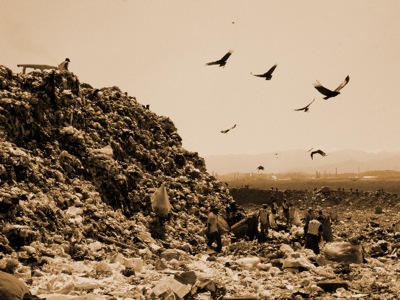
Alexander Genis: Today we talked about how the art avant -garde looked like 100 years ago. About what he is today, tells a new film, with which our listeners will be introduced to the host of the “Films' '' of the American hour Andrei Zagdansky.
Andrei Zagdansky: Oscar Wilde once said: '' All art is completely pointless '' '', and this famous aphorism is disputed by artists, in my opinion, from the very day that Oscar Wilde uttered him. How successfully they dispute is another question. A clear case of how a contemporary artist wants to make his art useful, the filmmakers were captured in the film '' Waste Land '' '' '' '' '' 'Or' 'Garbage Field' ' - who received an Oscar nomination this year. The film by American director Lucy Walker. The artist creating good is Vick Munitz. Vick is one of the most successful contemporary artists from Brazil, from a very poor family. In America, he was due to a peculiar combination of circumstances. On Brazil Street, when he was still a teenager, a young man, there was a fight, he rushed to separate the fighters, one of them shot at Vika, wounded him in the leg. But since the one who shot was a wealthy person, he, wanting to atone for his guilt, gave Vika money. There was enough money for Vick to come to America. Thus began the American head of life Vika Munitsa. Its art is close to modern conceptual approaches, the Vic works with traditionally non -alive materials - chocolate, syrup, sugar.
Alexander Genis: It lively reminds Ostap Bender. Remember, oats?
Andrey Zadansky: The Ukrainian painters also had such. It is from these non -traditional materials that the VIC creates peculiar copies of well -known classical works - Leonardo, Monet or, closer to our days, Andy Warhol. His most probably the famous series - '' sugar children '' - was done as follows: Vick photographed teenagers who work on sugar plantations in Brazil, printed photos, laid out photographs of multi -colored sugar, laid out the image, removed the photo and shot the imprint. This is generally a very curious effect. These work gained great fame, brought Vika fame. And a few years ago, Vick Munitz, and now he is about 50 years old (he was born in 1961, that is, the same age as our President Obama), decided that he needed to give something to the place where he came from, that is, to help the needing layer of the population in Brazil, where he himself was. Thus, a project was chosen, which filmmakers, led by talented Lucy Walker, were removed from the very beginning from the origin of the original idea. '' Waste Land 'is the largest dump in the world near San Paolo. People work on a landfill. Sorting out many tons of garbage, they dig out what is subject to secondary use - bottles, mobile phones, plastic, and so on. This landfill is completely monstrous sizes and the type of people who are swarming in this garbage under the scorching Brazilian sun along with huge black crows, to forget me after watching the film, I think it will not be possible soon. Those who work in this landfill are the social bottom of Brazil. In transfer to the Indian caste system - the equivalent of untouchables. And then Vick appears with his team, with his camera. Vic wants to make a series of portraits of landfill workers, garbage portraits. First, he meets these people, with their living conditions, life, with their dreams and reveals to them his plan. All profit from the sale of work will go in favor of those who are depicted on these portraits. Moreover, they themselves will make their portraits. I must take a step aside and say that Vic is a man of considerable southern charm and charm. In everything that he does, I see absolutely sincere care for these people, absolute lightness and understanding of them, he has no distance when he communicates with these people who work on a garbage dump. He is one of them, and this is very important. So, workers from this garbage lay their portraits along the lines in the photographs. The most interesting of all portraits - a portrait of Etiao, the chairman of the Association of Employees of the Garbage Landfill - repeats in the portrait of his pose of the famous painting by Jacques -Louis David '' Death of Marat ''. Tio (or Etiao) dreams of creating a real trade union from his association. It is very curious that Vic, as an artist, leads the process on top, standing on a huge staircase - directs color and light streams of garbage, which workers lay in their photographs, says where more red, more green and so on. That is, all artistic control belongs to Vika. After this garbage dump is photographed, workers disassemble garbage and begin to work on a new portrait, a new project. Vic photographs these portraits laid out of garbage, prints huge, chic prints and sends to an art auction to London. I must say right away, everything ends well, portraits are sold and Tiao, who was brought to the auction, so that he would look and convinces how all this is happening, Vika cries and hugs when he sees that his portrait goes beyond the six -digit figure in English pounds. At the end of the film are the credits, and we see how the further fate of those who worked with Vick, how the money that Vick could be sent to this community was helped, was helped to someone, someone was not very good, how life had developed. In any case, it was a deep, sincere and real desire to help his community.
Alexander Genis: In this whole story, the most interesting thing is that contemporary art has turned into. Of course, all this sounds like such a heavy, ridiculous hack - some kind of garbage work, completely mysterious exhibits, it is not known for what the existing ones ... but, on the other hand, you can see in this the trend of time. Today's art, especially the fine art, which already experienced everything that could be made of colors and canvases, turned not into a result, but into the process: the most interesting thing was to look at how it is done, and not what happened. It seems to me that transferring to the process, transferring to an artist who became a juggler who entertains the audience (or city crazy) is a curious shift in our minds, in our aesthetics, and, no matter how it relate to him, he deserves attention.
Andrei Zadansky: What you say is true. And, apparently, the feeling here and now is the same integral part of the picture as what is depicted on it. How was she born, how did it happen? Its existence in eternity is a secondary issue, but its birth, the moment of its birth is very important, and we combine the story with the picture, it turns out some whole. But here is another thing. When I watched the picture, I remembered the famous phrase of Marshal McLuin, a genius of mass communications. In English, the phrase literally sounds like this: “The Medium is the Massage”. '' Mediator (or material - depending on the translation) is a message ''. When we look at the paintings composed of garbage, then the phrase of Makluen will acquire a new, unexpected, second meaning. What is a message - garbage itself or portraits? Does this garbage rise to the highest level, turning into portraits of people, or do portraits of people go down to a lower level, folded from garbage? There is a game here.
Alexander Genis: If you still add to what garbage is? Is it garbage, or are these paints that artistic works write, and where is the border between garbage and not garbage, where the border between art and not art passes? And when we begin to discuss all these endless boundaries, the main dogma of postmodernism comes to mind - '' burrow the ditches, cross the ditches. "This is what happens on the screen before us.