
Translated material
Nikolai Lomov
The host of the St. Petersburg hour of the Liberty Live program Tatyana Valovich: Is Russian law right? Are laws that are not consistent with the law? Nikolai Lomov wants to find out for several years for several years, trying to understand when the spelling in Russia, in the sense of writing laws, and law enforcement will not send citizens to a well -known saying: "The law is that you can do it, it turned out." However, having analyzed one of the last laws that was adopted in St. Petersburg on the election of the governor, came to the conclusion that the rails of Russian spelling are at a dead end. Nikolai Alexandrovich, you are engaged in the analysis of Russian law, laws, and what prompted you to start doing such an analysis, you are not a lawyer by education, why do you need all this?
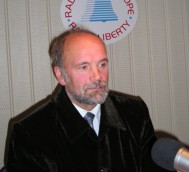
Nikolai Lomov: Yes, but at one time, in 1977, when I studied at the institute and we were given that Brezhnevskaya, the constitution, I became interested, and I, as always,, like everyone else, began to study this constitution, and since then I have become all the materials of the book that could be acquired and studying, as I saw that our life completely depends on every Bukovka, every kind of comma in our basic laws.
Tatyana Valovich: But, in your opinion, Russian citizens, there is such statistical information that no more than 30 percent generally knows what is written in the current Constitution of Russia, why is this happening?
Nikolai Lomov: Here is a little exaggeration. I think that no more than one percent, and that, highly managers, knows the text of the constitution and know how to use it. It is to use, because both the previous and current constitutions are registered precisely for interpretation and use, in the interests of those who know this constitution.
Tatyana Valovich: But in general, history shows that any power writes laws for himself so that it is convenient to interpret them as beneficial for those who are in power. What can society contrast for this?
Nikolai Lomov: The company can contrast only the only step, or the option: the establishment of the main documents, that is, the constitution, the institution through the Constituent Assembly. I had a procedure at one time, what it should be. One of the main components of this procedure was that each member of the Constituent Assembly has a ban on nominating their candidates for elected positions for life. That is, only the establishment of the new basic law. Further, he, like all citizens, lives and is subject to the new basic law.
Tatyana Valovich: And how does such a constituent council differ from the current Council of the Federation?
Nikolai Lomov: Very much. At least, firstly, by the fact that the constituent representatives of the Constituent Assembly are required to be elected only at the moment for the establishment of the Constitution, and nothing more. The current Council of the Federation, I’m not saying for the previous one, is even less responsible, since it is not elected, this time, and secondly, appointed by persons determining the main subjects of the Federation, that is, they are appointed presidents of the constituent entities of the Federation, governors and other first persons, and their representative legislative assemblies. This very negatively affects all our life functions.
Tatyana Valovich: Let's say the last Russian constitution was adopted in a referendum, but again, no one read, Russian citizens - they are passive ...
Nikolai Lomov: That is why on December 7, the former trade union had a newspaper, “unity”, they are the only ones who published my article that this constitution cannot be accepted, and I vote against. And I wrote there those moments that subsequently hit us all, and all these moments manifested themselves in life, up to a state of emergency. I did not know that Chechnya would be, but it is written that the constitution has absolutely no provisions on how it is carried out, according to what criteria and concepts an emergency is introduced, and how it ceases.
Tatyana Valovich: What do you think, how can one explain the passivity of Russian society in relation to such an institution as Russian law, laws? Citizens are deceiving, are they silent?
Nikolai Lomov: This is first from what they are directed incorrectly. We are told that our laws are not fulfilled, that we have lawlessness. After, consider each ruler, and after Stalin, and after Brezhnev, many said that lawlessness was happening. And by this, we, say, are sent incorrectly, because it is the basic, and not only, all the laws adopted and acting in our and in general any state determine everything in our lives. Also, after on December 5, 1936 we determined what the "enemies of the people" are, we recorded in the Constitution, and how to deal with them, after which the 1937th and subsequent years of repression began.
Tatyana Valovich: Please tell me who, in your opinion, should generally promote the development of the institution of law? After all, this is probably the prerogative of scientists. We already had an attempt in Russia for the cook to govern the state, because the laws should be registered so that everyone is clear, clear, of course?
Nikolai Lomov: Yes, but then you have to start with the linguistic procedure. Because we have completely confused concepts of law, in a different way I will say, “right” and “right”, it seems, we are talking about one thing, but we are talking about different things. Because "law", as a set of laws, is a little not what we mean by the concept of "law", as rights
Tatyana Valovich: Nikolai Alexandrovich, here Petersburg now lives on the eve of the elections, and lives under the new law on the election of the highest official of St. Petersburg the governor. Its adoption in June was explained by the fact that it is necessary to bring the city law on the election of a senior official in accordance with the federal. However, many experts say that the hasty acceptance was connected with the desire to hold a certain candidate in the governor's election. That is, again, those in power want to make all these laws for themselves. Here you are, as a citizen, as a person who will go to vote, by the way, will go to vote?
Nikolai Lomov: I always take away all my ballots home to justify myself to the descendants that I did not participate in these shows.
Tatyana Valovich: Why, by the way, do you decide so that this is only a show?
Nikolai Lomov: Because it is I who take these laws and study them. And I see, there was a law, a normal law, it was held on it twice elections, and successfully held, in 1996 and in 2000, which could interfere with this law and choose further? But it turned out that we had a person who cannot be elected according to this law, since the law records that the candidate may be a person who lived and submitted relevant documents in accordance with Russian legislation, who lived in St. Petersburg at least one year before the election day. In the new law, sorry, this is not. That is, this is already a large indicator - who is it designed for? ..
Tatyana Valovich: Maybe this is not such a large indicator, because in general, a residence permit in a democratic society should somehow move into a different status. We are all the time prescribed that you can work only where it is registered, although it should not be taken into account by legislatively. Another thing is that the townspeople should think about choosing a person who is well acquainted with the city or not. Indeed, in the list of candidates, the governors who wanted to run, but were not registered, were not yet approved, but were not registered.
Nikolai Lomov: You can do a few words about the registration, I'm not talking about the formalities that we lead to this, but, mainly in the same democratic countries as the United States, it is very taken into account, maybe not even a residence permit, but accommodation, birth in this state.
Tatyana Valovich: By the way, elections are held in California, and it also says that a person can put forward his candidacy for the election of the governor who has lived a certain number of years in this state.
Nikolai Lomov: Yes, this again refers to the law. But the same Schwarzenegger is already a little limited by the ability to at least nominate his presidential candidate, since it is stated in the law that only born in the United States can become president, and Schwarzenegger arrived.
Tatyana Valovich: Let us return to the law on the election of a senior official in St. Petersburg. Are all articles to you, as a person who is interested in laws, were clear, clear, rosary?
Nikolai Lomov: I can say that half of the articles literally one other contradicts, and if he does not even contradict, it allows a multi -valuable reading. That is, in one place it is written that election commissions are free from state influence, in another, that they are formed by the executive branch of the authorities, and in the third place, in article 13, it is written that territorial election commissions are state bodies. Since they are state bodies, or are they not? That is, and so you can read this position. In the same way, many articles are spelled out. At least take the same provision to make a pledge. In one case, I can calculate and read that it will be 33.5 million rubles ...
Tatyana Valovich: But in our St. Petersburg, it was determined in 7.5 million.
Nikolai Lomov: Sorry, but this is a violation of the law. The law says that the guarantee of the maximum deposit is 500 thousand minimum wages ...
Tatyana Valovich: But this is the limit. Above is impossible, but less is possible.
Nikolai Lomov: It turns out that it is possible and higher. Because in the next article, where it is written, for which it is possible to remove the candidate, it says that you can remove for excess of the maximum size by 5 percent. That is, 225 is not limit, it turns out that 230 million can be possible
Tatyana Valovich: But you are already talking about the election fund, and not about the pledge.
Nikolai Lomov: Nevertheless, this is a reusable reading.
Tatyana Valovich: Nikolai Alexandrovich, and you are satisfied with all the information that you hear in the media about the elections of the governor, which are expected in St. Petersburg?
Nikolai Lomov: Of course, no. Take at least the reason is that they conclude a moratorium among themselves, supposedly on black PR, but without this moratorium we would have learned a little more, even with some exaggerations. But we, in my opinion, should be consciously approaching the choice and outpatient black from white, and we must receive all the information, without any moratoriums. But, in the first time, of course, I must say about the media, which now write a lot of offensive. That is, they are offended by the fact that they take freedom from them. In some newspapers, even empty places are published, they say, this is information that you have not received. They say that the law and the constitution are violated. There is no this concept of "media" in the Constitution. There is “mass information”, “freedom of the mass media”, but freedom of the media is not such a thing as there is no freedom of speech, since the constitution prescribes, “freedom of thought and word”. Even if you remove the union "and", put a comma, and then there will be more freedom of speech. But we are obliged to write down in the Constitution without any sections between the concepts of “freedom” and “word”. When we do not have this, there will be no freedom of speech.