
Translated material
With a cross and a credit card
Christianity seems to condemn the pursuit of profit. The Pope Benedict XVI, reflecting on the causes of the global economic crisis, called the current world financial system "a house built in the sand." At the same time, one of the most famous teachings of Jesus Christ is a parable of talents, told in all four gospels. It talks about the owner who entrusted the three slaves wisely to dispose of his money. Jesus praises slaves who let the money in growth, and condemns a slave, for the purge of the preservation of silver that buried his talent into the ground.
Christian morality, especially Protestant, stimulated the development of capitalism. Nevertheless, the peak of Christian morality is not a parable about talents, but the words of a prayer addressed to the Father of Heaven as a lender of the last instance: "Forgive us our debts, as we forgive our debtors."
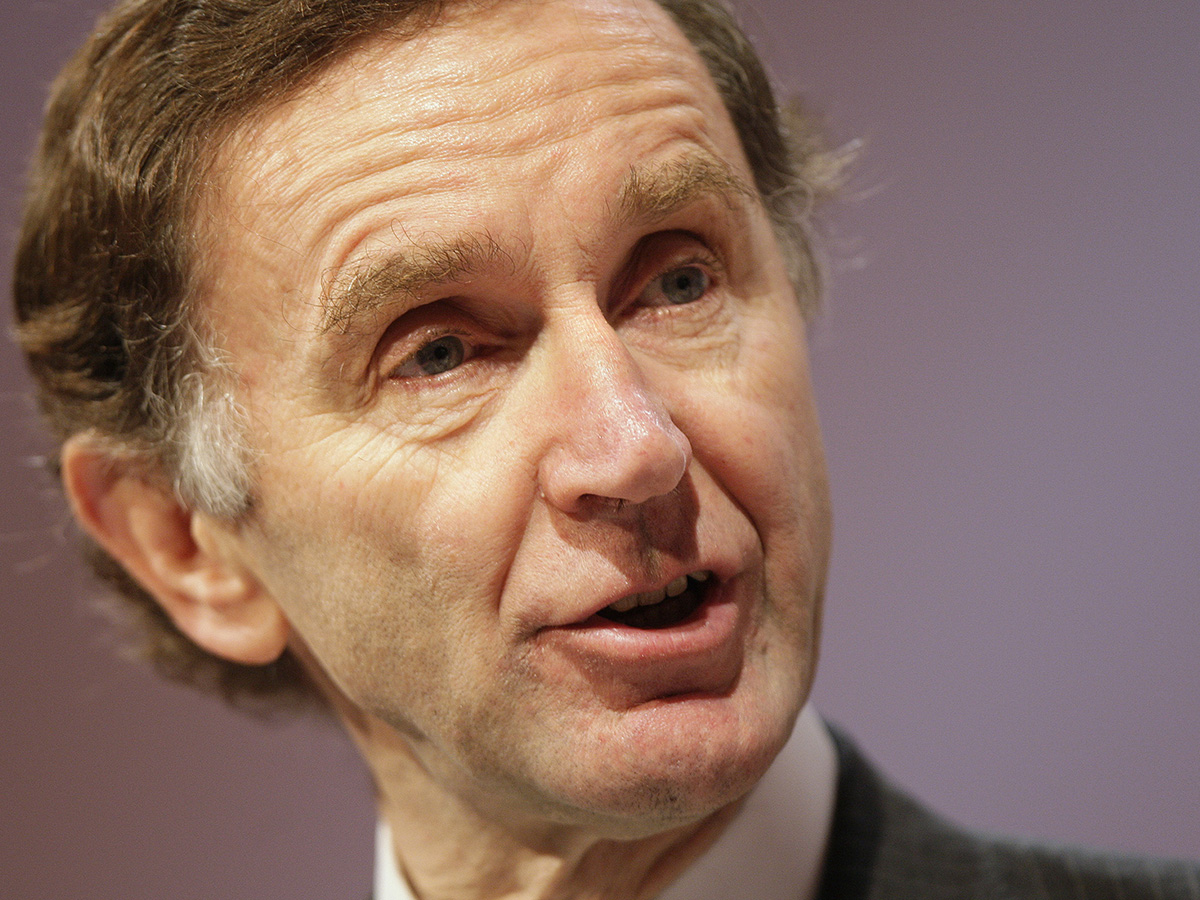
Stephen Green has repeatedly thought about all this in his life. At the end of the University of Oxford, he thought about devoting himself to pastoral service, but in the end he chose the path first to an employee of public organizations, and then a government official. In the Anglican Church, it is possible to combine a secular career with a priestly dignity - this is what happened to Stephen Green. In 1982, he went to private banking business and is currently heading one of the largest banks in the world - HSBC. He was the head of the Association of British bankers, and now he is the chairman of the business council at the Prime Minister of Great Britain.
Stephena Green was presented by an expert at the Brukings Institute, a political commentator and Jaea Diion :
- I must say that when this project was only running, I was glad to participate in it: I was intrigued by the fact that the president of one of the largest banks in the world at the same time was an ordained Anglican priest. But I began my work on the project with a feeling, I would say, unbiased skepticism. After all that happened to us over the past two years, I asked myself: do I really want to spend my time on the moralizing the banker? It looks like a parody. Then I began to read Green's book. And I want to say that Stephen Green is a wonderful personality, a person with whom it is just to go to intellectual and moral wanderings. He is a good fellow traveler for traveling in the geographical sense of the word. He writes about globalization, and he knows the world. From his book you will learn many facts that are good to show off at a ceremonial dining table or in a friendly dispute behind a stand of the bar. For example, I did not know that over the past 10 thousand years, the population of the Earth has increased from ten million to more than six billion people. I did not know that over the past 18 out of 20 centuries, China was the largest economic power of the world. Which of you know the word that I will try to pronounce correctly - Obrazza? Well, did it work?
“Quite,” Steven Green praised the speaker.
- Has anyone heard about Obrazza? - repeated Diion. - This is nothing more than a decorated ax - one of the earliest objects of global trade in the reign of Hammurabi in 1800 BC.
Stephen Green says that he protects capitalism in the same way that Churchill defended democracy - he said that this was the worst structure of society with the exception of everyone else. His book is called "profitable goods: reflections on money, morality and uncertainty of the world."
“I enjoy literary work,” said Stephen Green. - I wanted to state some thoughts on my mind on paper - the thoughts that I thought over for years. This book is clearly not about banking, this is not a book about the financial crisis, although it has a chapter about the crisis. This is a book about globalization.
I was lucky in my life: my position allows me to see the world. I drive a lot around the world. The bank in which I work has branches in 85 countries, so I see almost all conceivable cultures with my own eyes. And I have a feeling that the world is becoming a combination of intersections along which globalization is going on. And I wanted to reflect on the meaning of this process, because I think that its consequences will be very deep, very significant and very long.
I do not think that globalization is a new phenomenon. I think it began with the history of mankind, this is a pillar road of history - not without bumps and deviations, but still the main highway. The adjacent and equally important phenomenon is urbanization. 2008 became a line in this regard: more than half of the world's population now lives in cities. And around 2050, about 80 percent of humanity will live in cities.
We are used to thinking that globalization is irreversible. But is it really so?
“In your book, you are talking about the globalization of the 19th century and how the First World War, and behind it the Great Depression stopped her and, to some extent, turned her back,” said I -Jaea Diion. - Why can't this happen again?
“I think this is possible,” said Green. - But if this happens, then this will be one of our most bad nightmares. The reasons why globalization stopped in 1914 were, firstly, in the horrors of the First World War, and secondly, in the emergence of one of the most serious alternatives to the market. An attempt to implement this alternative was undertaken in the Soviet Union, and for some time it seemed that it was about to capture the whole world. Now we know that this achievement was false, we know what a monstrous price it required. I don’t think someone wants to repeat the experiment.
Of course, we must find the way forward. There is no guarantee of success, and you can invent apocalyptic scenarios - in which something is so terrible that it forces humanity to abandon modern communications and return to a simplified and much less attractive world. I do not think that something similar will happen. The powerful process of complicating the relationship in this world is now very difficult to expand back.
In the modern world, Stephen Green believes, such concepts as citizenship, national identity have changed:
- I look at myself. I was born in England, in a certain city of England, to which I feel attachment and where I may would like to return in the declining years. I am also an Englishman. Or am I a Briton? I sometimes reflect on this issue, this is a very specific British problem, the problem of national identity. I am a European, and in some aspects I am a citizen of the world. And I assume that the growing consciousness of general problems is like climate change, which we are not able to solve in any other way, except for the application of global efforts - this consciousness of many of us is inspired by a sense of global citizenship. The thing is that citizenship in itself is a multilayer concept, a very complex and, of course, changing over time.
Globalization is not only good, but also evil. For example, in developed countries, it turns into the closure of enterprises and an increase in unemployment, because production is transferred to cheap labor countries. Stephen Green considers this an inevitable and fair price.
“It seems to me that from the point of view of justice, the main problem of globalization is that capital is much more mobile than labor,” suggested I -Jaea Diion. - He is able to move much faster than an employee, and as a result, the employee finds himself in a deliberately losing position. We observe this effect of globalization in rich countries, and this is precisely this entails an irrational negative reaction. Do you agree with my definition of the problem? ..
“No,” Green answered. - I think this is an integral property of globalization. This is by no means a coincidence that over the past 20 years in almost all countries, the gap between the revenues of the richest and poores has increased. Partly this is the result of globalization, the result of the movement of the capital that you described. The special problem is, of course, that the jobs that lose rich countries do not disappear, but appear in poor countries. The other side of this medal is the fact that over the past 20 years, hundreds of millions of people from the poorest countries have got rid of poverty. It remains to seek balance, decide which recipe to write out the most victims; This is a real political problem of rich countries. What can not be done in any way is to jump out of the boat.
* * *
Does business need moral justification? Probably, the discussion on this topic is endless.
Based on the materials of the program, Irina Lagunina "Time and Peace" .