
Translated material
How to take off the ballet
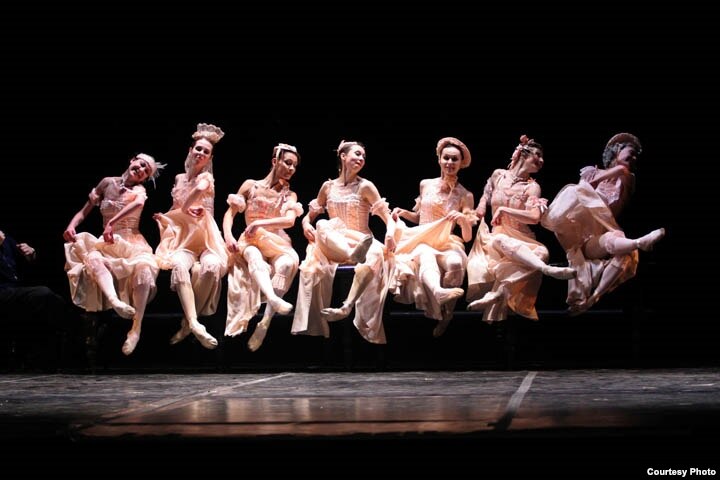
Alexander Genis: New York was given to the ballet on holidays. According to the established tradition, the New Year cannot be well celebrated without a “Nutcracker”. This time in New York there are eight different productions, including one Ratmansky, plus - a broadcast from the Mariinsky Theater in 3D. However, the ballet, and not only the “Nutcracker” is always a festive sight, which is why we decided to invite a ballet photographer and criticism in this New Year's program, my good friend, with whom we still worked together in the Dovlatov “new American”, Nina Alvert.
I must admit that Nina was an example for me. She always - no matter what! - She did only and exactly what she wanted: she shot the ballet, wrote about him, lived them. And now - the result. Many books and albums, among them are the best books about Baryshnikov, whom Nina shot another young man. On the 19th article in the “International Ballet Dictionary”, the Emmy Award for participating in the filming of the film about “Swan Lake”. Photos by Alvert are in the collections of museums and libraries of St. Petersburg and Moscow, in the theater library of the Lincoln Center (New York), in private collections of Russia and America.
The reason for today's conversation was the release of Nina’s new book, which has just been released by the Baltic Seasons Publishing House. The book is called - "Boris Eifman. Yesterday, today ... ". The editor of this publication was the head of the theater critic Elena Alekseeva, and Anton Dzyak became the artist of the luxuriously published folio. The book includes the articles of prominent ballet critic Arsen Degen. Well, then about the book, her hero and ballet, the author will tell us in general.
Nina, first of all, please imagine your book with which I congratulate you.

Alexander Genis: That is, is this criticism plus photos?
Nina Alvert: Critical articles, plus my photos.
Alexander Genis: Nina, how did you meet Eifman, do you remember?
Nina Alvert: I remember this very vaguely, but we were on some kind of booze, there was some evening. I already knew who he was, I saw the first work with the choreographic school. These were "mischievous ditties" to Shchedrin's music. She seemed very entertaining to me. It was for that time a very interesting combination of classical and folk dance, very witty. I remembered him so and since then I began to follow him. And we met. As Boris says, I stood in a long skirt with a glass of wine in my hands.
Alexander Genis: I always imagine you so. How did your joint work begin?
Nina Alvert: He had no theater before my departure. He put the first ballet, which I saw entirely, the ballet for three acts, it was in the small Opera - Gayane. It was his thesis, he ended the conservatory. And I shot there, without asking anyone, as I did at that time. Then I rented his evening at the Kirov Theater, he put a Komlevsky “Firebird” of Stravinsky for Prima-ballerina, I put it very curiously, I also took off, without asking anyone. But only then, when I returned for the first time in 87, I went to look, and he already planted me as it was convenient, I began to shoot the performances when I came.
Alexander Genis: And since then you have been shooting Eifman all the time?
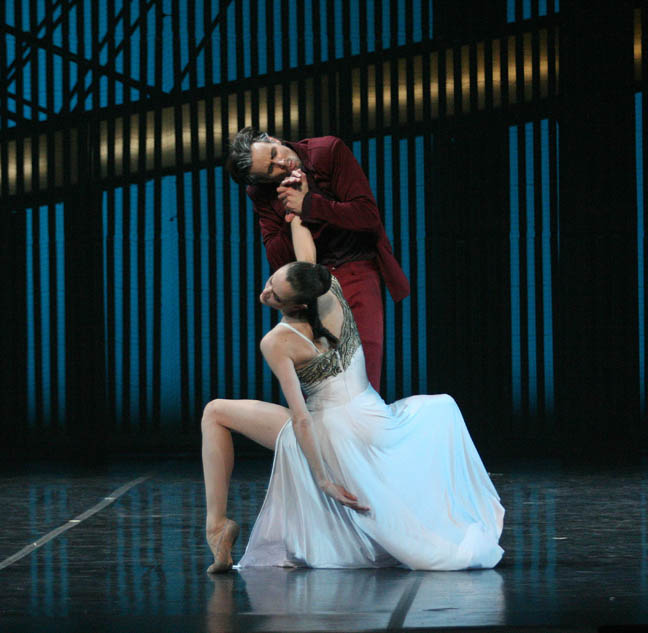
Alexander Genis: How do he like your pictures?
Nina Alvert: I probably like something, I don’t like something, I didn’t really ask.
Alexander Genis: Tell me, what place does Ephman occupy in the modern world ballet, from your point of view?
Nina Alover: from my point of view, in the Russian ballet, the Eifman Theater is the end of the magnificent path of Russian ballet in the twentieth century, despite all the obstacles, obstacles and contrary to them, the Russian ballet was brilliantly developed in the twentieth century, and the Eifman Theater is, as it were, completion. It was influenced by many directions that were in the Russian ballet of the twentieth century, and this is such a final, plus his own talent, of course.
Alexander Genis: This is interesting, because they say that great minds do not begin, but complete their eras. Let's say Brodsky was not so much an innovator as the final of the entire era of modernism. Agree with this?
Nina Alvert: I agree, of course.
Alexander Genis: And the same can be said about Ephman?
Nina Alvert: You can, of course. Because everything that he did, plus individuality, of course is the completion of the development of the Theater of the twentieth century, what was there, what was planned and gone, anyway, anyway, manifested itself.
Alexander Genis: And in the world context?
Nina Alvert: This is the last ballet theater today, not just small passages to different musical pieces, but a really ballet theater.

Nina Alvert: This is the completion of the nover, petip and the entire classics of the twentieth century.
Alexander Genis: And here we move on to a rather painful question - Eiffman and America. From love for hatred, I would say so. I remember how Anna Kiselgof, a ballet critic of New York Times, called him the best choreographer around the world. But the last tour in New York, where Eifman showed a ballet about Roden, in my opinion, wonderful, this ballet was defeated in the same New York Times. How do you think why, what happened, what has changed?
Nina Alvert: There are three answers to this. The first is that in our time, rather unstable, in any case in the ballet world, where there are no solid ideas, nor established authorities, everything is very unsteady, every complete theater seems outdated. This is a very new situation, but at the moment we are passing it. And the Aifman Theater is a created, completed theater of ideas, expressions of philosophy, it continues to develop it, but, in principle, it has already built it. And this seems outdated to modern people, which is not true. Nothing can be done. The second is a change of critics. The fact is that Anna Kiselgof and especially Clive Barnz, who said that Eifman is a genius, they were people widely educated not only in ballet, they knew world art, were interested in Russian art.
Alexander Genis: Anna Kiselgof simply spoke Russian.
Nina Alover: She spoke Russian, but Clive Barnz in the ballet “Russian Hamlet” said that many Russians did not occur: that at the end of the first act, the group on the stage depicts a monument to Catherine, consisting of her close associates.
Alexander Genis: Of course, the St. Petersburg monument is famous, where all the Ekaterinoic eagles gathered around the queen. Witty remark. I watched this ballet and I remember this impression, but only now I realized that this is true. Thin.
Nina Alvert: And it occurred to the head, by the way, American criticism. The same Clive Barnz wrote that “it will be a sorry if in our American snobbery we will miss the phenomenon as the Ephman Theater”.
Nina Alvert: This critic of New York Times is absolutely uneducated, he does not know anything other than his London royal ballet or, in any case, believes that this is the top of everything that can be created on Earth. And in previous articles he taught the Mariinsky Theater how to dance the classics - but how they dance it in the London ballet, which is four times less than the Mariinsky Theater, it doesn’t matter, so he thinks so. Absolute peremptory and dislike of generally to the theater. I am absolutely convinced that he does not like ballet. I always give a Coctele as an example (unfortunately, I don’t remember literally), who said: I come to the theater to love. These modern critics do not come to hate, but to find everything bad. They do not go to enjoy as spectators.
Alexander Genis: I understand, experts, they are like a flux, one -sided, they primarily feel like experts, and not spectators - that, of course, a big loss. The same with literary critics who do not like books. Well, now, when we got off with this critic, tell me, please, is it necessary to know the Russian theme in order to enjoy Ephman's ballets, is it necessary to be in the Russian context in order to understand his ballets?
Nina Alvert: I think not. There are ballets in which you do not need to understand anything at all, but simply look and enjoy. There are ballets that need to understand what the game is, what is the game with history, with a literary source. I must say this is the answer to your previous question that the viewer loves him anyway, no matter what critics write.
Alexander Genis: Nina, you raised a very important topic for me - Ephman and literature. The fact is that, starting with the Karamazov ballet, I believed that Ephman is the best critic today in Russian literature, for his ballets, in my opinion, are the most interesting readings of the classics. This applies to Karamazov, this applies to Anna Karenina, which is now especially perceived, because the new film on Anna Karenina has just released, where there are many ballet techniques. I even thought: did the author of Ephman see? And this leads us to the following topic: how do you feel about his practice - to transfer complex, epic thick books, like Anna Karenina, to dance? How much do you think this is reasonable and possible, how much it turns out?
Nina Alvert: Absolutely reasonable, absolutely possible and absolutely obtained. After all, he does not take the book and does not set out it from beginning to end with means of silent cinema, and he makes his script. Moreover, he is the last one I know in a world that can build ballet drama. He takes the script, he has an idea, his reading of this literary work, he takes this idea and makes the ballet, sometimes introducing scenes that are not so significant in the novel, and then he puts them forward to show how this idea develops. Everything is built in his dramatic true and only for ballet.
Nina Alover: Degas, firstly, amazingly beautiful, while in his paintings he creates his own performance in these rehearsals, building them as it seems beautiful to him. No, I relate to this, in general, to the shooting, a little differently.
Alexander Genis: Tell us how the process takes place.
Nina Alvert: I am interested in when I shoot, catch the moment that is most emotional or most beautiful, if not a very emotional scene, and most accurately conveys choreography, let's say. Although I am more interested in not shooting the performance as a performance, but the shooting of a dancer, an actor, carrying emotion and idea. If I caught it, if I felt, if I came into contact with the dancer, this is also a very interesting moment, then I get what the performance more or less reflects and what the artist is dancing.
Alexander Genis: You know, this is vividly reminds me of your portraits. A year ago, you and I were in St. Petersburg on Dovlatov days, and there was your exhibition, where we were all from the “new American” were terribly young. I had so many hair there that, in my opinion, they did not fit in the photograph. But I looked at the pictures and thought that we all came out beautiful and pretty. Why does it work?
Nina Alvert: Thank you, I am very pleased to hear. Because, probably, I loved everyone. Once Yura said this to me, he examined my photos and said: “Why everyone presses the button, some have some interesting picture, while others just have a photograph of the moment.” I told him: "This is all love." He thought and agreed.
Alexander Genis: Andy Warhol said that even chimpanzees can photograph. He carried the Polaroid with him and shot 250 thousand photographs, all without love, for sure, this differs very significantly.
Nina Alvert: You see, he did not shoot the theater, and the theater must be loved.
Alexander Genis: Is it difficult to take off the ballet?
Nina Alover: I have been watching him for so long that I know in advance where the dancer will go further. Knowing the style of Eifman, I can more or less assume what this combination will develop, which he built and where that can be captured.
Alexander Genis: Nina, what is the most remembered for the ballet, there is such a quality mark, your business card?
Nina Alvert: Can you call more than one?
Alexander Genis: Of course.
Nina Alvert: Baryshnikov jumping on a black background in Daphnis and Chloe.
Alexander Genis: I remember very well, he was on the cover of the "new American."
Nina Alover: I learned the picture that I made like this: he jumped, and I removed the floor from the frame, I wanted him to fly in space. Then we all felt his flight like that. Then I have, of course, such a ballerina was Makhalin, she was already ending up to dance, Julia Makhalin, in the studio she raised her skirts, then she threw them, they began to fly down. I took it off, and I got such an image of a romantic ballerina. I love him. In order not to torment the explanations in words, there are photos of Vishneva, there are photos of Volodya Malakhov, Osipenko, from these dancers I can choose my favorite photos in general mine.
Alexander Genis: Of course, I would add a photo of Dovlatov here, which he loved most.
Nina Alvert: I'm talking about ballet.
Alexander Genis: Nina, back to general problems. What do you expect from ballet today, in the 21st century? You said that Aifman is completing the great stage, an era in ballet. In essence, there are two directions - either the plot as an eifman, or abstract like Balanchin. Which is closer to you?
Nina Alvert: Of course, the plot is closer to me. Because I belong to Russian culture, what touches my heart.
Alexander Genis: Balanchin also belongs to Russian culture.
Nina Alvert: He belongs to Russian culture, but he went along the path that he was closer to him, he did not like feelings, very expressed very much. In my opinion, the Balanchin was primarily a musician, and then a choreographer, and hence his ballets. Because he wanted to create music in the dance, he did not go from the dance, but from music.
Alexander Genis: That is, not from drama, but from music.
Nina Alvert: No, not from choreography, but from music, he wanted to express music in choreography. Therefore, he did not allow to change the pace, although sometimes this is not at all good, from my point of view, but this is another topic. In any case, for him, music was more important than choreography, and he walked along this path. Because Diaghilev did not start quite so, but then he developed his style. Since it happened in Russian culture, in Russian culture we expect from the theater that it will touch us, let it be without a special philosophy, but somehow a heart response is needed for art, then I belong to this direction.
Alexander Genis: You have been engaged in ballet all your life, have you already found the answer to the question, what is the secret of Russian ballet? Our colleague Solomon Volkov believes that the secret is in the corps de ballet, and you? Where does the magic of Russian ballet come from, which conquers which century the whole world?
Nina Alover: You think that you can say, to determine what the genius is? We take Brodsky of the same, you can make out, you can make an amazing analysis of literary. But to say that above this analysis, which is the essence of the genius, I am not sure that it is possible.
Alexander Genis: You know, if I was asked what Russian literature is great, I would say: the fact that the great Russian writers began literature from scratch, they came to literature as if there were no literature before them. Толстой писал так, будто до него не существовали писатели, он начинал с начала. Мне кажется, что все лучшее в русской литературе сделано без оглядки на Запад. Если с такой точки зрения говорить о балете?
Нина Аловерт: Балет, конечно, к этому не имеет отношения, но, вероятно, в нем главное - эта невероятная красота, к которой всегда стремился русский балет, одна из целей, для которых хореограф работает в России – это все-таки создать красоту. И это неповторимая черта русского балета по сравнению с остальными, которые не всегда считают, что надо быть на сцене идеалом и рождать красоту.
Александр Генис: Я вас очень хорошо понимаю. Я помню, когда мы издавали вместе «Новый американец», вы написали, что Петя и Саша, имея в виду меня с Вайлем, все время говорят: опять балет. «Но разве может быть много красоты?», – написали вы тогда. Я с вами согласен сегодня гораздо больше, чем раньше. Нина, мы ведем эту беседу в праздничные дни, когда вся Америка наслаждается «Щелкунчиком». Скажите, по-вашему, он может устареть, можно заиграть до смерти этот великий спектакль?
Нина Аловерт: Нет. Вообще хороших почти нет спектаклей «Щелкунчика», потому что это невероятно сложная ситуация, которая произошла дважды - с «Щелкунчиком» Чайковского и «Золушкой» Прокофьева. Второй акт в «Щелкунчике» трагический – это крушение мечты. А все его делают, за исключением трех хореографов в мире, исключительно детским спектаклем – веселый, подпрыгнули, все обрадовались. Только Григорович в первом варианте «Щелкунчика», Бильский, которого сейчас никто не помнит, Барышников и арфа-американский хореограф Дональд Бурт, который поставил просто трагедию, когда все остальные ставят детский спектакль. Наверное, так надо, но меня это всегда очень огорчает.
Александр Генис: Но вы любите «Щелкунчика»?
Нина Аловерт: Музыку – да.