
Translated material
Europe between Hitler and Stalin
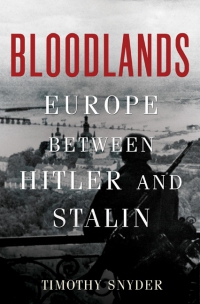
One of the four epigraphs to his book Timoti Snyder took from the story of Vasily Grossman “Everything flows”: “Everything flows, everything changes. But you can’t get into the same prison train twice. ” However, you can consistently go to prisons and concentration camps of two friends, and then enemies - Nazi Germany and the Stalinist Soviet Union. And such cases have been when people were on the "bloody land" - the zone where at first a friendly meeting took place, and then a clash of two totalitarian regimes. This zone lies between the Central Poland and the European part of the Soviet Union and includes the territories of Eastern Poland, Ukraine, Belarus and the Baltic countries. In this zone, from 1933 to 1945, 14 million civilians were killed, in most women and children. Over these 12 years, more than a million people were killed annually in this zone. Typically, public opinion in the West connects mass killings with Nazi concentration camps and the Stalinist Gulag, where Stalin ruined more innocent lives than Hitler. In his book, Professor Snyder proves the failure of this opinion. Working in the archives of Russia and Germany, he found out that much more people died outside the concentration camps - during German and Soviet hopeless reprisals on the "bloody land". In this case, according to the author of the book, the Molotov-Ribbentrop Pact prisoned in 1939, played a huge role. Without him, Snyder believes, Hitler could not begin the mass murder of Jews in Poland, and Stalin - to deport tens of thousands of residents of Estonia, Latvia and Lithuania to Siberia. According to Timothy Snyder "Molotov-Ribbentrop Pact was joint products of Nazism and Bolshevism." A million people died in the concentration camps of the Third Reich, while ten million were killed outside the camps. For the same “bloody land”, about three million Soviet soldiers died in German captivity for these 12 years. In only one of Poland occupied by the Germans, more than eight hundred thousand Soviet troops died from hunger and diseases.
“I am not considering the policy of totalitarian regimes as which comes down to my own national repressions,” said Timothy Snyder in an interview with RS, telling about the concept of his book. - For me, they communicate, contact each other, even if these contacts are often ideological in nature - like Hitler’s ridiculous convictions that Jews are led by the Soviet Union. And when I try to find out where the people were mainly killed, I find that for the most part people died not in Germany and not in the Soviet Union, but in the very place where both of these regimes met. ”
Timothy Snyder criticizes the established idea that the main victims of the Soviet and Nazi terror were prisoners of concentration camps. He proves that the main mass killings on both sides occurred on the "bloody land" - outside the camps. The author is convinced that much more people died during hunger in Ukraine in the 32-33rd years than in the Gulag.
“However, this was silent about this in the Soviet Union. Terror was carried out secretly there, ”says Snyder. “In the folk memory, the Great Terror of the 37th-38ths was preserved as camps and executions.”
According to the historian, due to the tactics of the NKVD terror, people did not know about the fate of their friends and relatives-they were sent to the Gulag for five to ten years or they were shot. Often, they had already reported to loved ones that they were in the camp.
Years passed, and even for decades, until the truth has surfaced. Only when the archives opened, the genuine scale of repressions revealed.
“According to official information, a large terror of 37-38 years took more than 680 thousand lives. This is a huge figure, however, hunger in Ukraine in the 32-33rds took them much more-more than three million. In Germany, everything was a little different, but the principle was the same. We know much more about concentration camps thanks to their saved prisoners. That is why Auschwitz has become a symbol of the Nazi policy of terror. The places where the Nazis killed: Treblinka, Helmno, Sobibor, Belzhets, the occupied part of the Soviet Union are known. But it is much more difficult to find out about the number of victims where there were no concentration camps, because almost no one survived in these reprisals. The sad irony is that we remember the Soviet and German concentration camps, but in fact there were places much worse than these camps, ”the historian believes.
In his book, Professor Snyder reflects on the similarities and differences of the German and Soviet strategies for holding terror. In his opinion, the Soviet Union of that period was not a country with frankly imperialist trends.
“It was a country, concerned mainly by colonization of its own territory and modernization,” Snyder is convinced. In those sinister circumstances, Ukrainians, Kazakhs and, of course, the Russians were the object of collectivization. Terror against the so -called "kulaks", Poles and other groups of the population was perceived as self -defense of the state. "
Professor Snyder claims that his own citizens were mainly destroyed in the Soviet Union. It was not that in Nazi Germany with its frankly imperialist ideology. In his opinion, all her victims were not German citizens. These were Jews who lived outside Germany, as well as Soviet and Polish citizens. The doctrine, at that time adhered to Germany, was in the deportation in the future of the population of the conquered territories to the east in order to free them for German colonization. This is a fundamental difference between two modes.
“The goal of Stalin was not so much conquest as the development of his own territories, while Hitler’s strategy was reduced to the destruction and destruction of the Eastern European countries, in particular the Soviet Union. Many believe that the Soviet Union, unlike Nazi Germany, was not fixated on a racial problem. In fact, Stalin, not Hitler, was the first to begin to destroy people on a national basis. Over time, not only class, but also national affiliation could become a reason for repressions in the Soviet Union, which comes closer to the Nazi ideology. ”
The similarity of both regimes in conducting political repressions, as the author tells, is especially noticeable during the period of their union, when they destroyed the Polish state.
“Germany and the Soviet Union had various ideological reasons for repressions in the territory of Poland, but they pursued a similar policy there. There were many cases when, in the 1939-41st, one brother was killed there by the Germans, and the other here was Soviet. The technique of implementation of repression was very similar. For example, the Soviet Union deported three hundred and four thousand people at that time, the Germans also deported the same amount. The Soviet Union shot about one hundred thousand people there, the Germans destroyed the same amount during this period. ”