
Translated material
Mikhail Glinka
The host of the Petersburg hour of the Freedom Time program Olga Pispanen: the 100th anniversary of the birth of Vladislav Glinka, one of the largest historians who worked in the Hermitage, was marked by the publication of the book "Guardian", prepared by writer Mikhail Glinka. Today he is visiting our studio. First, let's listen to a report on the topic that we will discuss. Says Tatyana Voltskaya:
Tatyana Voltskaya: Vladislav Glinka was born in 1903 in Old Russ, in a family where there was a tradition of starting a career with military service. His great -great -grandfather served in dragons, great -grandfathers in the guards sappers, grandfather in the military fleet, maybe from here Vladislav Glinka had a commitment to military history all his life. In 1919, he himself volunteered for the Red Army, in 1927 he graduated from the Law Faculty of Leningrad University, and soon entered the Museum of the Revolution on duty to the exhibition hall dedicated to the Decembrists. Before the war, he was a guide, a researcher in Peterhof, Tsarskoye Selo, Sheremetyevo Fountain House, the Russian Museum, worked with such scientists as Evgeny Tarle. Without hitting the front due to illness, Glinka worked all the blockade in Leningrad, first as a nurse in an evacuation hospital, then the keeper of the collection of the Museum of the Institute of Russian Literature. In 1944, he became the main keeper of the department of the history of Russian culture in the Hermitage. Vladislav Glinka was sure that the moral development of Russians in the 19th century, the St. Petersburg period of Russian literature, public thought - all this has the source of the first quarter of the XIX century with its main events for Russia - the war of 1812 and the uprising of the Decembrists. Glinka worked in the Hermitage for several decades, lived in the building of the Hermitage Theater for many years. He is now remembered in the museum. Says an employee of the press service of the Hermitage Elena Getmanskaya:
Elena Getmanskaya: Such people, like, say, Spassky, also a keeper, a numismatism department, and Glinka is like the legends of the Hermitage Museum. And in the last years, when Vladislav Mikhailovich did not work in the Hermitage, he was a consultant, many colleagues remember him, worked with him. As Mikhail Borisovich Piotrovsky said, there was always a holiday in the house when he came to them. The director said that he had never met people as elegant, elegantly smart as Vladislav Mikhailovich.
Tatyana Voltskaya: Vladislav Mikhailovich knew military history in the smallest details, striking even the most meticulous specialists, he was a consultant to 16 feature films, including the paintings "War and Peace" by Bondarchuk, and more than 30 performances on historical topics. He advised Alexander Solzhenitsyn when he wrote August 1914.
Olga Pispanen: Mikhail Sergeevich, a very capacious and exact name - "Guardian". The life of your uncle, which is described in this book, is completely amazing. Please tell us a little about him. You probably saw how he collected, it was who kept everything that was dangerous enough to store in those years?
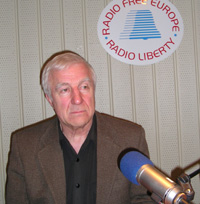
Mikhail Glinka: I will start with a commentary on the reported in the report. The fact is that I am not the author of this book, but the author-compiler. And we came up with the idea of this book, together with Georgy Vadimovich Velenbakhov, the current deputy director of the State Hermitage and the chief heraldmer of the Russian Federation. Georgy Vadimovich was a student of Vladislav Mikhailovich Glinka, and a book compiled and invented by his student and nephew of adopted, is the subject of our conversation. The main materials that are contained in this book are precisely the works of Vladislav Mikhailovich, and I can’t be the author of this book in any way. I am the author -compiler. I wrote a preface and comments, various kinds of inserts between the materials that are placed in it, there are letters, memoir prose and critical art history articles by Vladislav Mikhailovich, and I am only a commentator of these materials, because for a number of years I witnessed how Vladislav Mikhailovich, if I did not work, then, as he worked, they know those who were next to him in the place of him. Hermitage. I can only say that it was a person who was committed not only of knowledge, but also the ability to transmit, make an object from work not only daily, but annual art. The fact is that people swirling around him. He was a man who attracted those who were vividly interested in the past.
In general, I can’t imagine a more accurate place for work than the Hermitage, because in my view, the Hermitage would be most accurately called the Ministry of Communications with the past and art, the main thing that remains of humanity. Because science is aging. Real art not only does not get old, but only manifests more and more over the centuries. The Hermitage is a place where the main relay occurs, which is in a person, and is the subject of the service of people.
Vladislav Mikhailovich Glinka was, in my opinion, one of the brightest representatives of this kind of amazing service. I consider him an employee and, nevertheless, a person of art, this is a combination of punctuality and an amazing spiritual flight. It was impossible for him to imagine that it was possible to sell some knowledge for money. If the money was somehow formed-remarkable, but the process of transferring his own knowledge to other people was not just a joy for him, but he came into an enthusiastic state from the fact that someone could inform them. He came into a state of eloquent excitement, when it seemed to him that the person who hears him really hears him, and he could convey it. One of the chapters of the book is called the "relay". I am the author of this chapter, my rest is not too great. That's exactly the fact that the already aging, leaving for the retirement age, and then retired, found a successor in the person of the then young student, and then a young employee - Velenbakhov - is partly the leitmotif of the book. The joy of transmitting knowledge is amazing, now, unfortunately, quality is not so common in people.
Olga Pispanen: Mikhail Sergeyevich, I would like to return a little to the very beginning of our conversation and wait for you to memories of how he actually worked. It was just dangerous to store some things. Some memories could be stored in the head, but it is impossible at home.
Mikhail Glinka: Of course, the 20-30s is an unusually dangerous time. The uncle came from a noble family. This class was subject to physical destruction, his dear brother - my father - was sitting from 1937 to 1940 for what, as was said, he poisoned the horses. The uncle himself was arrested, in my opinion, in 1938, he spent several days in the "Big House" on Shpalelenaya. Then he was released, and the finale of this story was amazing, after 20 years. Once, in the mid-50s, it seems, in the 1956th year, after the Izvestia newspaper appeared a photograph: Javaharlal Ner was going on the Hermitage and next to it the guide Vladislav Glinka, after the placement of this material in Izvestia, at one city meeting in Foya, an elderly woman came up to his uncle, asked his name, and was certified that this was awarded that this was a certificate The same person she is looking for. She asked what his father was called. He called the name: Mikhail Pavlovich was a doctor in old Russ. “In 1938, remember, you were arrested?” She asked. He says: "Yes." “I was in that“ three ”that determined the future fate. I crossed you out of this list,” she said. Then the woman hid in the crowd. He was neither in the name nor the one who she, he did not recognize. It was probably a grandfather's patient. Thus, by chance, the uncle was released. Что касается разного рода семейных фотографий, сведений о том, кто кем был, думаю, у дяди просто не поворачивалась рука уничтожать наградные свидетельства деда, орденские грамоты, которые начинались с фразы "Мы, Николай Второй..." Фотографии – кстати, одна из моих родственниц, тетка, у которой был дед губернатором, отрезала головы от фотографий, хранила головы отдельно, а мундиры отдельно, думая, что таким наивным She can protect herself.
Olga Pispanen: Mikhail Sergeyevich, it is clear that without the past there is no future for the country. And in past years, for many years, history textbooks often corresponded, and even now they are corresponding. Here's your attitude to preservation and study of history?
Mikhail Glinka: Well, the life of the hero of this book, which we are now discussing, was all devoted to the preservation of the past with the help of the reliability of details. He was against the slightest lies, the slightest distortion. His approach to the museum worker, this word has not yet been mentioned by us, but all the time is meant when you are talking about Vladislav Mikhailovich Glinka, his accuracy the museum worker did not allow any kind of lies even in the little things relating to history. There was such an episode related to Yuri Nikolayevich Tynyanov, the author of well -known works on historical topics. He has such a story - "Wax person." Once, in one friendly company, an uncle, not familiar with Tynyanov, met this man, and when a convenient moment came, he asked him why the wax person got up from Tynyanov how this could happen. Tynyanov, ignored who is in front of him, irritably said: "Well, what, she really got up." Uncle says: "She could not get up." "How could I?" "Yes." - Uncle said that he, being an Ermitage employee, changed his wax person twice, took off wax brushes from wooden hands, and he says: "There is no mechanism, this mannequin could not get up." Tynyanov looked very irritably at his uncle, walked away, and no longer approached him. Apparently, to such an extent, such a conversation was unpleasant for him. Or another, already household detail during the filming of the Lady with the Dog: his uncle allowed himself to comment on Chekhov, he told the director Haifets that Chekhov had a mistake. "Which?" “There it is written about the lady, who fled to the Spitz, Spitz never runs behind,” his uncle said. “He always runs only in front of his master.” Haifets then specially turned to dog breeders, and they said - yes, Spitz is a dog that never comes behind its owner. So the uncle demanded an absolute, some kind of extraordinary accuracy in everything. As for his comments, tips, instructions on all kinds of shooting details when the epic “war and peace” was removed - this is a whole correspondence. In the book, I could bring only separate letters from the other side, my uncle did not set up draft letters that he sent. But everything related to the past - it seemed to him that it was the truth that we fix in the past that allows us to hope for the future, which will be without distortion. It seems to me that it was a straight bridge.
Olga Pispanen: We have a listener on the air.
Nikolai Pontyukhov: Hello, Major of the reserve Pontyukhov Nikolay Nikolaevich, the city of Leningrad. I welcome you all, I am very pleased to listen to your programs. The following question: why do not they say in schools now, do not conduct classes on Vedic culture, Russian Vedic culture. Indeed, during the Vedic faith, the Russians lived for several millennia, even more than in Orthodoxy. And in schools they practically do not talk about this, but this is the most valuable, allows children to be good from the very beginning.
Olga Pispanen: We understood your question, but, unfortunately, it is not on the topic. And I, Mikhail Sergeyevich, would like to ask you, cinema today - as a textbook for so many young people who still study at school and grow without accustoming themselves to read books - it is easier, of course, to watch the movie "War and World" or "Onegin", or "Anna Karenina", American film companies recently like to put Russian classics. And, having watched this movie, where the director often allows himself serious liberties - what is called the “Vimple Cranberry” filmmakers, a person gets a distorted idea, including the story of which, apparently, the hero of our conversation today fought.
Mikhail Glinka: I think this is a very important area and a very important aspect. The fact is that look, so to speak, take a comparative look at literature and cinematography. I think that almost every person becomes clear, how quickly cinema is obsolete, and how long, long-term, if not eternal, the effect of the literary impressions that a person perceives in himself remains. Of those 80-90 years that there is a cinema, we see how already entire layers of this art fell into an absolute dump. Only units of films of the 20-30-40s can be called, which survived the time and which can still be watched. Most often, these are, oddly enough, dumb films. And the fact that was made 30-40 years ago already seems so routine archaic that it is sometimes awkward to even watch. I think here the fact is that we must probably make our impressions long-term, to receive not digested material, but to digest something ourselves. Reading, we even put on the heroes in some kind of modern clothes, we easily interpret the heroes of the same “war and peace” or “Anna Karenina”, it does not seem archaic to us that Anna Karenina is dressed in crinolins, we are somehow improving this in his mind, and the film gives us a ready-made picture that ages extremely quickly. That's what, I think, is a matter.
Olga Pispanen: Of course, all that you say is true, and you need to read, and it creates a more global feeling. Nevertheless, they read less and watch cinema more, more and more films are made, and Russian cinema, one might say, is revived. The times when Bondarchuk shot the War and Peace, now no one will allow himself to make a film with such extras, but they shoot the series, and recently I noticed that the fashion for gangster series has passed, and there was a fashion for historical series, in which there are a lot of blunders. Are consultants working there? How did your uncle work as a movie consultant?
Mikhail Glinka: I believe that no one can be insured from blunders. The famous uniform Gabaev found more than 300 mistakes in the War and the World, although the consultant was Vladislav Mikhailovich Glinka. Glinka understood that a significant part of some circumstances was unattainable, the matter is not only in culture and knowledge, but also that something is simply unattainable, the cinema cannot be shown completely as it was before. But it is necessary to strive - the more reliable the transfer of even some figures, the more reliable the films. In literature, you can also see a variety of views on history. There is a story told by an expert and almost an eyewitness who got used to a page, but there are stories, as if the characters were taken from real history, but in fact - as a half -drunk sergeant from a beer stall. But, of course, it should be striving for the fact that it carries real knowledge, penetration, the spirit of history. It happens that people are dressed not as necessary, but they say as it should, with that expression and internal order. This, it seems to me, is sometimes more important than galloons.
Olga Pispanen: We have a listener on the air.
Student: Mikhail Sergeyevich, I am sorry, as a historian, after all, I am not quite aware of your conversation, I only turned on the receiver, and as a historian, you could not help recreation, in particular, Mikhalkov promised to make a film about the war. In my opinion, there were no serious films about the war over the latter, at least 45 years have not been shot. I remember the best films were in the same 50s. They are still closer in reliability to history, in my opinion.
Mikhail Glinka: I'm not a historian. I am generally a writer, I have books, there are one and a half dozen of them, but I touch the stories very carefully, realizing that I am not a specialist in this area. As for the films, then, in particular, the film "Star" according to the story of Kazakevich is a good film, but if you compare with the story, you will see, the ends in the story and the film are different. The film is made as if the main character is saved and goes with the brand new star of the hero of the USSR on a tunic.
Olga Pispanen: This is the first film, in the second, recently shot by Lebedev, he dies.
Mikhail Glinka: Unfortunately, I have not seen this. And in that I was struck by how to interpret this story so.
Olga Pispanen: There should have been a good end, the hero cannot die
Mikhail Glinka: Well, this is the law of American cinema.
Olga Pispanen: Calculation of history was not alien to many. By the way, if we talk about the historical heritage, your opinion: the governor of St. Petersburg Valentina Matvienko, it was supported by the speaker of the Federation Council Sergey Mironov, said that it was necessary to give monuments of the city’s architecture in private hands. Your attitude to this? They motivated this by the fact that the monuments are destroyed, and those who buy them will restore them, and, as the governor said, will not take them to London.
Mikhail Glinka: The attitude is dual. On the one hand, it is strange, if the real architectural monuments are in private hands, they can be fenced, the access of an ordinary person will be discontinued there. On the other hand, if we see that the buildings are destroyed and irrevocably lost, then what if the state does not have enough levers to save? What to do? Unfortunately, its own is still better protected than the general, because the common is a draw. And with the house of writers, a wonderful mansion with three facades, a characteristic story occurred. The Union of Writers lost the house thanks to quickly emerging fires, now there is some kind of bank, but still the house is saved. The Union of Writers actually ceased to exist. Apparently, this is a story, we cannot help but go through this stage, I state it with bitterness, but what to do, let the monuments be preserved at least like that.