
Translated material
Of the two evils, part 2
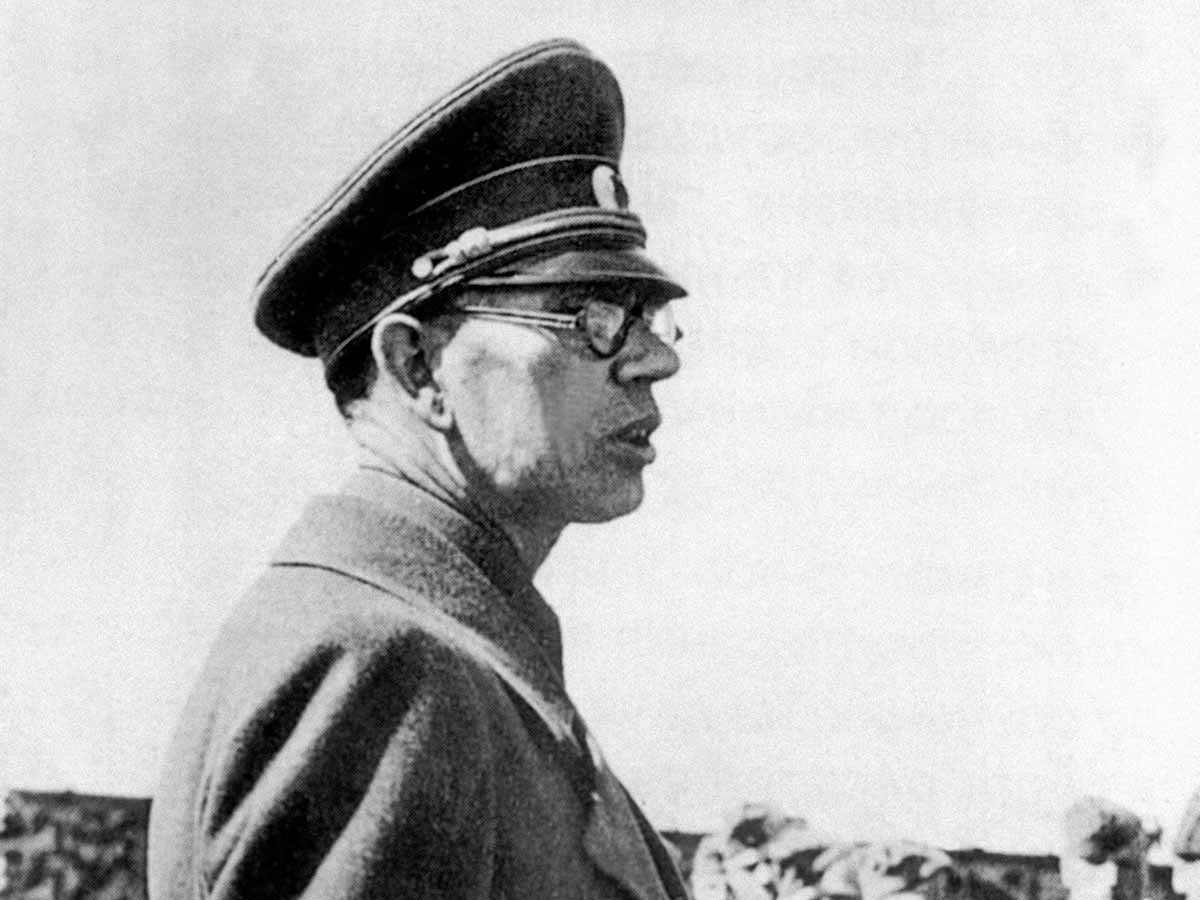
Vladimir Abarinov: We continue the story of Melentia Zykov - a man with a biography unexplained to the end, which is considered one of the ideologists of the Vlasov movement. Igor, what can you say about his political views, his program?
Igor Petrov: If we talk about political views, here is a quote from memoirs by the same Mikhail Samigin. Zykov said the following in a conversation with him: “We conclude a marriage not by love with Germany, but by the calculation. More precisely, we see the only real chance in the German armed forces, with which we can change the political order in our homeland. If tomorrow the Libra of Military Happiness swing towards England, we will work with the British and focus on England, with which we are even more on the way for many reasons, than for us for many more ways. With Germany. "
All this, however, was in fact perfectly combined with anti -English performances, anti -American performances in each issue of the same Zarya newspaper.
In conclusion, it should be noted that under the influence of Zykov, who called himself Bukharin, and his like-minded newspapers Zarya and Volunteer were really noticeable to the left than, for example, the Riga-Pskov “for the homeland”, not to mention the very right “Parisian messenger”.
Vladimir Abarinov: We will still talk about the Vlasov army in the future, but for now we will talk about the fate of Zykov.
Igor Petrov: Within 43 years, Zykov gradually goes into the shadow. I think there are several factors. Firstly, the development of events at the front, plus the Vlasov movement multiplied by the Germans’s unwillingness to somehow actively use it. In addition, he was an independent person, for a word in his pocket did not climb, which, of course, increased the number of enemies and denunciations. Moreover, as they say, many suspected him of Jewish origin, his political views were quite pro -communist, pro -socialist. That is, there were reasons for denunciations.
Zykov marries the Russian white emigrant, the widow of a Serbian officer, lives in a village near Berlin. In the summer of 44 years, he is going to use it with General Zhilenkov in the Operation Skorpion-Ost-it was the operation of Waffen SS. This is again active propaganda directly at the front line. But literally the day before leaving for the village, a mysterious car arrives to Zykov, takes him along with the adjutant Knizhin and no one ever heard anything about them. The versions here were also very different. But in general, they converge that without Gestapo in this story it was not. Probably, some of the denunciations overwhelmed the bowl.
Vladimir Abarinov: Our next character is a historian scientist. During the German occupation, he lived in Kyiv. About why he was not evacuated, he says in his Harvard interview like this: "I could not and did not want to leave." Under the Germans, he held a number of responsible posts, including edited the Russian -speaking newspaper "New Ukrainian Word". Here is an excerpt from the recording of a conversation with him.
"The Germans did not give specific directives, but the journalists brought up in Soviet conditions are used to writing articles in the" spirit ", which was supposed to be the Germans; it cannot be denied that many articles were fascist in spirit. I was accused of" communist "and" anti -Ukrainian renegat ". I was written by countless denunciations, and I was repeatedly written to reprisals. In the Gestapo.
A strange thing, saying "A", you are forced to speak with the logic of events. After a while, the moment comes when you find yourself in a position that you did not want at all. However, I insisted on some things: we did not use the words "Jew", but only the term "Judo -Bolshevism", which for the population had no sense and therefore was harmless. "
Vladimir Abarinov: Igor, name the author of this text and tell us about it.
Igor Petrov: Konstantin Feodosievich Stepe was born in 1896 in the Poltava province. In 1914, he entered the historical and philological faculty of Petrograd University, but did not graduate from it, in 1916 he moved to a military school. He served in the Russian army, and after the revolution he fought in the White Army near Denikin and Wrangel. He was seriously wounded, remained in the USSR, after which, of course, the episode of the service in the White Army hid. He left for a modest ineff, he finished his education, engaged in scientific activities, and taught. In 1930 he moved to Kyiv, he taught ancient history, was a professor at the university.
In 1938 he was arrested, under the pressure of the investigation recognized participation in a counter -revolutionary nationalist conspiracy, as well as cooperation with Japanese intelligence. Why Japanese? Steppe was a Byzantologist, and this is the east, the near or distant one, for the investigation, did not play a decisive role. At the trial, however, Steppe said that he was recruited by the authorities in Nyzhin in 1927, so yes, he collaborated with national organizations, but not of his own free will, but on instructions. He did not collaborate with Japanese intelligence at all. As a result, Shtepu was justified.
After the Germans arrived, in the newly created administration, Stepu was appointed head of public education. He also signed an obligation to cooperate with the security service, with diabetes. SD, however, kept him not only and not so much for the informant as for the analyst. He wrote several analytical articles about the Bolshevik past. But the main thing was editorial activity in the central Ukrainian newspaper, which he led after the past, in the opinion of the Germans, the nationalist edition was eliminated.
The Soviet source of 1942 reports: “The political direction of the new Ukrainian Word newspaper is sharply different from the old newspaper“ Ukrainian word ”. All articles in the newspaper“ New Ukrainian Word ”are aimed at idealizing the fascist system of the German army and praising Hitler as the liberator of the Ukrainian people. This newspaper is distinguished by the exceptional pose to the leaders of the CPSU (B.) and the Soviet government.”
Vladimir Abarinov: According to Professor Shtepa, his position was shaky - he was accused of pro -Russian sympathies and a lack of Ukrainian patriotism. But we will not go into this specificity now, but pay attention to the phrase “saying“ A ”, you are forced to speak“ B ”with the logic of events. And, of course, to a bold refusal to use the word "Jew". In this regard, the following excerpt from the interview of Shtepa is characteristic.
"Just as now I can’t morally justify the actions of the shutters-Vlasovites in Prague in May 1945, I even believed that if someone cooperates with the Germans (or someone else), then he must cooperate conscientiously."
Vladimir Abarinov: We are talking about the support of the 1st division of the Vlasov Army of the Prague Uprising-the last desperate attempt to become a “third force” and earn the approval of the Western powers. Igor, comment on these quotes about “A” and “B” and about conscientious cooperation.
Igor Petrov: I'll start with refusal to use the word "Jew". I am cautious about the post -war self -true statements of this kind, but since I have not reached the new Ukrainian word, I am ready to take it on faith. Nevertheless, in the order written by the SD "from Marx to Stalin. The teachings of Judo -Bolshevik Satanism" anti -Semitic rhetoric is still present. After the war, Steppe himself explained this, as they say, by production necessity. He wrote a memorandum about his own collaboration, and in it he wrote: "I do not bear moral responsibility for a specific terminology, such as, to an example," Judas -Bolshevism "or" plutocracy ".
As for conscientious cooperation, Steppe in the assessment of Bunyachenko’s campaign on Prague is not alone. Actually, Vlasov himself treated this idea disapprovingly. Many German officers who opposed the organization and weapons of the ROA saw in this episode confirmation of their own rightness. If the division in a critical situation turned the bayonets against those who handed these bayonets to her, then as if in such a situation a whole army entered. So, sabotage and tightening the creation of the ROA, we then acted correctly.
I’ll add from myself that the position of fans of the Vlasov movement, simultaneously reproaching the Germans for permanent sticks in the wheels when organizing this movement, but at the same time justifying the actions of the ROA first division in Prague, seem inconsistent to me. There is either one or another.
The relationship of Stepa himself with the German authorities was always in principle even, he was always quite loyal and he had no problems on this occasion.
Vladimir Abarinov: And the last - how the post -war fate of Konstantin Stepa developed.
Igor Petrov: After the evacuation from Kiev, Shtep and his family, according to a misunderstanding, first got into Berlin, but to the refugee camp, from which he could not get out for a month. Finally he was pulled into Berlin. The eastern ministry seemed to want to take him to his state, but so far the bureaucratic wheels were spinning, the Ministry of Propaganda put his paw on Shtepa. He was sent to the town of Plauen, where he edited the newspaper for Ostarbeters "at leisure." Nevertheless, he continued his cooperation with the Rosenberg opera station, for example, he wrote vocabulary articles for the so -called "Bolshevism reference", which eventually remained unfinished. In particular, he wrote an article "Jews and their role in the October Revolution."
After the war ended, Steppe reached Gettingen, where he met with the German physicist Houtermans, with whom he was sitting together in a Soviet prison in 1938. According to the memoirs of the daughter of Stela Aglaya, “Gettingen was in the British occupation zone. Perhaps this circumstance helped us to be saved. Father went to the commandant of the city and he advised to leave his family and hide in one of the camps under a foreign family. Two days later his father took his backpack and left Gettingen to the west. He had a lot of adventures, so far, so far, so far He did not get to Westphalia.
Stepep actively collaborated in the “sowing”, simultaneously with Housemanses he worked on a book about Soviet cleaning, which under the pseudonym Bek and Godin was printed in 1951 in England.
Then the Shtepa family almost emigrated to Colombia, but in the end he ended up in South Bavaria, where he taught at the American army school and at the same time he became one of the founders of the Munich Institute for the Study of the USSR, which we talked about in the last program. In 1952, he moved to the United States, where he continues to cooperate with the American Committee on Liberation from Bolshevism. Konstantin Shtepa died in 1958 from a heart attack.