
Translated material
Tyranian denunciator
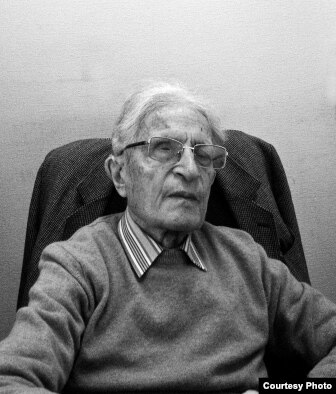
Memory of A.V. Antonov-Ovseenko
In Moscow, they said goodbye to Anton Vladimirovich Antonov-Ovseenko, historian, publicist, founder of the Gulag History Museum. He died on July 9 at the 94th year of his life.
Anton Antonov-Ovseenko was born in 1920 in the family of a revolutionary and diplomat Vladimir Antonov-Ovseenko. At the age of 15 he entered the History Department of the Moscow City Pedagogical Institute, graduated from it in 1939. He worked as a guide.
His father was shot in 1938 "for belonging to the Trotskyist terrorist and espionage organization." A.V. Antonov-Ovseenko was first arrested in 1940 as the son of an enemy of the people, then repeatedly in 1941 and in 1943. He spent about 13 years in prisons and camps. He was released in 1956, rehabilitated in 1957. In 1967, together with the 43 old Bolsheviks who survived the Stalinist purges, he appealed to the CPSU Central Committee with a protest against attempts to rehabilitate Stalin and his crimes. Since the end of the 1950s, archival surveys in the conditions of continuous surveillance, the materials collected in 1980 were confiscated by the KGB. Biographical books about the Father "The Name of the Revolution" (1965) and "V. A. Antonov-Ovseenko" (1975) were published under the pseudonym "Anton Rakitin". In 1980, he published in the United States a historical study on Stalin's Portrait of Tiran. The author of the books "Theater of Joseph Stalin" (1995), "Enemies of the people" (1996), "Beria" (1999), "Various feat?" (2003). Since 1995, he headed the Union of Organizations of Victims of Political Repressions of the Moscow Region. In 2001, he achieved the transfer of the building on Petrovka Street to accommodate the State Museum of the History of the Gulag . Until 2011, he headed the museum as a director, then as an honorary president.
In 2010, Anton Antonov-Ovseenko was a guest of the RS program "Face to face" .
He talked about his father, his camp experience, a civil war in Spain. Answering a question about Stalinism, Antonov-Ovseenko said:
A real historian must understand one simple and fundamental thing. If he does not understand this thing, he will go in the dead ends of the history of our country. Namely, that Stalin was a dictator was in fact, and a lot depended on his character. I would even say that this is a bandit elevated to the rank of state policy. By criminal notes, he painted collectivization, industrialization and military operations. And the second, very important remark about Stalin, characterizing him to the end, revealing his personality, on which the whole policy depended. It was an adventurer in everything. Stalin's personality is animal cruelty, so this is really a criminal.