
Translated material
King Tenor Saxophone
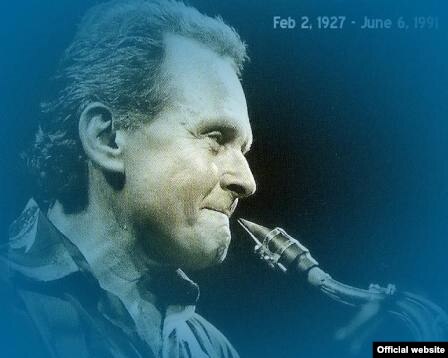
Stan Getz - Stanley Gaitsky, grandson of immigrants from Ukraine
Stan Getz played on a saxophone, on a tenor-saxophone, although the word "played" in this case sounds pale. It has no intensity and strength in order to describe an intimate relationship between the musician and his instrument. The saxophone was part of himself, as if it were his own voice. And at the same time, if he were born in another era and in another civilization, this meeting would not have happened. If the pogroms of 1903 had not forced his grandfather with a grandmother to flee from Ukraine without looking back, he might play on the faculty in a symphony orchestra or on a clarinet in a vagabond orchestra at peasant weddings. It is possible that he would have died of hunger in the first years of Soviet power or would die at the beginning of World War II. That is, if he had not grown in poverty in New York of the 1930s, his music, his life would be completely different. And the phenomenon, which we call "Stan Getz", simply would not exist.
Stan's father did not dine for a year, saved money to buy a saxophone to his son. The family did not know about this. The first Sax was a silver alt-saxophone dull green, as if it were covered with mold. Before Sax, Stan played on a labial harmonic, at a double bass, on a piano, without problems he learned a musical literacy. He could read anything from the sheet, but he could remember the melody and by ear. In short, with young nails he was a child prodigy, and his poor immigrant parents were well aware of this.
Stan learned to play on the basement when a place was freed in the school orchestra. His teacher was Simon Kovar-the best player on the faculty of the New York Philharmonic. At the same time, Stan worked as parties at parties, weddings and Jewish holidays, playing his green alt-saxophone. He was paid three dollars a day and for 1941 it was good money for a fourteen -year -old guy. He gave the part to his mother, and it was impressive help to the family, some put off to buy a tenor-saxophone. Judging by his late memories, he almost from childhood felt responsible for his family. Moreover, his father was rather a loser and a very modest entrepreneur. In these memoirs, you feel the desire to thank the father for a whole year spent without lunch. It was difficult to forget the green saxophone ...
Stan Ghetz had two nicknames: Sound, Sound and Steamer - literally a steamer. “The first nickname The Sound, sound,” writes Janou, “was more than justified: the hetz had an unheard of beautiful tone, sound ...” The second, The Steamer, is more likely to be the period of his greatest activity, which was often fed with alcohol and drugs. Stan Getz played under the influence of Leicester Yang, that is, in a manner opposite to the Hawkins Cowlman. But already in the early fifties, the hets began to sound on his own, he could not be confused with anyone.
The hetz helped Samba and Bosanov to penetrate the territory of North America and is considered almost the Bosanovs in the States to the Bosanovs. Stan recorded with Charlie Bird Jazz Samba disc. The interpretation of the composition Antonio Carlos Jobim Desafinado turned the disc into a giant hit.
Stan Getz continued to record Brazilian music with Laurindo Almeida and Louise Bonf. The top of his Brazilian period and the bestseller was Vinil Getz/Gilberto. The rhythms were unusual and new for Stan Ghetz. Getz still had a commercial success, and it was important, it was enormous. But Stan did not want the label of the American Father Bosa to stick to him forever. And he with difficulty, but left Kopakaban and Bayia.
The hetz's favorite disk was the Focus disc recorded a year earlier than his Brazilian debut. He went out in October 1961 on Verve. This is a hetz with the Eddie Soter orchestra. In style, this is the third course, and, frankly, something else. Soter wrote music and arrangement, and Stan Ghetzu - it remains only to improvise against the background of the string ensemble on the go.
In 1988, due to illness, he sharply cuts off European tour: liver cancer. A month later, he comes to Europe for the last time with a new quartet, after which he returns home to Malibu, California, where Stan Getz dies on June 6, 1991. He was 64 years old.