Translated material
Davoskaya affairs
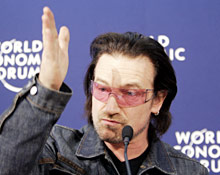 The World Economic Forum - this mystical power, like a magnet attracting bankers, prime ministers, plutocrates and rock stars to the Swiss ski resort in Davos - is involved in a powerful cocktail of greed, ambition, self -deception and philanthropy. It is not surprising that a very wealthy Bono, who loves to call himself a former punk rocker, should have an equally true idea of what this annual party is at the highest level than the rest of the gurus of a globalized economy.
Maybe for the rocker this is not the most suitable place, but for the sake of his business he is ready to make sacrifices. Bono knows very well that for several days a year, Davos is becoming the best place in the world for transactions. He had just tried to persuade the German chancellor Angel Merkel to fulfill earlier by Germany a promise to allocate 0.7% of national income for football in countries in third world countries, and, as Bono says, she obeyed. Another chancellor - the Treasury of Great Britain Gordon Brown - has yet to communicate with Bono. However, the main concern of the singer was to launch a campaign to collect hundreds of millions of dollars a year to combat AIDS in Africa. In a word, this will be an almost perfect Davos transaction.
Bono and his business partner Bobby Shriver (nephew John Kennedy and brother of Maria Shriver, the wife of Arnold Schwarzenegger) created a number of RED products - a trademark with which they will allow you to use almost any decent company, provided that part of the revenue from their sale will be sent to Global Fund - the world fund created to struggle with diseases in the poorest countries of the world.
Bono managed to persuade the American Express from March 1 to start Marketing Red Credit Cards in the UK, and this was his first major success. Then cards should be spread in other countries of the world, since it is precisely such successful operations that the American Express expects. “We want the business to have the opportunity to make money on Red money, because the more they receive, the more deductions to Africa,” says Bono.
No less wonderful than the success of Red, the fact of attracting the best representatives of the business world in Davos in Davos in Davos. Representatives of the private sector calmly lay out up to 100 thousand Swiss francs (44 thousand pounds) for the possibility of participating in the forum. About 57 organizations, including the Goldman Sachs investment bank, the McKinsey and Coca-Cola consulting company acquire an annual subscription at a price of 220 thousand pounds, at which they receive five-fold access to any events they liked.
Among invitations to corporate parties, the most demand was in the greatest demand from Google in a small municipal art gallery (Google is a corporate equivalent of the most fashionable megazvets, and it attracts real megazes such as present at Michael Douglas), as well as the annual lunch for the best customers from the largest Swiss bank UBS. This year, to entertain the public, UBS hired James Blunt-a soldier who turned into a pop star. Perhaps, welcoming several bankers, the Blunt helped the economic forum realize his key principle: “It is designed to improve the state of the world.”
The fact is that Shvab, which still remains the soul and inspirer of the forum, always knew how to pack his brainchild in philanthropic wrappers. Plutocrates are especially attracted not only by the prospect of being seen or noticed in a particular company. They are no less attracted by the prospect of a sincere conversation on how to save the world with leading scientists and heads of government, who are allowed for the forum for free.
It was invented very smartly, because entrepreneurs and bankers from the idea that they make the world a little better, a pleasant warming feeling appears, and this despite the fact that disputes are still ongoing, the society receives real benefits from the forum or this benefit is only the fruit of someone's fantasy. “Look, most of us are here, because everyone else is here, and therefore we should all be here,” says one constant participant in all Davos forums. - “And I think that the forum benefits at least because it simplifies opportunities for leaders of different countries or groups to listen to each other. Indeed, in other conditions, they could not find the opportunity to talk. ”
By their own admission of the participants, after several years of the forum, a certain success was a decrease in the number of street protest demonstrations arising due to debates about the advantages and risks of globalization. This year, the only dissonating voice from the anti-globalist movement belonged to some stupid foreigner who unfolded the poster on the balcony of the opposite building with the inscription "Do not kill for oil."
By the way, this year, the Internet Economic Forum was observed among the participants in the Economic Forum. The heads of the companies talked about the plans of the organization of the Internet business, while the rest had hidden hidden plans to squandering the money of their shareholders, buying online projects for pricked inflation prices. The remaining topics for discussion were quite predictable and interconnected - climate change, increase in oil prices, instability in the Middle East, a nuclear threat from Iran, rapid economic growth in China and India and insatiable appetite of these countries in relation to energy carriers.
Glamority was given to the event by the Google team in the person of Larry Page and Sergey Brin, the founding of the founding of business, which causes the most admiration and hatred. Brin paced in shabby jeans and an old, which saw the views of a gray sweater, and a cloth backpack dangled on his shoulder. If it were not for the guards and numerous admirers, he could be mistaken for a senior student, as he was a few years ago.
At the beginning of the Davos week, Brin’s company, its motto, “do not create evil” - launched the search service in China, which will monitor politically significant information (if a resident of China gains the word “Tibet” on www.google.cn, then he will receive a warning that information searches on this subject are prohibited). In a corporate sense, Google lost his innocence, starting cooperation with the Chinese government and putting plans for expanding his business above the idea that the Internet is a precious embodiment of freedom of speech.
Brin was just a miserable when I asked what made him sacrifice the purity of Modus Operandi by Google. He reminded me that his family emigrated to America from Soviet Russia, which was supposed to prove how this decision was made in a timely manner and how much effort it required.
© The Sunday Telegraph, UK, 2006
01/29/2006 / Robert Peston Material published in the newspaper No. 13 dated 01.30.2006.