
Translated material
Vunderkinda is behind development
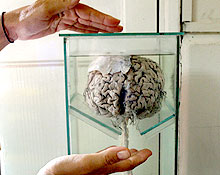 The process of brain formation determines the level of intelligence. The study of American psychologists shows that human intelligence - at least, the level of IQ - depends not so much on the size of the brain, but on the changes that occur with it at the development stage. And in this sense, "clever" lag behind people with medium or low mental potential.
Until now, it was believed that the IQ level is determined mainly by the size of the human brain and the amount of gray matter in it. However, Philip Show and his colleagues from the National Institute of Mental Health (Maryland, USA) nominated another hypothesis. “The point is not that smart children in the brain contain more gray matter. The intelligence of the brain development of the brain affects intelligence, ”the Nature magazine quotes the professor of the show.
The process of forming one of the most complex human organs occurs as follows: in early childhood, the cerebral cortex, which is responsible for a number of important functions, in particular for the memory, thickens, and then begins to sophisticate again. As scientists found out, in people with a high IQ, the thickening of the cerebral cortex occurs two to three years later than the rest, respectively, and it becomes late than the rest.
The show and his colleagues studied more than 300 children aged 6 to 19 years. Teenagers passed various tests with which their IQ level was determined. By magnetic resonance introoscopy, carried out at the interval of two years, the size of the internal parts of the brain of each child was measured. When the children were divided into three groups corresponding to their initial level of intelligence, the researchers discovered the general trends in the development of the brain among participants in each group. Thus, the crust of the brain at the “child prodigy” began to decline later than in all other children: not at 9 years old, but at 11. The largest differences were observed in the written areas of the bark that are responsible for drawing up plans and the development of judgments. By the age of 19, all the differences were leveled, and the cortex of the brain of each group looked the same.
"My first reaction was an exclamation: it's just amazing!" - says psychologist Jeremy Gray from the University of Yale in New Haven (Connecticut). “In fact, this delay can assume high mental abilities, implying that a child can process more complex operations, while the cortex of the brain continues to form,” said, in turn, the co -author of the study Dr. Judith Rapoport.
However, the experiment of scientists posed a number of new issues. The professor of the show did not set himself the task of establishing factors that predetermined the features of the development of the brain in each child.
Researchers suggest that this process is somehow associated with the formation and elimination of the connections between the cells of the brain. But the show professor admits: "We know too little about what is happening at the cellular level." The impact on the process of brain factors or, for example, environmental conditions, remains unexplored.
03/03/2006 / Oleg Komotsky material published in the newspaper No. 57 dated 04.04.2006.