
Translated material
The abroad will not help
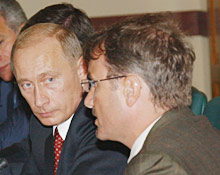 The president spoke for reducing imports yesterday's meeting of the president with government members was marked by an unexpected discussion of Vladimir Putin and the Minister of Economic Development and Trade of Hermann Gref about the role of imports for the Russian economy. Last year’s increase in imports, which exceeded 28%, seemed excessive to the president. “This is too much,” he said bluntly. And then I found the guilty - the Central Bank with the Ministry of Finance. “This (import growth. -“ newspaper ”) including the result of strengthening the national currency,” the president explained. Namely, the above departments are primarily responsible for the fact that last year the ruble is captured by 10.5%, which could not but affect the growth of imports.
“Import growth is not bad, as it reduces inflation,” German Gref tried to object. However, the idea that fighting this may not be necessary, in this case, did not develop. According to the head of the Ministry of Economic Development, it is necessary not to limit ourselves to the fight against the excessive strengthening of the ruble, but to find effective ways to combat a "gray" import, competition with which Russian manufacturers really can withstand. “It is important to maintain normal conditions for competition,” the minister emphasized.
By the way, according to the statistics of the Federal Customs Service, the growth rate of imports last year actually slowed down: in 2004, this indicator was more than 32% (the value of goods imported into Russia increased so much) against 28% not -missed by the president in 2005. At the same time, the amount of payments to the budget charged during imports over the past year increased by more than 35%, while in 2004 only by 29.5%. That is, imports somewhat "turned white", in other words, its legal component has increased. Apparently, according to both the president and German Gref, this “whitewashing” is not enough.
It is no accident, according to Herman Gref, the government in 2006 intends to closely engage in the reform of customs administration in order to adopt a "detailed plan of action in this area" within a year. And already this week, the prospects for customs administration reform will be discussed at a meeting of the College of the Ministry of Economic Development.
Another question that Herman Gref was supposed to discuss, if not with the president, then at least with the Minister of Finance Alexei Kudrin is the possibility of increasing the forecast oil price for 2006 from 45 to 51 dollars per barrel. According to the source in the Ministry of Economic Development, first of all, ministers should evaluate the macroeconomic consequences of an increase, which, "perhaps more will be more."
According to the source, the initiator of the increase is precisely the department of German Gref, according to which the average annual price of Urals oil in 2005 amounted to 50.6 dollars per barrel, while this year there is a tendency towards a further growth of this indicator.
The Ministry of Finance, on the issue of adjusting forecasts, still preferred to act carefully. The fact is that the greater the difference between the real and the predicted oil price (the lower the latter), the more Alexei Kudrin has opportunities for budget maneuvers. Recall that in the middle of last year the forecast oil price for 2006 from 35 to 40 dollars per barrel has already allowed to find an additional 600 billion rubles for national projects in the budget. At the end of last year, when preparing a draft budget for 2006, by the third reading, the average annual oil prices was increased by another $ 5 - up to $ 45 per barrel, which were not taken into account in the expenditure part of the budget. That is, this is at least about 600 billion rubles. If the Ministry of Finance agrees to increase the forecast by another $ 6, to $ 51 per barrel, as the Ministry of Economic Development offers, this will mean that Alexey Kudrin will actually sign that his department has a reserve exceeding 1.3 trillion. rubles, not taken into account in the already planned expenses. How to use them - to spend on some new national projects or to preserve in a stab fund is a second question. It is clear that the head of the Ministry of Finance is more profitable for this money to remain, as now, virtual, and for this the forecast does not need to be reviewed. Indeed, in the event that the Ministry of Finance agrees to an increased forecast bar, with further budget planning, it will be no simple to abandon it or significantly reduce it, which means that possible additional income will have to be divided in advance, which will significantly reduce the budgetary maneuverability of the Ministry of Finance.
01/30/2006 / Galina Lyashenko, the material was published in the "newspaper" No. 14 dated 31.01.2006.