
Translated material
Always night
About Hannah Arendt's book "Men in Dark Times"
Ad Marginem has published a new edition of Hannah Arendt's famous book "People in Dark Times" - a collection of essays dedicated to her contemporaries, poets, writers, thinkers and political figures who defended humanistic values in those years when it seemed a completely futile exercise. Anton Prokopchuk talks about what this book can teach us today.
All of us, since February 24, 2022, have found ourselves in the face of advancing barbarity, violence and lies. In this situation, it is extremely important to preserve at least the remnants of culture and support the values of humanism - including for the sake of the future of Russia. Therefore, the editors of Gorky will continue to talk about books, reminding our readers that there is still a place for thought and fiction in the world.
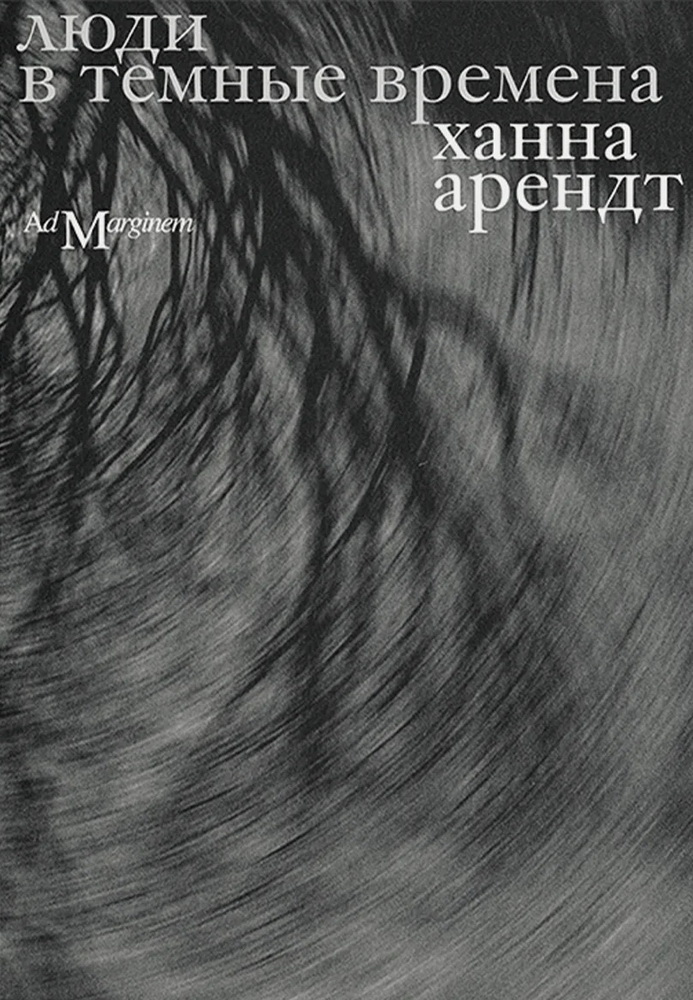
Hannah Arendt. People in dark times. M.: Ad Marginem Press, 2024. Translation from German and English by G. Dashevsky, B. Dubin. Content
 Hardly any era seems to itself completely clear and cloudless. As a rule, relatively happy periods of time, small by historical standards, passing in a purely limited area, are perceived as relatively happy. Even if the Belle Époque was established somewhere for a short time , then all the same, behind the river or the nearest mountain range, guns are sure to thunder, hunger reigns and tyrants rampage. Yet some times feel especially difficult and dark. Then, from the distance of past years, and even more so in contrast with the present, seasoned with a sense of nostalgia, they may turn out to be bearable and even happy. However, this does not make their experience any easier. In such conditions, you always want to find some kind of landmark. Ironically, human history provides a rich source of guiding light. True, it is full of all sorts of rubbish that does not deserve memories, but even in the most terrible centuries, humanity accomplished a lot of glorious things, and we, as a rule, remember it. Among many others, we choose individual glorious people to find in their destinies an example to follow and a model of life in difficult times. Hannah Arendt is undoubtedly worthy of serving as such an example, but today we will talk about her book, which is specifically dedicated to this kind of memory.
The belief that even in the darkest times we have the right to expect some kind of illumination and that this illumination comes not so much from theories and concepts as from the uncertain, flickering and often weak light that some people, in their lives and in their works, kindle under almost any circumstances and with which they illuminate the time allotted to them on earth - this belief serves as a silent background for the proposed series of portraits .
At first glance, Men in Dark Times is an unobligatory collection of essays written largely on occasion. First of all, Arendt strives to give due honor to poets, writers, thinkers and political figures, including those undeservedly forgotten and dear to her personally. Such work certainly has value, but it is quite limited. However, here her most important philosophical reflections seem to be embodied in the biographies of specific people. In the end, a book about people cannot but be fundamental for the author of a fundamental work on the “ human lot .” What kind of people are these? They are all outstanding personalities in their own way, but that’s not all. Apart from Gotthold Lessing, these are formally Arendt's older contemporaries. Only some of them are her direct acquaintances, such as Waldemar Gurian . Of course, a special place here is occupied by teacher and friend Karl Jaspers, who was awarded two entire texts. Nearby we find essays on the writers Bertolt Brecht and Hermann Broch , the writer Isak Dinesen and Angelo Giuseppe Roncalli, better known as Pope John XXIII . What unites them, as Arendt emphasizes, is, first of all, that none of them was either a product or a mirror of their era. These people lived contrary to the destructive trends of modernity, and therefore their fates were often tragic to varying degrees. Politician Rosa Luxemburg, philosopher Walter Benjamin, poet Randall Jerrell , one might say, fell victims of their age. And yet, its “darkness” did not lie in the troubles it brought, but in the gradual loss by man of the light of publicity.
Dark times recur every now and then in a variety of circumstances, including in the 20th century, marked by the terrifying novelty of its catastrophes. Nothing stops humanity from plunging into the darkness of silence and ignorance at any moment. After all, the life of each person individually is fragile and most often quite unsightly. Even the complete calm and well-being of everyday life do not guarantee any meaningful existence, which can end abruptly and ingloriously at any moment. A lonely person is constantly approaching inevitable death. In himself, he finds the only clue - his own humanity, which is obviously more durable than the life of an individual. People lived long before him and, most likely, will live for some time after. Therefore, it is human communication, acquiring more or less stable forms, ensured by certain rules, that is capable of preserving humanity as such. This means, among other things, that in society each individual person is given a chance for a unique afterlife, primarily in the memory of other people.
We are talking not just about vanity, but about existential concern, about the deep anxiety that the thirst for meaning causes in a person. Communication can give him hope that after physical death he will not perish in the dark waters of the river of oblivion. It is precisely this motivation, according to Arendt, that lies behind some human actions, and especially political ones. This means that public communication, that is, discussion of the common good, is a human activity par excellence. Publicity or common interest is a space in which a person can be seen and heard in his humanity. In public communication, life takes on meaning, since only in its light can the significance of an individual’s ideas and actions be assessed. A person deprived of communication is left alone with the surrounding darkness. Then he naturally strives to escape from hostile circumstances, completely withdrawing into himself and, at best, into the circle of people closest to him, that is, on his family in the literal or figurative sense. However, in doing so he loses what made him human.
In our time, Arendt says, there is nothing more doubtful and less self-evident than a person’s belonging to the public sphere. Today, several decades later, it seems that this problem has only worsened. Almost every modern person is on public display on social networks around the clock. Our personal lives are completely transparent to the all-seeing structures of police surveillance, and the “public spaces” of big cities are not only well lit, but, as environmentalists say, “polluted” by excessive amounts of light. Despite all this, the very possibility of any common good, and especially communication about it, is now more than ever in question. The field of once public dialogue is torn between numerous parties and movements, the sectarianism and radicalism of which are likely to only increase as the gap between them widens. There is less and less ground for communication. If today we are talking about humanity, it is only about the humanity of “ours”, surrounded by “non-humans” on all sides. Arendt made a lot of effort to show the absurdity of this understanding of humanity, but it was quite obvious to her where everything was going.
The world is located between people, and it is this “between” - much more than people or even man as such - that is today the subject of the greatest anxiety and the most obvious crisis in almost all countries of the planet. Even where the world remains—or is maintained—halfway in order, the public sphere has lost the illuminating power that was part of its very nature to begin with. More and more people in the Western world, which - since the end of antiquity - has considered freedom from politics as one of the fundamental freedoms, are taking advantage of this freedom and withdrawing from the world and their obligations in it. This withdrawal from the world does not necessarily harm the individual himself; perhaps he would even develop his talent to the level of genius and thus - in a roundabout way - serve the world again. But with each such departure the world suffers an almost demonstrable loss; and the concrete and usually irreplaceable “between” that would have formed between this individual and his neighbors is lost .
People formed by dark times tend to ignore and even despise this world “in between.” A common place for them is esoteric and paranoid ideas about the structure of politics: someone at the top “resolves issues” based on secret reasons that obviously exceed the understanding of an individual. Real politics is hidden from us, and it is better not to get involved in these dirty affairs. A person has no choice but to take care of individual survival and comfort, sometimes to the detriment of others. In such a situation, a variety of strategies can take place, ranging from escapism to “gnostic” assistance in the complete destruction of the remnants of the world. While all of them can be understood and even justified in their own way from a survival point of view, they are ultimately destructive to the human spirit. However, in some cases - almost miraculously - a special kind of humanity can develop in dark times. It is about brotherly affection for each other, stemming from a shared hatred of a world in which people are treated inhumanely. Arendt speaks primarily of peoples who have become pariahs, as the Jews were for most of their history. It increasingly seems that today any nation, or even humanity in general, could find itself in such a state. In a situation where people are opposed to the world as something external and hostile, a special warmth of human relations may arise that is unusual for them under normal conditions. Thanks to this warmth, people deprived of peace and humanity can almost by touch find each other again in the darkness of time.
In this love or friendship, the human spirit manifests itself, unwilling to give up in the face of the surrounding savagery. Since we are talking about human communication primarily, from just a personal, private relationship, friendship becomes a political matter, on which Arendt insists, following the ancient philosophers. After all, Aristotle argued that man is a political animal, that is, in need of communication. Contrary to the natural impulse to hide from the world in the cozy environment of his usual habitat, a person goes out to meet another. Thus society is re-established and peace is restored bit by bit. Friendship always takes the side of peace, but contradicts the impartial objectivity of pure knowledge. If Spinoza, who stoically endured expulsion from the community and political cataclysms, called for “ not to cry, not to laugh, but to understand ,” then Lessing, extolled by Hannah Arendt, “ experienced the world in anger and laughter ” and put friendship above truth.
Of course, a person deprived of freedom in public relations is forced to look for it within his own self, but the task is to return with autonomously acquired knowledge to other people. Ultimately, even thoughts, in order to remain alive, need a certain freedom of movement, and this does not exist outside of communication. Solitary thinking only anticipates dialogue with others, and only in this way is it able to overcome loneliness and lack of freedom. By the way, this is why science exists primarily as a social institution - not necessarily in laboratories or stuffy classrooms of academies, but more in informal correspondence, in smoking rooms and at buffets after conferences. Otherwise, we are dealing with countless "independent thinkers" and paid teachers of wisdom who are not bound by any common truth. Under such conditions, neither knowledge, nor communication, nor truly free thinking is possible. Therefore, it is not knowledge, not coercion, but this political friendship that serves as the last hope for peace. The light of humanity in dark times is carried by those whose thinking and creativity serve to maintain loyalty to friends despite the totality of enmity.
If the function of the public sphere is to shed light on human affairs, providing a space of reality in which people - by deed or word, for better or for worse - can show who they are and what they can do, then darkness comes if this light is extinguished by the “crisis of confidence” and “backstage government”, speech that does not reveal but sweeps under the rug what is, and appeals, moral and otherwise, under the pretext of defending old truths of all kinds. reducing truth to a meaningless truism .
In the process of destruction of the familiar world, calls spontaneously arise for restoration, for the embodiment of ghostly images of the past, when everything was simple and familiar. It is well known what catastrophes such historical utopianism can lead to. In place of the missing general truths, he puts the most terrible misconceptions and prejudices, hastily declaring the newborn chimeras of his darkened mind to be the primordial truth and unbreakable tradition. However, even the most sane and pragmatic conservatism, says Arendt, at best can be a temporary forced measure of protection from final destruction, but not a promise of a new beginning and foundation for future humanity. With each successive collapse of the last pillars of public order, their incorrigible fragility becomes more and more obvious. There is almost nothing left to save. In the end, there is nothing left but the “best known truths,” like humanity itself, which hardly anyone else believes in deep down. There can be no talk of any “positive image of the future” in this situation—only the complete destruction of a too-small world together with everyone who does not share a narrow set of party “values.”
In different ways, all the heroes of Arendt’s book restored peace between people, trying to prevent such an outcome of events. In truth, they all failed. However, the point is not to imitate them in specific everyday decisions. The main thing to remember is their glorious efforts in maintaining peace and preserving the soil for its renewal beyond the horizon of disaster. After all, we are talking, first of all, not about the end of all things, but about the end of the world, which can happen both in a limited area and on a planetary scale. The human spirit lives in defiance of natural gravity. It dies when the world of common interest, the world as a space between people, completely turns into a natural environment of survival in which man is a wolf to man. The great jazz composer Thelonious Monk said: It's always night, or we wouldn't need light . Darkness is the natural state of the universe, which is why we need light. Hannah Arendt reminds us that it is foolhardy to expect the light of humanity to appear from somewhere outside. Her book, perhaps, does not inspire optimism and does not inspire groundless hopes, but at least it gives consolation. A person does not live in vain as long as he is humane. Only then can there be light in the darkness.