
Translated material
250 years of art
"Manege" opened the exhibition "All Benois - All Benois", dedicated to the largest artistic dynasty in Europe

Exhibition “All Benois - All Benois” at the Manege. Photo: official TG channel of the Manege Central Exhibition Hall
For more than 230 years, members of the Benois family in Russia built theaters and palaces, painted paintings and created sets for theatrical productions, stood at the origins of museum work in Russia and preserved monuments of Russian culture. The organizers of the exhibition in Manege tried to imagine the scale of influence of this family on Russian art and Russian culture in general.
From Parsley to Peter
We must immediately make a reservation: the main figure who gave rise to the exhibition, around which the entire exposition is built, is Alexander Nikolaevich Benois. The famous theater production designer, one of the creators of the “World of Art”, the author of illustrations for Pushkin’s “The Bronze Horseman”, a series of watercolors “Versailles” - a list of his works and services to Russian culture would take more than one page. This May marked the 155th anniversary of his birth.
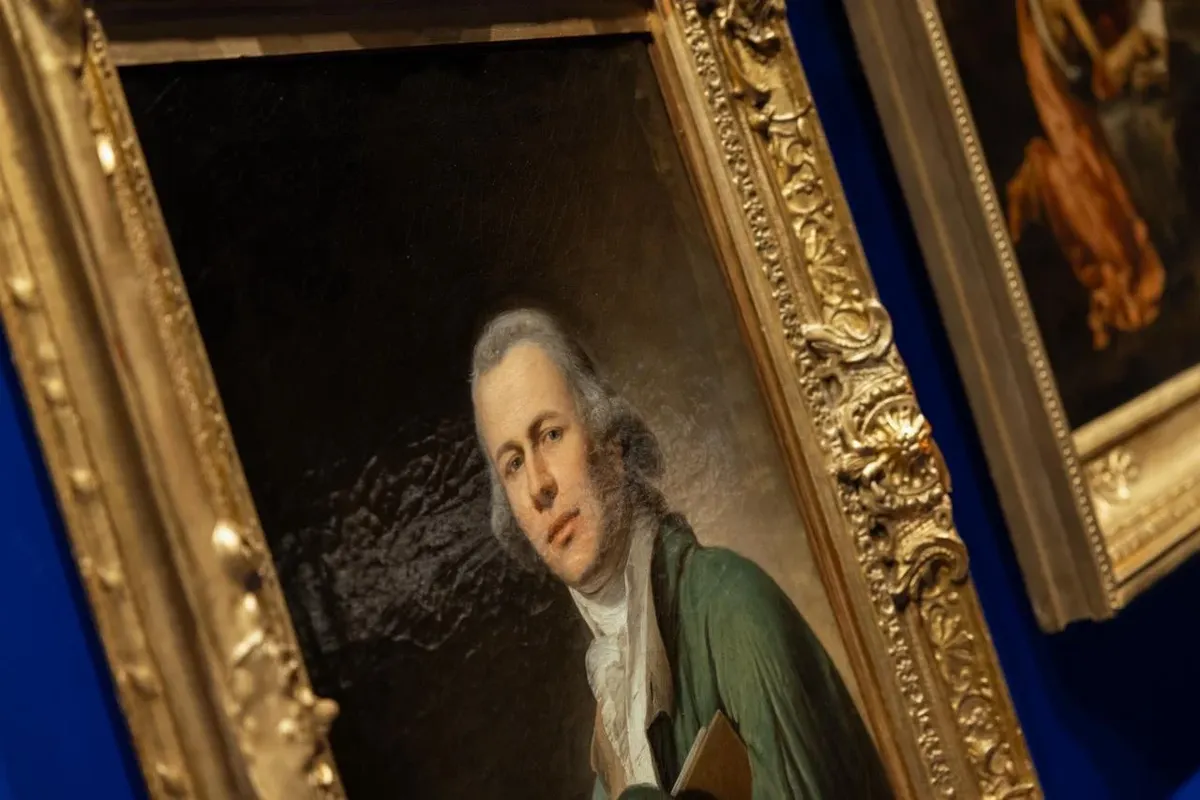
However, Alexandre Benois, although the main character of the exhibition, is not the only one: perhaps the largest artistic dynasty in Europe is represented here by the works of about 40 members of this huge family, as well as works by artists who were part of Benois’s inner circle. In total, the Manege space contains over 600 exhibits from more than 70 museums, archives, theaters, libraries across the country and from private collectors.
“The project is large-scale, it contains so many ideas and meanings that you could walk around the exhibition for a week and conduct a wide variety of thematic excursions,” says Elizaveta Pavlycheva, curator and project manager. “We tried to make the center of the exhibition Alexander Nikolaevich Benois, the heart of the whole family, and talk about him as a kind of Russian Leonardo.”
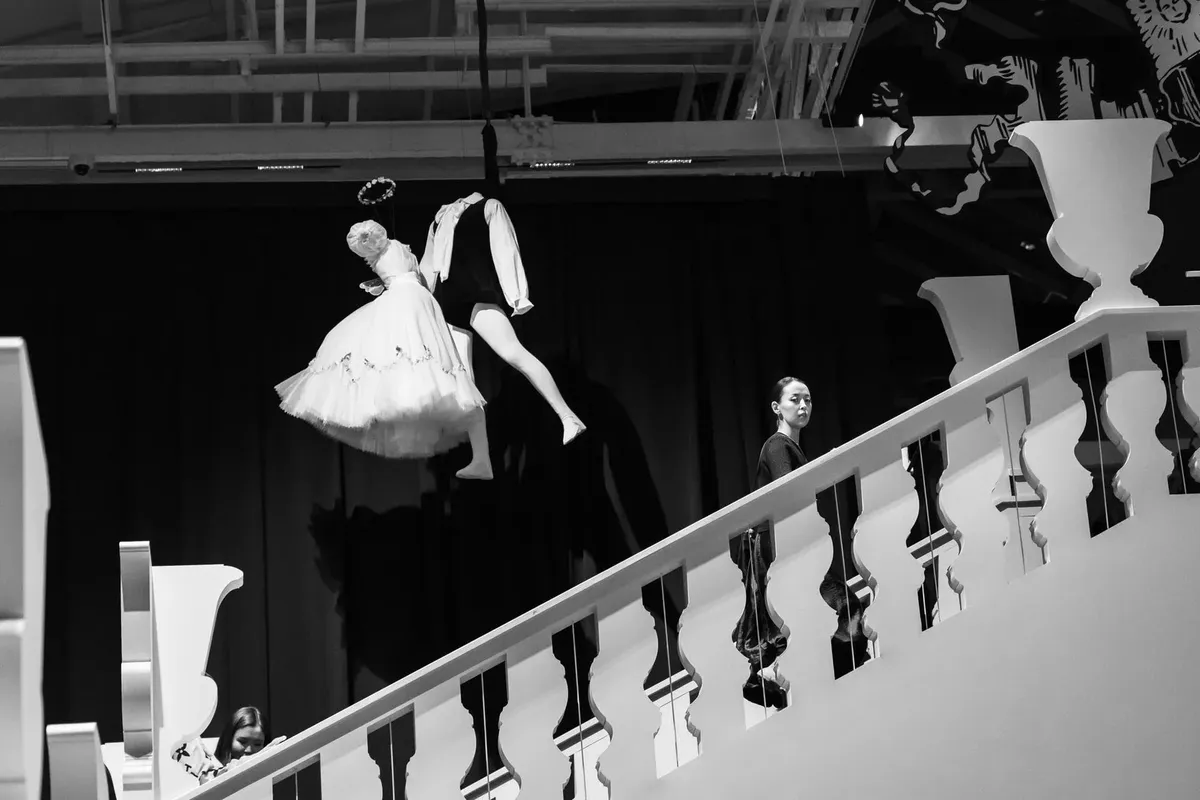
The entrance area is separated from the main exhibition by a huge theatrical curtain, upon entering which visitors immediately find themselves in the theater foyer, or antechamber. Here on a huge screen there is a non-stop video recording of ballets staged by Sergei Diaghilev and designed by Alexandre Benois: “Pavilion of Armida”, “Petrushka”. The main roles in these ballets were once performed by Vaslav Nijinsky and Anna Pavlova.
They seem to come to life in front of the audience, but this is a deepfake: the Mariinsky Theater soloists Leonid Sarafanov and Olesya Novikova are dancing, with the help of AI “putting on” the faces of Nijinsky and Pavlova.
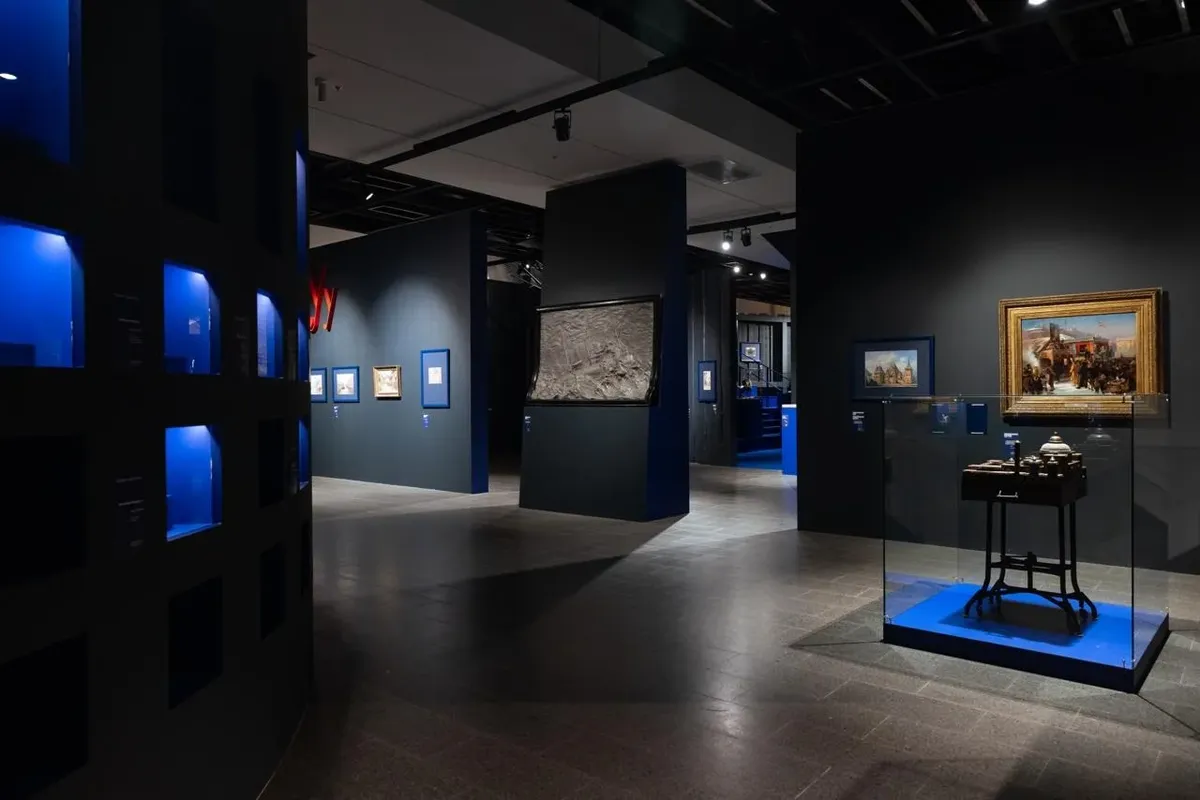
From the antechamber, along a snow-white staircase, on the top tier of which the audience is greeted by the figure of Petrushka, guests find themselves on the second floor, from where the tour begins. The exhibition on the second floor is a huge glass labyrinth with exhibits on its transparent walls. The floors are covered with a deep blue fabric, creating the effect of a full-flowing river, and the side galleries are decorated with views of St. Petersburg embankments, which Alexander Benois so often depicted in his works.
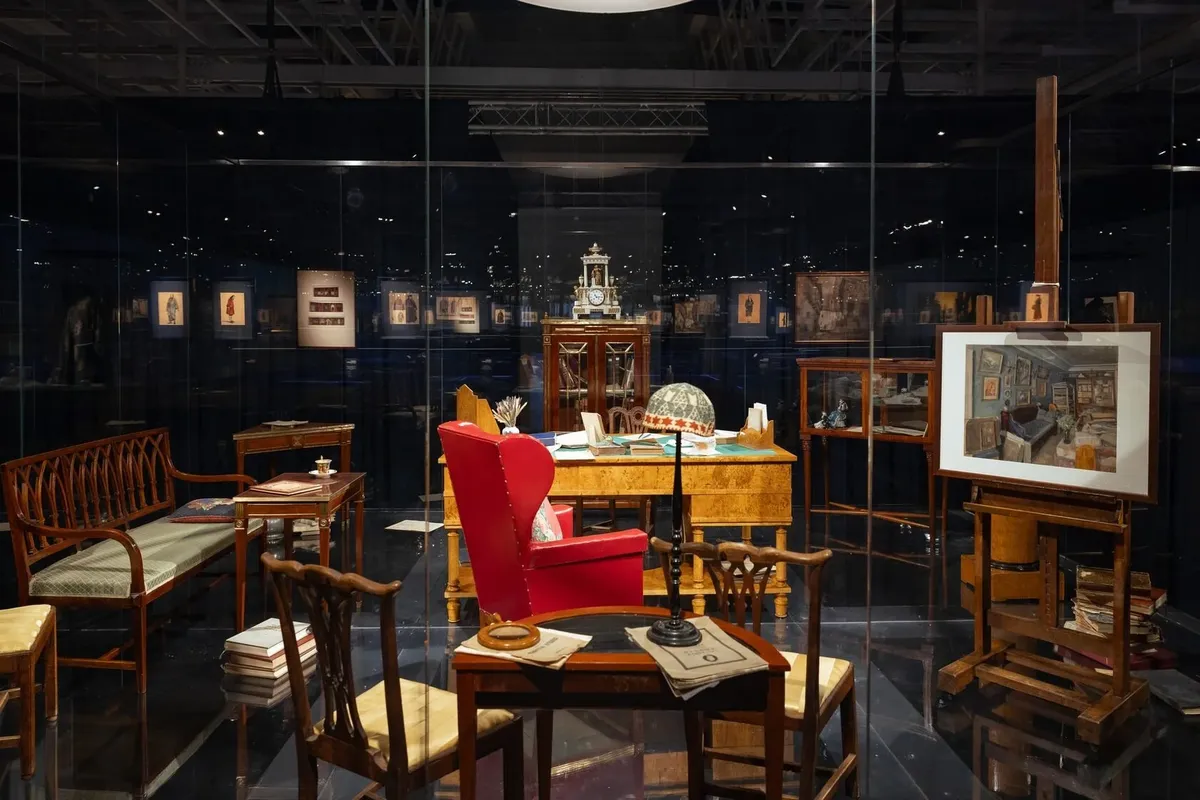
The labyrinth presents mainly theatrical sketches, works of both Alexandre Benois himself and his colleagues from the World of Arts, as well as costumes of Peter I - real and theatrical. Along the walls of the side galleries there are paintings from the Hermitage, among them many masterpieces that Alexander Benois acquired for the museum when he was in charge of the art gallery there from 1918 to 1926. The semantic and emotional center of the second floor was Benoit’s office, surrounded by transparent walls, as if enclosed in a glass capsule.
“The exhibits for the office were provided to us by the Benois Family Museum from Peterhof,” said Evgeny Dedinkin, co-curator of the exhibition. “But we did not seek to recreate a specific office from his apartment or workshop, or a study in the Bolshoi Theater or the Hermitage. We wanted to show the office as a metaphysical space that absorbed all the aspects of Benoit’s personality and creativity.”
To be more than just Benoit
Alexandre Benois was born in 1870. My grandfather and father are architects, my older brother is a famous watercolor painter. As Alexander himself later said, he had no other choice than to become an artist. He began drawing in kindergarten, and already from his school years he received lessons in academic painting: drawing classes at the famous Karl May Gymnasium, where he studied, were taught by Karl Wenig, a master of historical painting, a teacher at the Academy of Arts. It was in the May gymnasium that the future artist became friends with those who later formed the famous society “World of Art” - with Konstantin Somov, Walter Nouvel, Dmitry Filosofov (cousin of Sergei Diaghilev), Lev (Leon) Bakst.
Disappointed, he dropped out of his studies at the Academy of Arts after a few months, then received a law degree from St. Petersburg University, and underwent professional artistic training according to his own program under the guidance of his older brother Albert. Daily painting classes, drawing from life, exercises in composition, in-depth study of art history, including the Hermitage collection, travel to historical cities and museums in Germany, Italy, France - his preparation was clearly not inferior to academic.
At the age of 23–24, he declared himself as a mature artist and at the same time as a professional art historian: his works were celebrated at exhibitions, his essays on Russian art were published in Germany and Russia.
The series of watercolors “The Last Walks of Louis XIV,” written based on his impressions of his first trip to France in 1896, brought him fame as the “singer of Versailles and Louis” and became his calling card.
The end of the 90s of the 19th century for Alexander Benois was the creation of the “World of Art” society, in which Leon Bakst, Mstislav Dobuzhinsky, Evgeny Lansere, Igor Grabar and associated Nicholas Roerich, Mikhail Nesterov, Valentin Serov, Mikhail Vrubel, Konstantin Korovin, Boris Kustodiev and other outstanding masters of Russian art began their creative activity. beginning of the 20th century.
But theater became the love of his life for him. In 1901, Alexander Benois began his career as a theater artist and remained faithful to the theater until the end of his life: as a production designer, he designed dozens of performances in Russia and Europe. At the same time, in 1901–1902, he published a two-volume book “The History of Painting in the 19th Century. Russian painting".
Literally from the first days after the October Revolution, Alexander Benois actively participated in the preservation of palaces and parks of Petrograd and museum collections. Since 1918, he became the head of the Hermitage art gallery: thousands of works of art flocked here from private collections, the royal palaces of Gatchina, Pavlovsk, Tsarskoe Selo, Peterhof, Oranienbaum. Through the efforts of Benois, the Hermitage doubled the number of halls for an art gallery and became a public museum.
But in 1926, Alexander Benois left for Paris to stage a play at the Grand Opera and never returned to Russia.
Total blood
And he did the right thing: in the 1920–1950s, in the country of the victorious Bolsheviks, the Bolsheviks were repressed - killed, exiled to camps and settlements, imprisoned - including several dozen members of the Benois family. His nephew, son of Albert’s older brother, Nikolai-Karl Albertovich Benoit, inventor of sound reconnaissance, creator of a device for adjusting fire by the sound of explosions, remained with his family in Russia. He continued to work as an inventor, but in March 1935 he was arrested, recognized as a “socially dangerous person” and deported with his family to the Karaganda region. In February 1938, he was arrested again, accused of espionage and shot. They did the same with his wife. The children, Denis and Nikolai, were left orphans.
The family of Yuli Yulievich Benois, an architect, suffered (he, together with his cousins Albert and Leonty, built the famous complex of buildings on Kamennoostrovsky Avenue in St. Petersburg, known as the House of Three Benois). One of his sons, Yuliy Yulievich, was exiled in 1935 with his divorced wife and son Yuliy to the Aktobe region for five years; before the war he returned to Leningrad and died during the siege. Another son, Friedrich Yulievich, was arrested in 1920, sentenced to death, but after a ransom was released abroad. The third son, Franz Yulievich, was in exile in Irkutsk from the mid-30s; in April 1937 he was rearrested, sentenced to death and killed in January 1938.
The granddaughter of Alexander Leontyevich Benois, Ekaterina, died in exile: her husband, Nikolai Romanov, was shot in 1937, she was exiled, and she died in Samarkand in 1954. Architect Nikolai Evgenievich Lanceray, brother of Zinaida Serebryakova, nephew of Alexander Benois, was arrested twice and died in the Saratov prison hospital in 1942.
At the exhibition in Manege not a word is said about this side of the history of the Benoit family.
Pictures in your ABC book
If the second floor of the exhibition in the Manege turned out to be a state-owned one, then the first floor was more personal, homely and warmer (despite the same total cold blue background color). Because the basis of the exhibition for him was Benoit’s “ABC,” which he drew and published in 1904 for his son Nikolai. At the exhibition you can see the original sketches of “The ABC” with watercolor painting done by Benoit - they were provided by Goznak, in whose printing house the book was printed in 1904.
On the transition from the second floor to the first, visitors are greeted by the letter E - “Egypt”: behind the exhibit from the Hermitage (Egyptian cartonage, which the Hermitage itself does not exhibit) on the big screen are footage of the film “Death on the Nile”, in which the role of detective Hercule Poirot is played by the famous English actor Peter Ustinov. His mother, Nadezhda Leontyevna, is the niece of Alexander Benois. On the first floor you can see a figurine made by the actor’s son, sculptor Igor Ustinov, to be presented to the winners of the Benoi de la Dance competition.
After Egypt, in the space of the letter Z, “Stars” appear, which you can admire when entering a real wooden barn. This is the “Barn” installation by the Meganom Archbureau: the roof and walls are dotted with holes, and if you look at them from the inside under certain lighting, the illusion of a starry sky appears. Here you can see theatrical sketches by Alexandre Benois’s son, Nicholas, as well as works by Benois di Stetto, another nephew of the exhibition’s protagonist.
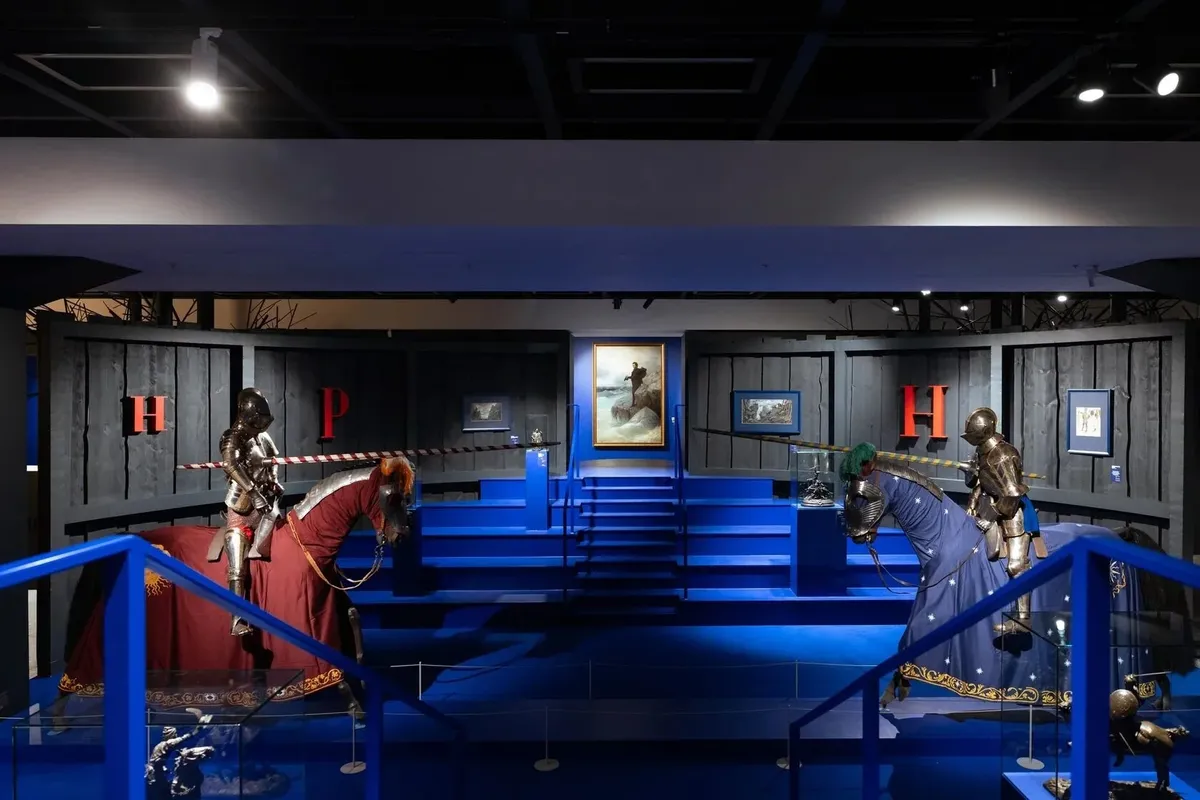
The letter N means “Attack”, and this section presents a sculpture by Evgeny Lanceray Sr. (husband of Catherine, Alexander Benois’s sister): “Vityaz”, “Dzhigitovka”. The theme of children's games of Indians also appears here. And next to it, at the letter R, “Knights” are galloping towards each other - figures from the Knights’ Hall of the Hermitage.
Alexander Benois was fond of folk art and collected a collection of handicraft toys (letter I). After leaving for France, the collection fell apart, then some of the items ended up in the Russian Museum. The exhibition in Manege features about 50 toys from Benoit’s collection, some of which can be seen in his works, including “ABC”.
And probably the warmest of the spaces is the letter M, “Mom”. A small pavilion was built for him, inside of which, in particular, the works of Zinaida Serebryakova are presented. The central place there is occupied by a virtual copy of Leonardo da Vinci’s Madonna with a Flower, which Leonty and Maria Benois sold to the Hermitage at the beginning of the 20th century. Since then, the painting has been known as “Benois Madonna.”
Alexandre Benois often repeated that art should be magic, that the artist creates other worlds, and does not copy reality. The Benois built their own world, which became a real encyclopedia of Russian art.