
Translated material
Amarcord
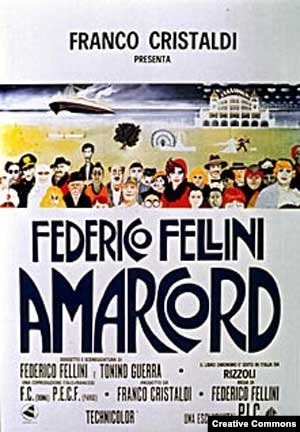
List of the best paintings of the century according to Radio Liberty
Dmitry Volchek: The issue is dedicated to the film “Amarcord”, which some consider the pinnacle of Federico Fellini’s work, while others consider it a canvas on which the master’s brush stumbled.
For the Soviet intelligentsia of the Brezhnev era, the word “Amarcord” was a kind of password. One of those verbal signs by which one recognizes one. The veneration of this film, which (unlike many of Fellini’s other works) successfully made it through the thorns of censorship, was a symbol of belonging to a special circle of the elite.
I remember well the absolutely unimaginable excitement these days that accompanied the release of Amarcord on Soviet screens. Another celebration of disobedience, which so brightened up our lives in the shadow of the Brezhnev events of the 1970s.
It must be said that, according to the tradition of that time, in “Amarcord” they saw something that Fellini himself clearly did not mean, something that did not fit into his plan at all, some kind of rebellion, a fig in his pocket. And “Amarcord” is an exceptionally free film, but this freedom was sometimes interpreted by the opposing viewers behind the Iron Curtain too straightforwardly, forcibly dragging the situation in fascist Italy of the 1930s into the cage of their own lives.
We can say that the Soviet intelligentsia, through collective efforts, built a very special myth around Amarcord. Even in the title of the film, the conventional Russian translation of which “I remember” was never fixed on the posters, even in this title there was a smack of mystery and that hidden challenge. However, as for the name, it actually hides a much more complex game than just “I remember” spoken in the Romagna dialect. Fellini wrote that “Amarcord” is a quirk of phonetics, a cabalistic sound and even the name of an aperitif, anything but the annoying association with “I remember.”
So, credits. "Amarcord". Screenplay by Federico Fellini and Tonino Guerra. Cinematographer Giuseppe Rotunno. Artist Danilo Donati. Composed by Nino Rota. Cast: Puppella Maggio, Armando Branchia, Bruno Zanin, Ciccio Ingrassia, Magali Noel and many others, mostly non-professional actors. Italian-French production, 1973.
Paradoxically, Fellini's film, built on memories of childhood in the provincial town of Rimini, turns out to have nothing in common with the traditional practice of filming memoirs. Even where you confidently suspect a solid historical foundation - for example, in one of the key scenes with the grandiose ship "Rex", which the town's residents gather to admire - you discover fiction.
Co-writer of the film's script , Tonino Guerra, says:
- "Rex"? I'll tell you a little secret. This very important episode in the film with the ship “Rex”... The real “Rex” was never on the Adriatic near Rimini, because it sailed directly from Genoa to America. But Fellini and I remembered that a very large ship once sailed past Rimini, and we decided that we could call it “Rex”. Because the most important thing for a screenwriter is to reinvent reality. What remains to us from the past is a taste of time. What kind of reflection of reality do you want from this film if Fellini didn’t shoot even a meter of film in the city itself?
Dmitry Volchek: The scene with “Rex” is called key for understanding the poetics of “Amarcord” and Milanese film critic Luigi Pacini :
— The entire scene where “Rex” appears, a symbol of those times, was completely filmed on the pavilion. The most expressive thing is this combination: the peak of falsity, when it is clear that the sea is plastic and the waves are made of crumpled paper, turns out to be the poetic peak of the film.
Dmitry Volchek: The film was completely shot in the studio, and the so-called memories have nothing to do with reality, says Luigi Pacini. Fellini himself said that in cinema he prefers fiction to truth; a lie, in his opinion, is always more interesting than the truth. Lies are the spirit of the production; fiction can be a truer reality than true history. What really needs to be authentic are the emotions that memories and works of cinema evoke. That is why this film, which describes a small town and even whose name is not in Italian, but in a dialect, is so important for the history of cinema.
Why does such a seemingly provincial film become one of Fellini’s most successful works and one of the most popular films in the world? The answer to this question is given by Milan Kundera, who greatly respected and loved Fellini. Kundera writes that Fellini is one of the few artists who made cinema a genuine part of modern art. Fellini is the only director, Kundera believes, whose work can be placed next to the works of Stravinsky and Picasso, since in his work he was able to show all levels of existence without passing judgment on them, all the way down to base vulgarity and exhibitionism.
Can the film be called autobiographical to some extent? I asked Tonino Guerra .
- No. We cannot say that this is our autobiography. The times were such that approximately the same thing happened at that time in all cities of Italy. Everything shown in Amarcord was in the air. And the teachers we portrayed in the film, and fascism. Remembering those times, it is indeed not difficult to imagine that somewhere the Nazis shot at a gramophone playing “The Internationale”. Fellini and I tried to interpret the poetics of time. But Fellini's most important achievement in this film is that he resurrected the taste of childhood for all viewers. The success of Amarcord is that it is not only a story about Fellini’s childhood or about my childhood. This is a story about the childhood of everyone who was born at that time. Some of the characters in the film actually existed, but that's not the main thing. The most important task for us was to convey the spirit of those days, the emotions of that age.
Dmitry Volchek: “Amarcord,” writes Fellini in his book “Making a Film,” is a word that, thanks to its unusualness, could become a synthesis, a starting point, almost a sound reflection of some special way of feeling and thinking, dual, controversial, contradictory. The coexistence of two opposites, the fusion of two extremes, such as indifference - nostalgia, cold rationality and sympathy, renunciation and inclusion, tenderness and irony, irritation and deep suffering.
It seemed to me that the film I wanted to make should mean exactly this: the need to break away from something that was yours, with which you were born and lived, which determined your behavior, from which you were sick and tormented, in which everything is so alarming, so dangerously mixed up. This is a past that should no longer poison us, and therefore it must be freed from the shadows, confusion, and old obligations that still remain. The past, which needs to be captured as the truest evidence of ourselves, of our history. The past, which must somehow be internalized so that our life in the present can be more conscious. This is a wretched school where ignorance and assault reigned. This is a stupid and difficult duty to participate in religious processions, fascist parades, to go with everyone to church, to the cinema, to gatherings where we sang hymns and made obscene sounds. This is a drowsy loneliness filled with dreams evoked by American films and frenzied masturbation. This inert and sluggish expectation of some decisive, miraculous, glorious outcome, which, it seemed, we certainly deserve, if only because we are Italians, we have blue skies, the Pope, Dante, Virgil... Is all this just history? Just yesterday? Just look around, there he is, over your shoulders. It seems to me that we have not yet emerged from our yesterday, have not yet stepped over its shadow.
I asked Tonino Guerra to talk about how he worked with Fellini on the film's script.
— Fellini and I wrote the script for “Amarcord” for 10 days. Only in the morning. And I must say, they understood each other perfectly. He came to me or I came to him, we laughed, joked, the work went very easily. The script was born with joy, it can be felt in the film, all in transparent, clean air. The difference between my experience and Fellini's is not that he was born in the city, and I am 10 kilometers from Rimini. Fellini's experience is that of a boy who lived by the sea, and my childhood was spent among the fields. The script for Amarcord appeared first as a book and then as a film. Each of us brought our own personal experience to it. Each of us read what the other wrote, and the result was this mixture. My memories overlapped with those of Fellini, for example in the school scenes.
Dmitry Volchek: It is in the school scenes of Amarcord that the connection between the film and Fellini’s previous works is noticeable, primarily with the television film Clowns, shot 3 years before Amarcord. And although the director himself writes about a wretched school where ignorance and assault reigned, in “Amarcord” what is more obvious is not denunciation, but delight, that immediate delight of a child with which a simple soul greets the most banal and even crude tricks.
Alexander Genis speaks about how Fellini’s passion for the circus was reflected in Amarcord:
— The mechanism of the relationship between reality and art in Fellini is explained by his favorite cross-cutting metaphor: life is like a circus. It’s not for nothing that he loved filming clowns so much. It is no coincidence that the circus theme is inevitable in the music of Nino Rota. It is not for nothing that so often at the end of the film the heroes stage a final performance, a parade alley. It was the circus, and not the theater, like, say, Shakespeare, that dominated Fellini’s imagination. Why? Shklovsky taught that every form of art has a fundamental convention. Welcome. They sing at the opera. Circus technique: here risks are overcome by real difficulties and dangers. A tightrope walker walks under the circus big top. The trainer is dealing with a live tiger. A strongman lifts real weights. In the arena, the lies of art are combined with the truth of life, which can be broken to death. And “Amarcord” is a magic carpet woven from the same circus material. Reality and fiction mixed in half. For the sake of the bizarre patterns of this carpet, Fellini left his art along with the characters, images, and plots. He sacrificed cinema itself to one passion: to merge the screen with the audience, to find, depict, embody the spiritual community that connects the director with the audience. This is a warm feeling of family closeness that leads to nothing and serves nothing. It appears in Chekhov's plays, but with Fellini it goes even further. He, abandoning his role as the creator and owner of the circus, himself descends into the frame, along with everyone else, the director enters into a round dance. Standing in the general circle, he calls on us, the spectators, to take a place in the round dance, in order to use our backs to shield the warm cosmos of art from the cold, disconnected world.
Dmitry Volchek: Fellini takes the notorious step, which, as we know, separates the great from the ridiculous, in Amarcord more than once. Titta's grandfather - throughout the entire film we perceive this image as, of course, comic. In the finale he becomes a truly tragic character.
The fog scene, one of the key ones in the film, is also noted by Tonino Guerra :
— I don’t like to divide films into separate scenes. I think it's good that not all the scenes are brilliant. It turns out like in life, when some moments are perceived as pauses. In Amarcord, I like the small passing scenes. For example, when the father sits at the table and is silent, realizing that a catastrophe is approaching. I sometimes fall in love with the smallest scenes. Well, of course, the most important scene for me is you markorli, and when grandfather walks in the fog, asks where his house is and cannot find it, although the house is very close. I really love this fog, which hides distance and changes the most ordinary things that a person usually recognizes by smell. For grandfather, the fog is a premonition of death, which he does not know and is afraid of.
Dmitry Volchek: Milanese film critic Luigi Paini singles out among the most significant in Fellini’s film the scene with the crazy uncle played by Ciccio Ingrassia. Ingrassia worked in a duet with another comedian, Franco Franchi, and critics found their numbers very tasteless.
Luigi Paini: In the scene where Uncle Theo climbs the tree, Fellini actually used the Pasolini technique. He took the actor Ciccio Ingrassia, who usually played in second-rate comedies, and filmed this wonderful scene with him in the tree. Pasolini did exactly the same thing with Ingrassia’s partner Franco Franchi, whom he invited to star in the film “Birds Great and Small” along with Toto. This wonderful character is Uncle Theo, who shouts while sitting in a tree: “I want a woman!” - until he is forced to the ground by a dwarf nun.
Dmitry Volchek: For a Soviet viewer who watched Amarcord in the 1980s, the theme of fascism in the film might even seem somewhat shocking. For the perception of that time, closer, of course, was Rossellini with his black and white division: traitors, executioners and patriotic heroes. The comic, absurd side of fascism shown by Fellini did not at all coincide with the principle of presenting this topic, canonized at that time in the USSR - pompous and gloomy. The parallel that the director draws between fascism and a person’s reluctance to grow up seemed even more unclear. “I’m interested,” Fellini explained, “what does it mean to be a fascist psychologically, emotionally? This is a kind of inhibition. Delay in the adolescence phase."
“In my opinion, such a delay, such suppression of the natural processes of an individual’s development could not but lead to the explosion of some dark compensatory mechanisms,” Fellini writes in the book “Making a Film.” “That is why, when the stages of genuine maturity are replaced by a certain evolution based on deception and betrayal, fascism, or rather, some aspects of it, may even seem like an alternative to disappointment, a kind of timid, disorganized rebellion. Fascism and adolescence, to some extent, continue to be our inevitable historical marks: adolescence in the life of individuals, fascism in the life of a nation. I am talking about our desire to remain children forever, to shift our own responsibility to others, to live with the pleasant feeling that someone is thinking for you - when mom, when dad... And when there is a syndic, or a Duce, and there is also a bishop, and the Mother of God, and television ... "
Giovanni Bensi speaks about the legitimacy of this view of Italian fascism:
— Italian fascism was a contradictory phenomenon and a phenomenon with many aspects. There was, of course, an aspect of such cruel fascism, there were repressions, although these repressions never reached the level that they reached, say, in Nazi Germany. But there were repressions, there were persecutions, and so on. But what was characteristic of Italian fascism? I would say not only for Italian fascism, because this is an aspect that characterizes all dictatorships, in fact, it is a comic aspect. For example, this desire of these leaders of fascism to dress in such exaggeratedly theatrical uniforms, as if from some kind of opera. Mussolini loved to perform as an actor. Mussolini, about to join the war, and from the balcony of the Venetian palace asked the crowd that had gathered there: “Do you want a comfortable life?” And everyone answered: “No!” “Do you want war?” - and everyone answered: “Yes!” These are forms of propaganda, influencing the masses, which had their tragic aspect, but were also comical. And this Fellini has this talent, which manifests itself in his other films. This is the talent of seeing the comic in the tragic.
Dmitry Volchek: I also spoke with Tonino Guerra about the theme of fascism in Amarcord:
— I myself was a prisoner in Germany, the Nazis sent me there. Now I don’t hate them, because I myself, like most people in Italy at that time, was a fascist in my youth. Of course, the population was aware of the enormous stupidity and enormous mistakes made by the fascists, and we were very pleased that we were able to convey in the film the comic and vulgar side of fascism and that era in Italian history.
Dmitry Volchek: I was 17 years old when I first watched Amarcord. Then, I admit, I didn’t like the film. Now I understand that the reason for this rejection lies in the hypocrisy of Soviet etiquette, which did not allow any manifestations of the notorious bodily bottom. In "Amarcord" one was repelled by the carnivalesque, that very Rabelaisian boiling of vital juices, manifested - in full accordance with Bakhtin's definition - in slurping, farting, urinating, and so on.
It is curious that the Soviet censors were confused by two scenes of the film: collective handjob in a car trembling with the zeal of passengers and an episode in a tobacco shop when a saleswoman, in a fit of passion, exposes her frighteningly sized breasts to a boy.
Now neither my then, and I think not only mine, fears passed off as aesthetics, nor the hypocrisy of Soviet censorship, can cause anything but laughter. Which, however, does not mean that “Amarcord” is protected from reproaches, and reproaches that are much more fundamental than the indignation of a huge bust captured on film.
Boris Paramonov: It’s very difficult for me to talk about Amarcord, because I definitely don’t like this film. I’m afraid to disturb the anniversary atmosphere of our film conversations, but I can’t help it: I don’t like it, and that’s it. I'll try to explain. For me, Amarcord is a departure from Fellini's previous work, the magnificent Rome. Some material didn’t make it into “Rome,” and the artist decided: the good stuff shouldn’t go to waste. But in art, goodness exists only in the context of artistic integrity. The material in art is not important, the style is important. “Amarcord” is built exclusively on material, and recycled material. The story about the artist’s youth, even adolescence, did not come out, because the artist himself does not exist. It is unknown what the young man, who appears to be the protagonist of the film, wants and will do. Notice that Fellini doesn't give him a close-up anywhere. He has nothing to say about this young man. There are some everyday things that take place, very nice ones, but that’s all. There is no scale in the film, there is no Rome, just Rimini, and Fellini does not use diminutive suffixes. He is a giant, he needs Rome, the city and the world, the city as the world. He is not a provincial, and the game of regionalism does not suit him. Fellini needs large symbols, generally going beyond empirical limits. Naturally, he tried to give this in Amarcord, but here he failed. Two scenes in this regard can be called: the peacock and the ocean liner, which went out to sea to meet the provincials. The liner turned out to be very realistic, although it is a cartoon, because everyone knows that fascist Italy had a very strong fleet - both military and commercial. This is again everydayism, not a symbol. But the peacock just doesn't work. The miracle in Rimini did not work; for this, at least Milan is needed.
Of course, in Amarcord we meet Fellini's favorite symbols, or better yet, archetypes. Naturally, a very busty woman is present, this time in the guise of a tobacco shop owner. This is Fellini's archetype of the so-called Great Mother, his version of the eternally feminine, more frightening than attractive. There are schoolchildren and desert fathers as educators. And all this does not rise above the everyday level. But in “Rome” there was a scene that is worth all the corresponding ones in Amarcord: the teacher-monk shows the schoolchildren transparencies of famous Roman monuments. And suddenly, after some Trajan’s Column, the naked bottom of a beauty appears on the screen, to the great delight of the students. Here is an example of the symbolic fullness of a seemingly everyday scene. Here is the Great History, and paganism, and Catholicism, and the inexhaustible vitality of the southern people. Fellini's irony in "Rome" in no way diminishes the greatness of his land. The Rubicon is a miserable stream, but here are the sources of the Great History. In Amarcord, Fellini did not cross the Rubicon. The film is not large scale. But Fellini’s genius lies precisely in the fact that he knows how to give everyday truth on a metaphysical, even religious scale. Even wretchedness can be presented as divine. There is none of this in Amarcord. The film is simply lyrical, and many, almost everyone, like it. It is simple, understandable for the general public, there is no need to strain, you can be touched. The author is touched by himself - the sentimentality of memoirs written not by a brilliant artist, but by a toothless retired colonel. The best scene in Amarcord is the teenagers dancing on their own. This is an image of youthful excitement, eroticism, as if a communion of the life ahead. But this future life itself is not indicated in any way. The film is one-dimensional, it has no transcendence, the future time has not penetrated into the past in any way. The teenagers of Amarcord are teenagers, and you never feel that any of them will surprise the world with anything.
Dmitry Volchek: Boris Paramonov talks about the invisibility and vagueness of the characteristics of Titta, who can only be called the main character of Amarcord only conditionally. The story of the actor Bruno Dzanin, who played this role, seems to continue the story told in Amarcord. The story is full of dark symbolism, considering that in the last scene of the film at Gradiska's wedding, the question is asked: "Where is Titto?" - and remains unanswered.
Where is Bruno Zanin now? I asked Tonino Guerra .
“The boy just disappeared.” A lot of time has passed now. I know that they were looking for him, but they could not find him. There were various rumors. Some said that he was sick and died, others that he left Italy and emigrated, and others that he simply disappeared without a trace. In general, nothing is known about him, but there were rumors that some tragedy happened to him. I can only say that nothing more is heard of him in Rome.
Dmitry Volchek: Boris Paramonov compares Fellini’s film “Rome” with “Amarcord” not in favor of the latter. Moscow film critic Pyotr Shepotinnik also draws the same parallel between Fellini’s two works, but comes to different conclusions.
Pyotr Shepotinnik: Fellini’s “Amarcord” is good and even convenient, if only because, like no other film, it does not require us to watch it again. Once it appears on the screen, it is learned by heart from the first try and materializes in memory at the first request. And having materialized, it settles there, creating a rare feeling of comfort. Not too much like the author, who never hid his reflections from us, since the days of La Dolce Vita he has tormented us with eternal questions, sometimes playfully putting them in the mouths of obnoxious journalists or decorously sculptural pastors. Here everything is somehow offensively clear, and no one seems to want to ask questions. Fellini's gaze in Amarcord is not questioning, but contemplative; sensuality is not heightened, as in Casanova. From the unnamed, but guessable town of Rimini in the film, it seems, by childish logic, a diminutive of Rome - especially since he filmed “Rome” quite recently. So, “Amarcord” is filled with her, slightly mocking balance, harmony, sewn with rough peasant thread. Watercolor flowing from frame to frame, sometimes just a simple pencil. All this condenses to caricature, except perhaps in Mussolini’s episodes. We are left to contemplate how Fellini, with his characteristic captivating egoism, slyly and lazily searches for the resultant of all these events, either the real or the imagined past. Fellini here, a little humbly, admits to the existence of such a seemingly uncomplicated constant of memory as simplicity. It turns out that sometimes it is life-saving: like a roadside pillar showing you the way, like the lazy splash of waves leading you out of the fog to the sea, which, as you know, is not allowed to become familiar. However, for a moment it seems that even what is given to become familiar finds some kind of secluded place in Fellini’s mind. Although no, this is a clear deception and trick. Each frame gradually prepares for us a feeling of shock. Suddenly, in the middle of the universal fog, a unicorn mule appears, or out of the blue we see a peacock sitting on the foam snow, its tail regally spread. That's all. And no comments needed. Fellini's previous creation, "Rome", was reared from the inside by heated visual fantasy. Here the allegro andante is unusual for the maestro, the rhythm is measured and unfussy. It seems that the growths of psychedelic passions peeled off for a while and flew away, the figurative whirlwinds dissipated and the fragments of a smoothly flowing epic were revealed in their irrevocable simplicity. Some even saw this as a loss of former expression. Don't know. In my opinion, Fellini here completely rewrote many of his youthful images. This is how Pasternak rewrote “Themes and Variations”, erasing polyphony, metaphors, sweeping epithets, whimsical constructions were removed by him, and he preferred this kind of essay on the topic.
Dmitry Volchek: “Amarcord” was supposed to be the final farewell to Rimini, with all this decayed, but still so attractive Roman booth, Fellini wrote in his book “Making a Film”. But Tonino Guerra reminds us that Rimini itself as such is not in the film - not a single meter of film was shot in this city. Special decorations were built. Perhaps Fellini made this decision because Rimini is so colorful only in memories?
Pyotr Weil talks about how this town appears to a traveler today:
— The connection between a person and his place of residence is mysterious, but obvious. This is precisely the universal pathos of “Amarcord”, the eternal return to one’s home. Such a home for Fellini has always been the provincial town on the Adriatic of Rimini, where he was born and where he is buried. I visited this grave and left flowers at the lattice door of the family crypt, through which you can see a stone with a bronze rose, the name Federico diagonally and dates... And for the first time I came to Rimini in the fall of 1977. I didn’t even know then that this was Fellini’s hometown. I hitchhiked around Italy, and Rimini vaguely reminded me of Dante and Tchaikovsky, and then I wanted to swim in the Adriatic Sea. The season was ending, but the hotel skyscrapers were glowing. This was the first international resort I saw in my life. In 1994, 3 months after Fellini’s death, my wife and I got into a taxi at Rimini station. I told the driver: “cimitero” is a cemetery, and we moved along the places already familiar from “Amarcord”. Cinema "Fulgor", where cinema began for Fellini. He's there. There were 2 films in it: Oliver Stone and Addams Family Values, also American. I rewatched “Amarcord” - “Fulgor” flashes there, and you can see the posters. One is with Norma Shearer, the other with Fred Astaire and Ginger Rogers. It seems that there has never really been any other cinema in the world other than American.
At the Square of the Three Martyrs we turned onto Corso d'Augusto, which runs from the Arch of Augustus to the Tiberius Bridge. On this street, which forever fascinated Fellini with the pulse of real life, there is now sluggish movement even on a Saturday evening. Regulars of the Kommerchi cafe do not stare at the legendary breasts of Gradiska, who marched triumphantly in a red beret through the entire Amarcord. And no wonder: no Gradiska, no Kommerchi cafe. In its place near Piazza Cavour there is not even a McDonald’s (which in the context of Rimini would look like a revitalizing exotic), but a standard coffee shop with the inevitable group of young people parking their deafening scooters at the door. Further away, at the della Pigna fountain, there are the inevitable old men, riding on cast-iron chairs. Of the three dozen Italian cities I have visited, Rimini is perhaps the most provincial and dull. Fellini extended these nondescript streets with ugly houses and crooked cobblestone streets throughout his long life. This is what we all do: we drag out the tires of alleys and trains, chew words and kisses, chew notes and notes. Only Fellini, unlike us, managed to make his private childhood an adult experience for millions of strangers.
Then from Rimini we went to Venice for the carnival, and on the last evening before Lent we went to Piazza San Marco 10 minutes before midnight, a giant procession in masks and with torches moved across the square, and then music began. That is, it sounded quietly, but the whole carnival immediately froze. An invisible orchestra played the theme from Amarcord.