
Translated material
There are no windows here
On the philosophical notes of Samuel Beckett
Samuel Beckett said all his life that he knew little about philosophy, although his texts are full of allusions to philosophical teachings and are themselves objects of close reading by philosophers. Excavations of the archives of the great modernist continue, and in 2020 a collection of philosophical notes was published in England, proving that Beckett, of course, was poor. Anatoly Ryasov talks about the endlessly boring and immeasurably beautiful publication.
All of us, since February 24, 2022, have found ourselves in the face of advancing barbarity, violence and lies. In this situation, it is extremely important to preserve at least the remnants of culture and support the values of humanism - including for the sake of the future of Russia. Therefore, the editors of Gorky will continue to talk about books, reminding our readers that there is still a place for thought and fiction in the world.
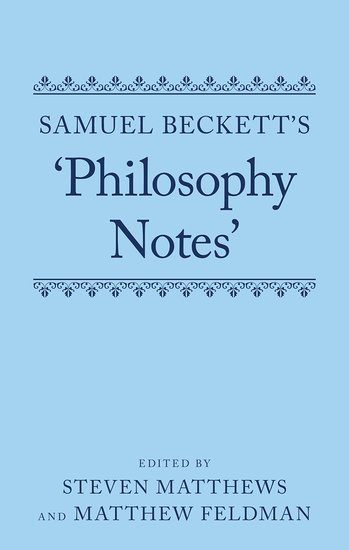
Samuel Beckett's 'Philosophy Notes' / Ed. by S. Matthews and M. Feldman with D. Addyman. Oxford: Oxford University Press, 2020
Throughout his life, Beckett insisted that he understood little of philosophical texts and did not consider himself competent enough to make any judgments about them. Nevertheless, allusions to philosophers, often very caustic, are found in his books, not only in early texts filled with various quotations, but also in later works, at first glance completely free of any references. Mark Nixon and Dirk Van Hulle's study of Samuel Beckett's Library reveals that the bookshelves in his Paris apartment contained many philosophical treatises, from heavily annotated works by Berkeley, Schopenhauer and Wittgenstein to the much less obvious volumes of Abelard, Spinoza and Derrida. “Notes on Philosophy” only partly confirms this emphasis. Thus, for example, despite Beckett's special interest in pre-Socratic philosophy, no less attention is paid to Plato and Aristotle, and the notes on the latter are almost an ideal introduction to his work. In turn, the scholastic record—as aptly described by editors Stephen Matthews and Matthew Feldman—suggests that “it is worth raising an eyebrow” when confronted with Beckett's claims to have only a superficial familiarity with the nominalist-realist debate.
But a few words need to be said about the context of creation and style of these notes. Those wishing to find Beckett's own philosophical studies here, or at least an original analysis of other people's concepts, will most likely be disappointed. Occasionally there are laconic remarks like the word "bullshit" to complement the super-detailed notes on Kant's ethical system, or the judgment that Christian philosophy underestimated the Romans and misinterpreted the Greeks, but for the most part we are treated to diligent notes on the history of philosophy. Apparently, having received a philological education, Beckett was irritated by the gaps in his knowledge regarding philosophical texts, and decided to fill the main gaps by devoting at least six years of his life to the study of key and peripheral schools of thought. At the same time, the main sources of these notes were not the treatises themselves, but books on the history of philosophy - for example, the works of the Hellenist John Burnet and the neo-Kantian Wilhelm Windelband. At first glance, multi-page extracts from well-known studies are an absolute overkill both for fans of Beckett’s work and for those interested in the history of philosophy. With boring scrupulousness, as if preparing for an exam that would decide his fate, Beckett writes down dates of his life, basic biographical information, classifications of schools and directions. However, these notes also have a less obvious feature: they demonstrate the role that philosophy played for Beckett in his writing, and partly explain the fact that his books were read closely by many philosophers, including Adorno, Deleuze and Badiou.
“Notes on Philosophy” allows you not only to look into Beckett’s “creative laboratory”, but also sometimes to learn something new about the nature of his writing. The fact is that he regularly - right up to the very last years of his life - turned to these notebooks when working on literary texts. And it is precisely this direct and indirect presence in books of images inspired by philosophers that sheds light on his reading preferences to a much greater extent than the number of pages devoted to a particular person in his diary notes. The editors' excellent comments allow us to trace, for example, how the image of millet grains from Zeno's aporia migrated to the novel Mercier and Camier, then to Malon Dies, and then to the plays Endgame and Happy Days. Imagery alluding to the teachings of Heraclitus appears in both the early stories and the later prose miniatures, and some of the entries about Parmenides seem to have been included, with minimal editing, in the novels The Nameless One or As It Is:
What follows from the statement that something exists ? Firstly, it could not have arisen. If it were to arise, it would have to arise from nothing or from something. But there is no nothing, and there is nothing except what is . And nothing but it can arise, because there is no emptiness in which this could happen. So is something there or not? If it exists , then it exists now, all at once. Ex ni hilo nihil fit .
Further, if it exists , it simply exists, no more, no less. There is as much of it in one place as in another. It is continuous and indivisible, for there is nothing other than itself that could divide it into parts. It is continuous and indivisible completeness.
Further, it is motionless. If it moved, it would have to move in the void, which is nothing, and there is no nothing. It is also finite and spherical, for it cannot be greater in one direction than in another, and a sphere is the only figure of which this can be said.
Another example: Leibniz's works were absent from the Paris library, but it is clear that his concept of the "windowlessness" of monads made a huge impression on Beckett - the image of hermetic, dark spaces would become one of the leitmotifs of his work. For example, in the novel Murphy, which Beckett was working on during the same period as Notes on Philosophy, the description of a patient’s room in a mental hospital contains a direct reference to Leibniz: “The room, like a monad, was without windows, except a peephole with a curtain in the door.” In later texts there will no longer be such obvious allusions, but the very image of the “horseless” will be repeated in the novel “Watt” and will not leave its texts. “There are no windows here,” the narrator of “Company” will announce, a story completed by 1980, that is, almost half a century after becoming acquainted with Leibniz’s concepts. These kinds of allusions can be listed almost endlessly - from direct references to Berkeley, Descartes or Geulinx to much less obvious, sometimes unconscious images inspired by Bacon, Augustine and Kant.
“Notes on Philosophy” ends at perhaps the most interesting point: detailed notes on Hegel and Schopenhauer are replaced by a paragraph on “The Birth of Tragedy from the Spirit of Music,” interrupted mid-sentence. The parallels between Beckett's aesthetics and Nietzsche's nihilism, suggested by many philologists, are reinforced in the Paris library only by a few dog-eared pages of The Gay Science. However, this, of course, does not prove anything. But it is known for sure that in the unpublished archives there is another diary of Beckett (from the period of work on the early mini-poem about Descartes), which, among other things, contains notes on Mauthner’s philosophy of language and Sartre’s phenomenology. Perhaps we'll wait for them too.