
Translated material
We have neural networks at home
During the war years, Russia fell far behind world leaders in the field of artificial intelligence.
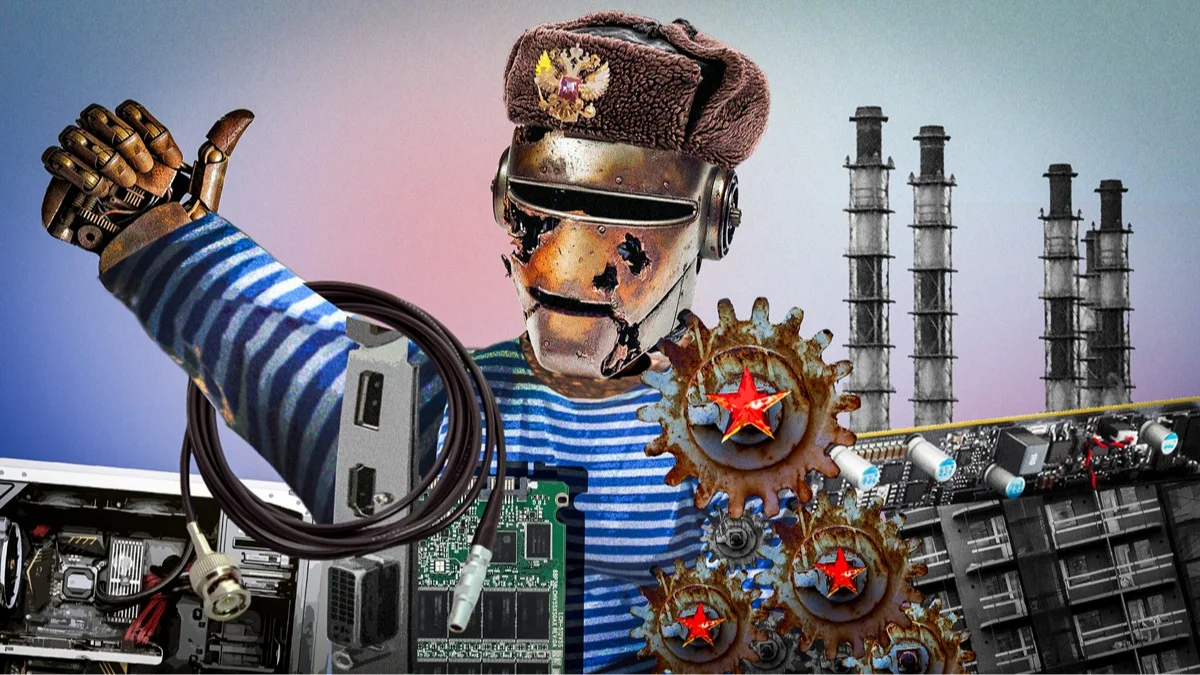
Illustration: “New Newspaper Europe”
Because of the war with Ukraine, Russia risks losing the main technological race of the century - the development of artificial intelligence. New Europe studied international ratings and independent data to understand how the Kremlin’s ambitions to become one of the world leaders in the development and implementation of AI compare with reality.
Vladimir Putin first articulated Russian ambitions in the field of artificial intelligence back in 2017, several years before the boom of large language models such as ChatGPT or Google Gemini. “Artificial intelligence is the future not only of Russia, it is the future of all humanity. <...> Whoever becomes the leader in this area will be the ruler of the world,” he said then.
From high tribunes the development of AI is spoken about exactly this way - not in economic terms, but as a guarantee of the “sovereignty, security and solvency” of the country.
In 2019, shortly after the release of the first GPT models from OpenAI, Russia adopted the National AI Development Strategy. The government planned to eliminate the gap with developed countries by 2030 and achieve global leadership in certain areas. But the war and subsequent isolation sharply limited international scientific cooperation, accelerated the outflow of talent and complicated access to components for computing infrastructure.
The Kremlin still declares its desire to make Russia one of the world leaders in AI and turn artificial intelligence into one of the drivers of economic growth by 2030. True, so far the successes have been modest. According to the three most cited international indices in the field of artificial intelligence, Russia lags far behind not only the United States and China, but also most of the G20 countries and even the BRICS countries.
By 2025, the slogan about “sovereign AI” is increasingly turning into a course towards cooperation with the BRICS, and above all, with China. At the end of 2024, the Russian Direct Investment Fund announced the creation of an “AI Development Alliance” with its partners as an alternative to Western dominance, and Putin instructed to build AI cooperation with Beijing, securing it as a key technology partner.
WHAT ARE THESE INDICES
In this text, we use three key international AI indices that rank countries on different aspects of artificial intelligence development and compare their positions in a global context.The Observer (ex-Tortoise) Global AI Index assesses a country's overall strength in the AI race: investment, infrastructure, talent, startups and business adoption. Covers 83 countries. Everything is important here at once, which is why the USA and China are leading by a wide margin, while countries without a developed venture market and big tech corporations find themselves behind. This is the only rating of the three in which Russia’s position has not fallen and has even increased slightly since 2021.
The Stanford AI Vibrancy Index reflects the vibrancy of national artificial intelligence ecosystems. The index measures the dynamics of artificial intelligence development across seven positions for 36 countries. The top three are the USA, China and India.
The Oxford Government AI Readiness Index measures the readiness of governments to use AI in public services and policies, assessing the strategy, infrastructure and technological readiness of 195 governments. The USA, Great Britain and France are in the lead, ahead of China and India.
In all three indexes that we studied - The Observer (ex-Tortoise) Global AI Index, Stanford AI Vibrancy Index , Oxford Government AI Readiness Index - the United States remains the undisputed leader, with China following closely behind. These two countries are setting the pace for the global AI race. They are followed by a noticeable margin by the UK, Singapore, India and the leading EU countries - France and Germany. Russia in this picture is consistently in the 30th position or below.
Based on data from international indices, we have identified key areas that have the greatest impact on the country’s success in the development of artificial intelligence. These areas include investment in research and training, access to computing resources and innovation infrastructure, market maturity and venture capital funding, and the willingness of government institutions to integrate AI into policy, regulation and public services.
What we thought
We relied on three key international indices that allow us to compare countries on various aspects of AI development. In each section, we used the latest values of the corresponding indices and their indicators available at the date of preparation of the text.
We took Stanford AI Vibrancy Index rankings from their interactive AI Vibrancy Tool using default weights. When specific index categories were considered, they were assigned weights of 100% and other index dimensions were ignored.
For the Oxford Government AI Readiness Index, we additionally recalculated the rankings for individual index categories using their published values: for each category, we ranked countries by scores and compared the resulting positions.
Large, language, domestic
Highly qualified developers are one of Russia’s strengths, judging by international AI indices. In the Stanford AI Vibrancy Index, the country ranks 18th in Research and Development, where research and development are combined, in Oxford AI - 31st in “development and implementation”, and only in The Observer Global AI Index - 39th in the Development section.
The activity of Russian developers in Open Source open source projects plays a significant role in these assessments. In 2024, according to the Stanford AI Index, they published almost 66 thousand AI-related projects on GitHub, which were given 211 thousand “stars” by other users. “Stars” are given on the platform when a project is bookmarked or the author is approved.
Russia remains in a narrow circle of countries where large companies are developing their own generative models, which can truly be considered a significant achievement in the field of AI and is highly valued in ratings.
However, the production of the best models is dominated by the USA and China by a wide margin, leaving Russia and all other countries far behind. According to the Stanford AI Index, the US will have developed 40 significant neural network models in 2024. For comparison, China released 15 such models, Europe - only three, Russia - none.
The best Russian generative models are still noticeably behind leading solutions, even for generating answers in Russian. In the ranking of the LLM Arena Ru platform, where Russian-speaking users evaluate the answers of neural networks, models from Russia rarely rise above the second ten. So, at the time of writing this article, the best Russian model, GigaChat Max 2, occupied 25th place.
Part of this gap is likely due to the fact that Russian models are particularly lagging in "deep" reasoning and multi-step inference
– the creators of GigaChat, in particular, spoke about this. They also note problems with transparency: insufficient openness of training data and the difficulty of independently verifying some results due to closed datasets.
In addition, a 2025 Ghent University study shows that the largest Russian models (GigaChat and YandexGPT) are among the world leaders in political self-censorship and are noticeably more likely to refuse “sensitive” political issues.
“Most solutions using generative artificial intelligence in Russia are built on the basis of foreign LLMs. This makes investments in AI solutions extremely risky, since at any moment our startups may be prohibited from using foreign agents, and all Russian solutions created with their help will become ineffective,” explained Anton Pronin, managing partner of Malina Ventures JSC. “And the use of domestic LLM models, for example, from Yandex or Sber, is only gaining momentum.”
Equally important, the widespread adoption of advanced neural networks in both everyday life and industry is seriously hampered by the fact that access to them is often only possible through a VPN or requires payment using foreign cards.
Patent activity in the field of AI is also declining: according to the Stanford AI Index, after the start of the war, the number of patents issued in this area in Russia fell by about three times
Science in isolation
Scientific activity is one of the important indicators of the development of the AI field. The Russian national strategy for the development of artificial intelligence continues to consider international publications as one of the indicators of success in the race. It aims to reach 450 publications from the world's leading AI conferences by 2030, four times more than in 2022 (113).
Despite certain successes in the development of products and models, Russia is doing worse with academic science in the field of AI. Russia ranks 18th in the Stanford AI Vibrancy Index in the Research and Development section (in this indicator, Stanford combines research and development) and 49th in The Observer Global AI Index for scientific research.
According to the AI Index from Stanford University, the total number of Russian publications in English related to artificial intelligence has dropped significantly since the start of the war. This is happening contrary to the global trend towards an increase in the number of such scientific works and is likely due to brain drain and the fact that it has become more difficult for Russian scientists to publish in international journals and participate in leading conferences.
The citation rate of scientific works by Russian scientists has decreased even more. If in 2022, according to Stanford, their publications were cited over 10 thousand times, then in 2024 - only 1.1 thousand. And this may also be due to the outflow of brains from Russia, and to the isolation into which Russian scientific centers have fallen.
Human capital
Estimates of the spread of AI skills and the availability of specialized specialists in Russia in different indices differ markedly. The Stanford AI Index ranks Russia 20th in the world, The Observer AI ranks 28th, and the Oxford AI Index in one of the subareas, “Human Capital,” ranks Russia 45th.
Such indices are usually based not on a direct “counting of specialists”, but on a set of indirect indicators: the number of graduates of specialized universities, the activity of developers on platforms like GitHub or StackOverflow, as well as immigration rates of specialists.
Part of the discrepancy in rankings is likely due to the specifics of data sources. For example, the Stanford AI Index, among other things, uses data from LinkedIn (blocked in Russia since 2016) and the Coursera platform, which actually stopped working in Russia in 2022, which may distort the picture.
The Russian talent pool in AI is based on a strong mathematical base and growing student interest in technological specialties. According to the Ministry of Digital Development, in 2023, almost every tenth university graduate had an IT specialty, and the popularity of such specialties continues to grow. In the same year, universities, according to a recent HSE study, accepted 20.7 thousand people into artificial intelligence programs—about 1.6% of all applicants. For a fast-growing new industry, this is a significant and growing share, showing that AI is becoming mainstream in higher education.
However, the AI industry in Russia still faces the problem of brain drain. In the first years after the outbreak of war, probably hundreds of thousands of IT specialists, researchers and scientists left due to mobilization, war, government pressure and restrictions that sanctions created. Since then, the outflow has slowed significantly, but experts believe that new waves of emigration are likely , including those caused by the deteriorating economic climate.
One of the most striking examples of recent years is the Nebius company. Once upon a time, it was the core of Yandex’s cloud technologies, which ended up in the Netherlands after the division of the company. About a thousand Yandex developers emigrated from Russia with the company. In 2025, after a series of large infrastructure deals, including withMicrosoft and Meta , Nebius's valuation reached $27 billion, exceeding the capitalization of Yandex itself and becoming a symbol of how key technologies and talent are leaving the country.
The lack of specialized specialists and the low prevalence of AI skills affect not only the research and development of advanced artificial intelligence models, but also the implementation of neural networks in company products and processes.
Thus, according to a survey by the Comindware 2025 industry forum, the lack of qualified specialists has become the most important barrier to the implementation of AI technologies. This reason was identified by 67% of Russian companies participating in the survey.
In 2025, human capital will become as scarce a resource as computing power. Experienced teams accelerate development, reduce the cost of experimentation, and bring models and products to market faster. Therefore, many corporations are willing to pay top researchers salaries of up to several hundred million dollars .
Shadow supercomputers
Russia ranks relatively low in estimates of the size of its computing infrastructure: 31st in Stanford AI, 32nd in The Observer Global AI and 41st in Oxford Government AI Readiness.
After the start of the war with Ukraine, the technological gap between Russia and world leaders in the field of infrastructure for training AI models began to grow even faster. So, if in 2022 seven Russian supercomputers - clusters for solving complex problems - were in the world top 500, now there are only five. Now the total power of Russian supercomputers included in the rating is 69 petaflops, which is approximately 100 times less than that of the leader of the rating - the United States, with a supercomputer power of about 6961 petaflops.
However, it is important to note that international ratings only record those capacities that are publicly announced. Now Russia imports modern components through gray schemes; such projects are often not advertised and therefore are not reflected in open lists like Top-500 . Accordingly, the country’s new computing infrastructure may remain “invisible” to world statistics. As a result, international ratings data on Russia's computing power may be underestimated.
In particular, the T-Invariant publication described the history of the creation of a new supercomputer at Moscow State University (assembled through purchases through Chinese intermediaries) with a stated power of 400 petaflops. Based on his characteristics, he could have taken leading positions in world rankings, but Moscow State University did not submit data about him to international lists.
However, gray imports cannot cover all of the country’s needs for infrastructure construction. According to The Wall Street Journal, based on UN data,
In 2024, imports of GPUs and other AI chips into Russia were 84% below pre-war levels, and 92% of shipments came from China and Hong Kong, increasing Russia's dependence on China for AI.
Thus, gray imports partially cover the needs of the industry, but such logistics do not scale well: supplies become more expensive and riskier. In addition, gray imports do not imply technical support from chip manufacturers, which is important when assembling supercomputers. As a result, it becomes more difficult for the Russian AI industry to compete with countries where there are no sanctions restrictions.
Before the start of the war and in its first years, a great future was predicted for the domestic production of processors, but by 2025 it was not possible to achieve any success in this area. In 2021, Baikal Electronics, for example, announced plans to increase the production of processors to 600 thousand by 2025. In fact, in 2026, only 100 thousand Russian processors are expected to be delivered , at least some of which are likely to be produced in Asian countries.
Attempts to localize individual operations within the country are limited by access to raw materials for the production of processors—crystals. Thus, a three-year experiment to create Baikal-M processors in the Kaliningrad region was stopped in November 2025 due to a shortage of components.
Against this background, the national AI development strategy looks unrealistically ambitious. According to the document, by 2030, Russia plans to increase the capacity of all supercomputers used for AI training by more than 13 times compared to 2022. This means that the country needs to quickly and significantly increase its fleet of modern accelerators and data center infrastructure, which is difficult to achieve under sanctions.
Rosgosintellect
The economic environment for the development of AI in Russia is rated low: in the Stanford AI Index, Russia ranks last, 36th, and in The Observer Global AI Index, 22nd. These estimates take into account the demand for AI talent, investment, business adoption of AI and its financial impact, and the size of the startup sector.
According to the Smart Ranking analytical report, in 2025 the Russian AI market could grow by 25–30% compared to the previous year and reach 1.9 trillion rubles (≈ $20.8 billion).
At the same time, according to analysts, almost all the profits from the monetization of AI (95%) are concentrated in the top 5 companies: Yandex, Sber, T-Technologies (the holding company of T-Bank), VKontakte and Kaspersky Lab, which indicates high centralization. All five companies on the list, except Kaspersky Lab, are associated either with the state or with people from Putin’s close circle.
Despite the sharp decline in foreign venture funding after 2022, investments in domestic AI startups continue. According to Russian Venture and the Malina VC fund, during the year from December 2024 to November 2025, 78 transactions were registered , while 27.8% of all funds were invested in AI projects - 2 billion rubles. However, startup investment in 2025 was down 10% from the previous year, and its overall scale remains far from the levels seen in the US or Chinese markets, where investment in AI startups is breaking records.
The structure of the AI ecosystem in Russia is still highly concentrated around large corporations, often with state participation. Companies such as Sberbank and Yandex remain the main drivers: they set the tone for the market, form the infrastructure, and finance research and implementation of AI solutions.
The independent startup sector is going through difficult times: in 2025, the volume of classic venture deals is approximately ten times lower than in pre-war 2021, so many projects are forced to refocus on government orders or close.
All this makes the AI ecosystem more closed, and development more “safe” in the bureaucratic sense. The priority is shifting towards predictable projects and customers, rather than risky product bets, which often provide technological breakthroughs and new markets.
***
An analysis of key international artificial intelligence indices shows that Russia today lags noticeably in AI development not only from the United States and China, but also from a significant part of the G20 countries, as well as from some of its BRICS partners.
This is in sharp contrast to the fact that until recently Russia was among the world leaders in digital services, from search to online banking. However, developing advanced artificial intelligence requires not only high-level engineering, but also science, hardware and startup funding.
Russia's official strategy and public statements continue to focus on quickly becoming one of the world leaders. But the goals set seem increasingly disconnected from the reality in which the industry is developing: limited access to computing resources, market isolation and leakage of key teams. The AI race is a struggle for control of the key infrastructure of the future economy, and losing it means long-term technological dependence: foreign models, foreign rules, weaker competitiveness and less influence on the global economy.
The idea of technological autonomy of AI in Russia is gradually giving way to a pragmatic model of external cooperation, where China is becoming a key partner. Without
war and isolation, the trajectory could be very different: more international connections, greater competition for talent, and greater access to technologies, without which the development of AI will slow down.
As is often the case in matters of import substitution, Russia is trying to compensate for the lag in quality by talking about “sovereign AI.” The authorities are promoting their own Code of Ethics for Artificial Intelligence and proposing to use it as an international model. AI is also seen as a tool for strengthening “traditional values.” For example, philosopher Alexander Dugin calls for the creation of “Russian artificial intelligence, which, without hesitation, will answer not only whose Crimea is, but also whose Kiev, whose Kharkov, whose Odessa, correctly, in Russian.” However, this is unlikely to allow Russia to strengthen its position in international rankings.