Five audiobooks worth listening to
“Gorky” and the Storytel service continue their joint column dedicated to the most interesting audiobooks. In today's episode - the witch refuses to kill, the economy refuses to work, Bunin returns to Capri with the Chinese, the young man tries to save Tsoi, and the detox leads to paranoia.
Alexander Dolgov. Save Tsoi. A novel where fiction and reality are intertwined. Bombora. Read by Andrey Finagin
 The not very smart and rather young main character learns the secret of time travel. Then he does what anyone would do in his place: he goes to Soviet Latvia in 1990 to prevent a car accident on the 35th kilometer of the Sloka-Talsi highway and save Viktor Tsoi from death. But not everything is so simple: instead of saving Tsoi, the hero kills Hitler. How did this happen? A camel has two humps, life is a struggle, and even if wishes are fulfilled, they are fulfilled in an extremely crooked way. Especially if your wishes are chaotic. I'm talking more about the novel. The famous music journalist Alexander Dolgov wanted to write a book about the death of Tsoi in a genre called “for the widest circle of readers,” and, apparently, to further expand the circle, he decided to combine it with fan fiction for the film “Back to the Future.” But the novel began to take on a life of its own, turning either into a fan fiction of “Inglorious Basterds” or, and this is the most surprising thing, into a fan fiction of “Shadows of the Teutons” by Alexei Ivanov. Okay, I’ve said enough, Dolgov’s book came out before Ivanov’s audio series, but the similarities are obvious. If the “Frankenstein of the Year” award were given for a book collected from the most dissimilar literary scraps, then “Saving Tsoi” would certainly receive it.
Listen on Storytel
Andrey Movchan, Alexey Mitrov. Damn economies. Audiobook. Read by Alexander Aravushkin
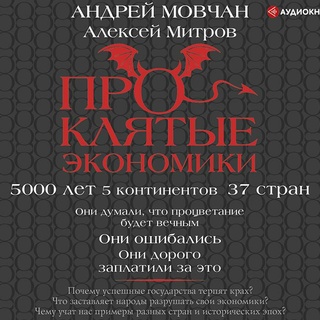 Lomonosov hoped “that the Russian land could give birth to its own Platos and quick-witted Newtons.” Economists Andrey Movchan and Alexey Mitrov have set themselves an equally ambitious task: to prove that Russian soil can give birth to its own Jared Diamonds, as well as Daron Ozhemoglu and James Robinsons. Diamond wrote the legendary books “Collapse” and “Guns, Germs, Steel” about why some civilizations lose while others win, and Ocemoglu and Robinson wrote a bestseller with the telling title “Why Some Countries Are Rich and Others Are Poor.” Movchan and Mitrov followed a similar path: they explain the success or failure (mostly failure) of countries and civilizations by the “resource curse.” Moreover, the resource can be very different - there is grain, slave trade, and, of course, oil, and access to cheap loans. As long as there is a lot of resource, civilization and the state prosper. Economics, politics, social and everyday life - everything is somehow connected with the resource and its abundance. When the resource runs out, collapse follows, and now where there were temples and colonnades, wormwood grows and feral local residents graze their goats. On the one hand, the scale of the plan is amazing: the authors crammed several dozen examples from all continents into the concept of the resource curse. On the other hand, some sloppiness is embarrassing: calling John the Landless “King John” is, of course, not as wild as calling John the Baptist John Baptist, but still somehow ugly. And because of resource determinism (transitioning into resource fanaticism), the authors do not even try to consider other reasons for the collapse of this or that power.
Listen on Storytel
Arno Strobel. Offline. Inspiration. Read by Alexander Aravushkin. Translation by R. Prokurov
 A group of wealthy Buratins arrive at a small hotel in the mountains. Pinocchio wants to indulge in a digital detox. At the hotel, they are deprived of their devices, disconnected from phones, tablets and computers. The nearest internet is many miles along a snow-covered serpentine road. The hotel has food, booze, obnoxious waitstaff and a walkie-talkie. Well, this is in case something goes wrong. And, you won't believe it, something really went wrong. Snow fell and the roads were snowy, the walkie-talkie was broken, and one of the rich Pinocchio was mutilated by someone: he was stunned, blinded and paralyzed in a savage way. The rest begin to panic, suspect each other, play Sherlock Holmes, drink and suspect the unpleasant service staff in everything. So what next? And then it turns out to be a German imitation of an English chamber detective with a slight criticism of the social system: here the rich strive to offend and blame all the blame on the poor.
Listen on Storytel
Kevin Kwan. Sex and vanity. ABC-Atticus. Read by Alla Chovzhik. Translation by N. Vlasova
 Rich but modest Lucy, a rich Chinese mother and an equally rich American father, comes to Capri. There is a friend’s wedding: Chinese billions will unite with the European aristocracy, the heiress of a huge fortune will marry a descendant of counts and dukes. On the island, Lucy meets HIM. He's Chinese, he's rich, he's good-looking, but he has a nasty mother. Somewhere on the horizon, Bunin and the gentleman from San Francisco are invisibly present; they are not mentioned anywhere, but are quoted almost verbatim. Kevin Kwan became famous for his trilogy of Crazy Rich Asians , Crazy Rich Chinese Girl and Crazy Rich Asian Problems. This is such a vigorous mixture of “Sex and the City,” a guide to Asian cities, a fairy tale about Cinderella and a letter from the Cossacks to the Turkish Sultan. In the role of the Cossacks - Asia raising its head, in the role of the Turkish Sultan - Europe and America, losing power and significance. It's both fun and a little disturbing to read at the same time.
Listen on Storytel
Darina Frain. I kill people beautifully. Samizdat. Read by Darina Frain
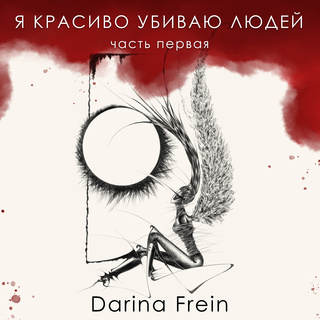 Let's start with the fact that Storytel has a platform for self-publishing - Storytel Hub . With it, anyone can publish their audiobook, and it will be available to all Storytel users. Some strange but interesting novels that were reviewed in this section came to the service through the hub - for example, the adventures of a deputy cat or a novel about the Arkhangelsk garbage crisis . The book “I Kill People Beautifully” is in the same category. So, the main character and narrator begins her story with a knight's move: let's imagine that I lived my life differently, and even differently. It would seem: who cares about the heroine and her life? A little googling shows that Darina Frain is a somewhat famous and even odious person, related to the “Battle of Psychics,” and pages glorifying her magical abilities are adjacent to sites where she is denounced as a “fake sorceress.” Yes, there are special areas on the Internet where some magicians expose others. But this is all some preface. Now to the plot: the heroine is a magical killer. Or rather, “master of black water.” She keeps herself in the “hedgehog grip of a regime of increased spirituality”, every year she wishes for the same thing - “to gain real immortality”, and makes a living by using magic and for a lot of money to kill some people at the request of others. And now she receives another order, but cannot fulfill it, because the potential victim is handsome, generous and knows how to please the girl (give her an iPhone and give her a ride in a beautiful car). To some extent, this is a fairly conventional thriller about a hitman who cannot carry out an order, only instead of sniper rifles there are astral-type weapons. The inner world of people who either sincerely believe in the supernatural or are trying to convince the reader of this is extremely curious and awaits its researchers.
Listen on Storytel
