
Translated material
Russian warship
100 years ago the film “Battleship Potemkin” was released: a classic of world cinema, filmed under a direct propaganda government order
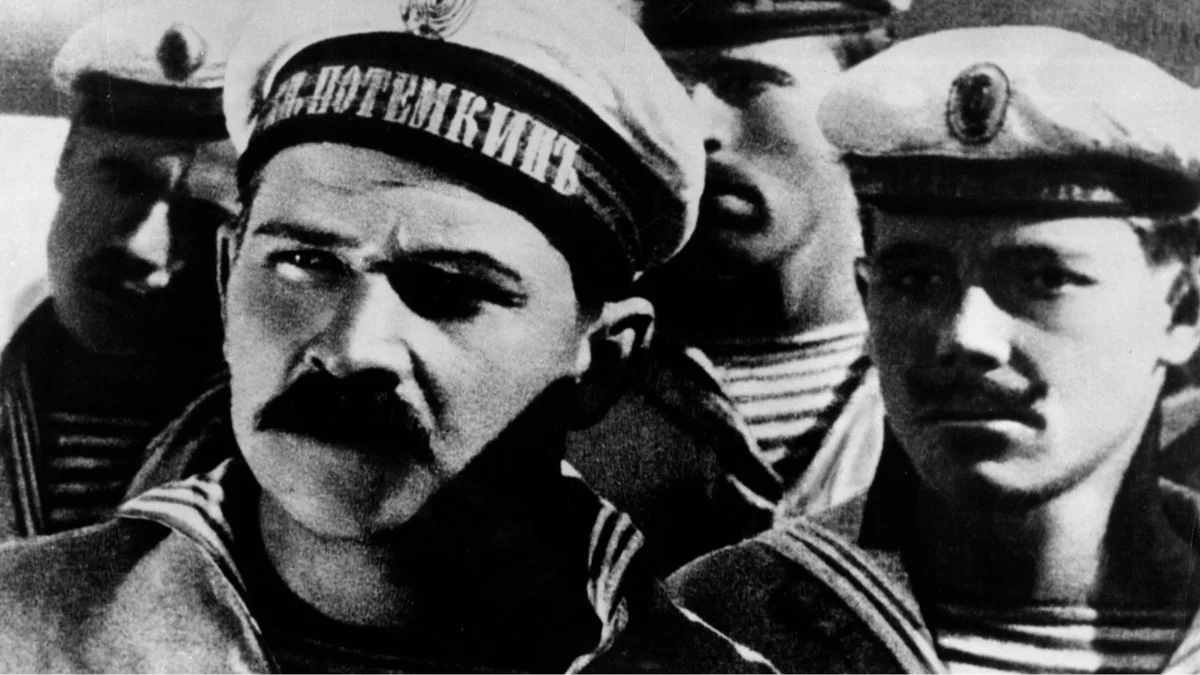
Photo: Goskino / Kobal / Shutterstock / Rex Features / Vida Press
Today, December 21, marks exactly one hundred years since the premiere of “Battleship Potemkin” at a gala meeting at the Bolshoi Theater dedicated to the anniversary of the 1905 revolution. Sergei Eisenstein's film, which has become a classic of world cinema, has absorbed all the contradictions of the era: on the one hand, an undoubted screen masterpiece, on the other, a clear example of Soviet propaganda.
Let's try to understand the nature of the phenomenon of this film - which clearly surpassed the tasks set by the party for its director, and remains surprisingly relevant today.
Talking about “Battleship Potemkin” now is not an easy task: after all, too much has changed in 100 years. For some, this is already a pure archive, nothing more than a historical artifact. But at the same time, as we will see later, Potemkin continues to remain topical both artistically and politically.
It is curious that Eisenstein’s film was perhaps the first “Danish” (as later in the USSR they began to call works created on official dates). Stalin had just taken over the levers of governing the country and, in order to further enhance his authority, among other things, decided to organize a particularly magnificent celebration of some revolutionary anniversary. Of the round dates, only the 1905 revolution was at hand. The anniversary commission of the All-Russian Central Executive Committee took the lead, ordering the filming of an entire epic: to squeeze into one film the disastrous Russo-Japanese War, the massacre of Armenians in Baku and Nakhichevan, “Bloody Sunday” in St. Petersburg, and the December uprising in Moscow. Filming was entrusted to the young Sergei Eisenstein, whose name was well known after the success of his directorial debut “Strike” (April 1925). Eisenstein managed to film several scenes in Leningrad. However, it quickly became clear that the filming and editing would not be completed on time—and the film should have been delivered in December, despite the fact that the script was only approved on June 4. Therefore, the director focused on one episode - the uprising on the battleship Prince Potemkin-Tavrichesky, which took place from June 14 to June 25, 1905. Filmed in Odessa, at one of the most powerful film factories in the USSR. It is curious that the legendary ship, on Lenin’s orders, was already in the process of being dismantled for scrap - the Bolsheviks remembered too well that the mutinous sailors in 1905 remained indifferent to their agitation. Therefore, the battleship “Twelve Apostles” and the cruiser “Comintern” were used as locations.
Eisenstein reduced the outline of events to three days, focusing on a few key episodes: a revolt of sailors over wormy meat, the murder of the uprising leader Vakulenchuk, farewell to the deceased on the shore, which grew into unrest, execution on the Odessa stairs, the confrontation between the battleship and the admiralty squadron.
Of course, the film is an example of Soviet propaganda. Right from the epigraph - first a quote from Trotsky, later replaced by a quote from Lenin about the revolution as the only just war.
The future leaders of the rebellion, Vakulenchuk and Matyushenko, even in the prologue, pick up the leader’s thought and talk about workers’ solidarity. All the sailors have simple, good faces; the officers have the faces of thoroughbred scoundrels; the ship's priest is a pure caricature. In the execution scene on the stairs, the soldiers literally trample on corpses. The scene itself never took place in reality; Eisenstein invented it all from the first to the last frame (and this is far from his only “exaggeration”). The meeting of "Potemkin" with the squadron rings with pathos. The further, by no means heroic, fate of the battleship and its crew remained behind the scenes.
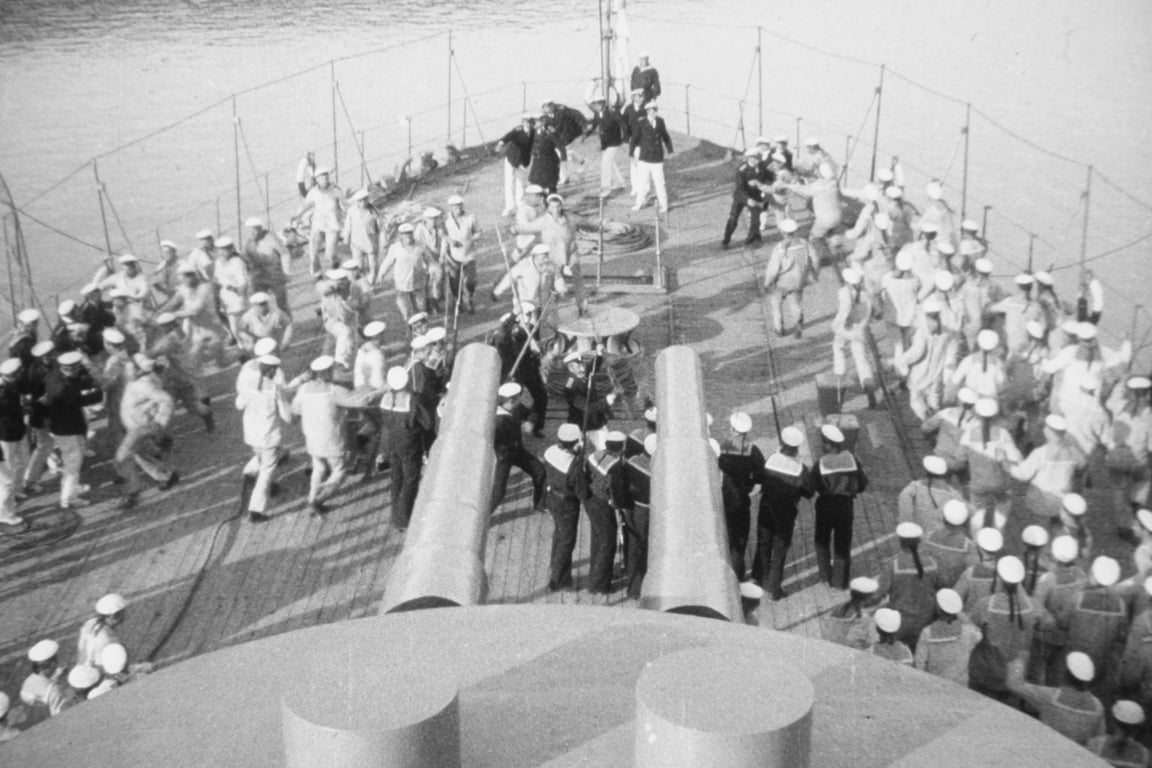
And yet, this film, full of distortions, caricatures and pathos, went down in history. “Battleship Potemkin” regularly appears on lists of the best films; it is used to teach directing in all universities around the world. The reason is that Eisenstein essentially made two films in one.
The entire narrative is divided into 5 sections, indicated by numbers, like chapters in a story, but the climax is reached in the fourth, most famous, constantly quoted part, “The Odessa Stairs”.
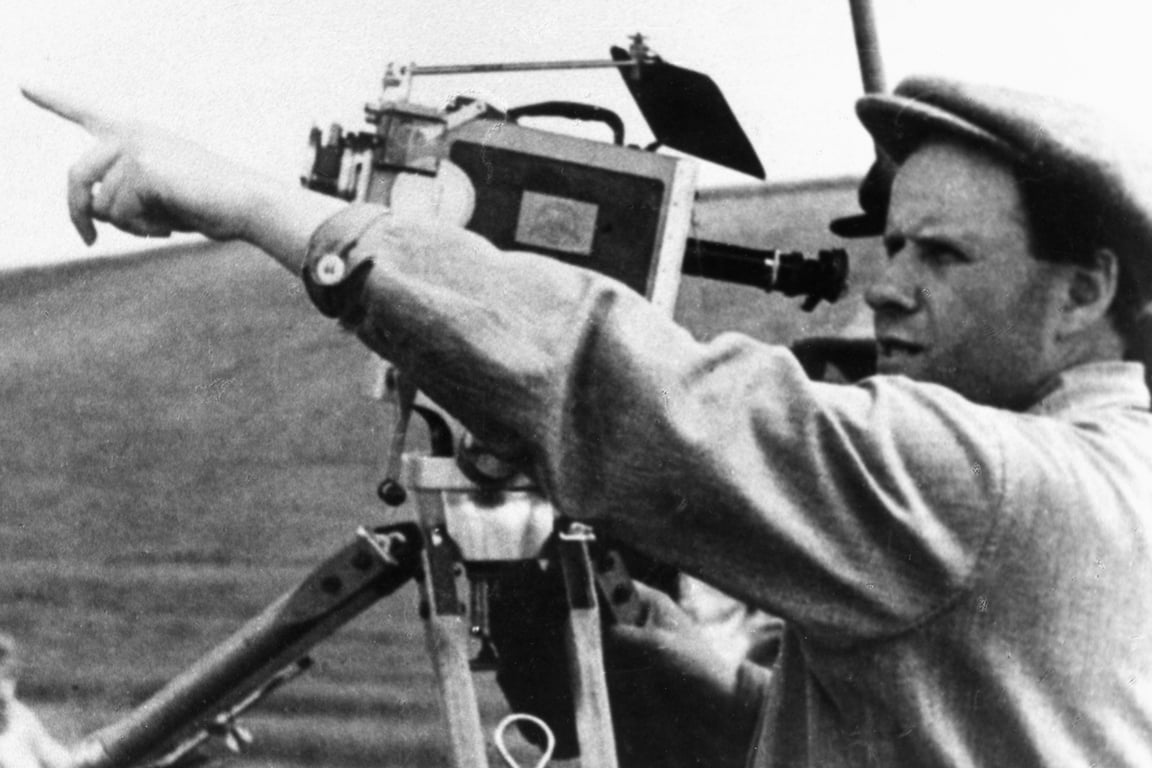
To film a massacre scene, Eisenstein (re)invented cinema in the literal sense of the word. For example, together with cinematographer Edouard Tisse, he designed a dolly large enough to accommodate the camera and cameraman. Wooden rails were built parallel to the Odessa Stairs, so that Tisse could go down with the actors. Another camera was attached to the waist of a circus acrobat, who was running, jumping and falling - this created a feeling of chaos in the scene.
It is not without reason that Eisenstein (along with his transatlantic contemporary David Griffith, also the author of the highly controversial The Birth of a Nation, which is still perceived as racist propaganda) has brought about a real revolution in editing. And this is most noticeable in “The Staircase”.
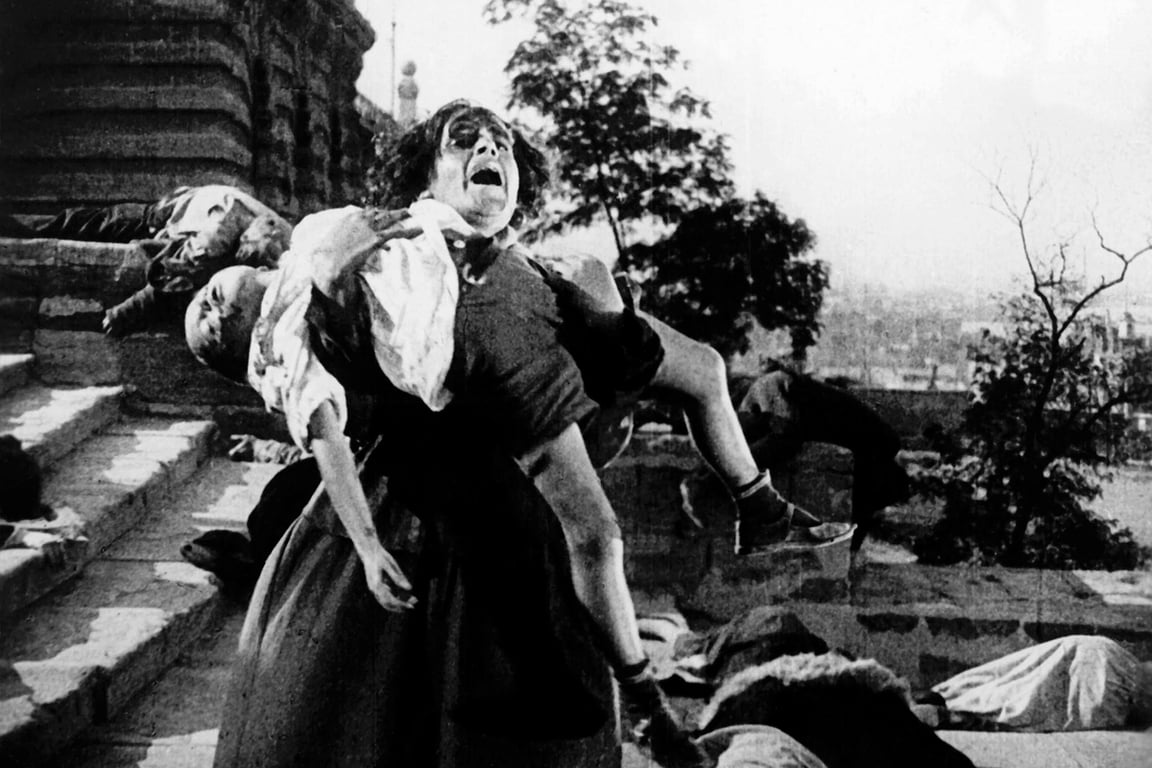
You can go down the Odessa steps in a couple of minutes, but Eisenstein stretched out the massacre for 7 minutes. Masterfully directing a crowded crowd, he captures the individual faces of the victims, which are instantly remembered, and at the same time deprives the line of advancing soldiers of any signs of personality, showing them only from the back or in a long shot in profile, a kind of multi-legged monster bristling with guns. A row of bayonets advancing from top to bottom is a perfect metaphor for the ruthless advancing power. A stroller with a baby rushing down is probably the best symbol of bloody madness. At the same time, Eisenstein constantly returns to the same images - an old man in a light raincoat, unsuccessfully raising a dead man from the ground, a helpless woman in glasses, who in a few moments will be hacked to death by a Cossack, a young mother falling from a shot - bringing all the horror and tension to a physically unbearable limit.
It is worth mentioning separately what is called “intellectual montage,” which Eisenstein began to use by analogy with the way completely different symbols are combined in Chinese characters, giving rise to a new concept. As the carriage rolls down the steps, this deadly trajectory is interrupted by close-ups of two faces - a student and an older woman; both are wearing glasses - four round pieces of glass as a rhyme to the four fragile wheels of the stroller - but this motif is unleashed not by the fall of the stroller, but by the rotation of the Potemkin's gun turret and the muzzle of the cannon (two more circles), aiming at the hall - but in fact at the headquarters of the generals who gave the order for the massacre. At the same time, we see the shot itself indirectly: through a series of frames with statues of lions near the Vorontsov Palace in Crimea, second shots - a lion sleeping, waking up and rising to its feet - are connected into a sequence that actually conveys the power of the shot, which even raised the statue to its feet.
There are similar rhymes, parallels, and allusions in other scenes, but it is the fourth part that is the standard of editing skill, clearly demonstrating the quintessence of cinema as such, this magic of time manipulation. Therefore, of course, Potemkin influenced and will influence more and more generations of directors. The Odessa Steps have been quoted in various forms by Alfred Hitchcock (Foreign Correspondent, 1940), Akira Kurosawa (The Hidden Fortress, 1958), David Lean (Doctor Zhivago, 1965), Woody Allen (Bananas, 1971, Love and Death, 1975), Francis Ford Coppola (The Godfather, 1972), Terry Gilliam (“Brazil”, 1985), Brian De Palma (“Intouchables”, 1987), Juliusz Machulski (“Déjà Vu”, 1988), Quentin Tarantino (“Inglourious Basterds”, 2009), Guillermo del Toro (“The Shape of Water”, 2017) - these are just the most famous names.
And here we return again to the extent to which the author’s talent breaks the ideological scheme, even quite sincerely shared by this author (and Eisenstein admitted that it was the Bolshevik Revolution that made him a director and discovered his gift).
The entire episode on the stairs stands out not only for its formal perfection, but also for its isolation from the general revolutionary onslaught. There are no caricatured oppressors, no thunder of class struggle, no heroes bronzed in their lifetime. And there are only peaceful citizens, women, old people and children, trampled underfoot by their own state, crushed by the repressive machine. And this is not just relevant, but frighteningly relevant. That’s why, among all the quotes and homages, today I remember the video by Lyapis Trubetskoy “Battleship (You have nothing to do with it?)” (2012), in which the advancing line of Eisenstein’s soldiers is consistently edited with footage of riot police dispersing a peaceful protest in Moscow.
So far, batons and rubber bullets are being used. But soon the bullets will become lead. And there was already a very specific parallel with 1905: the Prigozhinsky rebellion in Rostov itself was greeted quite kindly by the locals. The first attempt, seemingly for a completely different reason, but similar in the key moment of presenting an account to the authorities - and, it seems, far from the last.
The war, which is clearly not winnable for Russia (as with Japan in 1904), is already underway. What will become the notorious “rotten meat” this time, who will find himself in the role of the new Vakulenchuk, how many battleships (tanks, guns - further on the list) will deploy their guns on their own command, how many and where protests will be drowned in blood until everything is in flames - the questions are far from hypothetical, and the horizon of these events is approaching at colossal speed. There is a certain irony in the fact that the centenary of Potemkin fell at the end of 2025 - according to forecasts, the last year when Russia could still fight without feeling systemic problems within itself.
Those who forget the lessons of history are doomed to repeat them. Eisenstein's film in this sense is a very visible, very loud warning.
Which, however, they prefer not to hear.