
Translated material
Shelter of fellow travelers
About Robert Maguire's book “Red News. Soviet literature in the 1920s."
Soviet literature of the 1920s was and remains in the focus of reader attention for many years, although it fell out of it for a long time for political reasons: when its careful rehabilitation began during the thaw, Western Slavists began to increasingly turn to the writers of those years, one of whom, Robert Maguire, published a book in the memorable year 1968 dedicated to the history of Krasnaya Novy, the first post-revolutionary thick magazine. It appeared in Russian only in 2004, but to this day it has not lost its relevance. Konstantin Mitroshenkov talks about how it can be useful to the modern reader.
All of us, since February 24, 2022, have found ourselves in the face of advancing barbarity, violence and lies. In this situation, it is extremely important to preserve at least the remnants of culture and support the values of humanism - including for the sake of the future of Russia. Therefore, the editors of Gorky will continue to talk about books, reminding our readers that there is still a place for thought and fiction in the world.
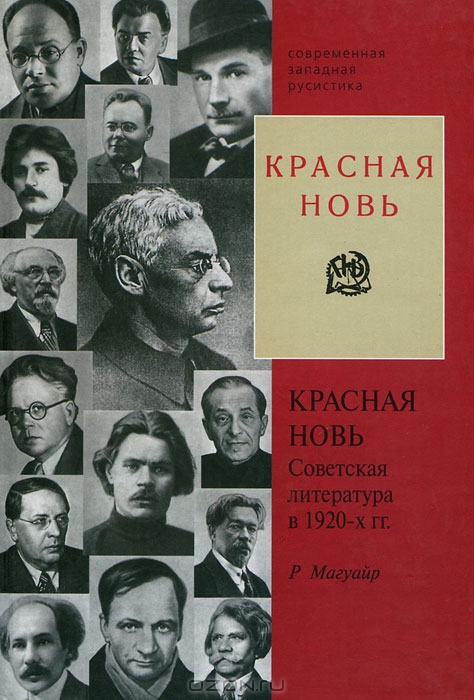
Robert Maguire. Red new. Soviet literature in the 1920s. St. Petersburg: Academic project, 2004
Nevertheless, the experienced Bolshevik Alexander Voronsky managed to convince Lenin, Krupskaya and the party’s Politburo of the need for a publication that, along with works of art, would publish scientific articles and journalism, thereby reviving the traditional thick magazine format for Russian intellectual life. The first issue of Krasnaya Novy was published in June 1921. Everything, from the circulation (150 thousand copies) to the wide thematic coverage (literature, history, political economy and even the exact sciences), testified to the seriousness of the undertaking. In subsequent years, Krasnaya Nov became one of the leading Soviet literary magazines and found itself at the center of discussions about what literature should be like in the post-revolutionary era.
Published in 1968, American Slavist Robert Maguire's book Krasnaya Nov' is an attempt to write a history of Soviet literature of the 1920s, centering on Alexander Voronsky and the magazine he headed. The Russian translation of “Krasnaya Novy” was published in 2004 by the Academic Project publishing house, which in those years actively published belated translations of the works of Western Slavists. Despite some inaccuracies and limitations of the method, Maguire’s book remains one of the most important studies on its topic today.
By the mid-1960s, the literary life of the post-revolutionary decade was still rather poorly understood. Many writers and critics of the 1920s became victims of Stalin's terror, which made republication and open discussion of their works in the USSR impossible for many years. During the thaw, the process of rehabilitation and “returning names” began, but it proceeded slowly. In the West, literary scholars were mainly concerned with Russian formalism and "proletarian" associations , while other important subjects - for example, "traveling" literature and the history of literary magazines - were still waiting for their researchers.
Maguire did not have the opportunity to work with the Krasnaya Novy archive : in Moscow he was told that all documents related to the magazine “were lost in the war.” Therefore, the research is based exclusively on published materials: books by Soviet authors of the 1920s, articles by critics, and correspondence between Voronsky and Gorky, published in the USSR shortly before. However, the lack of access to archival materials did not prevent Maguire from creating a complete picture of the literary process of the 1920s, which, as the author himself reports in the preface to the Russian translation of the book, is generally confirmed by studies written after the opening of the archives.
In the preface, Maguire notes that he is interested not just in the criticism, prose and poetry published in Krasnaya Novy, but in the format of the thick magazine itself and Voronsky’s reinterpretation of it. The researcher describes in detail the history of the Russian thick magazine, which flourished in the middle and second half of the 19th century, when such publications as Sovremennik (1836–1866), Otechestvennye zapiski (1839–1884) and Russian Vestnik (1856–1906) were published. Maguire identifies several distinctive features of the thick magazine: the preference given to prose over poetry; presence of a strong critical section; a well-thought-out ideological line; wide coverage of topics from literature to science and politics. By the beginning of the 20th century, thick magazines fell into decline, unable to withstand competition with symbolist publications and newspapers; The revolution of 1917 finally finished them off. Therefore, the decision of the party leadership to revive this format in the early 1920s was, to put it mildly, unexpected. Maguire believes that the reason for this was both the Bolsheviks’ nostalgia for the golden age of Russian realism, which coincided with the period of thick magazines, and the desire to compensate for the lack of “ideological consistency” of the works of new literature by placing articles by party leaders next to them.
Be that as it may, the party hoped that “Red Nov” would become an important instrument of cultural policy. By the beginning of the 1920s, the authorities were concerned about attracting non-party writers and fellow travelers to their side, who, not having the opportunity to publish in their homeland, could well end up among the authors of emigrant magazines. Now a publication appeared in the USSR, which, on the one hand, was ready to pay generous fees for those times (Vsevolod Ivanov recalled that “Voronsky brought a briefcase tightly stuffed with money from Moscow to Petrograd; he did not hide the fact that he wanted to buy young writers”), and on the other hand, did not require a “proletarian worldview” from the authors. At least partly, the magazine coped with its task - almost all notable fellow travelers were published in it, including Boris Pilnyak, Isaac Babel, Alexei Tolstoy, Vsevolod Ivanov and Leonid Leonov.
Voronsky, who was entrusted with such a responsible task, had some experience in magazine work, but could not boast of a serious literary education. In his first critical articles for Krasnaya Novy, he assessed the works of modern authors by how accurately they reflected reality, and repeated standard arguments for that time about the determining role of ideology in artistic creativity. However, Voronsky was condescending towards his fellow travelers who were not entirely politically literate, assuring that they would soon master the ABCs of Marxism. At that time he did not propose any theory of literature of his own.
But everything changed in 1923, when Krasnaya Novy had serious competitors - the magazines LEF and On Post. Abstract statements of commitment to Marxism were no longer enough to justify a literary program, because rivals also positioned themselves as Marxists. Circumstances prompted Voronsky to more clearly formulate his aesthetic views, the expression of which became the formula “art as knowledge of life.” As the editor of Krasnaya Novy pointed out, art (he uses this very word, although he is primarily interested in literature) is similar to science in that its task is to understand the “surrounding reality.” But if scientific knowledge occurs with the help of concepts, then art operates with images. Maguire points out that Voronsky's argument for the cognitive role of art actually weakened his position. After all, if art performs the same function as science, then it turns out that novels and poems can be replaced by scientific articles and statistics, as the Lefovites proposed. Voronsky never resolved this contradiction in his aesthetic theory, later focusing on the problem of creativity and the question of what role intuition plays in it.
From the mid-1920s, Voronsky began to develop the idea that the creative process is inherently intuitive, and its results are not amenable to “logical verification.” According to the editor of Krasnaya Novy, the writer’s task is to remain faithful to his inner sense of the world; if he approaches creativity rationally and tries to write on a given topic (in the terms of those years - “fulfill a social order”), then the result will be a weak and hacky work. On this basis, Voronsky preferred Mayakovsky's lyrical poetry, finding his propaganda poems false. In formulating his theory, Voronsky actually defended the right of fellow travelers to relative creative independence, while simultaneously striking a blow at the Lefovites and Napostovites, who, from his point of view, approached writing work too rationally.
Maguire pays no less attention to the writers published in Krasnaya Novya than to the aesthetic theory of Voronsky. He devotes a separate chapter to Pilnyak and Vsevolod Ivanov, two major stars of Soviet literature in the early 1920s, and also analyzes in detail the works of Isaac Babel and Leonid Leonov. The book also mentions now firmly forgotten authors like Alexander Arosev and Georgy Nikiforov . Maguire proceeds from the fact that the works published in Krasnaya Nova in one way or another reflected Voronsky’s literary program, especially if we are talking about the mid-1920s, when he had already formulated his aesthetic theory in general terms. This initial premise seems far from indisputable. Compared to other magazines of the 1920s, Krasnaya Nov stood out for its pluralism - it published both fellow travelers and Lefovites (Mayakovsky, Nikolai Aseev) and proletarian writers (Fedor Gladkov). Voronsky, of course, had his own idea of beauty, but when selecting works, he, apparently, was primarily guided by their quality, and not by compliance with his own literary program. All of the above authors also collaborated with other magazines, including those hostile to Voronsky - such as Babel, who published several stories from Cavalry in LEF. In the example of Babel, the most noticeable limitation of Maguire’s approach, building the history of Soviet literature of the 1920s around the “Red Nova”: cavalry stories, working with the idea of documentary, can just as well be considered in the context of Lef’s factual program.
If “Krasnaya Nov” created any special literary school, then it was the “Pereval” group, which formed around the magazine at the end of 1923. Initially, its members included only writers and poets, but over time critics also joined them. Among them were Abram Lezhnev and Dmitry Gorbov, who became prominent participants in the literary process of the 1920s. Perevalsky critics relied on Voronsky’s idea about the intuitive nature of artistic creativity, highlighting the problem of “sincerity” in art. Lezhnev argued that an insincere work is devoid of artistic value, since it “does not reflect any reality” and cannot teach readers anything. (The idea that the purpose of art was to understand life was an axiom for the Perevalians.) The Perevalians oriented themselves towards a realistic novel with a plot, well-drawn characters and an explicit morality - a model rejected by many writers and critics of the 1920s, who talked about the “end of the novel . ” Therefore, the Pereval residents preferred literature of the 19th century, looking with disapproval at the formal experiments of their contemporaries. In the orientation towards tradition, Maguire rightly sees the similarity of perevalism with the socialist realist doctrine, which called on writers to “learn from the classics.”
According to Maguire, it was in the mid-1920s, when Voronsky and the Perevalians formulated their views on literature, that Krasnaya Nov turned into a real thick magazine with its own program and ideology. However, writes Maguire, the “thick magazine” period did not last long - over the years, Krasnaya Nov began to pay less and less attention to non-literary sections and lost its former thematic scope, which the researcher considers one of the distinctive features of the thick magazine. It is difficult to agree with this statement: if you compare the contents of the magazine for 1925 and 1927 , it becomes clear that the ratio of literary and non-literary sections did not fundamentally change during this time.
Be that as it may, 1927 really became a turning point in the history of Krasnaya Novy. Voronsky, who had previously successfully fought off attacks from Lefovites and Napostovites for several years, was removed from the editorial board of the magazine in October. Apparently, his fall was associated with the defeat in the internal party struggle of Trotsky, whom some researchers call the patron of the editor of Krasnaya Novy. After Voronsky left, the magazine found itself in the hands of much less competent people and began to quickly lose ground. In the 1930s, Krasnaya Nov' was still a prestigious publication, but no longer played such an important role in the literary process.
Despite the fact that Voronsky was declared a “Trotskyist” and repressed during the years of Stalin’s terror, many provisions of the literary program of “Krasnaya Novy”—orientation to the novel form, neoclassicism, emphasis on the educational role of art—were included in socialist realism. “Essentially, socialist realism attempted to unite two very different views on the nature of art—one the ‘politically active’ one represented by LEF and October, the other the ‘contemplative’ one represented successively by Red Nova,” Maguire writes in the preface. Thirty years later, a similar idea in a more detailed form will be expressed by Evgeniy Dobrenko in the book “The Formation of a Soviet Writer ,” which considers socialist realism as a synthetic culture that arose as a result of the “mutagenesis” of revolutionary theories of the 1920s.
Speaking of “Trotskyism”. With the exception of an epilogue in which Maguire recounts the fall of Voronsky, Trotsky is mentioned only a few times in the book, and his influential essay Literature and Revolution (1923) is not analyzed at all. Probably the reason is Maguire’s desire to overcome the cliché about Voronsky’s “Trotskyism” imposed by Stalin’s officialdom and consider him as an independent figure. This is another imprint of the times that the book bears: today it is difficult to imagine a serious conversation about the literature of the 1920s without discussing Trotsky and his proposed classification of post-October literature.
It was no coincidence that in the 1960s Maguire took up the history of Krasnaya Novy, and not any other magazine of those times. With the onset of the Thaw, the concept of “sincerity,” which occupied such an important place in the vocabulary of the Perevalians, re-entered Soviet critical discourse, and the program of Voronsky and his like-minded people began to be considered by liberal-minded intelligentsia and some Western Slavists as a real alternative to socialist realism. “In the search for a new aesthetic... the ideas and ideals launched in the twenties by Red News magazine may well live and operate in the liberating spirit that their creators hoped for,” Maguire reasoned in the epilogue. By an evil irony of history, his book was published in 1968, when the entry of Soviet troops into Czechoslovakia finally buried hopes for liberalization in both the political and cultural spheres.
However, Maguire's book can hardly be called untimely. Soon after its publication, a real boom in research into Soviet culture of the 1920s and 1930s began. The works of Sheila Fitzpatrick, Katerina Clark , and a little later by Vladimir Paperny, Boris Groys and Evgeny Dobrenko created a language for talking about this period, which we still use today. Since the 1970s, scholars have proposed a variety of conceptual models to explain the transition from the pluralism of the post-revolutionary decade to the normative aesthetics of mature Stalinism. “Red news. Soviet literature in the 1920s." does not pretend to large-scale theoretical generalizations and therefore is somewhat lost against the background of studies published in subsequent decades. But it offers a careful analysis of the material, which conceptually loaded works of a later period cannot always boast of. Therefore, even today, more than fifty years after its first publication, Maguire's book can serve as an excellent introduction to the history of Krasnaya Novy and all Soviet literature of the 1920s.