
Translated material
Second siege of Telegram
The court blocked the messenger back in 2018, but it continued to work in Russia. Will Durov's project survive again?
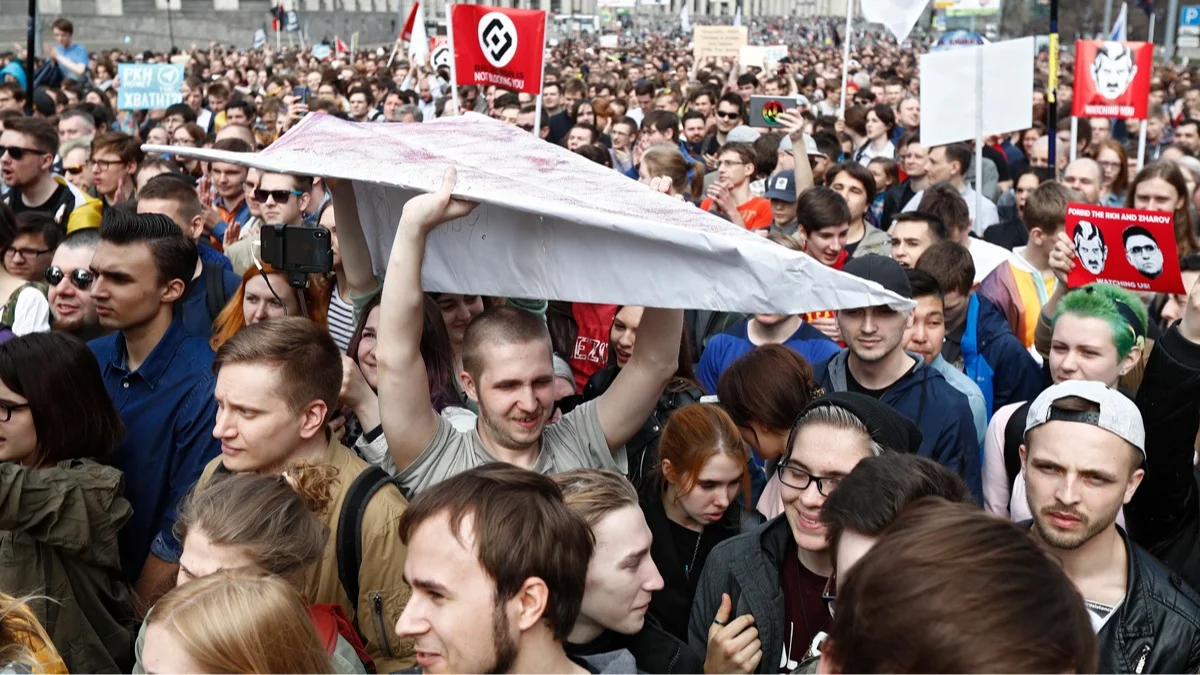
Participants in a rally for free Internet and in support of the Telegram messenger in Moscow, April 30, 2018. Photo: Sergey Ilnitsky / EPA
In 2018, the Russian authorities tried to block Telegram, but Roskomnadzor’s actions ended in failure. The messenger continued to work, despite millions of IP addresses unavailable in Russia and massive problems in the operation of other services. In response, the state built a new model of digital censorship: through the law on the “sovereign Internet” and the introduction of deep traffic filtering equipment (DPI). At the same time, human rights activists began to suspect Telegram of collaborating with the Russian authorities. The new blocking of the messenger, which over the years has become the main means of communication for Russians, forced propaganda to remember that the court decision to ban access to Telegram has never been canceled. “New Europe” recalls the history of the confrontation between censors and Pavel Durov and asks the expert: will blocking in the conditions of a “sovereign Internet” be more effective?
How RKN tried to block Telegram
The confrontation between Roskomnadzor and Telegram began after the adoption of the “Yarovaya package” in 2016. It includes two laws, one of which obliges messengers to register in the RKN register of information distributors from July 20, 2016. In addition, they must identify the identities of their users, transfer encryption keys to the FSB, and store user messages in Russia. If these requirements are not met, services should be blocked in Russia. Telegram founder Pavel Durov refused to comply with the new demands. He emphasized that “Telegram does not share data or encryption keys with third parties, including governments,” and “laws adopted in individual countries will not affect this policy.”
In the summer of 2017, Roskomnadzor sent Pavel Durov an open letter threatening to block the messenger. A few days later, the head of the department, Alexander Zharov, warned that the number of days until blocking was counting. Durov himself explained that registration data about the Telegram publishing company is available in open sources and, “if the regulator’s desires are really limited to this, I have no objection to using this data to register Telegram Messenger LLP in the register of information dissemination organizers.” At the same time, he once again emphasized that he would not implement the “unconstitutional and technically unrealizable” Yarovaya Law. As a result, RKN temporarily abandoned the idea of blocking the messenger.
In the fall of 2017, a Russian court fined Telegram 800 thousand rubles for refusing to hand over the keys to user correspondence to the FSB. The messenger’s management itself has repeatedly explained that fulfilling the FSB’s requirements is technically impossible. In particular, in secret chats with end-to-end encryption, keys are created and remain only on users’ devices, without being transferred to Telegram servers. Therefore, the FSB requirements actually mean the need to intervene in the very mechanism of the service, and not just access to existing data.
In April 2018, the court decided to block Telegram in Russia. After this, Roskomnadzor included Telegram sites in the register of information prohibited for dissemination in the Russian Federation and instructed providers to begin blocking addresses. To do this, Russia blocked more than 1 million IP addresses of Amazon and Google, whose cloud infrastructure was used by Telegram. This led to large-scale communication problems not only in Russia, but also in Belarus. At the same time, services that were in no way connected with Telegram were affected . For example, online stores, the SkyEng school, the Ptichka courier service, the Viber messenger, the Odnoklassniki social network, the Open Science association and others did not work. Telegram itself also stopped opening for some users, but generally maintained its operation, including thanks to VPN and proxy servers.
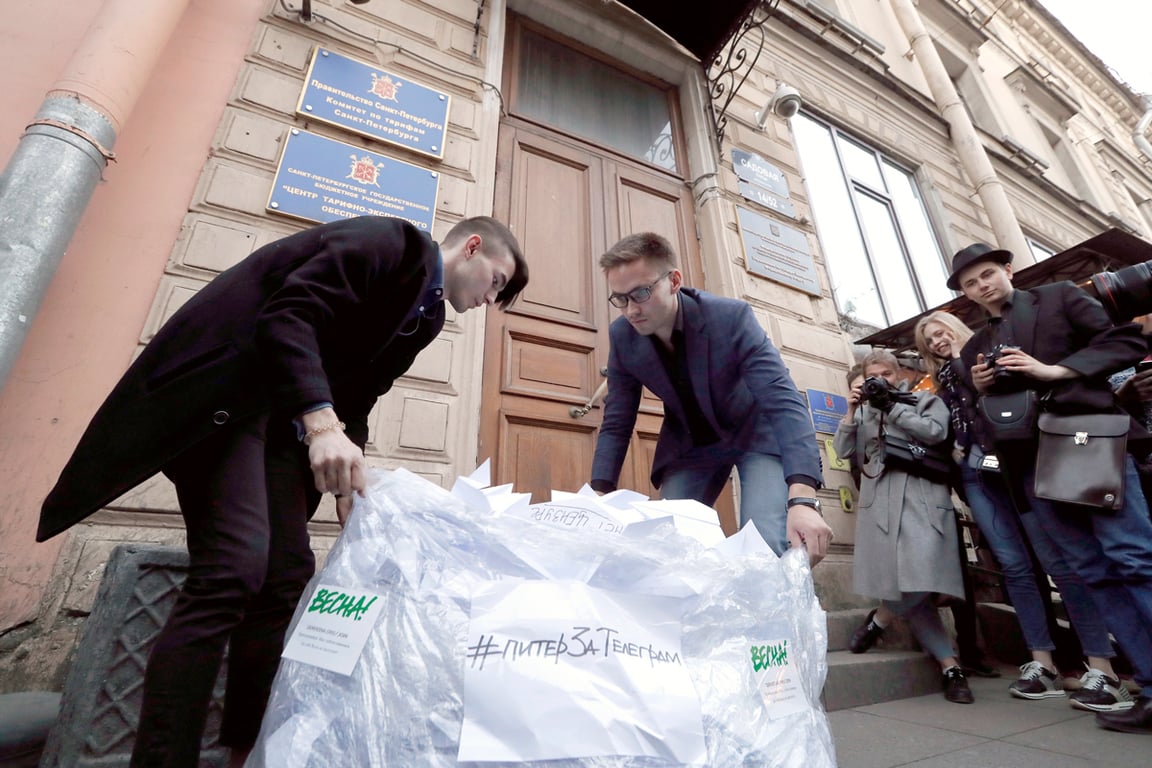
A month later, Roskomnadzor added more than a thousand IP addresses to the register of prohibited sites. The messenger itself continued to work, but WhatsApp, Viber and a number of other services were mistakenly subject to mass blocking.
Confrontation
Despite repeated attempts, Roskomnadzor was never able to completely stop Telegram. In addition to using the cloud infrastructure of large providers, Telegram quickly changed IP addresses and distributed traffic, which made the blocking ineffective. The application also had built-in proxy support (SOCKS5 and MTProto), which allowed users to easily bypass restrictions. In fact, only the web version of the messenger was blocked, but many users also connected to it via VPN.
RKN itself had not yet developed enough technical capabilities for deep traffic filtering to effectively isolate Telegram in particular without causing a serious blow to the entire Internet infrastructure.
Russian society took the side of the messenger. On April 30, 2018, a rally in support of Telegram, coordinated with the city authorities, organized by the Libertarian Party took place in Moscow on Sakharov Avenue. The call to go to the rally was supported by Pavel Durov. According to the organizers, the action under the slogans of Internet freedom and demands to dismiss the RKN leadership attracted more than 10 thousand people. Promotions with paper airplanes as a symbol of the messenger took place throughout the country: users launched them from the windows of their apartments and offices.
New strategy of Roskomnadzor
After the situation with Telegram, it became clear to the authorities that they would have to abandon “carpet” IP blocking and find some new control model.
As a result, in 2019, Russia adopted a law on the so-called “sovereign Internet.” Its initiators were several senators and deputies, one of the main authors was Andrei Klishas. The authorities explained the need for the law to protect the Russian segment of the network from possible external threats and the risks of being disconnected from the global Internet.
The document obliges telecom operators to install equipment through which Roskomnadzor can centrally manage Internet traffic. The law also provides for the creation of a national domain name system so that Russian sites can continue to operate even if there are problems with international infrastructure. In fact, the law created a legal basis for tighter and centralized control over Internet traffic within the country.
To avoid repeating the mistakes of 2018, authorities also began to use more sophisticated blocking methods. For example, DPI (Deep Packet Inspection) is a technology for analyzing Internet traffic at the content level of data packets, and not just by IP address or domain.
It made it possible to determine which service the user is accessing, what protocol is used, and, if necessary, slow down or block a specific type of traffic. In Russia, its large-scale implementation just began after the adoption of the law on the “sovereign Internet”: telecom operators, at the request of Roskomnadzor, began to install special equipment for centralized traffic management. In practice, DPI was used, for example, to slow down Twitter in 2021 and Youtube in 2024.

In parallel with the implementation of DPI, the SORM system continued to develop in Russia - the infrastructure for intercepting and storing data from telecom operators. Formally, SORM has existed since the 1990s, but in the 2010s and especially in the 2020s, the requirements for operators have increased significantly: data storage volumes and technical capabilities for accessing them have expanded . Operators are required to install equipment that allows intelligence agencies to obtain information about user connections, traffic metadata and, in cases provided for by law, the content of transmitted data. This infrastructure is built directly into communication networks and operates at the level of providers, rather than individual services.
“There is a difference between 2018 and 2026”
In June 2020, Roskomnadzor officially announced the lifting of restrictions on Telegram. Formally, this was explained by the messenger’s willingness to participate in countering extremism and terrorism. In subsequent years, Telegram continued to operate in Russia and became the most popular means of communication, which was actively used by officials and government agencies. By October 2018, the monthly Russian audience was almost 9.3 million people, and in November 2025, the number of unique Telegram users in Russia reached approximately 105 million people.
Almost until 2025, there were no further attempts at repeated large-scale blocking, despite the tightening of Internet regulation in general. At the same time, TASS emphasizes that the court decision to block Telegram is still in effect, since no one has canceled it. The messenger's lawyers filed an appeal, but it was rejected. Cyber lawyer Sarkis Darbinyan, in a conversation with the Agency, noted that in this way Roskomnadzor violated the law for six years when it unblocked Telegram.
“The court decided to block Telegram in 2018, but Roskomnadzor at first could not do this for 2 years, and then did not. Why the department decided that it has the right not to execute the court decision is still not clear. But there is a difference between 2018 and 2026,” Darbinyan told New-Europe.
According to him, firstly, the department itself has turned into a “monster - a super-regulator in the Internet sphere,” and in fact, since the fall of last year, it has been endowed with superpowers to block anything and everything. In addition, now the censor’s arsenal is not censorship delegated to providers in the form of orders to block certain domains, IPs and subnets, but “a high-tech automated censorship machine in the form of a TSPU with a very modern DPI under the hood and connected neural networks.”
“And Durov is no longer the same. In 2018, he encouraged people to take to the streets, fly airplanes, distributed grants to support MTproto proxies in Telegram, but now they limited themselves to only an edifying post about the doom of the decision to strangle Telegram,” the expert points out.
Darbinyan believes that Durov can be understood, because when his messenger was “just expelled from Russia,” its main audience was in Russia. Now Telegram “is a big tech with a billion-strong audience, of which Russians occupy only 1/10th.” Therefore, business interests have shifted to other parts of the world, “and now you can’t take the responsibility of calling people to the streets.”
At the same time, the expert notes that amid attempts to block Telegram, an administrative boost for the national messenger MAX did not happen. He points out that people can be forced to install MAX, but getting them to use it as a means of private communication and channel reading is a very difficult task.
“As we see, people would rather install a VPN to be with Telegram than use MAX. Yes, it may probably lose about 20% of its current audience, but we also see how actively the VPN audience is growing. According to our estimates, it already makes up almost half of the country’s Internet population, and this inspires optimism,” says Darbinyan.
Did Telegram cooperate with Russian authorities?
In 2025, the human rights project “First Department” reported that the FSB was opening cases of treason against Russians who wrote to bots or feedback accounts of Ukrainian Telegram channels. According to human rights activists, at the time of the arrests, security forces already had correspondence between the defendants and these channels.
It is unknown how the messages became available to the FSB. Possible explanations included both the use of special technical means and possible cooperation between Telegram and the Russian authorities.
“Important Stories,” citing a leaked border crossing database, wrote that Durov visited Russia more than 50 times between 2015 and 2021, despite claiming that he had not been to his homeland for a long time for security reasons. The publication also published an investigation into Telegram’s server infrastructure. Journalists found that part of the network infrastructure was maintained by Global Network Management (GNM), a company associated with Russian entrepreneur Vladimir Vedeneyev, who previously collaborated with Pavel Durov. The investigation mentioned connections between structures affiliated with Vedeneev and Russian government orders. In particular, they were implementing Deep Packet Inspection (DPI) technologies to monitor user traffic.
A technical feature of the MTProto protocol was discussed separately - the presence of an open device identifier (auth_key_id), which is added to each message in Telegram. Experts noted that when accessing the network infrastructure, this identifier can be seen and compared with IP addresses and activity times. This does not allow you to read correspondence, but theoretically makes it possible to track the fact that messages were sent or received by a specific device.
Telegram itself denied the accusations. The company stated that the servers belong to Telegram, access to them by third parties is impossible, and correspondence is not transferred to government agencies.