
Translated material
“At least they lied properly”
Antifa United case: three young people were convicted of creating an “extremist community” and hooliganism, the fourth died before the trial began
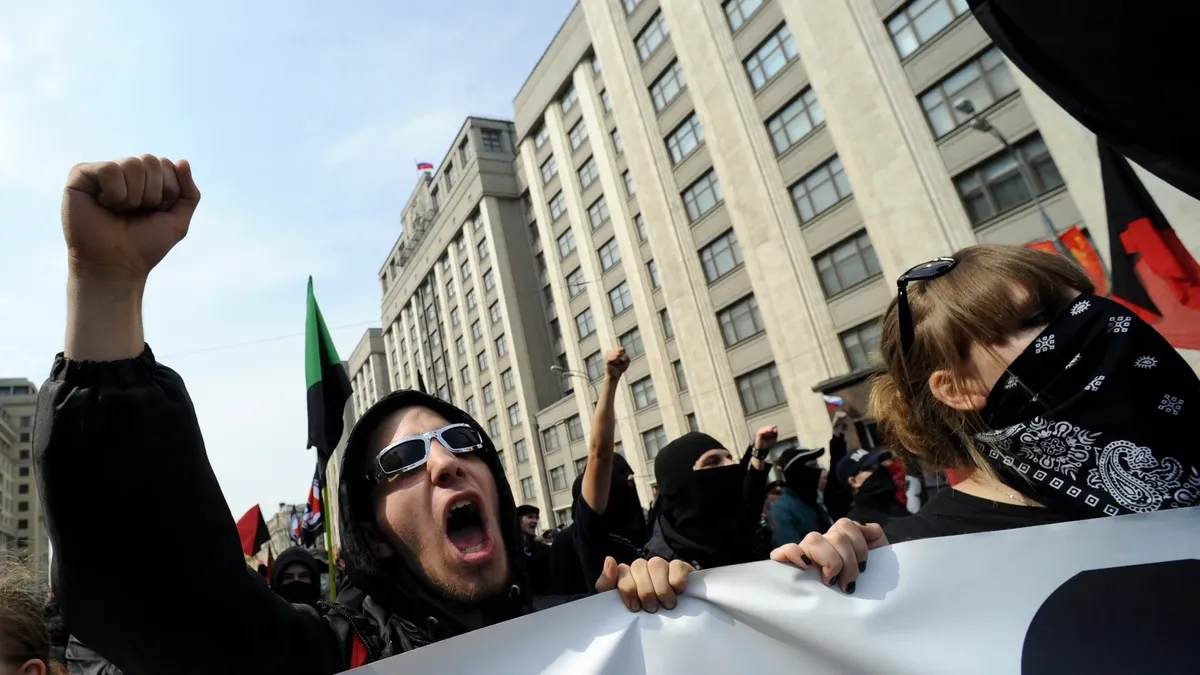
Photo: ITAR-TASS
The Izmailovsky Court of Moscow completed the trial in the Antifa United case. There are three young men in the dock. They were found guilty of creating and participating in an “extremist community”, as well as hooliganism. The prosecution is confident: the defendants profess “pro-Ukrainian anarcho-Marxism,” a term that sounds in the case materials almost like the name of a philosophical circle, but is used as a legal stigma. All defendants in the case were found guilty and sentenced to 2.5 to 9 years in prison. How the final part of the process went is in the Novaya report.
Initially, there were four defendants: Matvey Ostrovsky, Roman Chizhikov, Ilya Popov and Bogdan Yakimenko. At the very beginning of the process, it became known about the death of 23-year-old Ostrovsky, presumably due to drug problems. In the end, three remained - in the “aquarium” was 26-year-old Yakimenko, whom the prosecution calls the head of Antifa United. Two other “participants” - 19-year-old Chizhikov and 24-year-old Popov - got to the court on their own with a bracelet on their ankle.
According to the prosecution, in the summer of 2020, Yakimenko created a group and a closed chat on VKontakte, Antifa United, a platform for finding like-minded people and “planning violent actions.” In correspondence he used the pseudonym Max Vertsinsky. It was at this time, the investigation claims, that he met Ostrovsky, Popov and Chizhikov - and brought them into the group.
The three episodes that formed the basis for the charges occurred in 2021–2022.
In April 21, the investigation believes, near Chongarsky Boulevard, Yakimenko and Ostrovsky demanded that passer-by Kondratyuk take off a T-shirt with a portrait of Hitler - threatening them with a hammer.
In June of the same year, Ostrovsky and Popov, according to the prosecution, sprayed pepper on Krasnoselskaya and shot from a gas pistol at two young men of “right-wing views,” causing them slight harm to their health.
And a year later, in the spring of 22nd, Chizhikov hit Dmitry Kravchenko in the Gallery Airport shopping center, who refused to take off his Thor Steinar brand bag, a popular accessory of the far-right subculture. He eventually gave up the bag, and the defendant posted a photo of it in the Antifa United group.
The arrests took place in June 2024: three defendants were detained in Moscow, Yakimenko in Rostov-on-Don, where he was studying at the university at that time. From the materials read out in court, it follows that the key evidence against the alleged leader was given by Ostrovsky and Popov - his confession is in the case.
Interrogation with plaster
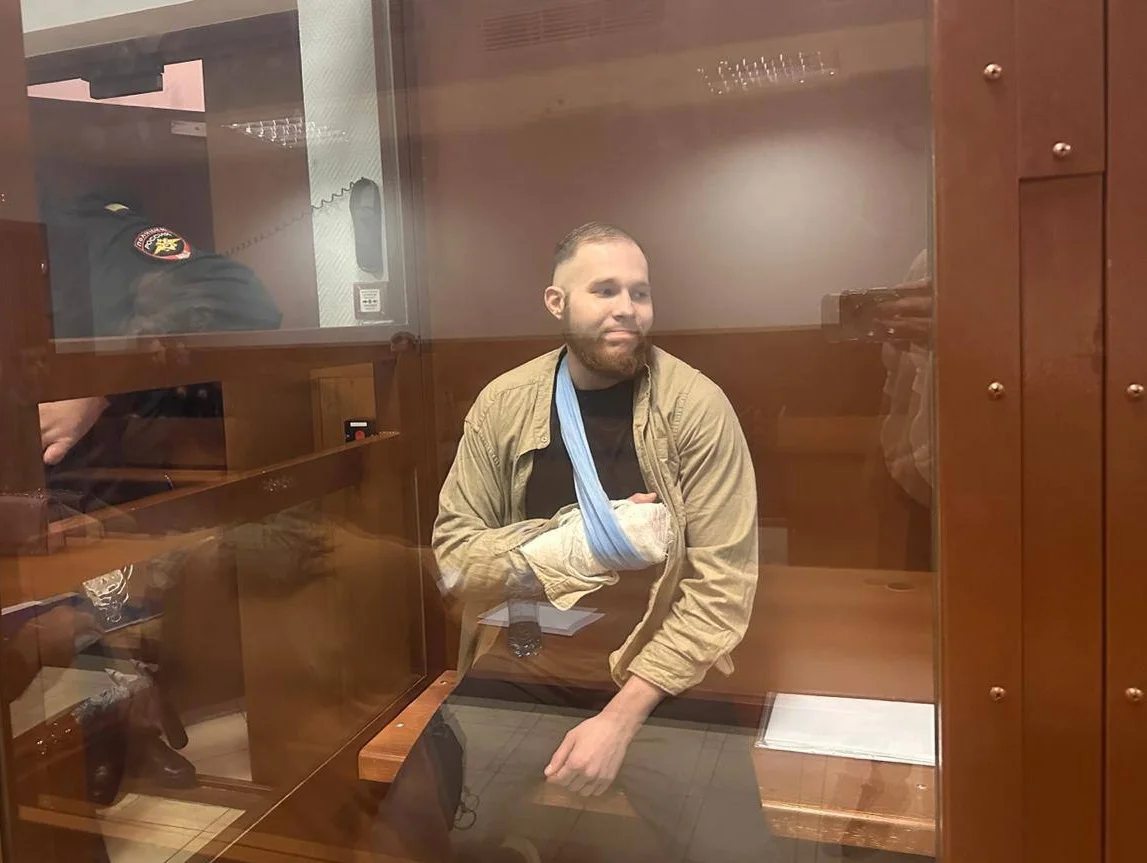
On December 1 last year, Yakimenko’s interrogation was scheduled. He was taken into the “aquarium” with his arm in a plaster cast and a bandage around his neck. He asked the judge to postpone the hearing because he was under pain medication and found it difficult to participate in the trial. The convoy presented a certificate from the pre-trial detention center:
“According to the certificate presented, Yakimenko can participate in investigative actions,” Judge Ekaterina Stepina did not believe it and rejected the defendant’s petition. — Are you ready to testify?
- Not ready. I agree to testify, but not today.
-Are you refusing?
- No.
After the break, the interrogation still took place. Yakimenko stated that he learned about the existence of Antifa United from the materials of the criminal case. Later he clarified: he was only subscribed to the group on VKontakte. He does not know who was the administrator of the community and who published the posts. In August 2021, according to him, he stopped communicating with Popov and Ostrovsky, and saw Chizhikov only a few times.
The defendant insisted: he was physically unable to post any publications in the group. During that period, he was first under house arrest, then in custody on his first case of hooliganism ( due to a fight with neo-Nazis - Ed. ), after which he was transferred to Omsk. Later, an appeal overturned the verdict, Yakimenko was released from the pre-trial detention center on his own recognizance, and he lived in Taganrog.
During the preliminary investigation, Yakimenko claimed that the publications he was accused of were posted on his behalf by other people. He suggested that his acquaintance Melnikov, who was abroad, could have done this.
Yakimenko also completely denies involvement in the attacks, in the organization of the “extremist community” and said that he does not know who is hiding under the nickname Max Vertsinsky.
After a series of questions, lawyer Svetlana Gabbas interrupted the interrogation:
- How do you feel?
“It’s bad, I’m shaking,” Yakimenko answered heavily.
- Your Honor, please take a break.
- I have already rejected your request. There is a certificate that you can take part in the court hearing. We can call an ambulance,” the judge suggested.
“This is inhumane,” said the defender, and she had to continue the interrogation.
Yakimenko also mentioned the forensic political science examination, which, at the request of the investigation, was prepared by Roman Silantiev (the author of the examination, on the basis of which a criminal case was opened against director Zhenya Berkovich and playwright Svetlana Petriychuk for “justifying terrorism”). In his conclusion, he indicated in the examination, with reference to Popov’s testimony, that Antifa United is a “pro-Ukrainian group”, since Yakimenko is allegedly of Ukrainian origin. The defendant denied his involvement in Ukraine and noted that he never discussed his origins with Popov. “Silantiev’s qualifications are questionable and unworthy of discussion,” Yakimenko believes.
“I have always adhered to Christian views. I have an extremely negative attitude towards any manifestation of fascism, racism, -
Bogdan explained. — Every morning I see [prisoners wearing “nationalist clothes”] in the “Matrosskaya Tishina” pre-trial detention center]. Half of the contingent there are supporters of this ideology. They are involved in high-profile cases. I have a negative attitude towards them. They call themselves fascists, but we have no conflicts.”
The prosecutor asked about the attack on the victim Kondratyuk.
- I can’t say anything. I met him in court. I was unpleasantly surprised. There were also indignations addressed to me, and also with claims against me.
— Did they take off his T-shirt?
“I didn’t see him before the trial.”
Chizhikova’s lawyer asked to see photographs from the case file, which depict Yakimenko’s tattoos, in particular, with the logo of the Ukrainian organization “Sich” and others.
— Explain what this tattoo of a pro-Ukrainian nationalist organization means? - Yakimenko was asked.
— The lawyer erroneously said that it was done in Ukrainian. This is done in the Don language, and has nothing to do with the organization.
- And this tattoo? — the lawyer pointed to the image of an elephant with a bladed weapon in its paws. - Why did you do it?
— It’s an ordinary knife, I just liked it.
At the end of the interrogation, the judge asked Yakimenko directly:
— Did you have access to the administration of the [Antifa United] group?
- I'm afraid so.
Extremism on video
At the stage of additions, the prosecutor requested the study of video materials. The first video shows operational footage of Yakimenko, Ostrovsky and the victim Kondratyuk. The defendants demand that the T-shirt with the image of Hitler be removed. After this, Yakimenko kicks the victim, and he runs away. Yakimenko refused to answer questions after the viewing, citing poor health.
“I am ready and willing to answer questions when my condition allows,” he explained.
— Since you were brought to court, that means you can participate in the trial. If you want, we can call an ambulance for you,” the judge suggested.
Yakimenko agreed. A break was announced for half an hour. After it was over, the defendant was returned to the courtroom. Yakimenko was indignant that the doctors “tried to inject him with something,” and he refused medical help.
Then the court proceeded to watch the second video - a story from YouTube “Young Antifa: How Teenagers Become Anti-Fascists and Why They Are Persecuted by the State.” The video talked about Yakimenko’s participation in anti-fascist actions, his first criminal case and persecution by security forces. After viewing, the prosecutor again tried to ask questions. Yakimenko again refused to answer. The lawyer clarified:
her client does not refuse the interrogation, his health condition simply does not allow it to continue. At the next meeting - January 15, 2026 - he also did not answer similar questions. But he no longer complained about his condition.
As a result, the parties moved on to debate. The prosecutor stated that the guilt of the defendants had been fully proven and was confirmed by the testimony of victims, prosecution witnesses and written materials from the case. The state prosecutor proposed to sentence Yakimenko to 10 years of imprisonment in a general regime colony. For Chizhikov - 5 years in prison; as a mitigating circumstance, the prosecutor asked to take into account his admission of guilt and his minor age at the time of the crime. They asked for four years for Popov, taking into account his cooperation with the investigation and full admission of guilt.
The first among the defenders was Ostrovsky's lawyer. He said that his client fully admitted his guilt and was previously convicted of the same episodes and was charged with exactly the same charges. “I ask that the case be dismissed due to my voluntary withdrawal from the community,” the lawyer suggested.
Popova’s defense lawyer asked the court for leniency, since her client did not realize his actions, ended up in a “forbidden” community under the influence of Yakimenko, and then voluntarily left: “Your Honor, if you find my client guilty, four years is too severe a punishment for such a bill. I ask you to impose a punishment in the form of correctional labor, which will additionally force him to think and atone for all the negative aspects.”
On January 29, the debate continued. Chizhikov’s lawyer said that the only evidence of his guilt that the state prosecution has is Silantiev’s political scientific conclusion about Ukrainian anarcho-Marxism. “Such a flow does not exist in nature! - the defender noted. “His expertise is pseudo-evidence.”
According to the lawyer, Chizhikov’s actions do not constitute a crime under the “extremist article” and his client did not take an active part in Antifa United. “He is only to blame for the actions that Kravchenko used against the victim; he should not have then posted on the Internet how he trampled on the bag,” the defense lawyer noted.
According to him, Chizhikov’s participation in the “extremist community” has not been proven, and the charge of hooliganism has been unreasonably burdened.

Lawyer Gabbas completely disagrees with the accusation and qualifications; the case was initiated illegally and is not justified. The prosecution did not provide evidence that Yakimenko distributed extremist materials and led Antifa United. In her opinion, the prosecution used unacceptable evidence - examination, testimony of witnesses, victims and confrontations with them.
The lawyer recalled that Popov was repeatedly brought to administrative responsibility for distributing Nazi symbols, and questioned the very possibility of his participation in the leftist movement. Popov’s testimony is contradictory, inconsistent and far-fetched; he made a deal with the investigation, gave false testimony in order to whitewash himself and throw all the blame on Yakimenko, the defense attorney suggested. “Subsequently, no case was brought against Popov [for administrative charges]. This indicates that he made a deal with whom? It was important for the investigation that Popov point specifically to Yakimenko as the organizer and that he made posts on behalf of Max Vertinsky. There are no other facts to support these arguments,” Gabbas noted.
Separately, the defense lawyer drew attention to Ostrovsky’s testimony. During interrogations, he claimed that he was involved in Yakimenko’s Antifa United in September 2021 - at a time when Yakimenko was in custody.
The lawyer is confident that Ostrovsky’s testimony should not be taken into account by the court, since he died before the start of the trial, and now it is impossible to eliminate all the inaccuracies.
Gabbas is outraged that the victim Kondratyuk allowed himself to wear a T-shirt with Hitler and a belt with Nazi symbols. “Instead of bringing Kondratyuk to justice, they began to persecute Yakimenko, and he [the victim] also demanded compensation,” the lawyer said, asking the court to stop the criminal prosecution against her client due to the lack of evidence of a crime.
Yakimenko himself stated in the debate that his persecution by security forces began back in 2020. According to him, an employee of the Rostov center “E” followed him for a long time, threatened him, and later FSB officers came to him in the pre-trial detention center and demanded that he give a confession. “My lawyer Gabbas was repeatedly humiliated by the investigator, who created unbearable conditions for her to defend me,” Yakimenko added.
He called the accusation illegal and unfounded, and the case itself falsified and asked the court to make a fair decision, and not “what they say from above.”
In response, Popova’s lawyer stated that Yakimenko’s defense interprets the charges freely and insists that her client did not change his testimony. “He never presented himself as law-abiding. He is punished for his actions. He has never shied away from responsibility and does not shift the blame onto anyone. There were additions to the testimony. All his testimony is consistent. Your Honor, I ask you to take this into account when passing a sentence,” the lawyer retorted, adding that the position of Yakimenko’s defense is an attempt to evade responsibility.
“Popov does not shift responsibility to someone else. This is done by his lawyer,” Yakimenko reacted sharply.
After the parties' remarks, Judge Stepina allowed the accused to make their last word.
LAST WORDS OF THE DEFENDANTS
Ilya Popov:
“Your Honor, I have made a lot of mistakes. Which I really regret. In general, politics and all these movements have not interested me for a long time. This makes no sense. I live my normal life. I'm starting a family. I'm very sorry. When I realized what was happening, I wrote a confession. I really hope for a fair verdict.”
Roman Chizhikov:
“Dear Court, I did wrong and I am very ashamed. I sincerely repent. I signed up for Antifa United just for fun. He was not a member of any extremist organizations. After the incident with Kravchenko, I unsubscribed from the group. Started working. Combined work with study. I still need to help my mother. She is raising us and her younger brother alone. Please don’t punish me harshly.”
Bogdan Yakimenko:
“In which countries are anti-fascists persecuted? The answer is obvious. The prisoners are discussing the judges, in fact, they are talking about you as a tough but principled judge... It is acceptable to be tough within the framework of the Criminal Code when there is no doubt about guilt. I hope that our position has shown these doubts. <…>
People can make mistakes. And even guided by good intentions, guided by Christian or anti-fascist beliefs. This does not justify them, but it must be taken into account. But at the same time, you cannot invent, falsify and admit anti-fascists to various crimes - it is illegal. <…>
I am an anti-fascist, but I do not adhere to Marxism. The name of the group incriminated is Antifa United. According to investigators, it is directed against the ultra-right - so what is pro-Ukrainianism? How did anarcho-Marxism manifest itself in practice? At least they lied properly. I'm not even talking about morality, but about the law - it's simply illegal! At least think it out properly, do it beautifully, but you couldn’t. If you make a guilty verdict, you will, in fact, outlaw anti-fascists, and this will go against state policy. <…>
The FSB officer at the closed joint-stock company told me so proudly that he had been following me for four years. Such a crime was solved! He came to me in the pre-trial detention center and told me to admit my guilt... The maximum here is hooliganism! <…>
The victim calmly walked around Moscow with Adolf Hitler. What should cause this? Even if you are not interested in politics. OK? Neutral? What if my relatives suffered for this? But why was no legal assessment made of the actions of the victim Kravchenko or Kondratyuk. I really hope you [the court] will evaluate this. We stand up to the Nazis, but we have them as victims who wear a Hitler T-shirt. This is nonsense!!”
On February 2, the judge found the defendants’ guilt fully proven. Yakimenko was sentenced to 9 years in prison in a general regime colony. Chizhikov received 3.5 years of imprisonment; Popov was sentenced to 2.5 years of general regime. The last two were taken into custody in the courtroom. In relation to Ostrovsky, the proceedings were terminated due to his death.