
Translated material
Rare master
Dmitry Bavilsky about Carlo Ginzburg’s book “The Riddle of Pierrot”
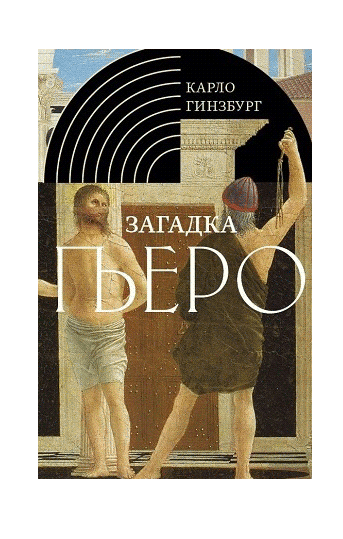
Among the geniuses of the Early Renaissance, the painter Piero della Francesca remains perhaps the most unstudied. Everyone saw his famous “Flagellation of Christ,” but experts still haven’t decided when the masterpiece was painted and what the artist wanted to communicate. The work of Carlo Ginzburg, a professional historian who decided to take on a problem that art critics were powerless to face, was published in Russian. Dmitry Bavilsky - about what is interesting about “Pierrot’s Riddle”.
Carlo Ginzburg. The Mystery of Piero: Piero della Francesca. M.: New Literary Review, 2019. Translation from Italian, foreword by M. Velizhev
In these movements along the chronological scale, Carlo Ginzburg argues with famous art historians, mainly Roberto Longhi, clarifying their attributions, since dating is important not in itself, but for solving the plot puzzles of Francesca, about whom practically nothing is known.
Victor Golovin in his book “The World of the Artist of the Early Italian Renaissance” (“UFO”, 2003) notes that the time when Piero della Francesca worked turns out to be borderline in every sense: “the dividing line between the old and the new passes precisely through the 15th century, at the beginning of which there are still many features of the old and traditional, and at the end we discover no less signs of the New Time.”
It seems that this border runs right through the life and work of Piero della Francesca, which adds intrigue to Ginzburg’s research. In the background of the “Baptism of Christ” he notes angels, whose gestures - more precisely, the positions of their hands, handshakes - perhaps repeat the figures of the ancient “Three Graces”, which the artist could see in Rome, and, therefore, the picture is transferred to a later period.
The hypothesis about the time of creation of “The Baptism of Christ,” as well as “The Flagellation,” to which the bulk of the book is devoted, on the one hand, is based on the study and interpretation of iconography, and on the other hand, it is based on data about the possible customers of this, perhaps, the most mysterious composition.
One of the most famous masterpieces of the 15th century is divided into two parts, which seem to fit poorly with each other. On the right side are boards; in the foreground, apparently in the courtyard, in the open air, three men are standing, deep in conversation. They do not notice how Jesus is being tortured on the left side of the composition, in a building with columns. Ginzburg believes that in “The Flagellation” there is too much secret writing and undeciphered signs that have been lost over the centuries. And it is quite natural that modern researchers differ in their interpretation of the plot.
“We will not present them according to the chronology of their birth, but will divide them into three groups: 1) those in which it is said that there is no significant connection between the characters in the foreground and the scourging of Christ, they are simply juxtaposed with each other; 2) those in which it is argued that the foreground characters naturally serve as part of the scene of the scourging of Christ; 3) those in which it is stated that the two scenes are separated (including in time) and that there is a connection between them..."
Studying the hypothetical customers of the painting through the historical circumstances of that time, Ginzburg offers his interpretation of not only the plot, but also names the three men depicted in the foreground. Its interpretation causes a scandal and discussion, as a result of which Ginzburg clarifies some details of his decoding, and is forced to abandon some conclusions - which is reported in the articles included in the appendix to the main text.
Ginzburg's predecessors based their interpretations mainly on iconography, while he, a historian who is aware that he is invading the adjacent territory of art historians, bases his conclusions on the features of social history. The institution of ordering a painting, to which he devotes most of his time, is the most important verification argument of the “interpretation of external origin,” wandering from the detail to the whole and back again.
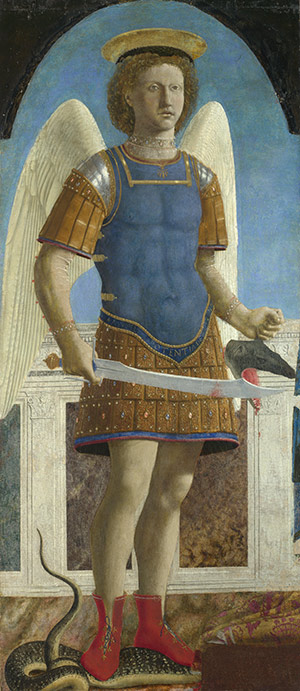
Saint Michael
Mikhail Velizhev, professor at the School of Philology at the National Research University Higher School of Economics and translator of this book, suggests that “The Secret of Pierrot” be considered “a scientific study, written and structured as a detective investigation.” These words of his, picked up by a few reviewers, seem to me to be only partly true - the issues of dating seem very speculative and abstract: numbers are almost always an abstraction.
In addition, most of Piero della Francesca's works have disappeared; those that remain are literally in vain. It consists entirely of gaps and disappearances, the painful regret of which forces one to read specialized literature, where each researcher blows his own trumpet, depending on the method, school, personal preferences and all previous experience. There is no truth here and cannot be, and the truth is so relative and unsteady that you involuntarily recall the parable of how three blind men felt an elephant. One of them held on to his trunk, another to his huge ears, the third to his cyclopean body, which is why they all described three completely different creatures.
“The Mystery of Piero” can be read as a book about the futility of logic, because all versions still hang, suspended without final conclusions, they are all gi-po-te-ti-ches-e, and it could not have been otherwise with Piero della Francesca, who became a legend during his lifetime. “However, in the face of facts you will have to come to terms.” More precisely, in the face of their absence.
“The time when historians believed that they had to work exclusively with written evidence is long gone. Already Lucien Febvre proposed analyzing weeds, the shape of fields, the phases of the moon; why not do the same with painting, for example, Piero della Francesca? In the end, paintings are also documents on political or religious history...”
Sometimes, plunging into the details of the historical context, theological disputes, the dates of the union of the Eastern and Western Christian churches, encrypted in the compositions “Flagellation” and “Baptism”, Ginzburg’s book begins to resemble a cultural investigation in the spirit of Umberto Eco, but one where all the flesh and texture are removed, and only auxiliary tools remain. Not the text of the adventure itself, but notes in the margins. It’s like in the ducal palazzos, once filled with paintings, carved furniture, precious utensils and tapestries, where now it’s empty and only the wind blows through the Gothic corridors.
Tourists come here to look at the remains of frescoes and stucco, preserved here and there as an exception. Well, also the traces of soot by the fireplace, as well as the coffered ceilings and the view from the high windows into the courtyards with walkways and passages that have not changed since medieval times.
In short, only scattered traces of past life are available to tourists, an “archiving of performance.” Because everything else that had at least some material meaning was long ago scattered across foreign countries and museums, rebuilt or simply destroyed, ground into the dust of centuries. Some in Urbino, some in Ferrara, some in Mantua.
Judging by the “Book of the Courtier” by Baldassare Castiglione, life used to be in full swing here, elegant festivities entertained the ladies of the court, poets and artists praised donors and competed with each other, but now there are only harsh bare walls...
Despite temperamental objections to colleagues and constant self-reproach, Carlo Ginzburg's book is a bit dry. In order for his speculative calculations to become warm-blooded, I read the already mentioned “The World of the Artist of the Early Italian Renaissance” by Viktor Golovin.
Before moving on to higher mathematics, it is important to understand arithmetic and early algebra. Drawing on documents and a variety of primary sources, including Boccaccio's short stories and Lorenzo Ghiberti's autobiography, Golovin explains, for example, how the perception of people in the 15th century evolved from understanding the artist as a craftsman to the realization that the painter was a unique and unique craftsman who should be treated in a special way.
Golovin introduces the reader to the circle of potential customers (after all, it also changed along with the socio-economic densification of the Italian states, the strengthening of the role of the papacy, humanists and wealthy ordinary people), into the specific criteria for evaluating the work of artists and their works, and also talks about the features of contracts stipulating everything - from the consumption of pigments and paints to literary, ideological and religious programs.
True, “The World of the Early Italian Renaissance Artist” is mainly written about the Florentines, but Piero della Francesca is mentioned in it several times.
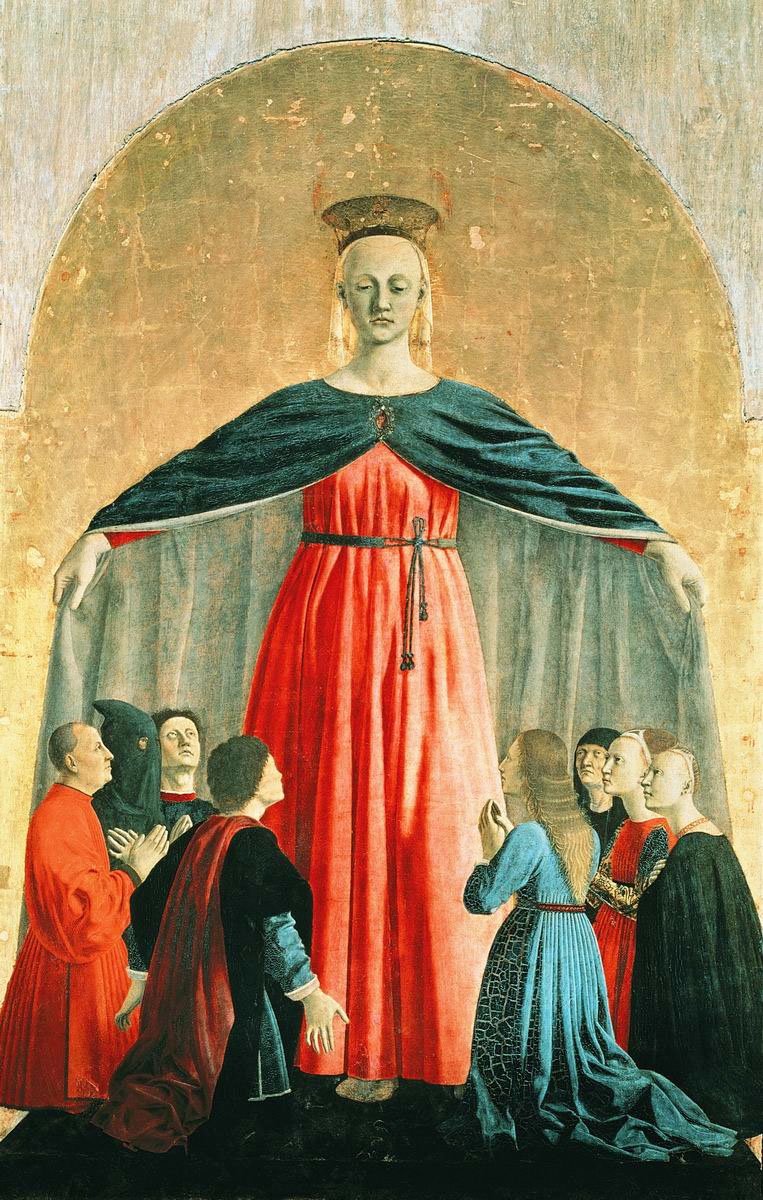
For example, it was from the chapter about customers that I learned that one of the earliest contracts, which stipulates 100% participation of the artist’s hand, is connected specifically with his “Madonna della Misericordia”. The 1445 contract stipulated that “no one should touch the brush except Francesco himself.” This painting (like Michelangelo’s Pietà) went to the customer for amounts approximately corresponding to the cost of two horses.
But much more important for understanding “The Secret of Pierrot” are those parts of Golovin’s book where he explains the dialectic of the customer’s influence on the plot of a painting or fresco, down to its smallest details - after all, it is this circumstance that forces Ginzburg to plow through not only the immediate circle of Piero della Francesca, but also “friends of friends,” colleagues and “relatives of the rabbit,” including completely distant ones.
Why is Pierrot so interesting to us and our time? Transparent melancholy that allows you to overcome mental fatigue? Gaps, intriguing incompleteness that you want to fill, at least mentally? The covenant to divide all nature into a cylinder, a ball and a cone, which through the centuries led to the appearance of Cezanne?
After all, as Giorgio Vasari wrote about “The Dream of Constantine” in a military tent on the wall of San Francesco in Arezzo, “Piero shows in the depiction of this darkness how important it is to imitate natural phenomena, choosing the most essential in them,” that is, the same cone, ball and cylinder, “respected as a rare master in overcoming the difficulties of regular bodies, as well as arithmetic and geometry.”
Vasari was a great confusion. But it was he who left the most complete list of Piero della Francesca’s works, which over time became a list of irreparable losses. Moreover, they began already during the life of Vasari, who immediately after the paragraph about Pierrot’s youth complains, as if prophesying: “Guidobaldo Feltro, the old Duke of Urbino, was called to painting, for whom he completed many paintings with the most beautiful small figures, most of which perished, for this state was repeatedly subjected to the shocks of war.”
After Urbino, Piero della Francesca “went to Pesaro and Ancona, but in the midst of work he was summoned by Duke Borso to Ferrara, where he painted many rooms in the palace, which were later destroyed by the old Duke Ercole when rebuilding the palace in a new way. Thus, in this city, of Piero’s works, only the Chapel of Sant’Agostino, painted in fresco, remained, and even that was spoiled by damp...”
The Chapel of Sant'Agostino has not survived, as have the works in Ancona and Pesaro, the translator adds, and Vasari continues about that very trip to Rome, because of which “ancient motifs” appeared.
“After this, being invited to Rome by Pope Nicholas V, he painted two stories in the upper rooms of the palace, in competition with Bramante from Milan, which, like the others, were destroyed by Pope Julius III, so that Raphael of Urbino could paint St. Peter in prison and the miracle of communion in Bolsena..."
The translator states that Francesca could not compete with Bramante, since he was engaged in painting half a century later, Vasari again mixed everything up, and I think that sometimes the frescoes were painted over old ones, and sometimes they were barbarously chipped off. If Raphael wrote over Francesca’s recording, then maybe you can at least see the compositions in infrared rays?
And Vasari continues the martyrology further, describing an unpreserved painting in the hometown of Piero della Francesca, where “in the parish church he painted in fresco from the inside in the middle door two saints, who were considered the most beautiful work. In the Augustinian monastery he painted on wood the image of the high altar, and this work received great approval, and in fresco he painted the Madonna della Misericordia for one community,” and this disappeared Madonna della Misericordia should not be confused with the Madonna della Misericordia painted on a panel, which is now in the city museum of Borgo San Sepolcro.
The images on the vaults of the sacristy in Loreto, which Piero della Francesca began with his teacher Domenico Veneziano in Santa Maria, have not survived either, but, fearing the plague, they left, leaving the work unfinished. These sacristies were brought to life by his student Luca Signorelli, and such a unique combination of three great manners in one makes one grieve the loss especially bitterly.
Piero della Francesca even managed to work in the monastery of Monte Oliveto Maggiore in San Bernardo, which later became famous for the great cycles of Sodoma and Signorelli. On the wall in a niche, Francesca depicted Saint Vincent, “who is highly valued by artists. In Sargiano, near Arezzo, in the monastery of the Zoccolante Franciscans, he painted in one of the chapels the most beautiful Christ praying at night in the garden.”
Then there was a mass of unknown paintings painted in Perugia - crumbs of them also remained, but not a trace remained of the “Betrothal of Our Lady”, painted behind the altar of St. Joseph in the church of San Chiraco d'Acona. And Vasari called her “most beautiful.”
If the frescoes and paintings of Piero della Francesca have not reached us, then is it worth regretting the banner for the processions, which he painted for the community of Nunziata all in the same blessed Arezzo, where King Constantine, guarded by a servant, sleeps in a military tent and dreams?
Obviously dreams are about something more...
Sooner or later we have to come to terms with this: yes, a tiny part of what the great artist did has reached our time. By the way, this is what allowed some art historians to say that after the outpouring of frescoes in Arezzo with the story of the discovery of the life-giving cross, della Francesca became exhausted and completely tired. Starting to go blind.
But then the historian Carlo Ginzburg invaded the territory of traditional art history and started talking about changing generally accepted dating.