
Translated material
Hero Stephen
Alexey Polyarinov on the anniversary of the author of “The Dark Tower”
Today marks the 70th anniversary of the birth of Stephen King, one of the most popular modern writers. Especially for Gorky, Alexey Polyarinov talks about how King himself comprehends his writing skills and what he can teach aspiring writers.
Almost all books about writing are useless. Their authors will tell you the “parable of the tapeworm” (literary work devours the writer’s very life like a huge parasite), advise you to “walk more,” and if you’re very lucky, they’ll tell you about the three-act structure of the work and teach you how to place commas. No book on writing teaches you the most important thing: dealing with rejection.
As a child, Stephen King began submitting his stories to fantasy magazines. They were invariably returned, and he strung the refusal forms onto a nail driven into the wall. When there were too many forms, King replaced the nail with a carpenter's crutch. He did not despair: “When you are too young to shave, optimism is a completely natural reaction to failure.”
It seems to me that this detail is the most important in his memoirs, which are called “The Book of the Craft”, and in the original “On Writing”. It has something of a parable in it, like that old anecdote about Diogenes, who asked for alms from a statue, and when asked by passers-by what he was doing, he answered: “I am accustoming myself to refusal.”
King writes about this in his autobiography. About the fact that every young author at the very beginning of his journey struggles not so much with words as with doubts; that writing is a voluntary Robinsonade, and if you don’t give up even after a dozen rejections, at some point you will still feel this emptiness - like an astronaut who was forgotten on Mars. The only tools you have are scotch tape and potatoes—try making a novel out of them, smart guy. In this sense, King's memoirs are extremely useful, even soul-saving reading, like a sudden radio signal from space reminding you that you, a promising young novelist, are not alone. It’s no joke, the author of the novels “It” and “Confrontation” himself comes to you, pats you on the shoulder and says: “Everything is fine, guy, that’s how it should be. We've all been through this. Hearing “no” every day is an important part of the initiation rite. To get the first “yes” from a publisher/reader/critic, you must first collect a whole collection of “no’s.” If you collect two hundred “no’s,” this will be your ticket to literature.”
And then the second part of the book begins, actually, about the craft. Stephen King kind of looks at your tools, at the tape and potatoes, and says: “Wait a minute, are you going to make a novel out of this? Well, no, my friend, that won’t work. Novels are assembled from completely different materials,” and explains how language works, what a plot is, and how to make your characters look like people and not like potatoes covered with tape. And most importantly, there is not a drop of condescension in his advice.
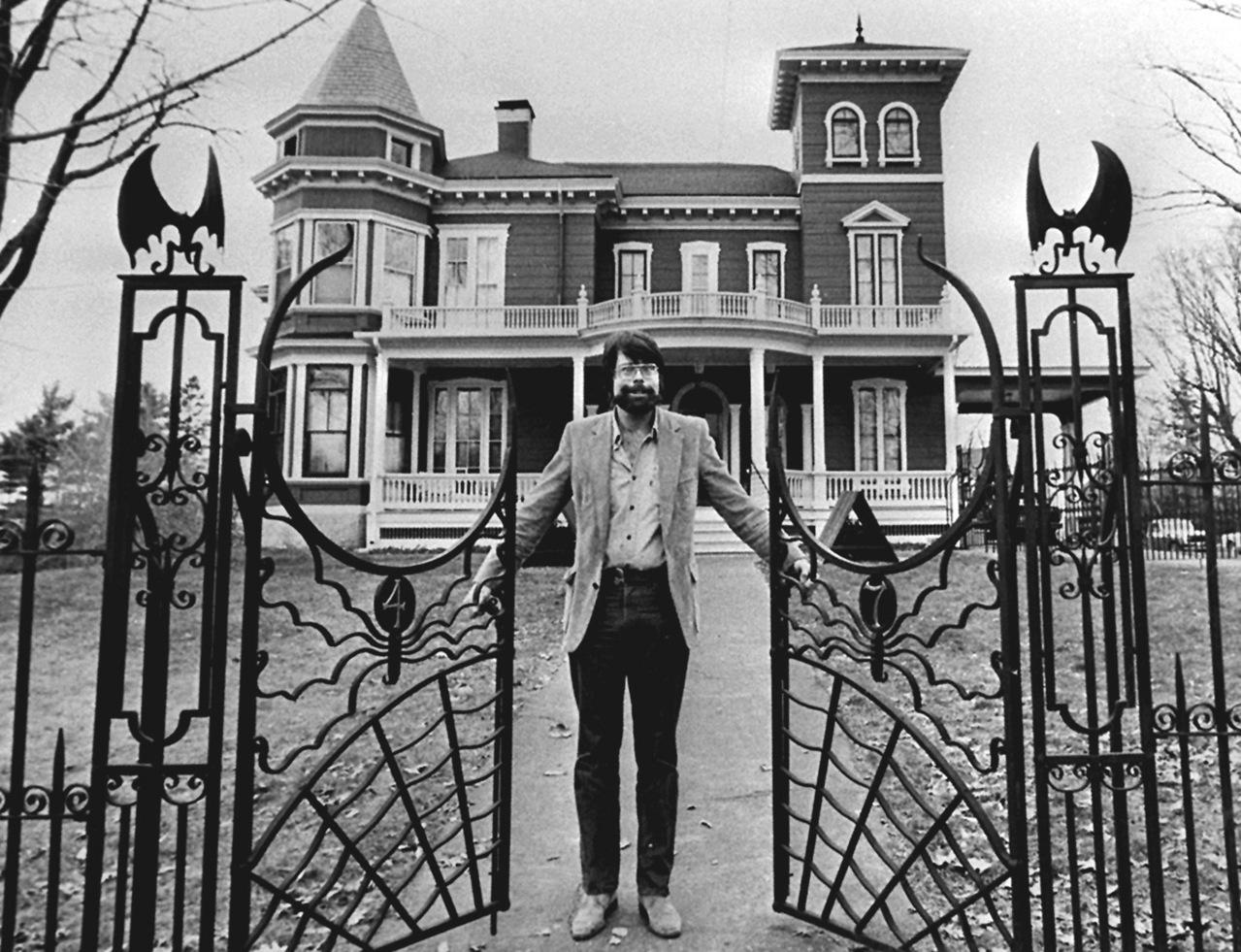
Stephen King at the gates of his home in Bangor, Maine
Photo: themanyrulesoffilmclub.com
This is the difference between King and the rest. Writer's memoirs are most often so densely packed with narcissism that behind their eternal I, I, I, I it is almost impossible to discern anything - only the figure of the author, smoke and mirrors. Salman Rushdie, for example, or, say, Nabokov, they are usually so passionate about their own feelings, style, style, difficult fate, that in their memoirs (“Joseph Anton” and “Memory, Speak,” respectively), the reader is needed solely to witness their exclusivity. But King is different, everything is the other way around for him, he seems to be the only writer who did not lie when he subtitled his text “memoirs of craft.” Perhaps this is what distinguishes “How to Write Books” from others: it is not at all about success, it is not even about the author, it is about a way of thinking. It is about a man who simply loves to tell stories, who as a child read Edgar Allan Poe and Howard Lovecraft, wrote stories about monsters and dreamed of seeing them published. King is not trying to build the book as a “success story” or “overcoming”, in the style of the movie “Rocky” - so I suffered and suffered, was an underdog, and then defeated everyone - on the contrary: his attention is focused on the reader, his goal is to encourage young people, to inspire them that they are not alone. And this is worth a lot.
Even the autobiographical chapters here are not so much about him as about the people who were always there and pulled him by the scruff of the neck through life: he writes with tenderness about his mother, with admiration about his brother, with humor about the friends he made while working in a weaving factory and in a laundry; what is there! even the story of the first novel sold here is an ode to his wife, Tabitha.
It’s difficult to say whether this is an intentional technique or not, but it works: King seems to be removing himself from his own story and directing the spotlight on his favorite (and not so beloved) people.
When I read The Dark Tower in my youth, I was sure that this whole story - with Roland Deschain's journey through the worlds, with his attempt to protect the Rays - was one big metaphor for writing, a task that cannot be abandoned, which must be completed at any cost, otherwise the world will fall apart, collapse. Another important lesson from the author of 55 novels and one seven-volume epic is to always bring everything to the end.
How was it there?
I don't kill with weapons.
He who kills with weapons has forgotten the face of his father.
I kill with my heart.
And I write too.
Happy birthday, Stephen King.