
Translated material
Don't be ashamed
Nikita Eliseev - about Erica Mann’s book “Barbarian School”
Erica Mann, the daughter of a classic of German literature, published a book in 1938 in which she summarized the methods of Nazi propaganda aimed at the future of Germany - its children and teenagers. “The School of Barbarians” was published almost simultaneously in two languages and was intended for two audiences - German and American. About what the writer wanted to say to these two peoples, as well as about what, thanks to the appearance of the Russian translation, we can read from her, is in the material of Nikita Eliseev.
All of us, since February 24, 2022, have found ourselves in the face of advancing barbarity, violence and lies. In this situation, it is extremely important to preserve at least the remnants of culture and support the values of humanism - including for the sake of the future of Russia. Therefore, the editors of Gorky will continue to talk about books, reminding our readers that there is still a place for thought and fiction in the world.
Erica Mann. Barbarian school. Education under the Nazis. St. Petersburg: Jaromír Hladík press, 2023. Translation from English by Vladimir Lazaris. Content . Fragment
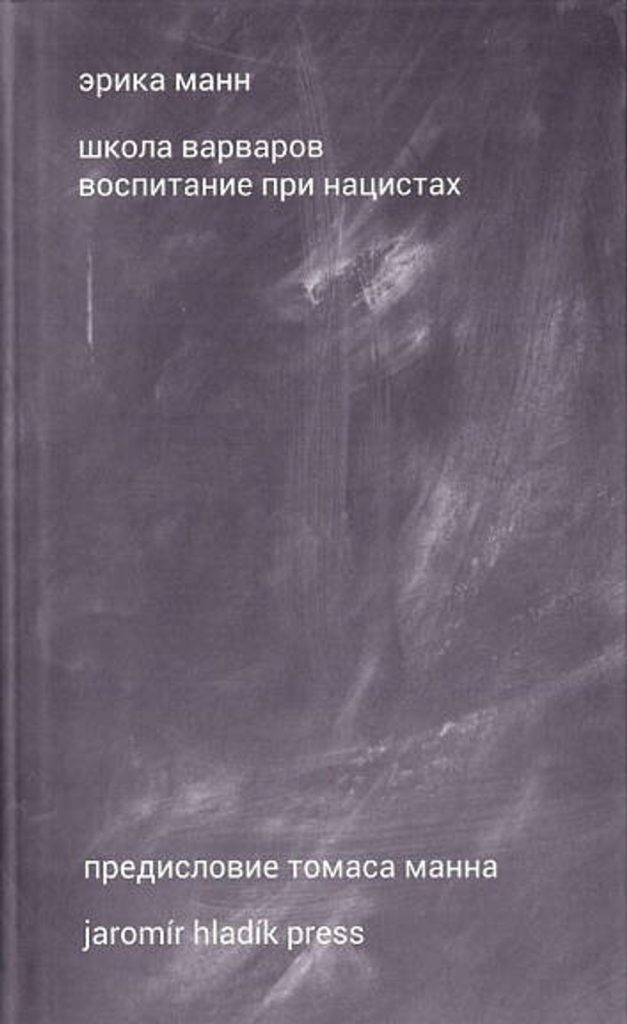
However, time has made adjustments to this aphorism. Now we perceive it differently. There are books without history, without their own biography, destiny, and there are books with their own destiny, biography, history. Erica Mann's book "Barbarian School" Education under the Nazis” with a foreword by her father, Thomas Mann, published in Russian translated by Vladimir Lazaris, is just like that - with biography and fate.
Her biography, of course, is closely connected with the fate of the author, the author of the preface and the translator. Let's start with Erica. The daughter of a classic of German literature, a Nobel laureate, Erica became a writer, teacher, and cabaret performer. Unlike her father, a conservative, patriot and traditionalist, she occupied extreme left positions, close (let's call the monster by his real name) to the communists. She emigrated from Germany in 1935. In 1938 in Amsterdam she published the book “10 Million Children. Education of Youth in the Third Reich" in German and in the same year the same book - in English in the USA under a different title: "School of Barbarians. Education under the Nazis." Erica worked through a huge number of children's and youth, pedagogical Nazi magazines, Nazi textbooks, training manuals, poems for children and youth and analyzed everything... this.
Thomas Mann wrote the foreword to the English version of his daughter's book. Here we must dwell on the position of the author of the introduction. I repeat, Thomas Mann never shared leftist beliefs. During the First World War and immediately after it, he published two books - “Thoughts during the War” and “Reasonings of an Apolitical” - with which even in 1944 in America, not without reason, they pricked his eyes. Of course! This is how he then assessed the Brest-Litovsk Peace Treaty: “Peace with Russia! What I dreamed about all the years of the war. Now the war will continue hand in hand with another anti-bourgeois, anti-democratic nation. This will be a war against liberalism, democracy and false sacred human rights!”
These two books, again not without reason, are considered one of the ideological foundations of the “conservative revolution”, from which fascism and Nazism grew. The more hated Thomas Mann was towards the Nazis. They discredited his traditionalism, his conservatism, his German patriotism. Are these sadists, pogromists, poorly educated boors who allow themselves to make criminal jokes about their defenseless opponents the embodiment of the German spirit? defenders of traditional values? Are they knights? Bandits, criminals, capable of committing their crimes to any ideology that allows them to carry out what is sweetest to them - violence.
Anyone, but not them... They disgrace and dishonor Germany worse than any occupiers. Thomas Mann remained in this position until his death. In Discourses of the Apolitical he devoted an entire enthusiastic chapter to Palestrina, an opera by Hans Pfitzner, his then friend. Pfitzner became a Nazi, one of the leaders of the musical life of the Reich. After the war, a very old, very sick composer, whose son died on the Eastern Front and his wife during a bombing, was supposed to be summoned to the denazification commission. German intellectuals wrote a letter of petition to the denazifiers, saying, well, leave the old man alone, he doesn’t have much time left, and his music is wonderful. We collected signatures and wrote to Thomas Mann, saying, help your friend (even an ex-friend). Mann responded with restrained fury: “I won’t lift a finger for this Tonsetter...” Let me explain: the Nazis did their best to Germanize the language. Therefore, not a composer (composer is a foreign word), but... a sound compositor - a tonsetzer.
This rage, restrained by a polite tone and correct expressions, is also palpable in Thomas Mann’s preface to the book by his daughter, Erica Mann. The country that now lives under this government is disgraced and dishonored. This is not my country. She deserves to lose the war she will start. The Russian poet expresses this feeling more clearly, more crudely: “So the spirit of the Nibelungs and Schiller’s spirit / was once covered with Nazism. / The legend of Faust died thus / in the shadow of the Hakenkreuz, under the shadow of the eagle, / and Dürer ended as a Fuhrer, / and Luther died from this.”
And finally, the translator, Vladimir Lazaris, the author of one of the best books about the 30-40s of the last century - “The White Crow”. He translated Erica Mann's book in the USSR, in the mid-1970s, when he was "in denial." Let me explain again: he applied for repatriation to Israel, he was kicked out of his job, but was not allowed out of the country. This is what was called: “being in denial.” Then he came across Erica Mann’s book, which the translator writes about in the preface: “This happened in the house of theater expert Lyubov Davydovna Vendrovskaya, who in her youth was an employee of Vakhtangov and worked at the Jewish theater “Habima”. It was she who took from the shelf a tattered American edition, on the cover of which a swastika was blackened in the red glow of the fire, and books were burning in the fire. “The School of Barbarians” became a complete revelation for me, because together with my generation I went through approximately the same upbringing that she talked about (I cannot help but note the conscientiousness and objectivity of Vladimir Lazaris: for all his - to put it mildly - dislike for the Soviet system, he still cannot admit that the Soviet upbringing was exactly the same. - N. E. ). On the one hand, this book was many years late for me, on the other, it came at the right time, because at that time Jewish repatriation to Israel was in full swing, and after being refused permission to leave, I edited the samizdat magazine “Jews in the USSR,” where several chapters from “The School of Barbarians” were published. A well-secret typist retyped the translation on the “Erika” typewriter, combining the name of the author of the book with the main tool of samizdat, which, as is known (from Galich’s song - N.E. ) “takes four copies.” The fourth, blindest copy, which survived two home searches and a customs inspection, somehow miraculously made it to Israel with me and lay in my desk drawer for another forty years until its first magazine publication (Lechaim, No. 5, 2016). Adolf Hitler’s words “to whom the youth belongs, the future belongs” could become an epigraph to the “School of Barbarians”. After all, this is exactly what this book is about – the seduction, corruption and conquest of children’s minds by the state.”
You can’t say anything better about the book he translated than Vladimir Lazaris. Yes. A book about this. About a generation that has been placed in a false coordinate system since childhood. Therefore, another epigraph is seen (or heard): “Woe to him who seduces these little ones; it would be better if he hung a millstone around his neck.” If, even for just five years (from 1933 to 1938) in schools, newspapers, magazines, textbooks, military sports camps, we explain to children and teenagers that there is nothing better than war, which forges the spirit of the nation, that our country is surrounded by enemies who only dream of destroying it, that within the country there are vile agents of influence on whom it is allowed (and encouraged) to inform that our country is the best, the most spiritual, the most cultural and it would be better if the whole world perishes than our country, then what - even in these five years - will come out of these children and teenagers?
Yes. This is exactly what will happen: thoughtless soldiers of the Wehrmacht and SS, guards in concentration camps and sadists in the Gestapo. It is these grown children and teenagers who will bring grief and torment to neighboring countries. It is to them that the grief and suffering that they brought upon others will boomerang. There is nothing to add, except perhaps... the addressees or recipients of Erica Mann's books, her readership - German and English-speaking, American.
The German book is addressed to emigrants and those who remained (for one reason or another) in Germany, who by some miracle will receive either the book itself or its typewritten copy (blind, fourth copy). Everything is clear when it comes to addressing emigrants. No matter how difficult it was for us in emigration, we did the right thing by leaving. There (if we are cultural workers) there is no point in staying there. There is no place to hide from misanthropy. If one of us has to write textbooks on arithmetic, then he will be forced to give appropriate examples - not about apples and plums, but about bombs and cartridges. If someone is engaged in local history, he will be forced to write about the German spirit of his native land and the pernicious influence of the Jews on this spirit. If you are there, you will work for them - whether you want it or not.
The appeal to those who remained, oddly enough, is more personal. Erica Mann's main body of examples is Bavarian educational and propaganda literature. Erica Mann was born in Munich. The layer of local intelligentsia there is quite thin. One way or another, everyone knows each other (or the enemy of the enemy). Erica Mann's appeal to them is not so obvious, but it is there. How can you? Doctors of science, directors of gymnasiums, educated people - how can you do this? Aren't you ashamed? In the end, they could unwind from patriotic events. Write advertising texts about lingerie on the third floor of the Ulshtein publishing house, write reviews, but do this? The answer is also clear: NO SHAME. One of the slogans of fascism: NO SHAME.
Erica Mann gives one of many examples of Nazi repression against those decent people who remained in Germany. The pastor of the town of Niederleben, Friedrich Müller, taught his parishioners that they should not confuse the party, the government and the Fuhrer with God and the fatherland. One can and should become a martyr for God and the Fatherland, but for the party, the government, the Fuhrer? No. The pastor was arrested. Then (in 1935) they limited themselves to a fine. (Pastor Müller was sent to a concentration camp in ’39, and died in a concentration camp in ’42.) The official SS organ “Black Corps” wrote about Müller’s arrest in 1935: “Pastor Müller is now in prison. He's training to be a martyr." The person who allowed himself such a joke is not only devoid of heart, he is devoid of shame. He is NOT ASHAMATED to joke like that.
The addressee and recipient of Erica Mann's English-language and American book is an American in 1938. Typical, average. He knows that there is nothing worse than war (he has read Aldington and Hemingway). He knows that he should not interfere in the internal affairs of other countries. America has its own problems. American conservative, anti-communist journalists travel around Nazi Germany and write books about how Hitler stopped the communist infection, how the German people love him, and how wonderfully, in the traditional spirit, they educate the youth of Germany.
Children and teenagers do not wander the streets after school, but are united in unions: girls in the “Union of German Maidens”, kids in the “Pfimf” detachments, those older in the “Hitler Youth”. Sports camps, hobby groups - what's bad?
For Americans, Erica Mann explains what German children are taught in all these wonderful sports camps and hobby groups. They are taught war. They are prepared for war: forced marches, the ability to throw a grenade, shoot, kill. They are taught not just the technical skills of war, but that war is wonderful, heroism, valor, front-line brotherhood. Children are being turned into little soldiers. In those soldiers who will mercilessly fight against you, Americans. Before it's too late (1938) - stop this Horde. It will rush at you not next year, but the year after. If a whole generation is pumped up with war, then it (this generation) will blow itself up and the whole world in a horrific catastrophe.
This is not just a country with its own characteristics, with which you can trade, negotiate, agree on something, make some concessions - this is the Horde, barbarians. It is impossible to come to an agreement with them and it is impossible to negotiate with them. They want war. And they will start a war if they are not stopped. How? At least don't listen to conservative American journalists excitedly telling you how good Germany is under the leadership of its effective manager, Adolf Hitler.
There is a third recipient of this book - you and I, residents of today's Russia. Well, that's where the cards fall. How will anyone read this book? That's what interested me in her, or rather in her notes. The fate of those who wrote teaching aids, textbooks, poems for children and youth (“The old bones are shaking...”!). What happened to them after the war? Nothing special. With rare exceptions (they committed suicide in 1945 or 1946), they lived normally. They continued to publish teaching aids and teach. Many of them were not even members of the Nazi Party and therefore were not subject to... denazification. And the denazified person did not work in his profession for five years, could not hold government positions, did not have the right to choose and be elected (he did not choose anyone under Nazism), then returned to his profession. No, I don't mind. Democratic solution to the problem, who argues. The question remains for them: how could they not be ashamed? But this is a personal, intimate question. Why ask it? So, no shame.