
Translated material
The killer is a killer
Anton Fedorov staged the play “Sherlock and All-All-All” in the Space “Inside”

Scene from the play "Sherlock". Photo: teatrmesto.ru
...Tra-la-la-la-la-la-la-la: this performance begins with a screensaver motif from Igor Maslennikov’s series.
The play is about eccentrics who are either on a carriage (a sofa on wheels that they move with their own feet), or on a boat (which descends from the sky), or on a two-seater bicycle, rushing to the rescue faster than Chip and Dale.
Doctor Watson in a baseball cap (Sergei Shaydakov) returned from the Afghan war shell-shocked, maybe that’s why he always hums Dashkevich’s tunes from the folk series in a bad voice. Natalia Rychkova's Mrs. Hudson is a buttoned-up housekeeper, lady perfection Mary Poppins with reinforced concrete eggs for breakfast, brandy before a voyage for courage, an umbrella for flying away. He throws logs into the fireplace, knocking the already broken violin off the wall. It beats out a marching rhythm, recognizable from the TV series, with beaters on a floor drum, again sending us back to “The Adventures of Sherlock Holmes and Dr. Watson.”
Holmes (Semyon Steinberg), literally like Winnie the Pooh, knows about everything in the world and instantly guesses literally everything suspicious: a dog's whip, a ring, Rachel... a mottled ribbon, poison, a pill, a bloody light bulb, a purse, canaries and a cheetah...
“Do you want to know how I unraveled this tangle?” “Brilliant!” - Watson repeats as usual, in love with Sherlock, like Piglet with Winnie the Pooh. The devilishly cunning, Napoleonic-confident Moriarty dances a deadly dance with Holmes over an icy abyss in the polyethylene mountains, parodying scenes of deadly fights from millions of action films.
And outside the long window - now rain, now snow, now an aquarium, now the London landscape, now the Hound of the Baskervilles will rush by with a howl, sparkling red eyes, then Nikita Mikhalkov in a white scarf, looking like Willy Tokarev, will open his immense arms to us. Animation by Nadya Goldman expands the space in which the cheetah and baboon, brought from India by Dr. Roylott, and other passionate faces come to life.
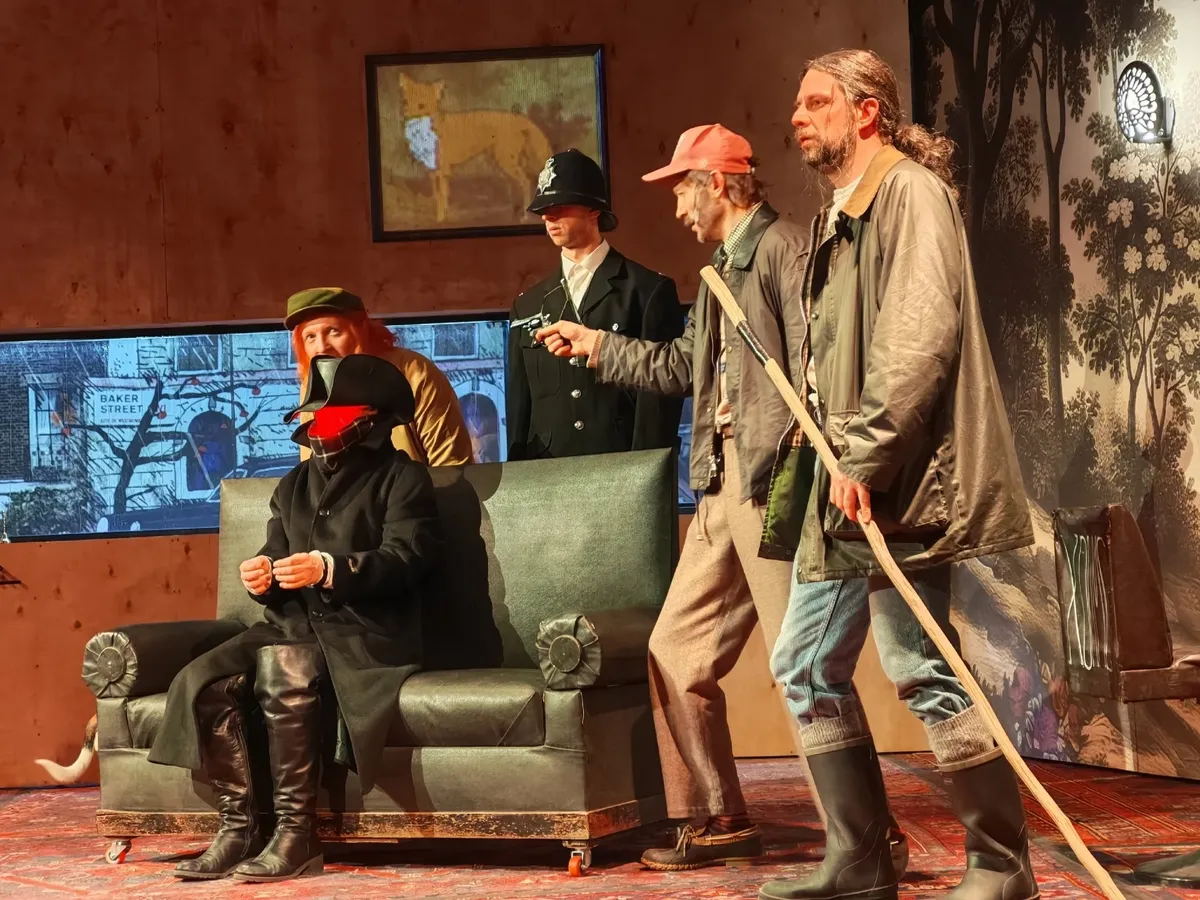
Steinberg's hippie Sherlock is a comedian and rescuer, a narcissistic neurotic, ready to sacrifice himself and his three-legged dog Thatcher for the sake of unfamiliar women - all of whom look the same (all of them played by Olga Beshulya), who need to be immediately dragged out of trouble. What difference does it make - who? The main thing is immediately! A curly-haired, nervous veil, a neurasthenic, zealously playing the violin, and an undaunted superhero.
Holmes is a hostage to his gift; before solving another murder, he performs a shamanic dance and in a guttural voice describes the next criminal in boots with square toes and a red face. He is seized with the rage of a bloodhound, he breathes quickly, like a hound that has taken the scent. However, here they are all a little wound up dolls. And the very moving space of the stage with turning walls is an unstable conditional “world in a snuff box”.
A mosaic of quotes turns into pastiche.
Holmes rushes over the Catcher in the Rye towards Vanity Fair, changing registers, turning from Carlson to Robin Hood. At times the juggling of quotes seems overwhelming. However, here everything is multiplied, everything is squared and cubed: repetitions, quotes, gags, plasticity.
The performance is excessive, deliberately caricatured. Somewhere closer to the finale (intoxicatingly danceable and peaceful) it gets stuck on repeat.
But it seems that the authors of the play did not strive for cathedral statements. “Sherlock Holmes and All-All-All” is a “bagatelle” performance, a trifle that does not pretend to be large-scale, designed in times of hysteria, chaos and fear to console with non-vulgar laughter visible to the world. These are “marginal notes” in this case not only of the works of Conan Doyle, but also of our “unifying” impressions recognizable from the “three notes”: melodies, TV series, books, characters, quotes. An intellectual game involves unraveling the meanings and subtexts hidden in a “trifle”, turning into an amusing exercise for the mind. However, bagatelles were written by Beethoven, Liszt and Bartok. Composers and writers have used the genre for experimentation and unexpected polytonal overlays.
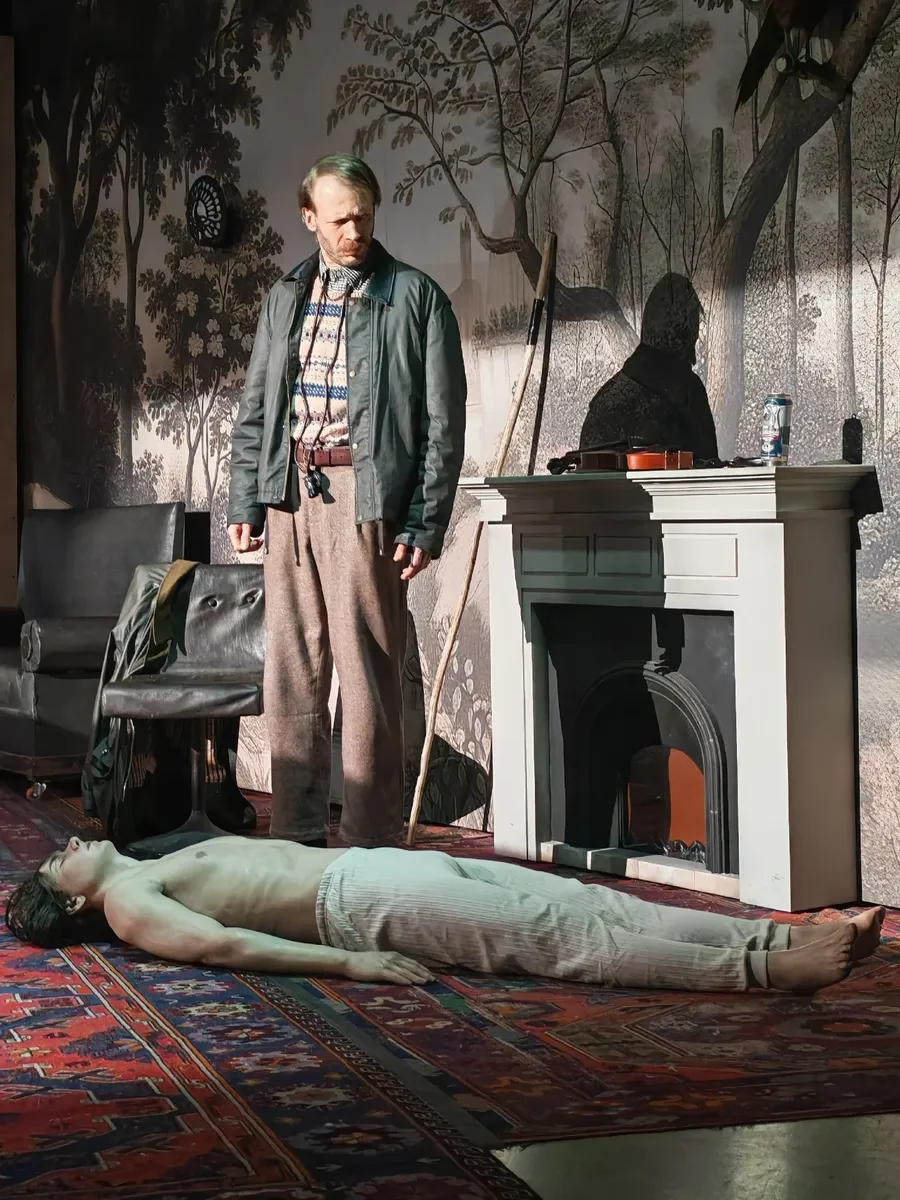
And in every joke here there is only a fraction of a joke: “Who is the killer? The killer is the killer (Who is the director? The director).” And the general message of the performance suddenly chills the blood.
After the next crime, Holmes says that there will be no more murders, but corpses are brought and brought, brought and brought. There are more and more murders. They turn into an unstoppable cycle. Holmes does not have time to undress/dress. Rush to the rescue. But he cannot stop this conveyor of evil and blood... although in the finale the authors will greatly sweeten the bitter pill.
Until a new hall has opened in the Space Inside theater, the play is being performed on the Art Platform “New Manege”.