
Translated material
Liberation Day
165 years ago, serfdom was abolished in Russia: what is the significance of this event for us today?
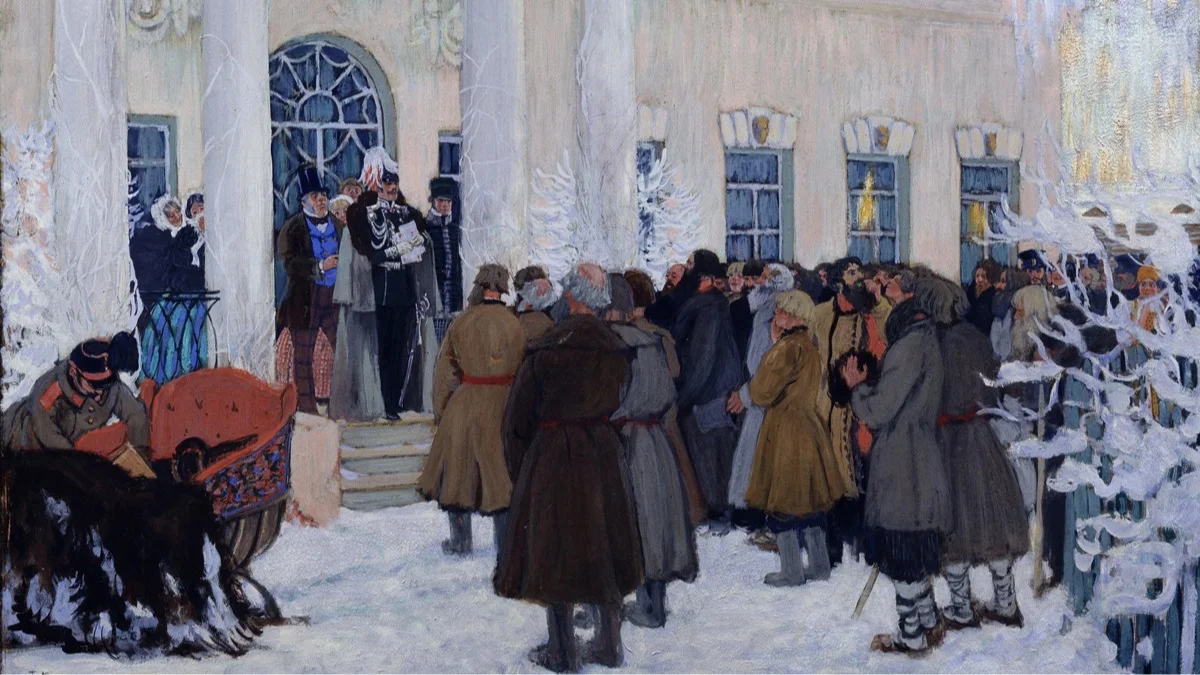
Painting by Boris Kustodiev “Liberation of the Peasants (Reading of the Manifesto)”, 1907. Source: Alamy / Vida Press
Historically, key events take place in Russia at the end of February and beginning of March. The assassination of Emperor Paul I and the accession to the throne of his son, with whom society pinned its hopes for reforms. The death of Alexander II, which dramatically changed the political situation: not reforms, but their abolition became the motto of the day; The era of reaction and strangulation of freedom begins. The fall of the monarchy, the abdication of Nicholas II, the formation of the Provisional Government, which was destined to further democratize the country (sorry, there was not enough time). The shameful (according to Lenin’s classification) Treaty of Brest-Litovsk, which gave the recent enemy a significant part of the territory of the former Russian Empire (densely populated, with developed industry, fertile lands, important communication routes), which allowed the Bolsheviks to remain in power and begin building their own army. The death of Stalin and the long-awaited softening of the terrorist dictatorship. The 20th Congress of the CPSU was the “Soviet Nuremberg”, which condemned Stalinism, released millions of prisoners, ushered in the Thaw era and established a relatively soft social order. Election of M. S. Gorbachev as General Secretary of the CPSU Central Committee. Perestroika seemed to put an end to the totalitarian regime (which was no longer very scary at that time).
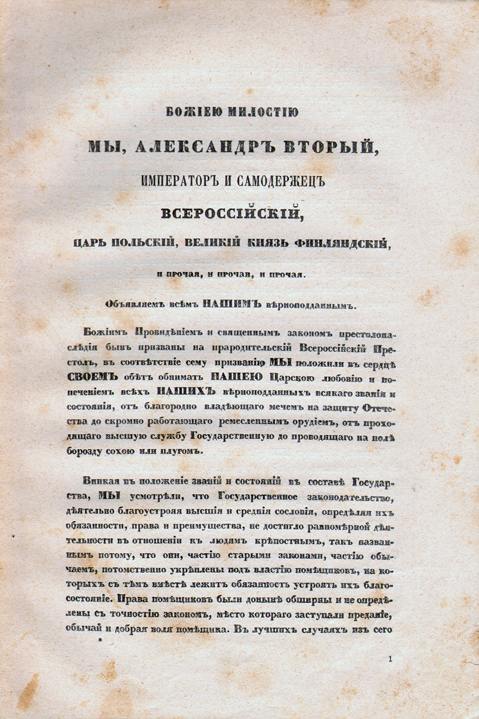
Among these, as they recently said, “fateful” events are the abolition of serfdom on February 19 (March 3, new style), 1861, and the liberation of the Russian peasantry from centuries-old slavery. From this moment on, the gradual dismantling of the autocratic-serf system begins. The Great Reforms of Alexander II will follow - the judiciary, zemstvo and city self-government, the autonomy of universities, a significant softening of censorship, the creation of a modern army, etc.
All this became possible after the death of Nicholas I on March 2 (New Style), 1855. February-March days again!
***
Legally and politically, autocratic-serf Russia existed from the middle of the 17th century. (from the Council Code of 1649). Moreover, all social groups (estates) were enslaved. The first serfs to become serfs were the nobles. This class was created by the Moscow state at the end of the 15th - beginning of the 16th centuries. Its main task was the defense of Russian lands from raids and invasions (then Muscovy is sometimes called a “military camp in the field”); The only occupation is war. Military service continued either until death or until a person’s physical potential was exhausted. Service serfdom was ensured by the work of peasants, whom the nobles received from the state along with the land. But this was a conditional possession, limited by the period of noble service. After its termination, the nobles lost their right to own peasants and land.
Being historically the first enslaved class, the nobility was the first to be freed from serfdom. On February 18 (O.S.), 1762, Emperor Peter III issues a Manifesto on the freedom of the nobility. It received an indefinite leave of absence. The outstanding Russian thinker Georgy Fedotov commented on this document as follows: “The decree ... freed the <nobleman> from compulsory service to the state.
From now on, he can devote his leisure time to literature, art, and science. His participation in these professions liberates them too; they, indeed, become free professions... From the core of the nobility the Russian intelligentsia grows.” And also noble nests (estates), centers of a new European culture, we will add.
V. O. Klyuchevsky noted: having freed the nobles on February 18, it was necessary to free the peasants on February 19. And so it was done. But after 99 years.
The decree of Peter III undermined the raison d'etre of peasant service to the nobility. If the nobleman is no longer obliged to serve the state (the sovereign), why do “we” still serve him? This is one of the psychological reasons for the imminent Pugachev era. This is the irony of history. The emancipation act contributed to the “merciless” rebellion of those who rightly considered themselves “humiliated and insulted.” And - deceived. As Lenin would say more than a hundred years later, reform gave birth to revolution.
***
The issue of serfdom and getting rid of it cannot be understood if we miss and ignore the fact of the fundamental split of Russia into two subcultures - as a result of the transformations of Peter I. Klyuchevsky accurately said this at one time: “From ancient (i.e., pre-Petrine. - Author's note ) and new Russia came not two adjacent periods of our history, but two hostile patterns and directions of our life, dividing the forces of the Russian society and turned them to fight each other instead of forcing them to fight together against the difficulties of their situation.”
Half a century before Klyuchevsky, Alexander Herzen wrote about the same sociocultural conflict (article “Baptized Property”): “From the beginning of the 18th century, the two Russias became hostile against each other. On the one hand there was a governmental, imperial, noble Russia... On the other hand, a Russia of the black people, poor, arable, communal... Is it surprising that the emperors gave up for the plunder of their Russia, a courtly, military, dressed in German, educated on the outside, peasant, bearded Russia, incapable of appreciating imported education and overseas morals, to which it had a deep aversion.” And he: “Two different Russias... the community and the nobility, opposing each other for more than a hundred years and not understanding each other. One Russia - sophisticated, courtly, military... - surrounds the throne, despising and exploiting the other. The other, agricultural, disunited, rural, peasant, is outside the law.”
This antagonistic confrontation between two subcultures - the traditionalist, old Moscow, which included the bulk of the country's population - and the Europeanized subculture of the “upper” (Marx called it “imaginary”, i.e. superficial, not rooted, borrowed) - manifested itself fully during the Pugachev era, which was not only a social, but also a cultural and mental war. Typologically similar to the Luddite movement in England. And also, perhaps, with the uprising of the colonized against the colonizers.
***
Usually, when analyzing the reasons for the abolition of serfdom, they first of all point out that it was a reaction to the sharp weakening of Russia’s position in the outside world. Many contemporaries considered the deafening defeat in the Crimean War (1853–1856) and the humiliating Peace of Paris for the country to be a consequence of social ills. The conviction that Russia surrendered “not to the external forces of the Western Union, but to our internal powerlessness,” that it needed renewal, was, perhaps, perhaps the main driver of the peasant and other reforms of the 60s and 70s of the 19th century.
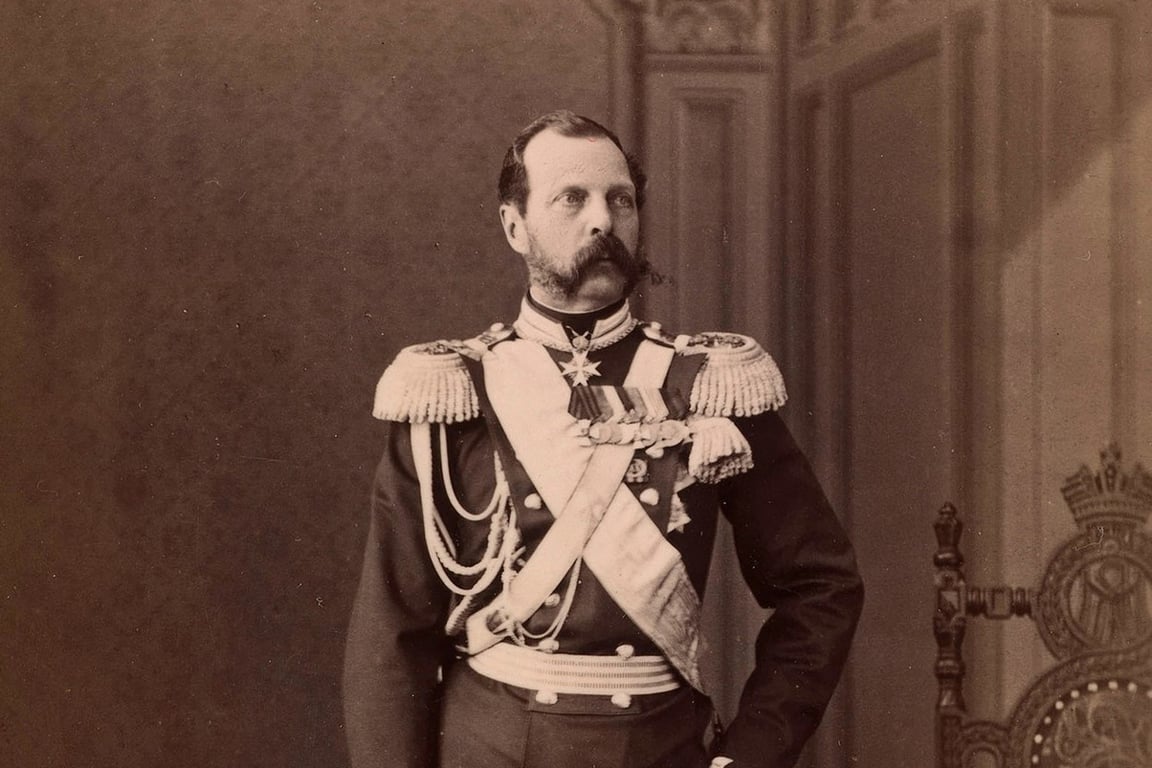
Apparently, this was of paramount importance for the monarch, who went down in history as the Tsar Liberator. Alexander II was not at all “an ideological reformer... who, so to speak, wanted, due to his inner convictions and inclinations, to carry out the reforms that he had to carry out,” wrote the pre-revolutionary Russian historian Alexander Kornilov. This pupil of Vasily Zhukovsky and Mikhail Speransky is “the perfect son of his father” (“a convinced supporter” of the system of Nicholas I; he was driven by an “extremely reactionary mood”). “The reforms took place ... not because of the sovereign’s desire for them, but almost in defiance of his convictions, and he had to give in to the developing socio-political process, since he saw that if he fought this process, as his father fought, it could lead to the collapse of the entire state.” This monarch understood:
In order not to fall out of the “European concert”, to survive as a world power, to expand, the country had to open up and transform. And, it must be admitted, Alexander’s reforms allowed Russia to restore the positions lost after the Crimean disgrace.
However, the radical revolution in peasant affairs was based not only on state, “great power” reasons, but also on deep moral prerequisites. Both in the state apparatus and in educated society there was a strong opinion about the moral harm of serfdom, about its extremely negative impact on public morality and the general social climate. The best minds in Russia agreed that serfdom imposed its mark on the moral physiognomy of all “elements” of social life - landowners “armed” with serfdom, officials guarding it, peasants bound by it. “The landowner, not meeting resistance to the equal rights of the people around him, is every hour exposed to the temptation to give free rein to his arbitrariness. The people submit to the power of the landowners as a difficult necessity, as violence, just as Russia once submitted to the rule of the Mongols in the hope of future deliverance.” But this humility, humiliating morality, develops pretense, deception, and flattery in the peasants: “That is why the peasants, in almost all circumstances of life, turn to their landowner with the dark sides of their character. A smart peasant pretends to be a fool in the presence of his master, a truthful one shamelessly lies to his face, an honest one robs him, and all three call him their father.”
These words belong to a man whose name is little known today, although it was he who gave the theoretical justification for the liberation of the Russian peasantry from serfdom. And he took an active part in the implementation of the emancipation reform. This is Yuri Samarin (1819–1876) - Slavophile, thinker, theologian, scientist, public figure.
***
Many minds of the 19th century struggled to resolve the problem of serfdom; in a certain sense, it was pivotal for the socio-political development of Russia at that time. This is how the leading Russian constitutionalist of the early 20th century explained its complexity. Baron Boris Nolde: “The sum of legal relations that was embraced by the general name of serfdom was in Russia... much more an everyday fact than a legal formula. One thing was clear: the landowner, the peasants and the land constituted an inextricable whole, but neither the laws nor, most importantly, the legal consciousness were clear about the nature of the rights of the landowner in relation to the serfs sitting on the land... In the eyes of Russian society, which had never been distinguished by the distinctness of its legal consciousness, serf relations were depicted in the legal sense as unusually vague and foggy. Those who, like Samarin, approached ... the question of the emancipation of the peasants, were faced ... with the need to somehow qualify serfdom in order to determine whose and what rights were subject to abolition, change or preservation ... "
It must be said that Nicholas I was clearly aware of the harm and danger of serfdom. Under him, various secret committees were created, which were tasked with finding a legal formula that would allow the emancipation of most of the population of the empire without undermining its foundations. It is curious that one of the most important obstacles to solving this problem was the conviction, strengthened during the reign of Nikolai Pavlovich, that the power of landowners over peasants is by its nature private law - a Russian version of the institution of private property (in his own way, his opponent Herzen, who called the peasants “baptized property”), agreed with this opinion of official St. Petersburg. It was considered impossible to encroach on private property, since this called into question the prevailing belief at that time: its inviolability is a prerequisite for progress and successful social development. Thus, if in Europe, and in the West in general, private property was an obligatory attribute of advanced social orders, then in Russia it was one of the main tools for preserving the archaism that had outlived itself.
Samarin found a way out of this impasse. The genesis of serfdom was depicted to him as follows. Initially, land ownership among the East Slavic peoples was a simple, “everything accessible fact” (there are a lot of lands!), which did not have the nature of a property right. Then the state, “in the name of protecting general interests,” declared its right to dispose of the land that was actually owned by the peasants. This means that in the name of the same “common interests”, it has the right, in new historical conditions, to abandon that method of “disposition” that has ceased to correspond to the times.
Let us also note that, being a supporter of social reforms, Samarin did not seek solutions to problems through the complete denial of one or another component of public life. Therefore, despite his rather critical attitude towards the socio-political role of the nobility (to the top of which he himself belonged), he also cared about how not to ruin the landowners. Samarin believed that landowners and peasants had long lived together, their mutual interests were closely intertwined, behind them lies “an entire historical past,” which determines their present position and which cannot be ignored when determining their future. “We,” he wrote, “now face the solution not of an arithmetic problem of regulation, but of a social issue of the first magnitude: to improve the life of the peasants without ruining the landowners. If neither one nor the other class can be sacrificed and if it is impossible to invite them to disperse in different directions, then it remains to take as the basis, in determining their obligatory relations to each other, their mutual needs, in other words: to subordinate arithmetic conclusions to the conditions of a social transaction, harmless for both parties.”
The legal formula found by Samarin had a strong influence on his contemporaries.
“Now... we must make an effort to realize how bold and new this understanding of serf relations was, and what enormous practical consequences it entailed. But these seemingly… now almost elementary truths, extracted from any textbook on the history of Russian law, were then a whole mental revolution,” Nolde noted.
The leader of Slavophilism Alexei Khomyakov, for whom the need to free the peasants stemmed from his religious and moral views (a Christian can be a slave, but not a slave owner), assessed the discovery of his comrade-in-arms this way: “Thank you for attacking that legal formula that expresses the meaning with the greatest clarity and distinctness, namely the existence of two rights for us, equally strong and sacred: the right of hereditary to property and such the same hereditary right to use. In a more absolute sense, in particular cases, true and unconditional property rights do not exist: it resides in the state itself (the great community), whatever its form... All private property is only more or less use, only to different degrees.”
Khomyakov’s and Samara’s understanding of the nature of property, of course, is not entirely relevant and is outdated. But in the middle of the 19th century. it seemed to sanction and justify the state reform of serfdom. The state received a mandate to transform social foundations. The monarchy and the nobility embarked on the path of finally overcoming the serfdom and despot in themselves, the peasantry - overcoming the slave within themselves. The year 1861 opened a new chapter in the history of Russia, the main content of which was social emancipation. Without which no modernization projects are possible, and the progress of science and technology does not guarantee an improvement in the conditions of human existence.
***
The people who conceived and implemented the reform of 1861 are one way or another known. I would like to remind you of their ideological predecessors.
Prince Vasily Golitsyn (1643–1714) - an outstanding diplomat, “first minister” of Tsar Fyodor Alekseevich and Princess Sophia. A reformer with far-reaching plans that were ahead of his time. Being one of the first “Russian Europeans,” he dreamed of turning Muscovite Rus' into a modern, effective state. According to European diplomats, he considered the abolition of serfdom and the emancipation of the peasantry to be a prerequisite for the modernization of the country. He died in exile in the north.
Count Nikita Panin (1718–1783) - statesman of Catherine's era. Author of the first draft of the Russian Constitution (“Discourse on Indispensable State Laws”). He proposed limiting monarchical power to an elected body of noble representation. He considered liberty, combined with the right of property, to be the basis of national well-being. He stood for the gradual liberation of serfs and serfs.
These two are extremely bright, talented, and influential. That’s why they are so noticeable in history. But they are not alone; behind them is a whole historical line, a great tradition. The topic of the abolition of serfdom seriously worried the minds of domestic thinkers, writers, nobles and kings for almost two centuries. February 19, 1861 crowned this historic movement. Summarized.
***
So, serfdom was historically immersed in the context of the split in Russian (post-Petrine, pre-reform) civilization. And it could truly be overcome only in the course of overcoming this fundamental social and cultural-mental gap. This is the main content of the post-reform era (1861–1917). And it is from this point of view that the words of Alexander Kornilov should be understood: “From the second quarter of the 18th century. the gradual emancipation of the classes begins... This complex process of emancipation of the classes, liberation of the population and softening of the <despotism> of state power constitutes the main content of the history of Russia in the 19th century.”
Alas, the glorious post-reform era, marked by high social, economic, political, cultural, scientific and other achievements, was interrupted by a fall into the abyss of civil war and communist terror.
In the early 1930s, the abbreviation “VKP(b)” in the USSR was deciphered as “Second serfdom of the Bolsheviks.” The era of “returnable serfdom” began.
Today we live in times of “retroactive totalitarianism.” When about a hundred years ago, under the “leader of the peoples”, who is now glorified in his fatherland, serfdom returned to our history, it turned out to be much more cruel and bloody than before. Post-Soviet totalitarianism has not yet reached the scale of communist totalitarianism. However, he is moving full speed towards this. An insanely destructive war against Ukraine, galloping repressions within the country, some kind of perverted murder of opponents in design and execution...
Yes, we are again in Asia (Pavel Milyukov’s parody of the definition of Russia given by the Eurasians). And the emancipation reform of 1861 shines all the brighter. A reform carried out with the utmost thoughtfulness and caution. A reform in which the best, progressive forces of the bureaucracy (“enlightened bureaucracy” is the brainchild of Mikhail Speransky) and responsible circles of society have found agreement.
The Tsar-Liberator, the era of liberation, a decisive step towards freedom, the rejection of slavery as the basis for the functioning of society...
The reform of 1861 shows that Russian civilization is not only not alien to the idea and practice of freedom, but at the right time can find the appropriate tools.
How to disagree with the great Klyuchevsky: the liberation of the peasants is the most important event in Russian history.