
Translated material
Let's go to refusal
Protesters in Russia are already being dispersed with chainsaws

Rally against Roblox blocking in Tomsk. Photo: Alexander Golikov / Kommersant
The reasons why authorities refuse to approve public actions they do not like, although varied, are generally known.
Either the site of the action has already been occupied, then urgent work is being carried out on it, then the monuments located nearby are in poor condition, then the Covid epidemic has been raging for six years... But recently, new examples of power fantasy have appeared.
In Vladivostok, in November 2025, a rally against an increase in the recycling fee and VAT on the square in front of the Youth House was twice denied.
Both times, the organizers were informed that renovations would be carried out on the square, and it would last “from the third ten days of November 2025 until the spring of 2026.” At the same time, according to the organizers, “Moscow called and unofficially warned: “You better not interfere, you won’t be allowed anyway.”
In the same Vladivostok, a rally against restrictions on the work of Telegram and other messengers was refused due to the renovation of the stage in the square, which did not allow for security.
In Krasnodar, where residents for a long time (Novaya Gazeta reported on this) have been protesting against the construction of a temple on Rozhdestvenskaya Embankment, they were denied permission to hold rallies against this development twenty-six times (!).
For each request, the organizers were informed that they were late: supposedly someone had once again beaten them to the punch with a request for a specific time and place for the event. Residents reasonably ask: if this embankment is so busy with public life every day, then why are officials planning to develop this significant public space? But they receive no answers.
In Novosibirsk, a rally against the blocking of Telegram was refused (and then the participants who did come were detained) due to the need to inspect the trees.
And they even brought workers from the local Gorzelenkhoz to the site (near the Globus Theater) with chainsaws to create the appearance of work.
In Petrozavodsk, a rally of the Communist Party of the Russian Federation against the construction of a hotel on Kirov Square was denied due to the fact that the action is planned on the territory of a cultural heritage site of federal significance, and, as established by the prosecutor’s office, the monument to S.M. Kirov is in unsatisfactory condition, and the meeting cannot be held. This is despite the fact that street celebrations at this monument take place constantly, recently - first on New Year's, and then on Maslenitsa, and the condition of the monument did not interfere with this at all.
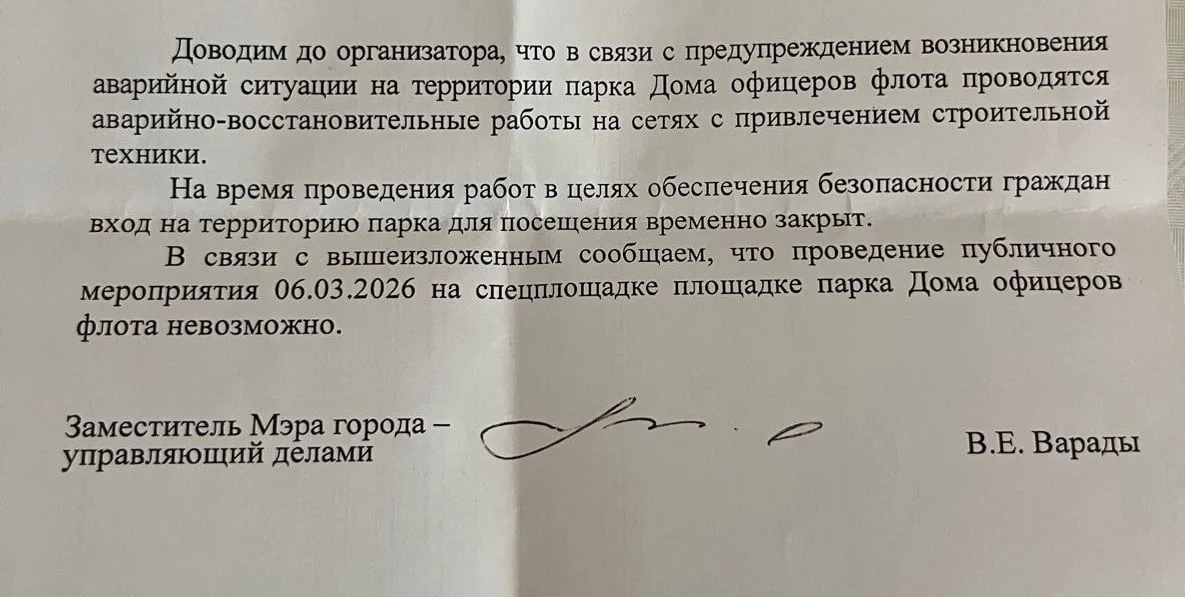
In Khabarovsk, the city administration refused to allow the Rassvet party to hold a rally for free Internet, which was planned to be held in the park of the House of Fleet Officers. And the day before the event. With an indication that emergency restoration work on utility networks has begun in the park, which is why the entrance to the territory is temporarily closed. The organizers noted that earlier the administration itself had proposed this site for the action, but after the cancellation it did not offer an alternative location. At the same time, at the entrance to the park there is a sign “The park is temporarily closed for technical reasons,” but the entrance remains open, people continue to walk around the territory, and there is no construction equipment.
In Moscow, Yabloko was denied permission to hold a rally on March 1 against the blocking of Telegram due to “Covid” restrictions, which are still in place in the capital (as well as in St. Petersburg).
At the same time, they referred to paragraph 2.6 of the decree of the mayor of Moscow dated June 8, 2020 No. 68-UM “On the stages of lifting restrictions established in connection with the introduction of a high-alert regime,” according to which allegedly “the ban on holding public events in the city of Moscow continues to apply.”
The fact that the epidemic ended a long time ago is well known - and even the capital’s authorities admit this: in June 2025, the deputy head of Rospotrebnadzor in Moscow, Elena Ignatova, acknowledged the improvement in the epidemiological situation in the city, and specialized capital resources stopped maintaining and publishing infection statistics. But something else is interesting: in the mentioned decree of the mayor of Moscow there is no such clause at all. Clause 2.4 is the last, followed by clause 3.
This did not prevent the fact that one of the applicants of the rally, the head of the Moscow Yabloko, Kirill Goncharov, was issued a warning by the Simonovskaya Interdistrict Prosecutor's Office of Moscow about the inadmissibility of violating the law at the very rally that was banned. Moreover, the prosecutor warned: “Information has been received about illegal actions being prepared that contain signs of extremist activity in connection with the organization of an uncoordinated public event. <…> Carrying out uncoordinated events may lead to a violation of public order at polling stations in Moscow.”
How interesting. It turns out that there were elections in Moscow on March 1? “I’d like to believe that the worthy won,” Goncharov sneers...
Well, now - about innovations.
A year ago in Krasnoyarsk, a protest rally was denied due to SVO. And they wrote in the refusal: “holding public events during the period of a special military operation declared by the President of the Russian Federation Putin is unacceptable.” The law, however, does not contain such grounds for refusal.
In Irkutsk, the head of the local Yabloko, Grigory Grabenko, and activist Pavel Kharitonenko, first approved the rally “For a Free Internet”, and then withdrew the approval, stating that the event had attracted “considerable public attention,” that more people could come than announced (300 people), and the organizers of the rally would allegedly not be able to guarantee the safety of the participants.
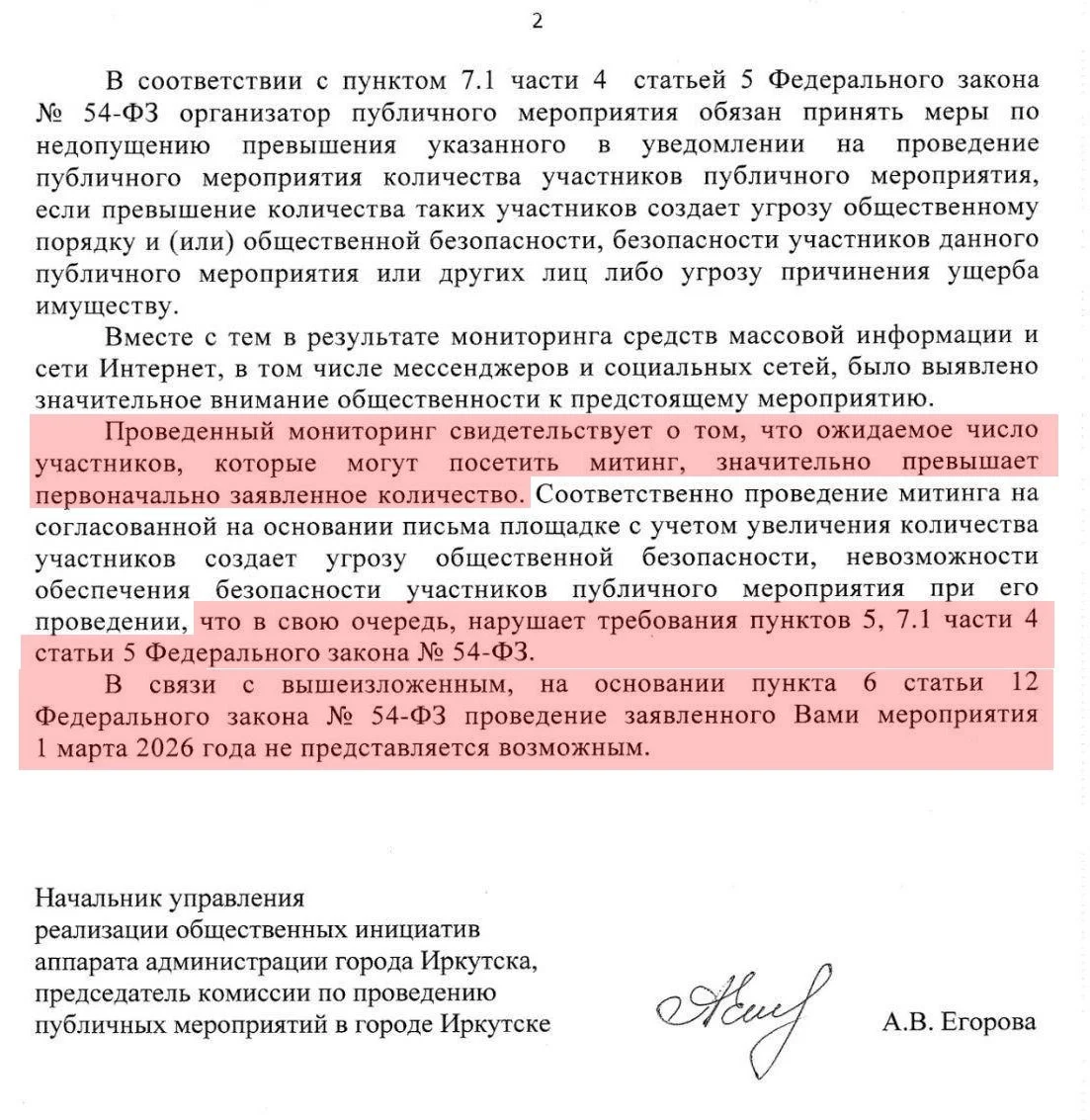
Yabloko members went to court, which declared the ban on the rally legal, although, according to the federal law “On Police,” ensuring order at any agreed public event is the task of law enforcement agencies.
The organizer of a public event (already under the federal law “On Rallies”) can only assist in ensuring order within the framework of his competence.
And there is no such basis for refusing to hold a rally as the alleged inability of the organizers to ensure security in the federal law on rallies.
But these arguments had no effect on the court.
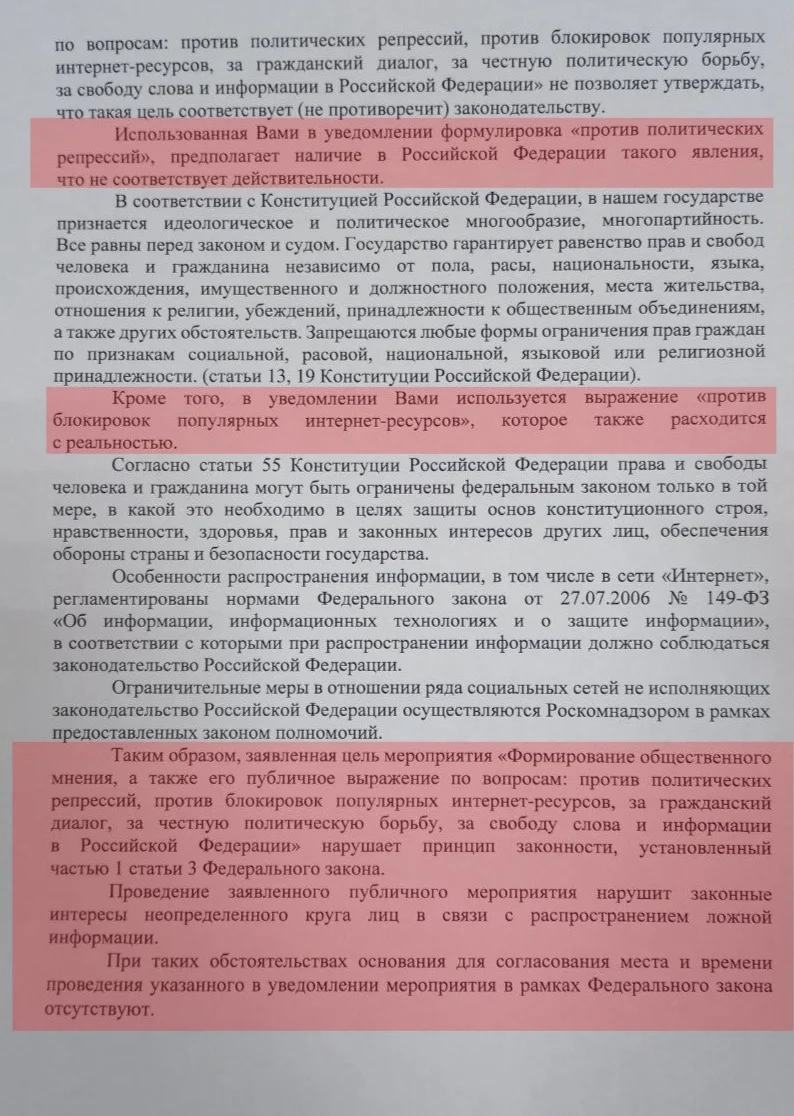
Finally, in Barnaul, the local branch of the Communist Party of the Russian Federation was refused approval for a rally against political repression and Internet blocking, because these phenomena simply do not exist in the country.
“The wording you used in the notification “against political repression” suggests the existence of such a phenomenon in the Russian Federation, which is not true. In addition, in your notification you use the expression “against blocking of popular Internet resources,” which also diverges from reality,” the administration said.
And she added that holding the rally “will violate the legitimate interests of an indefinite number of people due to the dissemination of false information.”
What information is false in this case - whether there are political repressions in Russia (as well as blocking of Internet resources) or not, can be easily verified by looking at resources that have not yet been blocked.
And the question is appropriate: what kind of “indefinite circle of persons” is this, whose legitimate interests will be violated by the message that there are both repressions and blockades in Russia? Who are the Barnaul authorities so zealously protecting?
However, the result is simply a classic illustration for “Moscow Kitchens” by Yuli Kim:
*Actually, there’s nothing special to think about here:
The most real terry anti-Soviet.
The text of the poster demands from the Central Committee
Freedom for political ZKs.
But among all the enlightened peoples
It is known that we have no political prisoners.*
*Once we have done away with the cult of personality,
One crime remained in the cash.
But the poster says the opposite,
Thereby actively promoting
That our government is merciless and hypocritical,
Which, as we know, is fundamentally wrong...*
The play takes place in the 60s and 70s, and was written by Yuliy Chersanovich in 1990. When we were sure that everything described was a totalitarian past that would never return.
Vladimir Maksimov