
Translated material
Knife vs telescope
About Zora Hurston's book "Mules and Men"
Until recently, the name of Zora Neale Hurston in Russia was known only to specialists in ethnography and black modernism. But over the past two years, several works have been published in Russian, representing different facets of her talent. The originality of Hurston’s literary-anthropological method is analyzed by the editor of Gorky, Ivan Napreenko, using the example of the book “Mules and Men”.
All of us, since February 24, 2022, have found ourselves in the face of advancing barbarism, violence and lies. In this situation, it is extremely important to preserve at least the remnants of culture and support the values of humanism - including for the sake of the future of Russia. Therefore, the editors of Gorky will continue to talk about books, reminding our readers that there is still a place for thought and fiction in the world.
Zora Neale Hurston. Mules and people. M.: Alma Mater, 2024. Translation from English by Olga Isaeva. Content

The situation will become more complicated if we assume that the metropolis and the colony are united and even mixed within one country, and the colonialists and “savages” live side by side - in a word, if this happens in the USA at the beginning of the 20th century. Who can and should obtain knowledge about the community? Who is it available to? What will be the text that carries this knowledge?
It is precisely these questions that the book “Mules and Men” makes one think about—at first glance, the least striking work of Zora Neale Hurston that has become available to domestic readers over the past two years. Until recently, this name in Russia was known only to anthropologists and specialists in African-American literature of the 20th century. Now, in Russian translation, you can read the writer’s most famous work - a novel of education (“Their Eyes Were Seeing God,” 1937), an ethnographic work about voodoo practices in the Caribbean (“Tell My Horse,” 1938), as well as the story of one of the last witnesses of the Transatlantic slave trade, the former slave Cudjo Lewis (“Barracoon,” 2018), published after Hurston’s death.
Mules and Men was published in 1935, the same year Margaret Mead's Sex and Temperament was published. Both Hurston and Mead worked at Columbia University under the scientific direction of the founding father of American cultural anthropology, Franz Boas, but their work is not similar, nor is the fate of their work. Sex and Temperament is a classic anthropological work. It is based on the results of a white researcher's trip to the Papuans, built on participant observation, and invites American readers to reflect on the relativity of gender rules. The publication was immediately recognized by the academy.
Mules and Men is a different story. Its author is a black writer who collected material in Florida, where she spent her childhood, and New Orleans. Written in the first person, the book consists of two parts, which at first do not even try to seem formally whole. And if the New Orleans part, where Hurston describes his apprenticeship with sorcerers of the Hoodoo tradition (the Louisiana equivalent of voodoo), still resembles a field diary, then the Florida part is more like a collection of slave tales, legends and songs inserted into the frame of the researcher’s conversations with informants. The material is presented “naturally”, without generalizations or signs of analytical distance. This seemed so atypical, even frivolous, that Boas, instead of an extensive preface to his doctoral student’s work, limited himself to a couple of introductory paragraphs. There, in particular, it was said that “Miss Hurston’s enormous merit is that she was able to once again become one of her own for the southern blacks, the comrades of her childhood, and see their life without embellishment, without the pretense to which they often resort, her world from the eyes of a white observer.” "Mules and Men" received a mixed reception. Some praised the ethnographer for his light and lively rendering of African-American folklore, while others criticized him for insufficient emphasis on the social problems of the black population and pandering to the tastes of white readers who wanted to see African-Americans “in the safe and narrow orbit where America prefers to see the life of the Negro - between laughter and tears.”
Indignation was also caused by the fact that Hurston carefully conveyed the peculiarities of African-American pronunciation in writing, i.e., she wrote “Ole Massa begin to figger dat John musta seen something” instead of “Old master began to figure that John must have seen something” (this feature was completely lost in the translation, which was otherwise remarkable). This not only gave the work an "unscientific" sound, but was also read as supporting stereotypes of uncouth slaves, contrasting with the desire of other participants in the Harlem Renaissance to present an idealized image of African Americans. It is worth considering that Hurston did not support the Civil Rights Movement and had her own views on the racial issue, opposing “begging” for equality between blacks and whites. In this regard, she suggested taking an example from the aborigines of North America: “It was unthinkable for an Indian to strive for a violent union with anyone. His well-known pride and self-respect saved him from this. I take the Indian position." It is not surprising that “Mules and Men,” along with her other works, were gradually forgotten and rediscovered only in the early 1970s, and today they are inscribed in the tradition of paradoxically optimistic and life-affirming African-American modernism.
In the first lines of the book, Hurston identifies the already familiar problem of boundaries and the production of knowledge about community:
“When I was offered to go on an expedition for Negro folklore, I was happy, because for me this is my native environment. Having fallen headfirst into this world, I found myself straight in the Negro cradle. From early childhood I knew about the funny pranks of Brer Rabbit, I knew what the owl screams when he sits on the roof at night. But this knowledge was akin to a tight shirt: once you put it on, you won’t be able to see the pattern on it. It was only at university, far from my native place, that I was able to look from the outside. But for this I needed a telescope, the role of which was played by anthropology.”
To understand who you are, you need to get out of yourself and look through a telescope - that is, through an instrument that, as it turns out after a couple of pages, is used by angels, agents of heavenly power ( “Do you know why lightning happens? It’s the angels who look down through telescopes, and the glass reflects.” ). At the same time, Hurston does not sail overseas to the tribes - she goes to her fellow tribesmen: “I knew that even for me it would be difficult among strangers, but in Eatonville everyone is friendly, they will help me.” Her position is that of a native ethnographer, an “aboriginal ethnographer,” a kind of third way in relation to the alternatives indicated at the beginning of the text. What's interesting about Hurston's book, however, is that it honestly shows that being "on" doesn't guarantee the success of an event. The power relationship between researcher and researched may be contested.
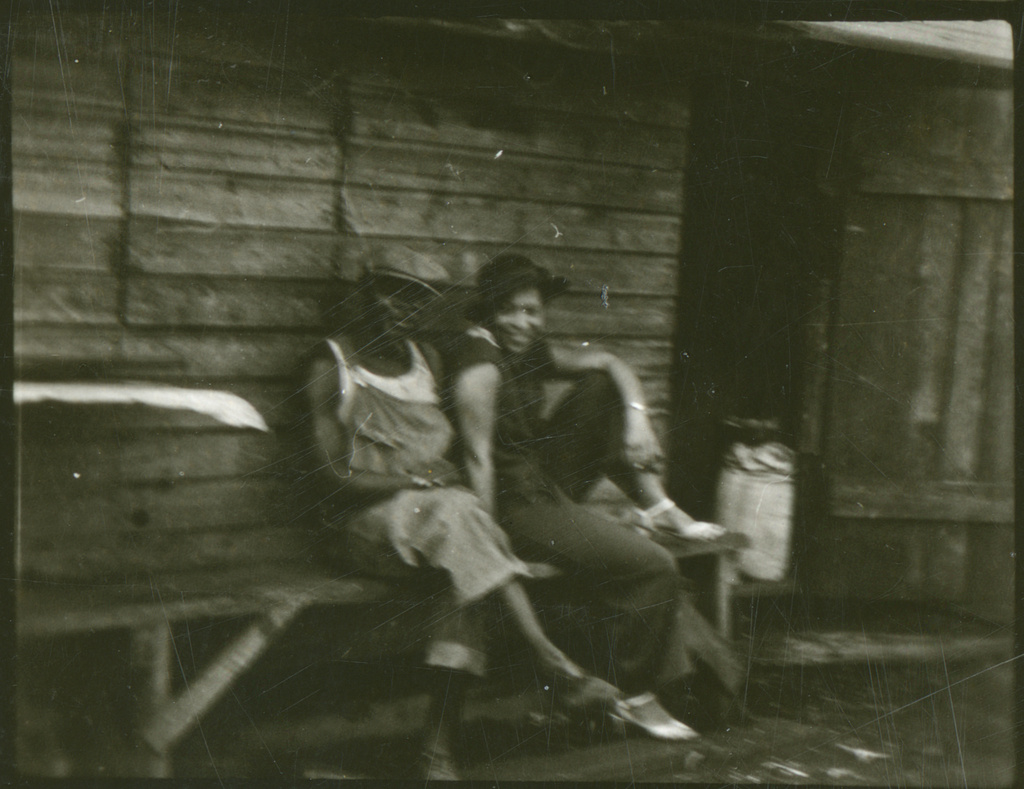
It quickly becomes clear that local residents are in no hurry to open up to a fellow countrywoman who came from the North, in a car and in a dress for 12 dollars, while all the Eatonville women are dressed in “shabby robe dresses”, issued by mail. Hurston tells the incredulous that she is hiding from the law: “I got caught smuggling... I need to lay low.” At first, this seems to relieve tension. The ethnographer is able to exercise the rituals of his epistemic power with the help of a pencil, a notebook and an invisible telescope.
Hurston collects folklore material, where the world, if you look through the jokes, appears as an arena of endless competition between the devil and God, women and men, black and white, crocodiles and dogs, everyone and everyone, a cycle of cunning and deception, where an African American, despite his unenviable position, manages to slip between the trickles of rain - but not always. It would seem that the researcher manages to bypass the “feather-bed tactics” with which blacks protect their lives from prying eyes: ““The white man always sticks his nose into other people’s affairs,” the black man thinks. “I won’t let him into his soul, but I’ll put some trinket out the door for him. He’ll read my handwriting, but never my thoughts. I’ll throw him a toy so that he’ll leave behind and go away, and then I’ll speak out and sing.” However, the conflict spills out beyond the boundaries of the mythological universe, drawing the ethnographer into it. Hurston learns that the incredulous informant is planning to kill her.
The first part of the book ends with a scene where the ill-wisher comes to fulfill her plan at an entertainment establishment.
“...Lucy appeared on the threshold with a knife in her hand. She immediately fixed her gaze on me: maybe she had been peeping through the window from the darkness for a long time. I'm against the wall next to Skinny, Lucy has blocked the only exit.
- Stop the music! - she shouted, without moving from her place. - Don’t dare to strum until I give permission. Now I’ll turn everything inside out here! I have the law in my mouth!”
What does the strange phrase “I have the law in my mouth” mean, besides the demand to obey? These words should be understood as a revolt of the field against the researcher: the cognizable object asserts its subjectivity in the face of the aboriginal ethnographer, its will in determining the meaning and meaning of its own speech, deposited with pencil lines in a notebook. The tactics of feather beds are being replaced by the practice of a knife; you can’t brush them off with a telescope. Hurston is forced to flee.
The second part of Mules and Men, in contrast to the first, is practically devoid of dialogue. There is no trace left of the position of the included observer. The researcher methodically, without wasting time on comments, records how she becomes a student of Louisiana sorcerers, undergoes initiation, masters rituals, fulfills orders from clients - returns lovers, casts spells on enemies, helps in court, etc. At some point, you begin to wonder: is this really research material, and not a textbook on shadow magic? And how does all this relate to the first part?
“That same night we started burning black candles. They placed nine candles in a barrel and every midnight they came to call on Death so that it would cling to the one who was about to die. It was a matter of revenge, so Pierre bit off the lower ends of the candles and lit them not from above, but from below.
After a month, we buried the coffin with the doll on top of the remains of the cat and chicken. Bouquets of white flowers were placed at the head and feet of the grave.
We placed the bull's brain on a plate, surrounded by nine pods of hot pepper, on the altar - this causes madness and shock. The tongue was cut at one end, a piece of paper with the name was inserted, the cut was pinned together with pins, and then the tongue was placed in the same grave.
“Black candles must burn for ninety days,” said Pierre. - He will die. No one can stand this.”
One of the critics' complaints about this part concerns the lack of compliance with research ethics: Hurston's informants did not know about her true intentions, otherwise they would hardly have revealed the secrets of their craft. As if in response to these accusations, the ethnographer ends the book with a fable explaining why cats wash themselves after eating - because if this is done at the beginning, the dinner has time to escape.
“The cat ate the rat, and then washed itself and licked its paws. Since then, all cats have done this. Here I am, like Sister Cat: I wash myself and remember good manners.”
Would The Chrysanthemum and the Sword have been written if Ruth Benedict had questioned the ethics of collaborating with the CIA?
But let's return to the question posed at the beginning of the material. There is another possible answer to this, which, however, goes beyond the usual understanding of scientific objectivity. Hurston herself said that her area of research was literary science. The transfer of knowledge in the form of text is always, to a certain extent, a betrayal; it’s just that writers, unlike anthropologists, are not ashamed of this. This does not mean that the researcher can be left to the whims of fantasy, but rather that the result of his work is the presentation of a life story, and therefore there are always aesthetic choices and artistic elements that should be accepted and not disguised. It is in this sense that Clifford Geertz later called anthropological texts fiction, since they are “made” through an interpretation of what happens, for which the researcher is responsible (even if Mules and Men does not resemble “thick descriptions ,” Hurston in many ways anticipates interpretive anthropology).
We do not have Hurston's own definition of literary science, but we can assume that "literariness" for her is another way of grasping reality holistically, that is, a step towards "dealing with the life we actually live" as opposed to "the life that sociologists imagine." Hence the disdain for academic rigor, the polyphony of voices, the desire to convey live speech, the recording of one’s own emotions and the presentation of material “as it is”, without analytical comments. From this perspective, one can see that the parts of “Mules and Men” are united by an experiment with the author’s position. The point of view of the aboriginal ethnographer, fraught with its own failures, is replaced by complete immersion in the narrative: having thrown away the telescope, the researcher herself becomes the heroine of her text.
...You can read this book purely for the sake of useful everyday advice:
“Be courteous to ghosts and do not harm orphans.
When someone calls you by name, do not respond immediately: it could be a ghost. If you answer him, you will soon die. Ghosts never call twice—wait it out and perhaps avoid death.”