
Translated material
With a hare against a big pile
About the book “Ecological poetics of Andrei Platonov. Stories from the late 1930s–1940s"
A forerunner of posthumanism and a writer who thinks ecologically, this is how British researcher Alex Thomas sees Andrei Platonov. There is a big stretch in this version, and it is not due to the fact that Platonov’s ideas do not fit well into the modern environmental agenda, but to the fact that the Soviet modernist goes much further, Ivan Napreenko is sure.
All of us, since February 24, 2022, have found ourselves in the face of advancing barbarism, violence and lies. In this situation, it is extremely important to preserve at least the remnants of culture and support the values of humanism - including for the sake of the future of Russia. Therefore, the editors of Gorky will continue to talk about books, reminding our readers that there is still a place for thought and fiction in the world.
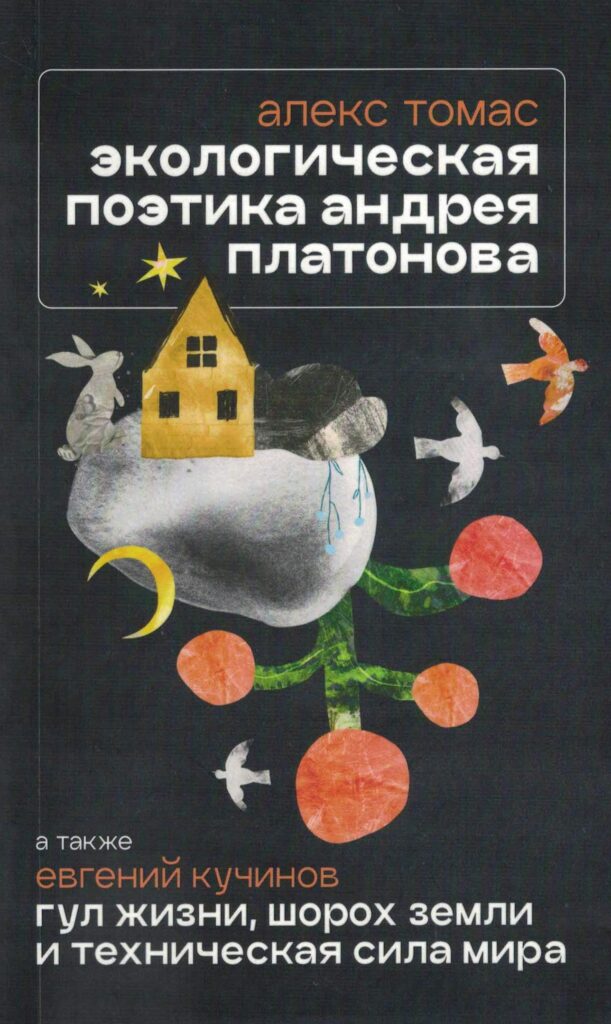
Alex Trustram Thomas. Ecological poetics of Andrei Platonov. Stories from the late 1930s–1940s. M.: Common Place, 2023. Translation from English by M. Mushinskaya, afterword by E. Kuchinov. Content . Fragment
According to many researchers, the reason for such an understanding can be found in Platonov’s article “On the First Socialist Tragedy” (1934) - I just quoted a few passages from it. It is in it, as is commonly believed, that the solid core of Plato’s later works emerged. The British researcher calls this article an “ecological manifesto” and weaves his own overtone into the storyline: it was then, in the mid-1930s, that Platonov stopped the Prometheanist struggle with nature and began to reconcile with it. In a small book that grew out of his master’s thesis, Thomas tries to show that Platonov’s later work is replete with ecological—in the most modern sense of the word—motives, and that the writer himself is a forerunner of posthumanism.
At the center of the work is the story “Among Animals and Plants” (1936). His story is this: after the success of the story “Immortality,” written after a meeting with the head of the railway station in Krasny Liman, Platonov was urgently given a new order. The writer went to the Karelian wilderness to write about Ivan Alekseevich Fedorov from the Medvezhya Gora station (at that time the “capital” of the camps where prisoners were building the White Sea Canal). Fedorov was awarded the Order of the Red Star for the fact that, at the cost of his own injury, he stopped a railway platform that threatened to crush people. According to Thomas, Platonov fits Fedorov’s life into a push-pull structure: at first, the hero seems to emerge from the forest, entering the world of technology and the city through the hut, then, having experienced trauma and disappointment, he returns home, and then into the bosom of nature to “look for his father among animals and plants.” “A temporary fascination with the ‘charm’ of the modern city with its technocratic culture is being replaced by a final recognition of the intrinsic and extrinsic value of the non-human natural world,” says Thomas.
In the Briton’s seemingly harmonious presentation, there is, however, a fundamental stretch, and it is not due to the fact that Platonov’s ideas do not fit well with the principles of post-anthropocentrism, but, on the contrary, to the fact that the writer goes much further and thinks much more radically than Thomas sees it.
I don’t want to argue with the author’s basic set of observations. Indeed, in his poetics Platonov purposefully blurs the boundaries between the human and non-human worlds - this revelation is available to anyone who has opened his books in principle. Indeed, in his later works, life flows freely across these boundaries—and it is therefore difficult to deny that non-humans have an intrinsic, autonomous value in Plato's perspective. Thomas, with the help of Adorno, defines this value as an unknowable non-identity: “Using the concepts of the incomprehensibility of nature as the non-human Other and the “sublime” - the residue that arises in any attempt to conceptualize this Other, we will see how in Platonov’s prose the non-human living substance forms a single whole with the human - a gigantic network called the biosphere.
But strange things begin almost immediately. Proving that Platonov is alien to anthropomorphism (read, the inegalitarian raising of animals to the level of humans), Thomas puts extremely similar cases into different categories. When Ivan, seeing the ants as kulaks-exploiters, tramples them, this is “an attack of aggression due to the association of the non-human world with the human.” But when, in the next paragraph, the railway worker notices a hare that sits “almost like a human,” this is “not anthropomorphization, but a way of representing all life as part of an indivisible continuum, where everything has similar properties and experiences . ” A little further, Thomas characterizes the words of the boy Nikita from the story of the same name ( “There are people everywhere, but they don’t seem to be people” ) as “a vivid formulation of environmental discourse,” offering another categorization option for what in all three cases is difficult to define as anything other than a literal expansion of the human sphere.
No less serious problems arise when the researcher contrasts technoculture with the non-human natural world. The author himself questions this opposition when he is forced to state the all-consuming empathy of Ivan, who speaks of machines as orphans, “who must always be kept close to your soul.”
Or, let’s say, the singing of the rails: “There was no moon, the faint stars were high up, but the rails shone clearly and far away, as if they were gathering light from all the poverty of darkness, from its scattering in the darkness. Puchkov laid his ear to the rail and heard the eternal singing of metal - from the flow of air, from the noise of distant leaves and branches, causing the rails to hum in response. The rails sounded right, they were probably intact and healthy throughout.”
Thomas points out that this is “a move far beyond the limits of anthropocentric aesthetics,” and adds that “the singing of the rails is not an illusion of the interpretive human consciousness,” and then reports the following: “man only passively perceives the song generated by the air, leaves and branches, and sounds regardless of whether he listens; man does not serve as a mediator in this dialogue of forms of matter. This affirms the external value of these forms in relation to each other, independent of people.” Indeed, the man in this scene listens to the rails only for himself (similar to the way - see below - as ants drag shavings from the railway for themselves), but, it seems to me, this sharply raises the question of what unites people, non-humans and machines - unites in a much more fundamental way than empathy and “good” non-hierarchical description.
They are united by a conflict stretched across the entire universe, and this conflict has a frankly social dimension.
To explain this idea, let's go back to the ants and the hare. “A vile creature with a kulak character - all their lives they drag good into their kingdom, exploit all the small and large solitary animals they can handle, do not know world interest and live for the sake of their greedy, concentrated well-being. Now, for example, the ants were taking away the body of an old deceased worm; Not only do they milk aphids and drink milk, they also love other people's beef. One day, a hunter saw two ants dragging iron shavings from the railroad. It turns out they also need iron. They collect the whole world for themselves, little by little, to make one heap. The hunter trampled the nearest ants and left this place so as not to upset his heart any more.”
And further: “Sergei Semenovich raised his gun. Something moved in the small, nearby grass. He walked there a little. There was a small hare there, still a cub; he sat almost like a human and quickly chewed a blade of grass, helping himself with his front paws, then he wiped himself with the same paws and began to frequently breathe clean, healthy air; he was tired, earning food for himself from an early age: his parents must have died, and he lives alone as an orphan. The hare did not notice the hunter or did not understand his significance. Having recovered, the hare jumped and disappeared. Sergei Semenovich did not kill him: he is too small and almost useless for food, and I feel sorry for him, because he is still a child, but already a hard worker. Let him breathe."
From these fragments, quoted a little more widely than Thomas cites them, it is obvious that Platonov not only and not so much blurs the boundaries between human and non-human, but rather draws a different kind of boundary over them. This strange social boundary is associated with the problem of productive forces, which in the case of animals takes the form of a struggle for food, and in the case of people - a painful transformation of the world. In other words, we find not an apology for reincarnation in the spirit of traditional Buddhism and not a decentration of the human subject in Plato’s texts, but a statement that the whole world is reduced to a spasm of general and purposeful suffering-rebirth.
The philosopher Evgeny Kuchinov leans towards a similar version in the afterword to Thomas’s text - I hope it will grow into a separate book: “If we assume that the two halves of the productive forces (the means of production and people) are present not only in the human, but also in the non-human world, then Platonov’s texts generously respond to this assumption, depicting populous worlds of the non-human, in which electricity is the natural proletariat, plants and insects - holy workers, and electrons use technical objects, fight, become more complex, enter into connections and sing songs.” The philosopher goes even further, arguing that when Platonov calls to fight nature, he does it out of love and in a special way: you need to fight something inside nature, while acting at the same time with it. “Such a loving relationship can be described through an attitude of one-sided discrimination: man is different from nature, but not vice versa. The world is different from the earth, but the earth is not different from the world.”
Now this is something interesting. This seems to clarify the relationship between humans and non-humans in the world, according to Platonov. Overcoming the inertia of matter presupposes its revival, and revival implies the discovery in it of the ability to suffer. It is precisely as inclusion in suffering that one should understand that literal expansion of the sphere of the human, which Thomas confuses with anthropomorphism. Finally, Kuchinov questions the attempt to equate Platonov’s creative evolution with the push-pull fate of Ivan Fedorov, who first fell away from nature, and then understood everything and returned to it again. No, says the author of the afterword, in the 1930s, going through the manifesto “On the First Socialist Tragedy,” the writer brings the motives of struggle and revival - through suffering - to maximum specificity.
And to understand these specifics, we will have to understand the role of machines. Turning to the same fragment where Ivan sees machines as orphans who should be kept close to his soul, Kuchinov shifts the emphasis from “soul” to “orphans”, to the insight that machines, in their own way, also bear “the torment of the world.” These torments are the work of transforming matter, which “is nothing more than the work of animation, which is opposed to Plato’s imaginary animation of animism.” In this perspective, non-human beings, technology and humans turn out to be allies in the war against universal inertia.
In order not to deviate from the mainstream of ecological thought, I will explain this thesis with the help of the famous idea of Bruno Latour. According to his observation, the social life of animals differs from the social life of people in only one way - the degree and quality of complexity. In the monkey collective, sociality is present in the form of expanded, unpacked complexity. Interactions between individuals are not mediated by anything, and each act contains all (rather simple) information about the actor. Human sociality is structured differently: in it, an incredible variety of relationships exists in a collapsed, packaged form (complication), which makes it possible to build much more complex structures. Packaging is produced by technology: in it, social relations are “precipitated”, mediated - but not ideally, with a kind of grinding in, since machines, these middle orphans of the world, have their own causing power.
Thus we see that for Latour the gradient of sociality crosses the universe, and the question of ecology is not how to protect good and wise nature from bad machines and stupid people, but how to reconcile the interests of the figures of this heterogeneous sociality. But for Militant Platonov, the issue of coordination is secondary. The primary thing is that the gradient has a vector of struggle and is itself permeated with struggle. The writer, of course, anticipated the thinkers of the Anthropocene, but not because he proclaimed the equal value of people, machines and non-humans, but because he pointed out: they are all busy on the universal front of the war against entropy, that is, against turning the world into one big heap.