
Translated material
Two fools
Why did Ehrenburg and Platonov turn to the image of a “reluctant trickster” in the late 1920s?
At the end of the 1920s, two years apart, Ilya Erenburg and Andrei Platonov wrote literary texts whose heroes were fools, whose very stupidity challenged the political meanings of the time. Read about how the images of these “reluctant tricksters” are constructed and why writers needed them in the era of the “Great Turning Point” in the material by Mark Lipovetsky.
All of us, since February 24, 2022, have found ourselves in the face of advancing barbarity, violence and lies. In this situation, it is extremely important to preserve at least the remnants of culture and support the values of humanism - including for the sake of the future of Russia. Therefore, the editors of Gorky will continue to talk about books, reminding our readers that there is still a place for thought and fiction in the world.
Russian literature of the 1920s knew many brilliant intellectual tricksters and wits: from Julio Jurenito and Benny Krik to Ivan Babichev and Ostap Bender. Somewhat similar, but still different, narratives were formed around unwitting tricksters - fools who involuntarily give rise to a carnival-like “world inside out” with their words and actions, destabilizing everything they touch. “The Turbulent Life of Lazik Roytshvanets” by Ilya Ehrenburg and “The Doubting Makar” by Andrei Platonov are among such stories.
On the one hand, a Jewish tailor from Gomel, on the other, a Russian peasant. A novel and a story. “A Stormy Life” only partly concerns the USSR; fate drives the poor hero throughout Europe. In “The Doubting Makar” there is also a journey, but no further than Moscow. Meanwhile, in structure, these narratives are quite similar: both resemble a fairy tale plot, but placed in a political setting. Both consist of monotonous episodes, although, of course, there are more of them in Stormy Life. Both here and there, the hero-fool is constantly being reprimanded for inappropriate words and actions - Lazik is generally transferred from one prison to another. The stupid inappropriateness in both cases has a political orientation and irritates the authorities (including outside the text). However, both “A Stormy Life” and “Makar” end, albeit ironically, but still happily: Lazik dies with a smile on his lips in Palestine, and even in a holy place - on the grave of Rachel, and Makar becomes the head of the commission for the abolition of the state and successfully abolishes it.
Why did such different - but differently political - writers as Ehrenburg and Platonov need a fool almost simultaneously? Why was a stupid look and stupid inappropriateness necessary at the turning point of history? After all, what are these two years - 1927-1929, from “Stormy Life” to “Doubting Makar”, from the expulsion of Trotsky to the rise of Stalin, the end of the NEP and the beginning of collectivization - if not a turning point?
"The Turbulent Life of Lazik Roytshvanets"
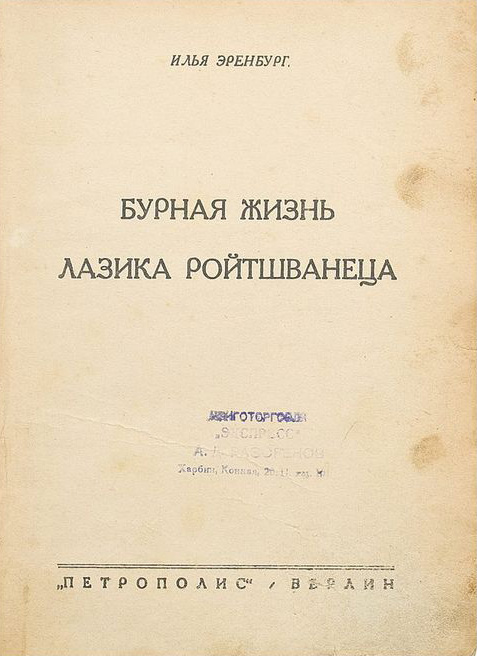
“The Turbulent Life of Lazik Roitschwanets” was published in Russian in Paris in 1928 and was almost immediately translated into several languages. Its publication in the USSR will occur only in 1989. Which, however, does not mean that Soviet readers, at least some of them, were not familiar with the novel. Ehrenburg recalled how in 1934, during the First Congress of Writers, he found himself at Gorky’s dacha, where writers met with the “leaders”:
“There I saw, it seems, all the members of the Politburo, except for I.V. Stalin. I didn't know any of them. When everyone got up after dinner with continuous toasts, M.I. Kalinin, K.E. Voroshilov and other comrades started talking to me; For some reason, everyone was interested in my book, written back in the 20s, “The Turbulent Life of Lazik Roytshvanets”; They liked the book, but, to my great surprise, they added that they felt anti-Semitism in the book, and this is not good. The hero of the said satirical novel is a Gomel tailor, who, by the will of fate, engaged in many professions, traveled many countries, a wretched man, if you like, a spiritual relative of Schweik. L. M. Kaganovich said that, in his opinion, the novel suffers from Jewish nationalism. I was surprised again * Ehrenburg I. G. People. Years. Life. Prep. text by I. I. Erenburg and B. Ya. Frezinsky. M.: Sov. writer, 1990. In 3 volumes. T. 2. P. 38. ”
That this novel can be simultaneously interpreted as both anti-Semitic and nationalistic is already evidence of the trickster nature of A Stormy Life. Ehrenburg did not hide this, directly comparing his hero with Schweik.
However, this comparison does not clarify much. “The Turbulent Life of Lazik Reutshvanets” is a counterpoint to “Julio Jurenito” (1921), which brought Ehrenburg enormous fame. In both the first and second, the action takes place throughout Europe and consists of one-quality episodes, united by the wanderings of the main character and ending with his death. However, unlike Julio Jurenito, Lazik is not an ironic messiah, but a shlimazzle who tries his best to adapt to circumstances, but invariably fails. Announced by Ehrenburg and picked up by critics * In 1928, the Prague magazine “Will of Russia” (No. 4) published an article by N. Melnikova-Papoushek “I. Ehrenburg and J. Hasek." In particular, the author writes: “I. Ehrenburg knows “Schweik”, there can be no doubt about this, even more, he obviously belongs to his admirers and made his Lazik in his image and likeness.” See also Rubashkin A. Schweik from Gomel. About the novel “The Turbulent Life of Lazik Roytshvanets”, Zvezda, 1989: 9: 170–173; Rits Evgenia. Hamlet from Gomel, Jewish.ru, June 16, 2018, https://jewish.ru/ru/stories/literaure/186418/ Lazik’s resemblance to Schweik is deceptive: the mask of a fool makes Schweik invulnerable to the influence of the state and history. Lazik is vulnerable, and even very vulnerable: every episode in the novel ends with the protagonist being beaten and/or imprisoned, regardless of what country he is in; At the end, his entire body is covered in bruises and he still suffers from hunger and remains homeless, even in Palestine. The main similarity with Švejk, apparently, is that Lazik, like Hasek’s hero, is both a character and a narrator - he has a story or anecdote for every occasion in life. True, Lazik’s stories, unlike Shveikov’s, were drawn either from Martin Buber’s book “Hasidic Legends”, or from the stories of the Jewish-Polish writer Oyzer Warsawsky, with whom Ehrenburg communicated when writing the novel * “At the end of the twenties, I met the Jewish writer from Poland Warsawsky in Montparnasse, with his friends. They told me funny stories about the superstitions and cunning of the Old Testament shtetl Jews. I read a collection of Hasidic legends that I liked for their poetry. I decided to write a satirical novel. Its hero, the Gomel tailor Lazik Roytshvanets, is a wretched man whom fate throws from one country to another. I described our Nepmen and provincial scribblers, Polish captains of the sanitization era, German petty bourgeois, French aesthetes, hypocritical Englishmen” (Ehrenburg. People. Years. Life. T. 3 P. 100). . By the way, by the time he met Ehrenburg, Varshavsky himself had already written a novel about Jews who became tricksters during the First World War - “Smugglers” (1920).
Lasik is a special type of fool - a schlimazle and a schlemiel, a loser and a klutz who does everything at the wrong time. Both his small stature (his lovers compare him to a bug or a flea) and his comical name, which connects the revolutionary red color with the phallus, become a sign of failure. Markers of carnival culture mark the story of his birth - his parents got married in a cemetery during a cholera epidemic: “if you can’t fool death, you can cheer it up” * Ehrenburg I. The stormy life of Lazik Roytshvanets. Berlin: Petropolis, 1929, p. 17. Below are links to this publication. . Of the traditional characteristics of a trickster in this character, the most emphasized is his liminality - arrested by the Bolsheviks on a denunciation, he is deprived of his place and home in his native Gomel and goes for a walk around the world. Lazik's route includes Kyiv, Tula, Moscow, Lodz, Poznan, several German cities (from Königsberg to Berlin), Paris, London and, finally, Tel Aviv, where he meets death. But everywhere he remains a tramp, an outcast, dreaming of dinner and ready to do anything for it. He has no place anywhere, including in his native Gomel, and in the land of his ancestors. If Julio Jurenito embodies the explosive energy of modernity, then Lazik Roytshvanets is a victim of the destruction brought by world war, revolution, the new rise of nationalism - global movements that invariably throw overboard the little disenfranchised Jew. As Lazik himself says: “... when one hundred percent history walks the streets, an ordinary person has no choice but to die with complete delight in his eyes.”
Trickster hyper-performativity is expressed in mimicry - Lazik's attempts to adapt to new social roles. But Lazik lacks trickster talent; he is a trickster unwillingly. Therefore, his attempts at mimicry turn out to be a parody at best. This happens when, once in Moscow, Lazik poses as a Marxist critic and writes an “ideological” preface to an unreadable translation of a pornographic novel, or when, already in Britain, he enlists in the service of missionaries and composes a letter to his starving Jewish brothers, calling on them to accept Christianity - but doing it in such a way that his customers are horrified. Most often, Lazik, through mimicry, takes political and ideological norms to the point of absurdity - eradicates the foxtrot, confiscates forbidden literature, pursues “sexual achievements,” breeds rabbits that exist only on paper, or takes on the role of a tzaddik, freeing wealthy Jews from the overly strict demands of Judaism for a moderate fee. All attempts at mimicry fail either because, like the folkloric fool, he takes social conventions too literally or, on the contrary, does not understand them at all. When his new owner, a sophisticated Parisian decadent, orders: “...you will play with my new friend, and I will look at you and experience every movement. I crave sensual pain” - Lazik invites a naked lady to play “play a game of sixty-six or sixty-six,” busily asking: “Why isn’t there a deck there?” Sometimes, even understanding the conventions, Lazik, due to lack of talent, cannot comply with them: posing as a Parisian avant-garde artist, he eats a duck and a rabbit instead of painting them. The sense of self-preservation and the instinct of survival lead to Lazik’s failure in the role of a Bolshevik in the crazy German film “about Russia”; he also fails to play the roles of a child exhausted by fake fish oil in a pharmaceutical advertisement, and a monkey in a traveling circus.
However, in all these transformations there is no transgression . Rather, Lazik only exposes and involuntarily emphasizes the transgressiveness of new social and cultural norms - in this sense, Ehrenburg is equally critical of Bolshevik dogma, emigrant rhetoric, imperialism, decadence, nationalism, aesthetic avant-gardeism, Zionism, prostitution and ordinary fraud. The world has gone crazy, he says, and Lasik is just trying to adapt to this madness. Lazik's falls and sufferings clearly devalue transgressions, demonstrating their incompatibility with the simple interests and modest dignity of the little tailor from Gomel.
Thanks to this shift in the semantics of the trickster trope, the question of Lazik's ambivalence comes to the fore in Ehrenburg's novel. In the case of other tricksters, ambivalence, as a rule, does not require proof; it is obvious and demonstrative. Not so with Lasik. Cultural traditions associated with the representation of a fool suggest that there is some hidden wisdom behind his stupidity. This is both true and false. Lazik now and then, appropriately and inappropriately, utters Hasidic jokes and legends. But these legends, as a rule, exist separately and parallel to his own actions and decisions. This is not the wisdom of a fool, but something else.
Hasidic stories about tzaddikim and sages have self-sufficient value as sparks of divine wisdom, so even collecting them is a service to God * See about this: Gedalyah Nigal. The Hasidic Tale. Liverpool: Liverpool University Press, 2012, pp. 51–59. . However, Ehrenburg is interested in something different in these stories - rather the opposite. From Buber's Hasidic Legends, Ehrenburg selects and characterizes only those plots in which the great and extremely valuable are rejected for the sake of the small and insignificant. This is the story of the Berdichev tzaddik, who “talked to God in the most ordinary jargon <...> and made God laugh, made God laugh so much that God laughed throughout the whole world” and who almost persuaded God to send a messiah to earth, but did not complete the job, because he saw how the pitiful old man Gersh fell unconscious, because “because of his conversation with God, the prayer was delayed and, therefore, the fast was prolonged.” The legend of Christ, who replaced the poor Jew, who, for the amusement of the pope and his curia, was forced to run naked around Rome, as Boris Frezinsky noted, Erenburg himself came up with back in 1915 in the poem “The Tale of the Possessed” * B. Ya. Frezinsky. Comments // Ehrenburg I. G. Collection. op. In 8 volumes. T. 3. M.: Khudozh. literature, 1991. P. 577. . In the same series is the story that concludes the novel about little Yoska, who interrupted the prayer on Judgment Day with his pipe and brought salvation to the entire congregation: “God closed his ears. God forbade me to cry. God no longer heard my prayers. But then the cry of this child was heard. He blew on the pipe, and God heard. God couldn't stand it. God smiled." Ironically, the same theme is heard in the joke about savages and Alexander the Great, where the king of the savages, having learned how “fairly” Alexander’s empire was structured, concludes: “You know what, Alexander the Great, if in your great country the sun still shines and it still rains, it’s only for the sake of small livestock.”
All these and similar stories are metaliterary in nature: they serve to justify the logic of a novel that judges modern civilization from the point of view of a provincial fool and a schmuck, not trying to raise his stakes, but proving that this point of view - the point of view of the victim of history - is important and necessary for understanding modernity. That refusal to take into account this point of view leads to various forms of violence - ideological, political, religious, nationalistic, etc. Lazik becomes a victim of all these forms of violence, they all leave a mark on his exhausted body. Actually, from the very beginning of his ordeal, Lazik understands that he is no longer a Gomel tailor, but just an “unidentified person.” As Cassio de Oliveira, the author of a new book on the Soviet picaresque, notes, “If [Lazik’s] “unidentified personality” can at first be understood as a symbol of the Bolshevik policy of remaking the individual, then as the novel progresses we see that “unidentified” becomes a curse for Lazik, because of it he is excluded from any group to which he tries to join.” * Cassio de Oliveira. Writing Rogue: The Soviet Picaresque and Identity Formation, 1921–1938. Montreal&Kingston, London: McGill-Queen's University Press, 2023, p. 117. .
Ehrenburg in “Lazika” is surprisingly reminiscent of Walter Benjamin with his call in “Theses on the Philosophy of History” to abandon the understanding of history from the point of view of the victors, adopting the “tradition of the oppressed.” Benjamin talks about barbarism as the price of modernity, and Ehrenburg's Lazik is the hero to whom modernity turns exclusively with its barbaric side. What Benjamin calls historical materialism, Ehrenburg prefers to disguise as Hasidic wisdom, giving Lazik the features of a kind of holy fool, or rather, a paradoxical secret tzaddik. This emphasis is emphasized by the ending of the novel, depicting the death of a beggar and homeless hero at a holy place - Rachel’s grave, death with a smile on his face, causing “living tears” even in the evil cemetery watchman.
"Doubting Makar"
As a rule, this story is interpreted as an allegory of the conflict between the “naked” rationalism of the Bolshevik reforms and the organic interests of the people. As Mikhail Geller puts it, “exhausted workers oppose the construction of “eternal houses of iron, concrete, steel and glass” according to plans and under the leadership of smart people with heart, soul, brotherhood. The utopia of the Crystal Palace is contrasted with the utopia of spiritual brotherhood” * Mikhail Geller. Andrey Platonov in search of happiness. Paris: YMCA Press, 1982. P. 148. .
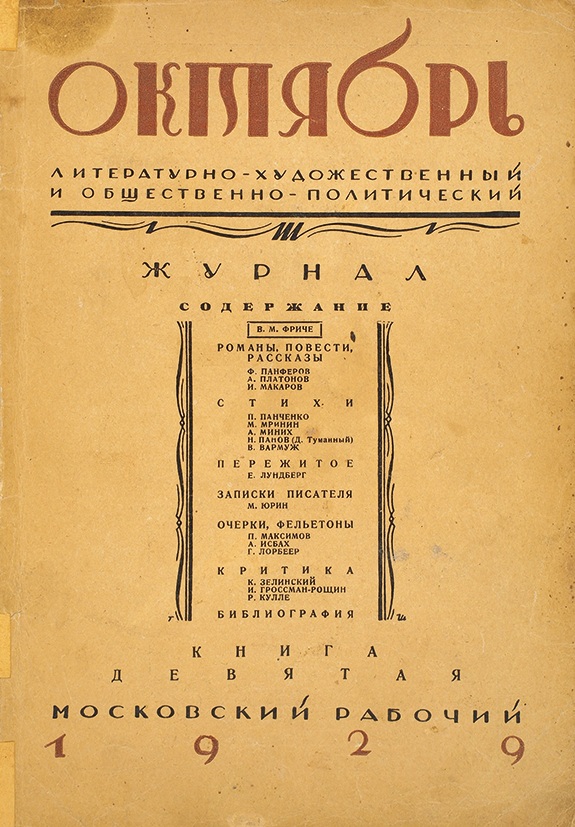
As you know, the story caused a storm of criticism from the leader of RAPP Leopold Averbakh - his angry article about the story appeared in two publications at once - “October” and “At the Literary Post”. Averbakh’s attack on Platonov is inseparable from the “Great Turning Point” of 1929 - the collectivization of the countryside, accompanied by mass expulsions of peasants, and bloody industrialization. Platonov will devote his “Pit” (1930) to these processes in their indivisible unity, not yet written, but clearly maturing in the mind of the writer. But even “The Doubting Makar,” devoid of tragedy and colored with fairy-tale optimism, is already perceived as a transgressive text only because Platonov allows himself to speak on a political topic in a tone that is different from an unambiguous hosanna. In the words of Averbakh: “mockery of everything and irony, equally skeptical in relation to the most diverse phenomena, do not at all testify to the depth of the author’s worldview and the proletarian attitude of his satire” * Averbakh Leopold. About holistic scales and private Makars. Andrey Platonov: Memoirs of contemporaries. Materials for the biography. M.: Sov. writer, 1994. P. 257. Further quotes from Averbakh’s article are given from this publication. .
The essence of Averbakh’s accusations was that Platonov’s story was too humanistic: “It is difficult and difficult for the grassroots working people, the masses, to live. It is hard and difficult for him because we care about houses, and not about the soul, about a holistic scale, and not about an individual person, about future factories, and not about today's dishes. These oppositions reveal the extreme superficiality of A. Platonov, his limitation to the mere appearance of phenomena, his lack of understanding of the main thing in what is happening around him.” And further: “As if there is anything more truly human in the world than the class hatred of the proletariat, as if one can actually show one’s love for “Makars” otherwise than by building those new houses in which the heart of a socialist person will beat, as if one can truly be a person except by feeling that oneself, a person, is only a part of the whole that realizes our idea.”
Averbakh sees not only criminal humanism, but also no less criminal nihilism and anarchism in the way Plato’s character retells Lenin’s last articles in his own words and implements Lenin’s idea of the withering away of the state: “It turns out that Lenin was cursing at our institutions, suggesting that the whole thing boils down to replacing bureaucrats with “mass” people! It turns out that if we make this replacement, the state will die out immediately! It turns out that we don’t have to remember Lenin’s explanations of how deep and why the roots of bureaucracy are in an uncultured country with a class struggle going on in it. It turns out that the state is needed only by the Lev Chumovs, either the commanders of the “oppressive scribal bitch,” or those who themselves are “bitches.” Commenting on Averbakh’s article, Elena Shubina noted: “V.I. Lenin’s articles “How can we reorganize the Workers’ and Peasants’ Inspectorate” and “Better less is better,” written shortly before his death, are retold in Platonic language. But replacing the bureaucrats of the state apparatus with “mass people” is also one of Stalin’s demagogic calls in 1929. Platonov is playing a complex and dangerous game here. On the one hand, it reminds us of Lenin’s last works, which, in essence, contained criticism of Stalin, who then headed the workers’ and peasants’ inspection; on the other hand, the attitudes of both leaders are ironically reduced: the activities of Makar and Peter are nothing more than the logical conclusion of Lenin’s utopia on state leadership, brought to the point of comicality...” * Andrei Platonov, p. 267. .
It is known that Averbakh’s attack on Platonov was personally inspired by Stalin. Alexander Fadeev, at that time the editor-in-chief of October, which published Platonov’s story, wrote in a letter to the old Bolshevik Rozalia Zemlyachka: “I recently missed Platonov’s ideologically ambiguous story “The Doubting Makar,” for which I got it right from Stalin, an anarchic story.” * Alexander Fadeev. Collection op. In 5 volumes. T. 5. M.: Khudozh. lit., 1961. P. 304. . As Mikhail Geller believed, it was not for nothing that Platonov’s story aroused the wrath of Stalin: “Peter and Makar contrast the Stalinist utopia—discarded by the party—with the Leninist utopia <...> Having read Lenin, the proletarian Peter and the peasant Makar decide “to go fight for Lenin’s and the common poor cause.”... But the utopia of Makar and Peter was also a refutation of Lenin’s utopia by bringing it to logical end" * Geller, 151. .
Despite its apparent artlessness, the story represents a milestone in the history of the Soviet trickster. If in Ehrenburg the fool appears as a victim of modernity, then in Platonov a similar character goes on the offensive against the state, which declared itself the first state of workers and peasants in history. It is also a turning point for Platonov himself. On the one hand, here the writer speaks directly on political topics for the first time. Subsequently he will say: “I was looking for an opportunity to be a political writer.” * Andrei Platonov: Memoirs of contemporaries. Materials for the biography, 300. . On the other hand, it was after Makar that the party bosses and Stalin personally would see the “native proletarian” Platonov as a hidden enemy.
At first glance, Makar is a classic fairy-tale fool: “He could not think, having an empty head over his smart hands, but he could immediately guess” * Platonov, p. 217. . Many have written about the fabulousness of the story (Geller, Shubin), but at the same time, as a rule, they lose sight of the fact that Makar, despite his “clever hands,” like a folklore fool, does not do anything sensible. Even the “people’s carousel” he built, driven around by the power of the wind, does not work due to the lack of a storm “that could move the carousel from its place.” Which, of course, confirms Makar’s engineering genius - his carousel can only work in a storm! The question of who will ride the carousel in a storm remains open.
All his further attempts to do something with “smart hands” end even worse. In exchange for the runaway foal, Makar promises to construct for Chumovoy “a self-propelled gun <...> from hoops and ropes.” For the sake of the miracle machine, he even extracts iron ore from a well and smelts iron in his home furnace. However, wheels made from this iron do not roll: “not a single wheel moved on its own, they had to be rolled by hand.” This is how the “self-propelled” idea ends ingloriously.
Further, having arrived in Moscow and seeing how milk in cans was being transported to the city from the suburbs, “Makar approached the dairy boss, who was in charge of the cans, and advised him to build a milk pipe from here all the way to Moscow, so as not to drive cars with empty milk containers.” Makar then repeats this brilliant idea after seeing how concrete is lifted to the upper floors of a Moscow construction site. The interchangeability of milk and concrete is comical in itself. But now Makar is already sure that he “invented the construction gut”; With this “invention” he goes to the “main Moscow scientific and technical office.” The following scene takes place here:
“Houses should not be built, but cast,” Makar said to the learned scribe.
The scribe listened and concluded:
- How will you prove, comrade inventor, that your gut is cheaper than ordinary concrete?
“And the fact that I clearly feel it,” Makar proved.
The scribe thought something secretly and sent Makar to the end of the corridor.
“They give poor inventors a ruble for food and a return ticket by rail.”
It is obvious that Makar is not the first such “inventor” and that the procedure for rewarding and returning fools home has already become standard, there are so many of them. Against this background, the ending of the story takes on an openly ironic sound, depicting how Makar and his friend Peter “abolished” the state:
“... Makar and Peter sat down at the tables opposite Lev Chumovoy and began to talk with the poor people who came, solving all matters in their minds - on the basis of sympathy for the poor. Soon the people stopped going to the institution of Makar and Peter, because they thought so simply that the poor themselves could think and decide in the same way, and the working people began to think for themselves in their apartments.”
If the “simple” thoughts of Makar and Peter are as effective as the “inventions” of Makar, then “the people stopped going to institutions” not because of the intelligibility of these thoughts, but on the contrary, because of their impenetrable stupidity and uselessness. The “People's State” represented by Makar and Peter turns out to be an even more absurd formation than the Soviet project, supposedly headed by a dead “scientific man” (Makar’s dream). When Makar comes to a workers’ shelter, he receives the following “social order” from the workers: “Give your soul, since you are an inventor.” The triumph of stupidity is Makarov's answer to this request. Of course, for Platonov the word “soul” was not an empty phrase, but such logic is clearly visible in the story, regardless of the author’s intentions.
The peculiarity of Makar as a character is seen in the fact that he is not only a fairy-tale fool, but also a carnival clown, who, according to Bakhtin’s characterization, has “the right not to understand, to confuse, to mimic, to exaggerate life; the right to speak, parodying, not to be literal, not to be oneself”, the right “to be a stranger in this world” - “they do not identify with any of the existing life situations of this world, none of them suits them, they see the wrong side and the lies of each position” * Bakhtin M. M. Questions of literature and aesthetics. M.: Khud. lit., 1975. S. 312, 309. . This function is indicated by Makar's surname - "Ganushkin" * In other stories by Platonov about Makar, he bears the surname "Prokhorov". . According to Geller, it is “derived from the word “ganit”, meaning “to find fault, blaspheme, blame, condemn, disgrace, disgrace.” Many researchers called Makar’s misunderstanding of Moscow life a way of satirical defamiliarization: when he asks “to show him the way to the proletariat,” he finds himself in a shelter next to beggars and seasonal workers - class inequality, as it turns out, persists even in the conditions of building socialism. However, many of Makar's other gestures have the character of self-sufficient carnival clownery. For example:
“The woman, the tram owner, gave people receipts, but Makar, so as not to embarrass the owner, refused the receipt. - I do! - said Makar and walked past.
They shouted to the hostess to give something upon request, and the hostess agreed. Makar, in order to check what was being given here, also said: “Mistress, give me something upon request!”
The hostess pulled the rope, and the tram soon stopped short on the spot. “Come out, as required,” the citizens said to Makar and pushed him out with their pressure.”
There is a double misunderstanding here: at first Makar does not understand that he needs to buy a ticket for the tram and “nobly” refuses it. Then Makar wants to take advantage of an opportunity he does not understand, supposedly provided by the “hostess,” and finds himself thrown out of the tram. Let us also note the obvious sexual connotation of this scene: “They shouted to the hostess to give something upon request, and the hostess agreed.”
This is followed by dialogue based on a comically concrete answer to an abstract question. Makar asks a passerby: “Where is the very center of the state?” The answer to this question is a comic pantomime: “The man pointed with his hand and threw a cigarette into a street trash can. Makar went up to the bucket and also spat in it so that he could have the right to use everything in the city.” The center of the entire state is found in a trash can, and Makar gets the right to spit in it.
Symbolization of gesture is a characteristic feature of clowning. Following this logic, Makar symbolically interprets the traffic controller’s gestures: “At an intersection, a policeman raised a red stick upside down, and from his left hand he made a fist for the driver carrying rye flour. “They don’t respect rye flour here,” Makar concluded in his mind, “here they feed on white females.”
The reverse operation is also possible: comic concretization of an abstract verbal gesture. Thus, seeing in the workers’ and peasants’ inspection the slogan “Who will win?”, which, of course, refers to the struggle of socialism against the remnants of capitalism, Makar immediately interprets it as a proposal to beat up Lev Chumovoy, who is also there: “Since it says “who will win?”, then let us give him....”
The culmination of this parade of inappropriate gestures is the reading aloud of Lenin's work - clearly understood as a sacred text - not just anywhere, but in a madhouse. The carnival meaning of this scene is emphasized by the translation of the sacred precepts of the founder into the carnival language of the “bottom of the body”:
“Our institutions are crap,” Peter read Lenin, and Makar listened and was amazed at the accuracy of Lenin’s mind. - Our laws are crap. We know how to prescribe, but we don’t know how to execute. In our institutions there are people hostile to us, and some of our comrades have become dignitaries and work like fools...
Other sick souls also listened to Lenin - they did not know before that Lenin knew everything.
- Right! - both workers and peasants who were sick at heart agreed.”
It is tempting to interpret this scene as evidence of Makar's status as a socialist holy fool. His anti-behavior makes us recall the following characteristic of the holy fool: “...“obscenity” was perceived by society, among other things, as a form of divine control over power. <...> Various kinds of extravagance can be called foolishness only if its witnesses see behind it not just mental health or pure morality, but also some special motivation, a reference to another reality” * Ivanov S. A. Blessed obscenities: A cultural history of foolishness. M.: AST, Corpus, 2019. P. 9. . Another reality to which Makar’s clownery refers is the reality of communism, which is understood by Platonov and his folk hero, a fairy-tale fool, completely differently than the way communism is understood by the ideologists of collective farms and industrialization * Accusations of “foolishness” were constantly heard in critical speeches against Platonov. Thus, Alexey Selivanovsky wrote about Platonov’s “wretched, tiresome, self-repeating foolishness” (Selivanovsky A. “What Andrei Platonov doubts,” Literary Newspaper, 1931, June 10). Alexander Fadeev in the article “About one kulak chronicle” wrote: “The holy fools and fools, at the direction of Platonov, do everything to disgrace themselves before the peasantry to please the kulak, and Platonov, also pretending to be a fool and a holy fool, is mockingly touched by their actions.” (Andrey Platonov, 274.) .
However, the ending of the story gives Makar’s “foolishness” a specific meaning. As Elena Shubina noted, “the whole scene is frankly buffoonish in style.” The buffoonery effect arises because the entire scene consists of “cancellations” - each subsequent plot twist cancels the previous ones. Makar and Peter come to the RKI, where they discover Lev Chumovoy, the embodiment of the “head” of socialism. A struggle is expected between the “grassroots active mind” and Soviet officials. However, no struggle occurs:
“We are class members,” Peter said to the highest commander. - We have accumulated intelligence, give us power over the oppressive scribbling bitch...
- Take it. “She is yours,” said the supreme one and gave them power.”
Taking power presupposes revolution and revolutionary change. But they are also abolished along with the state, which turns out to be unnecessary due to the “simplicity” of the leadership presented by Makar and Peter.
The state has been “cancelled” and Lev Chumovoy has been defeated? But this expectation is also canceled by the last paragraph of the story:
“Lev Chumovoy was left alone in the institution, since no one recalled him from there in writing. And he was present there until a commission was appointed to liquidate the state. In it Comrade. Chumovoy worked for 44 years and died amid oblivion and clerical affairs in which his organizational state was placed.”
The chain reaction of cancellations launched by Makar’s clownery is the main, self-sufficient result of his political “intervention.” As in “Lazika,” all long-term and large-scale goals are devalued in “Doubting Makar”—here these goals include the fight against bureaucracy, revolution, popular self-government, and even the utopian “withering away of the state.” Moreover, the position of power turns out to be identical to a complete renunciation of power. The “doubt” and “misunderstanding” of a fool turns out to be a powerful weapon that corrodes the ideological discourse of power until it completely disappears. This is exactly what infuriated Averbakh and what he called “nihilism”: “Nihilism is not only a poetic group of Nichevoks that disappeared without a trace, it is also the other side of the coin, which has “humanism” on its front side.”
But is it surprising that the poor Jew has no place anywhere, and the peasant Makar abolishes the state? Удивительно, по-видимому, то, что каждый из этих дураков как будто представляет некую традицию мудрости — еврейской или русской, хасидской или сказочной, — но по мере развития сюжетов, в сущности, ничего не остается. Или, вернее, остаются одни руины, а герой редуцируется либо до измученного и избитого тела Лазика, либо до бессмысленно-глупого «ума» Макара. Лазик и Макар воплощают оптимального субъекта, создаваемого властью. Эренбург, по существу, демонстрирует рождение глобальной модерной биовласти, для которой человек сведен к телу с его физиологическими нуждами: «На протяжении тысячелетий человек оставался тем, чем он был для Аристотеля: живущим животным, способным, кроме того, к политическому существованию; современный же человек — это животное, в политике которого его жизнь как живущего существа ставится под вопрос» * Фуко М. Воля к истине: по ту сторону знания, власти и сексуальности Работы разных лет. Перевод с французского, комм. и послесл. С. Табачниковой. М.: Касталь, 1996. С. 247. . В этом смысле, как видно из «Бурной жизни», никакой разницы между советской властью и «буржуазными режимами» не существует; этот роман Эренбурга, как и приглашение на «торжественные сеансы уничтожения иудейского племени» в «Хулио Хуренито», сегодня неизбежно вызывает мысль о надвигающемся Холокосте. Макар же фактически материализует реальное представление большевистской власти о «пролетарии» как об активном идиоте с абсурдными идеями, цитирующем Ленина и (по Ленину же) не нуждающемся в государстве. Атаки Авербаха на этот рассказ за «избыток» гуманизма только подтверждают правильность диагноза Платонова: советской власти человек как сложный субъект гуманистический культуры совершенно не нужен.
Однако и в этом, редуцированном, виде дурак остается трикстером — поскольку по-прежнему способен на диверсии против власти. Why? Вероятно, потому, что трикстер способен превратить позицию полного отказа, полного отрицания в источник свободы. В этом случае трикстер будет называться киником — вслед за Диогеном, а в современной культуре — вслед за Фуко и Слотердайком. Когда Авербах соединял в своих обличениях Платонова гуманизм с нигилизмом, он, не ведая того, предлагал весьма емкую формулу кинизма.
Фуко заинтересовался киниками в середине 1980-х, практически одновременно со Слотердайком, еще не зная о его работе * «… книга, с которой я не знаком, о которой мне сообщили лишь недавно, вышла в прошлом году в Германии у Зуркампа, ее автор некий Слотердайк, и она носит торжественное название «Kritik der zynischen Vernunft» («Критика цинического разума»). (Фуко М. Мужество истины. Управление собой и другими II . Курс лекций, прочитанных в Коллеж де Франс в 1983-1984 учебном году / Пер. с фр. А. В. Дьяков. СПб.: Наука, 2014. С. 186). . Кинизм является одним из главных героев последнего цикла лекций «Мужество истины: Управление собой и другими», прочитанного им в «Коллеж де Франс» в 1983—1984 гг. По логике этого философа, кинизм не имеет никакого отношения к современному цинизму, а воплощает философскую критику с точки зрения нагой жизни (bios). Радикальный отказ от потребностей, граничащий с аскезой, по мнению Фуко, является основой кинического «философского стиля жизни» и позволяет кинику «осуществлять в своей жизни и через свою жизнь скандал правды». Вот почему Фуко видит в кинике прототипическую фигуру политического активиста, революционера, нигилиста: «... самый важный способ быть активистом — это активизм как свидетельствование жизнью, стилем существования. Этот стиль существования, присущий революционному активизму и удостоверяемый жизнью, порывает, должен порывать с условностями, привычками, ценностями общества. Самой своей зримой формой, своей постоянной практикой и своим непосредственным существованием он должен прямо заявить о конкретной возможности и очевидной ценности другой жизни, которая есть подлинная жизнь».
Более того, по мнению Фуко, современное искусство — от импрессионизма до Беккета и Берроуза — продолжает традицию кинизма. Во-первых, потому что «устанавливает с социальными нормами, с эстетическими ценностями и канонами полемические отношения сворачивания, отторжения и агрессии»; во-вторых, потому что воплощает понимание «искусства как место вторжения низменного, жизни, выставляемой во всей ее наготе». Слотердайк, кстати, тоже пишет о «неокинизме современного искусства». Так что роман Эренбурга и рассказ Платонова фиксируют тот исторический момент (конец 1920-х), когда традиционный дурак с чертами юродивого и карнавального клоуна превращается в суррогат-революционера, прототипа для создателя современного — подрывного и клоунского — искусства. В следующем поколении именно эта роль будет усвоена андеграундными художниками и писателями-нонконформистами — Андреем Синявским, Венедиктом Ерофеевым, Дмитрием Приговым и многими другими.