
Translated material
“We all grew up on Hasek”
Schweik's experience. Life with an empire
18+. THIS MATERIAL (INFORMATION) IS PRODUCED, DISTRIBUTED AND (OR) SENT BY FOREIGN AGENT GENIS ALEXANDER ALEXANDROVICH OR CONCERNES THE ACTIVITIES OF FOREIGN AGENT GENIS ALEXANDER ALEXANDROVICH.
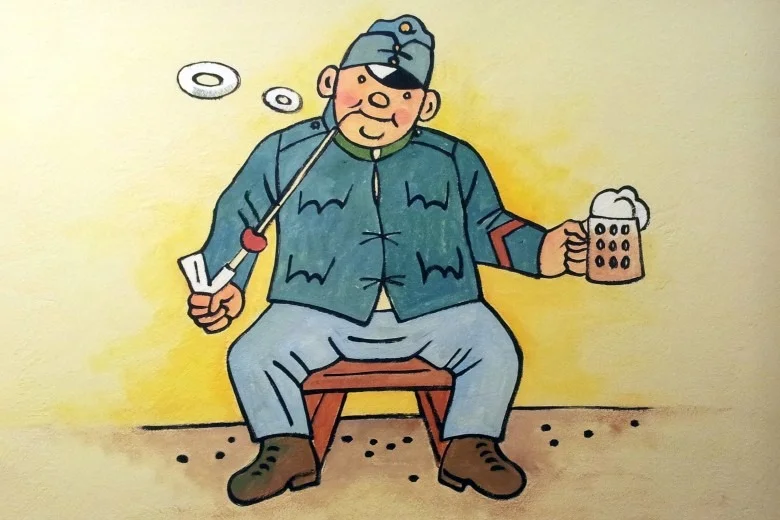
1. Idiot
We all grew up on Hasek, even Marshal Grechko. After the invasion of Czechoslovakia in 1968, he, irritated by negotiations with the Czechoslovak leadership, exclaimed in his hearts: “We also read Schweik!”
A witness and participant in those events, Gorbachev’s classmate Zdenek Mlynarz explained the nature of this famous hero by unfortunate geography:
“The Czechs always had a choice only between a greater and a lesser evil. This people does not have a messianic complex: chasing tanks with a broom does not correspond to our idea of heroism. So it’s no coincidence that Schweik was born here.”
Perhaps this is true. But to the confluence of historical circumstances it is necessary to add the merit of the author, who created a unique, irreplaceable and perfect character in his persuasiveness - the soldier Schweik.
The main thing you need to know about him is already in the fifth line of the novel. This is a statement of intent. We are offered another “story told by an idiot” (“Macbeth”): Schweik “after being declared an idiot by a medical commission, left military service and now makes his living selling dogs.”
Idiocy is the defining trait of a hero. But this is the main secret not even of the book, but of the image that stepped through the binding in order to live on its own in any conditions reminiscent of its homeland, which is what the marshal hinted at.
If Dostoevsky's idiot is too good for our vicious world, then Schweik is just right. He matches his surroundings and overcomes them thanks to his nature, which cannot be explained either completely or convincingly.
The easiest way is to decide that Schweik is pretending, like, say, Hamlet. His “dementia,” which everyone he meets insists on, as in the case of the prince, only dissuades us from the diagnosis - but not completely. Schweik is too simple to pretend. He does not pretend to be someone else, he is someone else. This is his uniqueness in the entire novel. The secret of a perfect disguise is that neither we nor Schweik himself know whether he is an idiot. It is enough that it is convenient for him to be one and be known as one.
Of course, we understand that exaggerated loyalty to the idiotic government is a mockery of it, which irritated the same marshal so much.
But this Shchedrin technique (“They knew that they were rebelling, but they could not help but kneel”) does not at all exhaust Schweik’s tangled relationship with the world. He fits into the environment precisely because he does not play a role, but lives it, joining in without leaving a trace.
Schweik is a complex of contradictions, embodied in a dense man with “stupid, kind” , as the permanent epithet assigned to him insists, blue eyes.
The hero of the picaresque novel, who seems to be a relative of Schweik, is always on his own mind, because he is looking for benefits. But this categorically unbrave soldier is only trying to survive in conditions unsuitable for this purpose, which are called a world war.
“Schweik enters into it,” the author explains on his fingers, “as a representative of “a people who will have to bleed for interests that are completely alien to them.”
2. Empire
Actually, there is not as much war in the book as there could be, given its full title: “The Adventures of the Good Soldier Schweik during the World War.” However, it was difficult to expect anything else from the hero who, the author warns in the introduction, “did not set fire to the temple of the goddess in Ephesus, as the fool Herostratus did, in order to get into newspapers and school textbooks.”
Schweik's merit is that with his very clumsy appearance he compromises the knightly ideal that was destroyed in the trenches of the First World War. He was not going to fight in it, because he knew that no one needed it. Almost the only evidence of the success of the Austrian army, the author casually notes, is a photograph from Serbia, “where a hanged family was photographed: a little boy, father and mother.”
When this whole nightmare ended, Schweik, who denied at least some meaning to this war, turned out to be right. But because of this, both the author and his hero found themselves in an ambiguous position. The enemies in the book are not the battle opponent, whom we don’t even see, but “our own people,” if the Austro-Hungarian Empire, its faithful servants, sadists and executioners can be considered such. All this was reflected in Hasek’s book, which Bakhtin called “deserter.”
We must admit that the Austro-Hungarian Empire was very unlucky in our country. What we knew about her came through the prose of two favorite writers - Hasek and Kafka. We didn’t even really understand how they differed, because we applied both to our own sores.
Devoid of purpose, meaning and justification, the decrepit empire was alien and alien. Schweik, not without reason, considered her infinitely idiotic and dangerous. He judged her in much the same way as Fazil Iskander judged his experience of dealing with the Soviet regime.
“All our lives,” he said, “we were forced to play chess with a violent madman, making sure not to win.”
Schweik was the grandmaster of this imperial game and came out unscathed even when there was no way out at all.
Kafka's hero was unlucky to be born this way. He played by the rules, but those known not to him, but to the incomprehensible power. And this brings the two characters closer together: guilty without guilt.
K. from “The Trial,” like Schweik, does not know why the authorities are punishing him. But both recognize this state of affairs as inevitable. Absurdity is the natural state of empire. Therefore, he is not surprised when he hides from an inattentive gaze:
“ The old woman was tried by a military court, and since nothing was proven, she was taken to the concentration camp at Steinhof.”
It is clear why the enthusiastic readers of first Hasek and then Kafka identified with their heroes: their enemies resembled ours. That’s why everyone so joyfully picked up Bakhchanyan’s mocking pun “We were born to make Kafka a reality.” Schweik was already a reality, and we considered him family.
“Like him,” we reasoned, “we happened to be an internal colony of a stupid leviathan - a small people inside a large one.”
This is the position in which Lieutenant Lukash, depicted not without sympathy, finds himself in the book.
“Being a Czech,” the author writes about him, “ he considered the Czech people to be a kind of secret organization from which it is best to stay away.”
That didn’t stop him from loving Czech songs, just as we love Vysotsky.
It is important to note that no one argued with Schweik. The country of 50 million people, famous for waltzes and cakes, did not find worthy defenders even when the best Austrian prose writer came into our reading circle. Robert Musil also laughed at his homeland, calling it "Pooping" . But at least he suggested who she wanted to be considered. Only when this empire disappeared, like Atlantis or the USSR, did they remember that it dreamed of creating a second America in Europe. Instead, Austria-Hungary was considered a “prison of nations.” In Hasek, the metropolis looks not only stupid, but also ridiculous - due to the exorbitant claims of a minor power to a global role and trust in divine providence. All of it was reflected on a bottle of lousy liquor with a pleading label “God, punish England!”
One way or another, the geopolitical map in Schweik’s view bears little resemblance to the familiar one. Europe, divided between empires, was simple and boring. Once in it, two great Prague writers acquired the status of victims who are brought to the exorbitant Moloch of the authorities without their guilt or state reason.
In fairness, I must say that there was a third contemporary Prague author, whom I love no less than the first two. But Karel Capek was different in that he embodied the norm even when his book involved salamanders. A convinced European, he defended the dignity of reason, especially when he wrote detective stories and defended himself against absurdity with a mockery: “The enemy insidiously attacked our planes, which were peacefully bombing his cities.”
If Capek was a lawyer for the norm, then Svejk did not spend the night next to it.
3. Duet
The narration in “Svejk” is entrusted to two narrators. There is no problem with one thing - the author himself. Hasek uses the entire palette of feuilleton style: evil sarcasm, ferocious pathos, lengthy digressions. In the text “from the author” you can even hear echoes of school learning. Once he calls Schweik's adventures "Odyssey", another time - "Anabasis". But you don’t feel any love for your high school childhood here. One of the most harmful characters in the entire book is Second Lieutenant Dub, a teacher by profession. In order not to become like him, the volunteer Marek, under whom Hasek took himself out, enthusiastically exchanges an officer’s career for anything.
A journalist by experience and recognition, Hasek explains in detail, to the point of obsession, everything he wanted to say, and in his own words, sometimes very funny. For example, he describes military worship as Leo Tolstoy describes an opera: “They began to talk about God as if they were talking about the Chief of the General Staff who directs military operations.” In the middle of the chapter, the author gets stuck on the description of the camp altar, sharing Gogol-style copious and absurd comparisons:
“Painted with garish colors, this altar from a distance seemed like a colored chart for testing the eyesight of railway workers” and “the whole trio blurred, and it seemed as if a train was entering the covered station.”
More often, however, Hasek calls the cat a cat, saying what is already clear. This happens to authors who know exactly what they want to say. This is where the second soloist enters the duet. This is, of course, Schweik himself.
These are called unreliable narrators. We have no reason to believe that he is lying, but we should not trust him unconditionally. Especially if you listen to the nonsense he spouts. Explaining to other prisoners how lucky they were to live in enlightened times, Schweik compares their lot with past trials: “And then the person was quartered or impaled somewhere near the Museum.”
I will never forget this amazing “museum” near the place of execution, because it contains the charm of all Schweik’s tales, skillfully weaving in unnecessary and hilarious details.
Talking about an infantryman who shot an officer, he smears all the drama with a stupid ending: “The bullet pierced the captain right through and also caused trouble in the office: it split a bottle of ink, and they spilled official papers.”
But this is not the end. Schweik includes in his story a prison guard who “was given six months, but he did not serve it, he fled to Switzerland and is now preaching in some church there.”
Parallel to the development of the plot - the hero’s movement from the rear to the front - the novel unfolds a panorama of the world sculpted by Svejk. It is crowded, absurd, scary, carnival-like, free from logic and surprisingly cozy - like, I dare say, the one that ridicules fools in Bruegel’s canvases.
In this pitch-black - “opposite” - world there is no norm. In Svejk's stories, everything that could pass for it is punished. If an honest hero turns over the 600 crowns he found to the police, then his neighbors drove him to the point of drowning for his stupidity. If, having found a buried monstrance, a peasant, instead of melting it down, Svejk suggests, takes the find to the church, he will be dragged to the police station. If a girl kissed at a dance says that the “pollen of innocence” has been removed from her, then her mother will give her a blow.
Having looked closely at the huge crowd walking through Schweik’s stories, we have the right to decide that his ordinary life is punishable. But sins and vices make heroes bearable.
This is the favorite of all my familiar readers, Feldkurat Otto Katz. A swindler, a cross, an atheist who became a Catholic priest for profit, an unlucky sharper who lost his orderly at cards, he even has “his robe inside out.” But it is precisely this that the author admires, who does not fail to quote entire pages from the flow of the hopelessly drunken consciousness of the sergeant-at-arms: “Is today Monday or Friday? Would you like to have an adult daughter? Can a horse go to heaven?
A secret anarchist, Schweik does not forgive sinlessness, associating it with the official order of power, which is disastrous for a free person.
4. Stoic
There is one circumstance connected with “Schweik” that is so obvious that it surprises no one: it is a comic novel about a tragedy the like of which at that time history did not know.
It was precisely for his inappropriate laughter that we loved Schweik to the point of hysteria. Long before Solzhenitsyn with his “Archipelago,” Schweik was the bible of the opposition, if that’s what you can call everyone who, to put it mildly, was skeptical of power.
She, like Schweik, was a fool. Useless, vicious, invincible, Power was considered a surviving dinosaur with an extremely small head and very large teeth. Those, as we learned much later from Spielberg, cannot be argued with.
No one did this, except for the legal Marxists, who hoped to improve the situation by correcting the classics. It was impossible to serve such a government, because they were the first to go to prison for honest work (remember Sakharov). And of course, it was impossible to strive for it - the very neighborhood was considered dangerous for soul and body (that’s why my non-party father did not even let me into the Komsomol).
But then there was no war yet. We lived in a relatively peaceful time, unless, of course, you count the invasion of Czechoslovakia. And yet it was soldier Schweik who taught us survival lessons. Chief among them was cheerful stoicism.
Grief does not exclude laughter, and courage is tied to a funny, complex but compelling knot. Beckett, who knew a lot about both, argued that there is nothing funnier than grief, and managed to convince the viewer of this in a hopeless drama. Chekhov, of course, did the same thing, but in an even more subtle way.
Unlike these refined authors, Schweik's humor cannot be ignored: it is born from utter inappropriateness, primarily in prison.
“ It’s stupid that we don’t have an alarm clock ,” Schweik says to his cellmates, afraid of oversleeping the interrogation.
While maintaining the appearance of order behind bars, Schweik denies the punitive authorities the right to impose their laws on the prisoners.
My comrade, who served his time in Mordovia on charges no less idiotic than Schweik, said that in their cell the political officers addressed each other as “you,” by first name and patronymic, sometimes in English, whoever taught there, whoever knew how.
But my favorite line in the entire novel is the one that I chose as an epigraph in my youth, and as a motto in my old age. It sounded again in prison, which serves as a background and, as they now say, an attractor of the narrative - sooner or later Schweik will definitely end up in it. This time, entering the cell, he remarks, not without approval:
“ It’s not bad here, ” Schweik tried to start a conversation. — Planed wood bunks.
Not having the necessary experience, I can only guess what the advantage of planed boards is, but it’s enough for me that Schweik was happy with them.
A life later, I still consider the other side of trouble to be humor, which does not give grief total power over a person if he is capable, like Shakespeare’s jester, of finding humor in any circumstances - including hopeless ones. Humor is the way out. He does not respond to the challenge of time, fate, regime; he changes the subject, noticing the "planed wood bunks" and enjoying them.
Schweik's awkward reaction to endless blows gives him that very divine invulnerability that the Stoics called autarky - independence and equanimity, always and everywhere.
It was expressed not in the fight against violence, but in ridicule of it. Unable to change anything, she changed those who laughed, giving them a little freedom.
This is the essence of the victims’ favorite weapon—the anecdote. I recently heard this:
“Having arrived in heaven, two Jews remember their life in Auschwitz and laugh. The surprised God asks what they found funny in the death camp.
“You won’t understand,” the Jews say. “You weren’t there.”
New York, April 2026
* Included in the register of “foreign agents”.
This material was published in the eighteenth issue of Novaya Gazeta. Magazine". You can buy it in the online store of our partners.