
Translated material
Volga formula and its components
Interview with artist and poet Evgeny Strelkov
Nizhny Novgorod artist and poet Evgeny Strelkov has been studying the Volga for many years, studying it historically and artistically. The result of his research was the book “Volga Formula. Sketches of an Artist,” at Gorky’s request, Alexander Kuritsyn spoke with Evgeniy Mikhailovich about her, as well as about the author’s creative and reading biography.
All of us, since February 24, 2022, have found ourselves in the face of advancing barbarity, violence and lies. In this situation, it is extremely important to preserve at least the remnants of culture and support the values of humanism - including for the sake of the future of Russia. Therefore, the editors of Gorky will continue to talk about books, reminding our readers that there is still a place for thought and fiction in the world.
— Tell us about your earliest book experiences. What books, magazines, texts made you feel that reading is not just a skill?
— Children’s reading was quite intense, but perhaps not so special: Soviet books like “Dunno on the Moon” or “Five in a Starship”, children’s fantasy “Town on a Hill” about the struggle of “blades of grass” and “grains” with mice - my brother and I translated this story into plasticine, sculpting the town and all its inhabitants and acting out scenes from the book. In 1967—that is, I was only five years old—my father subscribed to the magazine “Knowledge is Power,” which became my constant reading for many years. Especially the columns of the magazine “Mysterious Ages” and, later, “Fantasy Country” (Bradbury, Heinlein, Strugatsky, including their most favorite things “A Billion Years Before the End of the World” and “A Beetle in an Anthill”). Even later - articles about radio astronomy and archeology, about the search for Bigfoot, Atlantis and extraterrestrial intelligence.
Much later, I was preparing an exhibition at the Arsenal of Yuri Sobolev, the art editor of the magazine “Knowledge is Power” in the 1960s, I also exhibited several issues of the magazine - and with amazement I realized that I remember literally all the spreads, not all the texts, of course, but specifically the magazine spreads. So I absorbed the magazine as a construct from childhood, perhaps even as a child realizing the beauty of good book layout.
And some of my knowledge, according to the same Novgorod birch bark letters, comes from there, from reading at 6–8 years old; I never returned specifically to such topics as birch bark letters. Well, magazine sections like “Mosaics” broadened my horizons. I also read “Science and Life,” which was somewhat similar, and sometimes “Technology for Youth,” but “Knowledge is Power” was my favorite reading. When I had a cold and didn’t go to school, I covered myself with stacks of issues (the magazine, if anyone remembers, was in large format) and leafed through them in disarray - undoubtedly, a lot of this leafing was deposited in my consciousness, altered by the cold virus.
— How have your reading practices changed depending on your job and field of activity? You started as a radiophysicist, then there was a publishing period, after which you began to engage in art and literature, and now all this has been expanded by museum design and curating exhibitions. Did professional employment affect reading? Can you identify the features of reading and working with a book in each of these areas? Is reading and books important everywhere?
— Of course, choosing your first profession depends largely on reading; In high school, I bought and read books on astronomy by Hall and Sagan, I even found some rather special translated books, about rocket engines, for example. I subscribed to the magazine “Aviation and Cosmonautics”, began gluing models of jet planes from foil (the fuel was saltpeter from matches, my brother and I “processed” hundreds of matchboxes as if on a conveyor belt, and our planes flew several meters). Then I entered the university, the radiophysics department. We formed a friendly group there, four guys (and girls nearby, about the same number). We started listening to music (from the Beatles and Pink Floyd to Vivaldi and Bach), reading thick magazines, as well as Yunost. We worked together at that time to create the wall newspaper “Permanent Delight,” receiving scoldings from time to time from the faculty party bureau. Unlike our peers who were philologists, most of our reading time was occupied by Landau-Lifshits, but we also managed to read something artistic - in the evenings, on trips, during the holidays.
I remember that my entire company was greatly impressed by Boris Poplavsky’s “Apollo Bezobrazov,” published in Yunost (this was already around 1987). Around the same time, I subscribed to Foreign Literature and read the latest issues from cover to cover. On an expedition to Central Asia (after graduating from university I was assigned to the Radiophysical Institute in Gorky) I took the issue of “The Foreign Woman” with the chapter of “Siren” from Joyce’s “Ulysses.” I read on weekends in the empty restaurant of the Navoi Hotel. Forty kilometers from Navoi there were uranium deposits, where on weekdays we went to test our equipment intended for geologists. I never read Ulysses in its entirety, but I bought the book and am still re-reading some of the chapters.
Even before enchanting publications (both by our previously forbidden authors and Western ones) appeared in perestroika magazines, we became acquainted with certain layers of culture - as much as we had the strength and opportunity - underground. Let’s say I got hold of Freud’s “The Interpretation of Dreams” for a couple of days (and nights) - and I read this book, although in a very short time, but carefully and remembered something from it. Freud is now sold in stores, but I am not able to read him with the same intensity of experience as I did in 1982. This is a strange advantage of “forbidden knowledge.” In approximately the same mode, I read “Thus Spoke Zarathustra” by Nietzsche, and “Camera Obscura” by Nabokov, and even “The Stone” by Mandelstam (all in 1981–1983). It was given to me for a day or two in bad copies (either photographed, or printed on “Era”; there wasn’t even a concept of “copier” back then). But the importance of such “catacomb” reading was great; we discussed what we had read in a close circle. And even if a legal publication appeared a little later (in a small edition, made somewhere on the outskirts of the empire), it often reached me and my friends in the same format of half-blind copies. So I read both “Moscow - Petushki” by Venedikt Erofeev, and “Mitkov” by Vladimir Shinkarev.
At the same time, the “set” was read, laid out for a young man trying to understand the world - Borges, Cortazar, the same Castaneda; a little later - American authors (Ken Kesey, Salinger, Vonnegut). Among the domestic authors - Vasily Aksenov, Yuri Dombrovsky, and above all - Andrey Bitov - the brochure “Man in a Landscape” from the Ogonyok library, then “Birds”, “Lessons of Armenia”, “Wheel”, later “Flying Monks” and “Pushkin House”. My classmate Lekha and I and my classmate Misha and I then read everything we found in Bitov. And then, very opportunely, in the same “Yunost” they published his “Teacher of Symmetry”.
It’s interesting that I later met Bitov and even became friends - not close, of course, we were more like friends. This is a wonderful story in its own way. At the end of my scientific career, I and two colleagues mastered the computer layout of newspapers - on one of the first “personal computers” in the city. During the day, scientists calculated their tasks on it, in the evening we made up newspaper pages in the Ventura foreign program. Soon we wanted something more “important” and lasting, and we conceived a literary almanac. There was perestroika, everything fell apart in science, I left the institute, but the newspapers continued to feed us, and suddenly a sponsor appeared in the almanac. And if at first we were going to publish prose and poetry of familiar physicists in “Dirigible” (that’s what we called the almanac), the fact of sponsorship made us look for “real writers,” and, of course, we remembered Bitov.
I arrived in Moscow, met on the Square of Three Stations with my school friend Misha Pogarsky, we went to the Mosgorspravka kiosk and asked for the phone number of Andrey Georgievich Bitov, born in such and such a year - they gave it to us. We called from a nearby telephone booth, Bitov invited us to visit (“Actually, I don’t give interviews, but since you came on purpose…”) - he, as it turned out, lived nearby, on Krasnoselskaya, in a large house with a “Fish” store on the ground floor (that’s how he explained to us how to get there). Misha and I had a borrowed voice recorder and a bottle of cognac, and we talked with Bitov for about six hours; Later, from this conversation a text came out in the first issue of “The Airship” entitled “I Walked and Thought.” By the way, we drank cognac ourselves; Bitov said that the doctors had forbidden him cognac, and sipped some kind of medicinal forty-degree tincture. We went to the author in Peredelkino to approve the text for printing. Bitov also recommended us to Rezo Gabriadze, and he recommended us to Leonid Tishkov. This is how we found regular authors (and friends) of the almanac, and in addition, from Tishkov I learned about the “artist’s book” as a genre of art - and I took up this with pleasure, a little later, however, - I made the first “artist’s book” called “Air Arctic” in 1997. So reading literally led me through life, and “professional” reading somehow naturally turned into reading for “pleasure,” and this “pleasure” suddenly became a new profession - literary editor and graphic designer.
Later - and quite unexpectedly for me - the first poems were written (it was 2005) as an impression from a walk with a good friend from Moscow - just sympathy and pleasure from a walk together, nothing more, but for some reason it was necessary to express the moment in rhyme. Further - more. I became an artist of the “artist’s book” (at that time this genre was classified as contemporary art), partly a poet, editor-in-chief of the “Dirigible” (literary editors changed, there were even guest editors for individual issues - the project turned out to be long). New acquaintances arose, seemingly by chance. Friendships were born. So I became friends with the poet Sergei Zavyalov, and he advised me to publish a book of poems - in 2015 I published “Molecules”. We made a “French” edition of “The Airship” with a French friend, poet and translator of Kharms and Khlebnikov, Ivan Mignot (we met at a festival in Provence). I met Ivan Limbach in London, at a book fair, and now we are friends at home. Irina Prokhorova’s team (UFO) took me to Krasnoyarsk for the book fair there for several years in a row; This is how friendships arose with Kirill Kobrin (however, we had met with him before - both published literary magazines in Nizhny Novgorod), with Konstantin Bogdanov, with Andrei Levkin, with many other writers (more casually). In St. Petersburg, partly through Ivan Limbach (partly in some other way), I began to communicate with the translator and poet Valery Kislov, with the poet and literary critic Pyotr Kazarnovsky, with the publisher and editor Andrei Rossomakhin, with the art critic Andrei Fomenko, with the poets Alexander Skidan and Arsen Mirzaev. Well, with artists, of course - there are even more of them as friends, and many were (and continue to be) involved in writing, including texts - as authors of artist’s books.
Sometimes random, but fateful meetings took place. Thus, at one of the seminars in Yaroslavl in 2007 (it was about preparations for the celebration of the city’s 1000th anniversary), I learned about the “Science Museum in the 21st Century” competition and for many years found myself in the orbit of museum design (which I continue to do). It is clear that I design museums and exhibitions related (partly) to my first education - the exhibitions “Radio Couples” and “Doctor Radio” at the Nizhny Novgorod Radio Laboratory or the exhibition “The Third Idea” dedicated to Andrei Dmitrievich Sakharov at the Nizhny Novgorod Arsenal. But not only about physics or radio - for the Tula Historical and Architectural Museum (TIAM) I made an exhibition (and an artist’s book) about Alexei Stepanovich Khomyakov; and even wrote a series of poetic imitations of him - very accurate, it seems to me. They were included in the book “Figures of Speech,” which is now being published by the UFO publishing house in the “New Poetry” series. Not long ago I created an exhibition “Anniversary” about Pushkin - with the artist’s books, animated films, even with kinetic objects. By the way, I started making animated films as components of museum exhibitions, but now I make them as a stand-alone product. We have a series of films “Below Nizhny” based on our own book (with co-authors Eduard Abubakirov and Vadim Filippov) - a collection of pamphlets in the spirit of “alternative local history”.
— How do you work with a book? Do you have any reading habits or rituals? Are all books read to the end? What do you do with a book after reading it?
— I work with books in different ways, sometimes simply barbarically. So, I often write my poems in the margins of books by other poets that I like - this is the fastest and most convenient way to record what suddenly came to mind on a trip, when the book is almost always in hand. Some books have author’s dedications, but that doesn’t stop me, may my poet friends forgive me. In a village country house on the veranda I keep a volume of Oberiut by Alexander Vvedensky, and it is covered with my sketches very densely, sometimes right between the lines of the original. What helps here is that in a poetry book there is a lot of blank space, sometimes entire empty pages. This is how palimpsests turn out.
I now read almost exclusively on the road and (sometimes) before bed. I brought a long-term collection of “Foreign Literature” to the village, and sometimes I leaf through it. I follow new products, buy, read - not always to the end. But if I liked it, then, as a rule, I re-read it. When I spend the night with my friend Ivan Limbach in St. Petersburg, in the morning (and I’m an early bird) I methodically leaf through the new releases from their publishing house. If nothing distracts me, I can sit like this until the evening, fortunately the apartment is quiet and the view from the window is good - on the corner of Bolshoy Prospekt V.O. and the Kadetskaya Line (I have a poem about this view and about this activity).
I always have some kind of book in my backpack, not heavy of course.
Everything I read, as a rule, remains in my home library, which has grown incredibly—I’m constantly making new shelves. But I can’t part with the books. Although I understand that I won’t open most of them anymore. Perhaps this library collected over the years is my “external extension of the senses,” to use Marshall McLuhan’s term.
I also have a lot of albums on contemporary art and graphic design, but at least they are useful for graphic inspiration - I’m constantly creating some kind of catalogues, often my own. So the library is vast and very diverse, I navigate it by memory, because there is no system, the books are in layers, like in geology. Sometimes you have to do a real excavation; It happened that I spent half a day or longer looking for a book I suddenly needed. What I don't have are collected works of the classics. Although there are thematic collections - for example, almost everything published by Gilea about nerds, all of their editions of books by Ilya Zdanevich. Well, the monographs “Gilea” about pataphysicists, futurists and surrealists.
— What are you reading right now and why?
— Right now I’m reading Andrei Levkin’s “Smoke Inside the Weather,” John Berger and Lawrence Durrell (his “Alexandria Quartet”). I'm interested in reading about cities now (Darrell's is Alexandria). This interest is disinterested, although it is partly caused by the fact that I am now writing texts about cities for my new book “Transits” and remembering trips and places. Foreign - London, Istanbul, Prague, the same Central Asia or Armenia, and domestic - here, first of all, Volga cities and subjects, often memorial ones. I am very attached to my heroes, be it Ilya Zdanevich, Velimir Khlebnikov, Pavel Florensky or the forgotten traveler and writer of everyday life of the Volga, Klyazma, Sura and Vetluga Nikolai Ogloblin.
— What, in your opinion, is happening now with thick magazines and almanacs? Do you follow this part of literary life? What is their function and task today? Who reads them?
- Yes, I'm trying to follow the magazines. I definitely look through the New Literary Review and Emergency Reserve - online, of course. Sometimes I read the full length and more at once, and even repeatedly. But these are not literary texts, rather analytics. I look at what they publish in Volga, Zvezda, and Novy Mir. You will always stumble upon something important, but now I read thick magazines much less than I used to. When I get my hands on “The Foreigner,” I at least skim through it (I used to read it in full). Now I prefer to read poems not in magazines, but in collections - I buy them in humanitarian stores in large cities (alas, there is no such store in Nizhny Novgorod now). Sometimes the authors themselves donate books. I have poets whose poems I am very attentive to, I follow their new releases, I even look for them. But I’m afraid that thick magazines will go away as a reading phenomenon. We will still read books - some online, some in paper (I like to read in paper).
— What happened to the illustrated almanac “Dirigible” you are releasing, designed to unite writers and graphic artists? What are the plans?
— Our “Dirigible” was needed at one time, then there were few platforms for a certain type of texts and authors, and besides, we (a rare case for a magazine) had special attention to layout and to illustrations - very different, from drawing to photography and collage. Now poets will find more readers in an online magazine like “Articulation”, why do they need “Dirigible” with a circulation of 250 copies, which, moreover, is not clear how to distribute? We, the editors, simply didn’t have the energy to send out to stores or do all the accompanying paperwork (invoices, all these reconciliations). I’m glad that all 17 issues of “The Airship” are posted online , with (almost) the original layout and all the illustrations. But somehow all of our editors eventually became interested in personal projects, including author’s publishing houses and an artist’s book.
If we draw an analogy with rock music, we can say this: all members of the group began to pursue solo careers. So “The Airship” landed and was put into the hangar for several reasons at once - from changes in the book market to the emergence of new formats. I have a dream to do an “anniversary” issue one day, I even have a theme, but I’m afraid I’ll never get around to it.
— The artist’s book is one of the genres in which you work. For many, an artist's book is perceived as an album or catalogue. Tell us about this phenomenon, its principles and structure. Why is it important in art history? Which authors are worth knowing? Which ones to watch today?
— Well, an artist’s book is a genre, although little-known, but quite diverse. Some artists create unique book-objects, sometimes theatrical in material and style, but sometimes descending, alas, to the level of a salon. Some are content with digital printing and copier. I belong to the “party” of printers, those who cannot do without a press - etching or lithographic, in my case, as a rule, silk-screen printing. The final “machine” stage of creating a book is very important; among other things, it is largely unpredictable - which is additionally valuable to me. Sometimes artists use other people’s texts (here the leaders among our “book writers” are Kharms and Kafka), but most often the artist of an artist’s book (forgive me for such a design) is a “one-man orchestra”: he is the author of texts and illustrations, the architect of the book, often does something with his own hands - pastes, holes, bends, stitches, stamps and packs. And he sells it himself, whenever possible, at specialized fairs, to collectors, and to museums. Collecting an artist’s books is a whole tradition; many large museums have graphic rooms for storing this kind of art. It all started with William Blake, and continued with the French a hundred years later, at the very end of the 19th century. Then in our genre (if we talk only about the domestic line) the World of Art and Futurists, Constructivists and Oberiuts, then the Moscow Conceptualists and “Young Conceptualists” were noted. My peers and colleagues came to the genre after them, and fans of zines and photo books are breathing down our necks.
Almost each of us has an ephemeral publishing house and a dozen or two books over twenty (or even more) years of work. We organize exhibitions of the artist’s books—personal and group exhibitions. My most significant ones (besides London and Prague) were in Moscow at Shabolovka (at the Avant-Garde Center), in Tula (at TIAM), in Perm (Perm Gallery) and in Yekaterinburg (Museum of Fine Arts), in St. Petersburg (Izmailovskaya Library), in Kazan (Smena Center), in Saratov (Radishchevsky Museum), as well as in Tomsk and Krasnoyarsk.
For me, an artist’s book is precisely a project, a kind of container in which you can “pack” (and then “unfold” at an exhibition) a whole story; in my case, often personal - I dedicate many of my books to cultural heroes from Khlebnikov to Sakharov. And sometimes completely forgotten figures like the Volga explorer Samuil Gottlieb Gmelin, who back in the 1770s compiled a book-atlas of the lower reaches of the Volga and the Caspian Sea with engravings of birds and animals, views of fortresses, outfits of the inhabitants, maps of cities and fishing patterns.
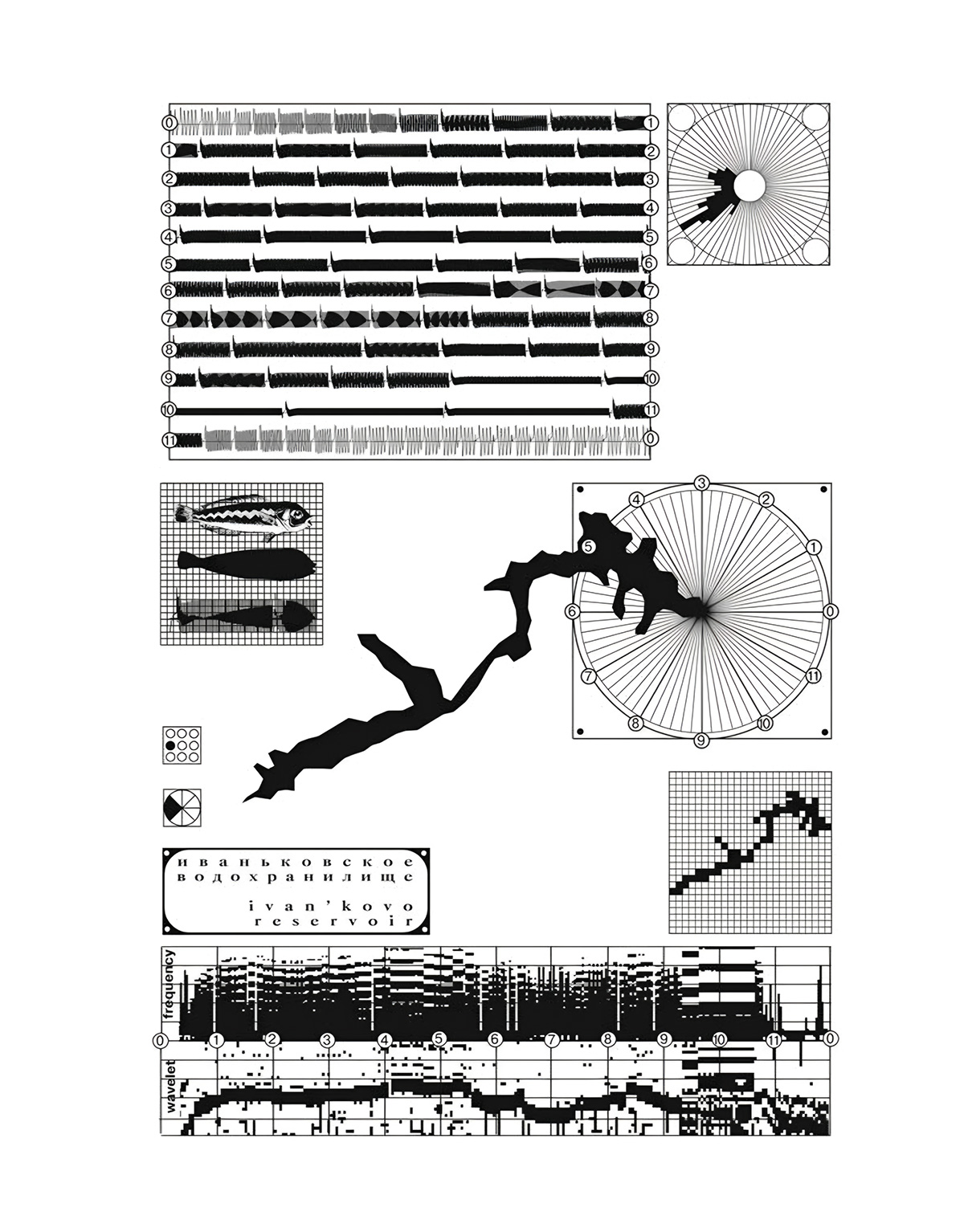
I often include a media component in a book project—an audio clip, an animated film, or even something like a computer game. So, in the artist’s book “Gmelin’s Table” you can listen to the “sounding” of the spring flood - I turned into chords the columns of water level measurements from the table of Samuil Gmelin: he kept his notes every day for four months, from April to June, while a ship was being prepared in Astrakhan for his expedition to the Caspian Sea. And in the book-game “WaterBust”, a visitor to the exhibition can vote for his favorite mermaid-bereginya from Gorodets house carvings - just like in a beauty contest, only instead of female contestants there are ancient images-reliefs of mermaids made by folk craftsmen. In the “Sirens” project (and the artist’s book of the same name), I turned the shapes of the reservoirs of the Volga cascade into sound passwords using a computer program written by my friend and fellow physicist Alexei Tsiberev.
Many interesting artists paid tribute to the genre of the artist’s book: Henri Matisse, Marcel Duchamp, and among the living - William Kentridge. The same Ilya Zdanevich in his Parisian publishing house “41 degrees” published the artist’s books, etchings for which were made by Max Ernst, Marc Chagall, Leopold Survage, Pablo Picasso - now these are classics of the genre.
Among the contemporary domestic authors I am close to are Leonid Tishkov, Andrey Suzdalev, Valery Korchagin, and Pyotr Perevezentsev. There are wonderful young authors, but they have more “zines” than “artist’s books” - I feel the difference, including in relation to technology and “projectivity”. Authors close to me in spirit and age pay more attention to design and printing techniques, papers and tracing paper; in addition, they design “long stories”. Our young followers, as I see it, are more for spontaneity, reflection and self-expression - with a general indifference to the subtleties and diversity of printing practices.
In general, an artist’s book is not just a luxurious small-circulation publication with all sorts of printing delights, it is, first of all, an embodied (graphically, textually, even architecturally) original idea of the author, which completely mastered him so much that he needed such different and numerous means of expression as fonts, drawings, stamps, machines and, of course, texts. Although the border between an artist’s book and a luxurious catalog is not always visible, I think it passes precisely where the author’s will creates its own world from available means, among which may be one’s own dreams and fantasies, and other people’s thoughts that have delighted you, and paper, and paints, and threads with a button (as was the case with Olga Rozanova in her artist’s book at the very beginning of the 20th century).
— You travel a lot. What is important for you to know about your travel destination? Through what and through whom do you delve deeper into it? Are guidebooks still in demand? Do you use them? What local history works, in your opinion, about individual cities and regions are worth highlighting?
— I try to read before traveling, not always guidebooks (but those too). More interesting are diaries, memoirs or novels made from this. Like the novel “Philosophy” by Ilya Zdanevich, which I read before my first trip to Istanbul (and before my second too). I love Soviet guides to ancient Russian cities from the “white” and “yellow” series of the publishing house “Iskusstvo” - despite some pathos or routine panegyrics of Soviet construction, the specificity and attention to detail is captivating; from these books you can really understand something about what you will soon see on the road.
And now there are successful books at the intersection of impression and study, for example, essays and studies by Muscovite (and an avid traveler around the province) Mikhail Baru. I enjoyed reading Andrei Fomenko’s essay on Turkestan impressions, where the realities of travel are interspersed with digressions in various directions, including art history - from an analysis of Central Asian paintings by Vasily Vereshchagin to references to the contemporary Kazakh artist Alexander Ugay. I find something similar in the London tome by Kirill Kobrin, where we talk both about the city as such and about a wide variety of exhibitions in its galleries. Andrey Levkin has more reflection and formal refinements than Kobrin and Fomenko, but the spirit of Riga is so present there that if I ever get ready to go to Riga (and I would like to), I will certainly re-read “Smoke Inside the Weather.”
I savor the pages about Alexandria from Lawrence Durrell or about Paris from Georges Perec. Konstantin Vaginov’s descriptions of the suburbs of Leningrad are shrouded in his signature sad irony; for me Peterhof or Tsarskoe Selo are now forever colored by its melancholy. “Letters of a Russian Traveler” by Karamzin and “Journey to Arzrum” by Pushkin are magnificent travelogues! This is, perhaps, the closest thing to me, when next to me is information gleaned from somewhere (from books, conversations, rumors), my own impressions and lyrical digressions - on a variety of topics. The master of this kind of travelogue was Andrei Bitov in “Georgian Album” and “Lessons of Armenia”. Wonderful descriptions and memories are found in the diaries of Yuri Koval. Yes, and Paustovsky has piercing fragments, something stuck in my memory forever - like this: “the autumn sun poured onto the white bell towers of Beloomut” from “Shining Clouds.” No, it’s hard to stop here in this enumeration. Walter Benjamin's Moscow Diary or the Volga travel prose of Bruce Chatwin and Joseph Roth are all very good too.
— The publishing house “New Literary Review” in the series “Essays on Visuality” published your book “Volga Formula. Sketches of the Artist". What are your key books about this river? What should you turn to if you want to get to know the Volga and its life? What texts form local Volga identity?
— Probably, first of all, “Russian Nile” by Vasily Rozanov. And - as the opposite pole - “Between a Dog and a Wolf” by Sasha Sokolov, there is also the Volga there, he then worked as a huntsman in a reserve not far from the Volga station near Rybinsk and described life on the Volga.
Or “Dictionary of Volga-Caspian Fishermen” - a fascinating read. I really like Korolenko’s river stories - however, he has not only the Volga, but also Vetluga (“The River Plays”). In some places, Boris Pilnyak, and even Ilf and Petrov, write very well about the Volga, if you remember the thirties. I love old books like “Description of a Journey to Explore All Three Kingdoms of Nature” by Samuil Gmelin, but I understand that this is a kind of reading, “for everyone.” Our contemporaries, Saratov resident Igor Sorokin and Kazan resident Denis Osokin, produced good short Volga texts. But such a huge river undoubtedly deserves more attention from writers. Previously, before 1917, many people wrote about the Volga - both Evgeny Chirikov and Nikolai Ogloblin; in some ways they are undoubtedly outdated and half-forgotten, remaining in the shadow of their titan contemporaries - Rozanov, Korolenko, Bunin and Gorky.
— Tell us about your new book: what does it consist of and how is it organized? And what is this Volga formula?
— “The Volga Formula” is a collection of essays that took quite a long time to write. Each one, as a rule, is based on the figure of an educator, natural scientist, writer or, say, an architect; I came across these figures in the process of my own museum research; each figure required an “art frame” - a film, a graphic series - and the whole story eventually became an exhibition or museum stand. To these “memorial” stories, the book added texts on the topics of various Volga phenomena - from Upper Volga frescoes and Gorodets carvings to the cascade of Volga reservoirs.
Collected under one cover, all these texts became, albeit incomplete, with large gaps, but still a “map” of the Volga. Some themes merge or flow into one another - like streams of a river in flood. There are many quotes in the texts, but I have removed exact links to publications so that the remarks do not become dams in the flow of the text. In doing so, I have added (in the notes) several poems, as well as (in the spaces between chapters) many images. At the beginning and at the end of the book there are pages with graphics without any text commentary at all - it looks like an “opera structure”, with an overture and a finale.
In general, musical metaphors seem appropriate to me here; I often balance between “crying” and “hymn” - the fate of my heroes is so deplorable and their thoughts are so sublime. Nobility of thoughts is the underlying current that flows throughout the book.
For example, Samuil Gmelin, a Russian academician of German origin. He risked himself to describe “all three kingdoms of nature” on the lower Volga and the Caspian Sea and ultimately paid with his own life (he was captured by a Caucasian prince and died in prison) for his desire for knowledge and in an attempt to promote this desire in Catherine’s Russia. Or Ivan Kulibin, who abandons the established life of the capital for the sake of building navigable machines on his native Volga to ease the work of his fellow citizens, suffering a colossal failure in this project. Or Nikolai Lobachevsky, building a university in Kazan and finding an associate in this matter - an architect from the provincial Arzamas, Mikhail Varentsov, nicknamed “Corinthian” - and thanks to both of them, the very spirit of ancient harmony begins to hover over the Volga waters. Or Vsevolod Troitsky, who launched an entire program at the Volga radio astronomy sites to search for alien intelligence - and this on the eve of the 27th Congress of the Communist Party of the Soviet Union! Or Andrei Sakharov, who took upon himself the burden of protecting not the alien, but the earthly mind, and even earthly life itself from the technogenic abyss that has come too close - these are just a few stories.
I am not a professional historian, I don’t know my heroes thoroughly, but I see how they (together with obstacles and their failures, insights and labors) become part of the Volga “hyperobject” - not only the natural one, which is before the eyes of a good quarter of the population of the fatherland, but also a mental, social, active hyperobject. The Volga River itself became for me only a pretext for combining all these plots into a meta-plot, but for all participants (including me) the Volga is a condition of existence not only in the physical plane, but also in the metaphysical one.
I have a project “Fish!: Volga Feast”, an art domino with photographs attached to the dominoes. When a domino game is played on a specially built (or accidentally found) table, a line of “dominoes” is built, and along with it - a photo gallery of Volga residents of all times and territories, where Yuri Gagarin, drinking tea immediately after space landing opposite Saratov, and Valery Chkalov, clinking a glass with his fellow countrymen in Vasileva Sloboda on the Volga (photo from the magazine) "Ogonyok" for 1937). Saratov German colonists having a beer or Yaroslavl residents having a family dinner. It becomes obvious to us that all this is one chain, pulling figures and phenomena out of the Volga into the “light of God” - and again plunging them into the waters of the Volga-Leta. At the same time, the memory of thought, the memory of place and deed remains - this is probably what the book is about.
I become very attached to my characters (perhaps the reader will feel this) and walk in circles around them. Around the same Volga photographer of the turn of the 19th–20th centuries, Maxim Dmitriev, whose photographs I turned into sounds (the audio installation “with Irenade” based on his portraits of chansonettes at the Nizhny Novgorod fair), and into films (“Russian Nile” with texts by another of my favorites, Vasily Rozanov), and into books by the artist (“Photoportation. 1896”).
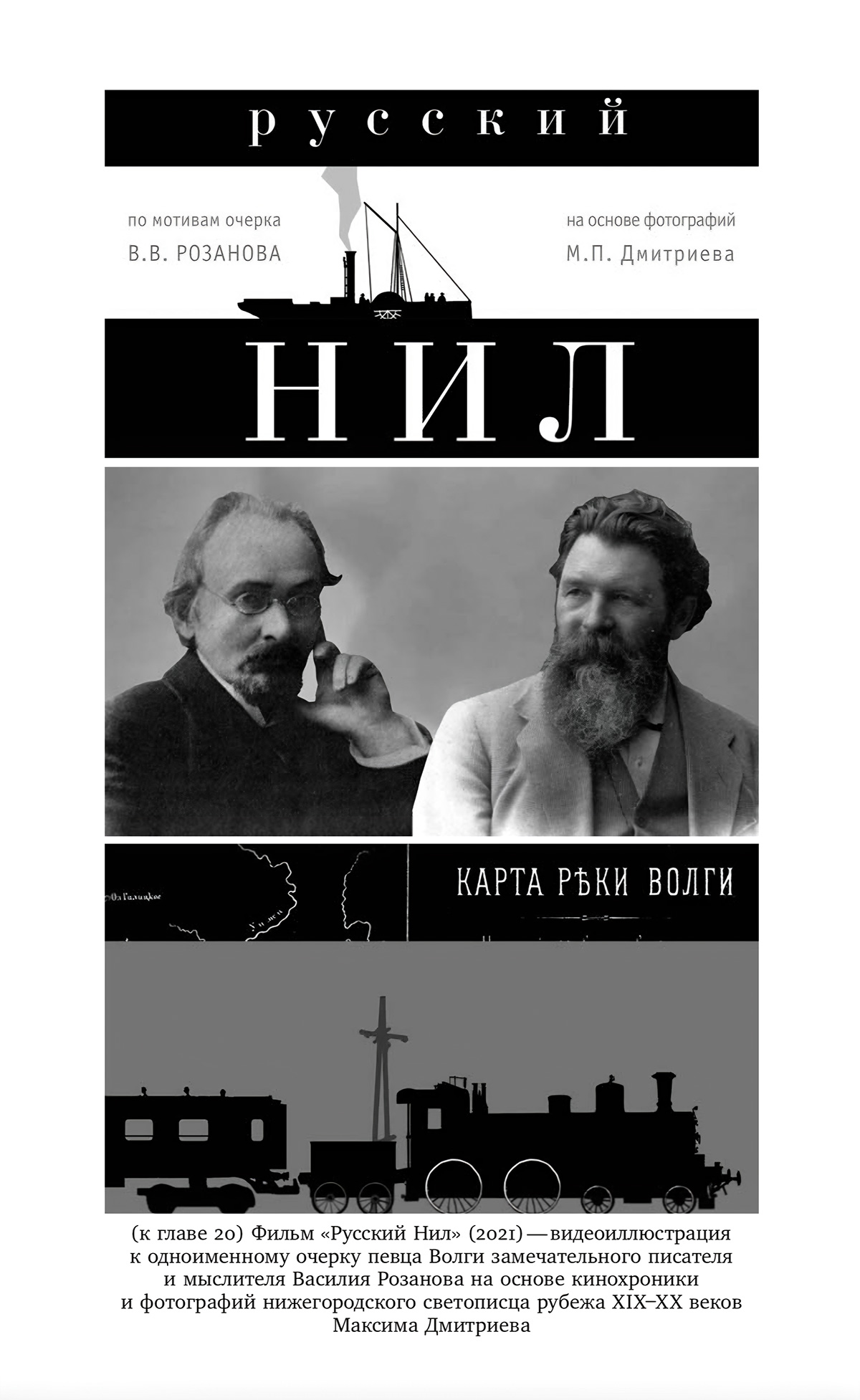
It is worth noting that, like Maxim Dmitriev, I am not a native Volga resident. Dmitriev once came to film the Nizhny Novgorod Fair from Moscow, and there from near Tambov, where he was born. I was born in the Urals, spent my childhood in Siberia, at the confluence of the Tobol and Irtysh, and graduated from school in Murom on the Oka. I think we both simply “connected” to the Volga as a global “electrical” network, and perhaps to us, visitors, such a “connection” seemed more fraught with something surprising than to someone “from the locals.” Don't know. But I don’t do anything specifically “about the Volga”, the subjects themselves appear, like shells or pieces of iron on the shore, I pick them up, wipe them, examine them and “copy them” - like the Volga doctor Paganel.
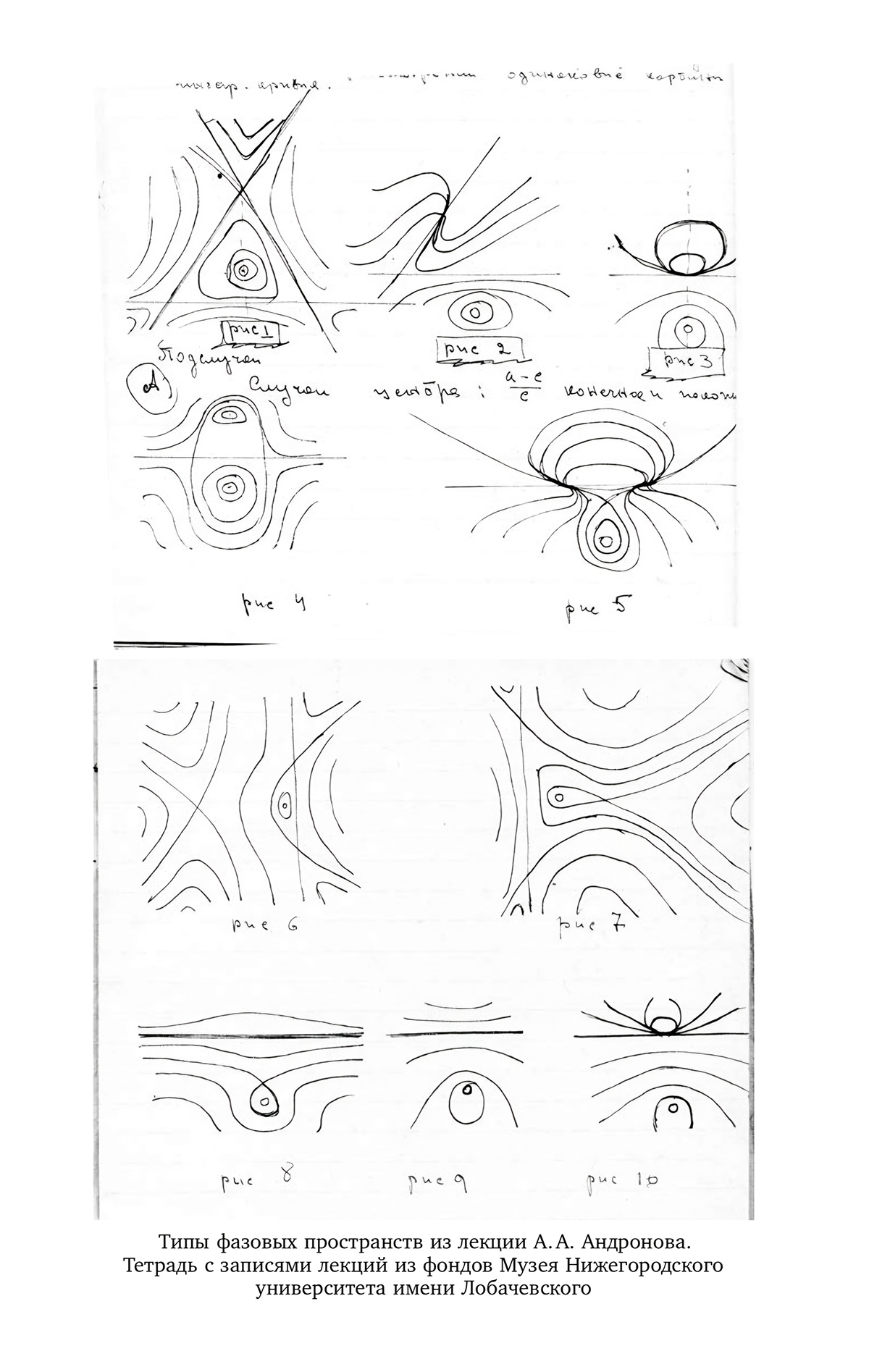
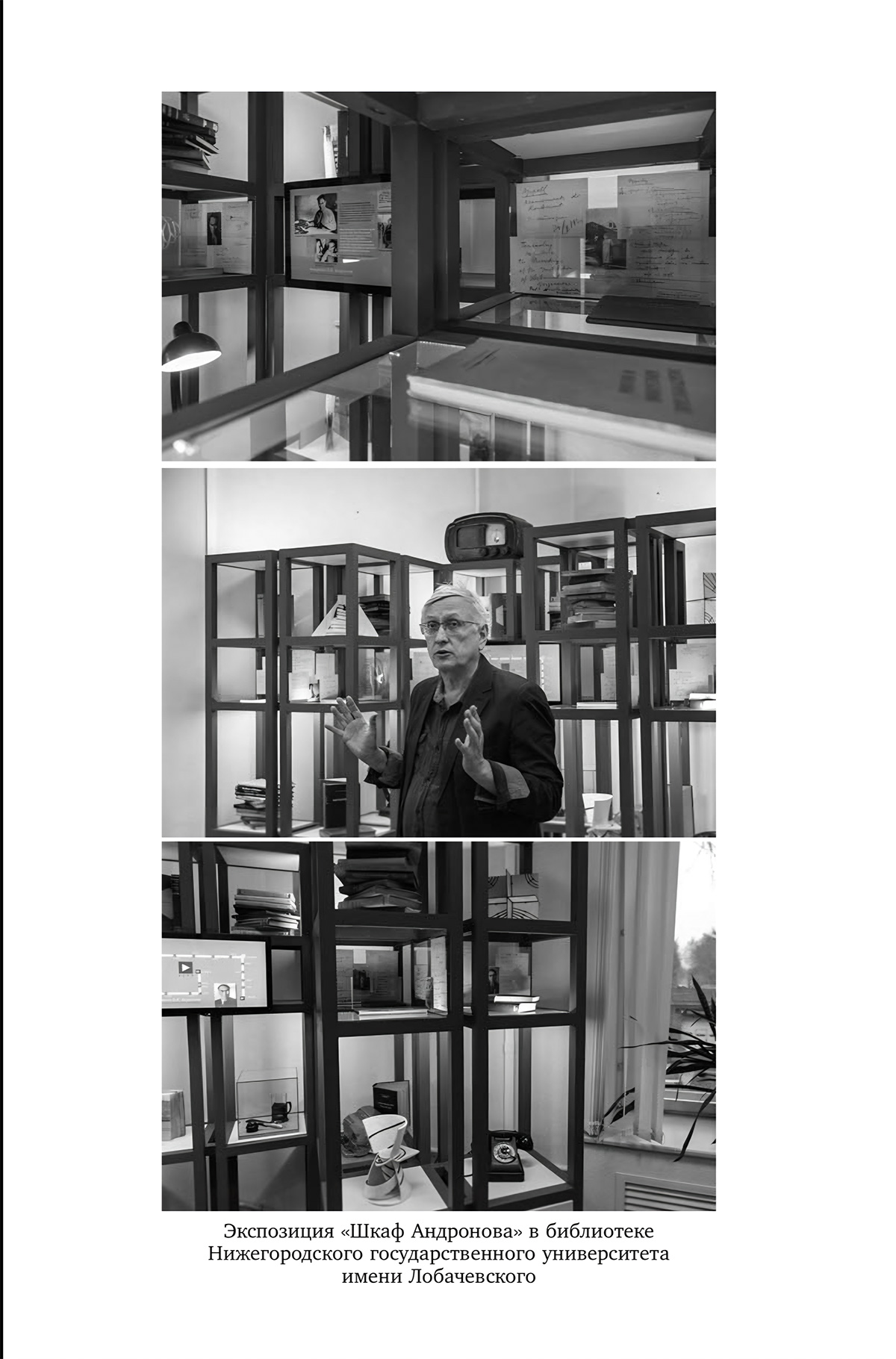
By the way, about “pieces of iron”: quite a lot of the book’s plots are devoted to technology - from the same “vodokhod” of Kulibin to the “lightning detector” of radio inventor Popov, to antennas and radio transmitters designed in the Nizhny Novgorod radio laboratory under the leadership of Mikhail Bonch-Bruevich. The book contains a lot about technology and science. About Alexander Andronov, who invented limit cycles as a way to describe the operating mode of all technical systems in the world and almost all natural systems.
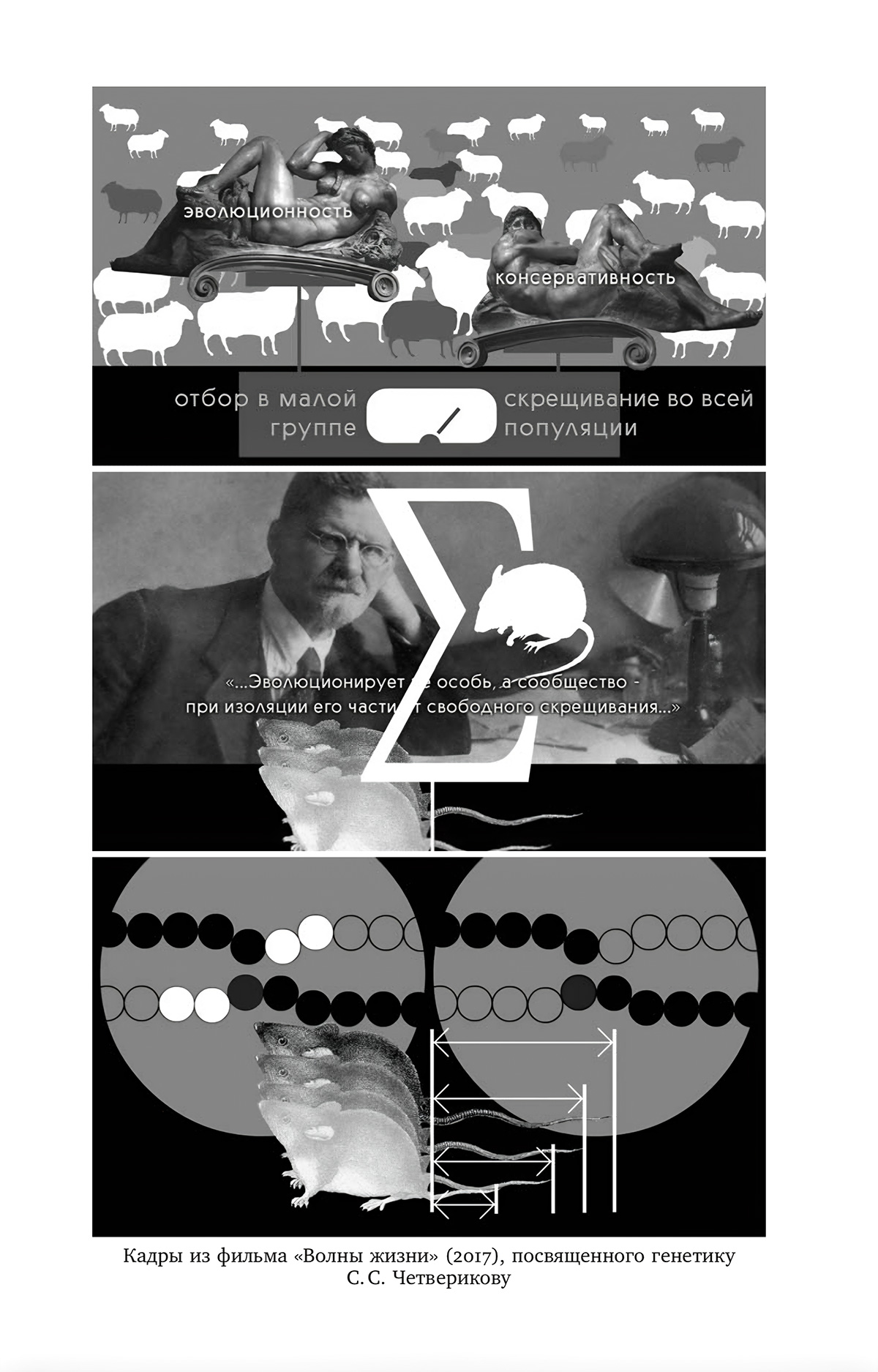
About the geneticist Sergei Chetverikov, who adapted the Japanese silkworm to the Volga climate and, looking at the Volga waves, wrote about the “waves of life” to his student Nikolai Timofeev-Resovsky. About Andrei Sakharov, who forged a thermonuclear shield in Sarov, and when he was excommunicated from this difficult (in many senses) occupation and exiled to the city of Gorky, he took up cosmology - the first moments of the life of the Universe, when quantum acoustic fluctuations in the smallest embryo of the world became, after its expansion, the rudiments of galaxies.
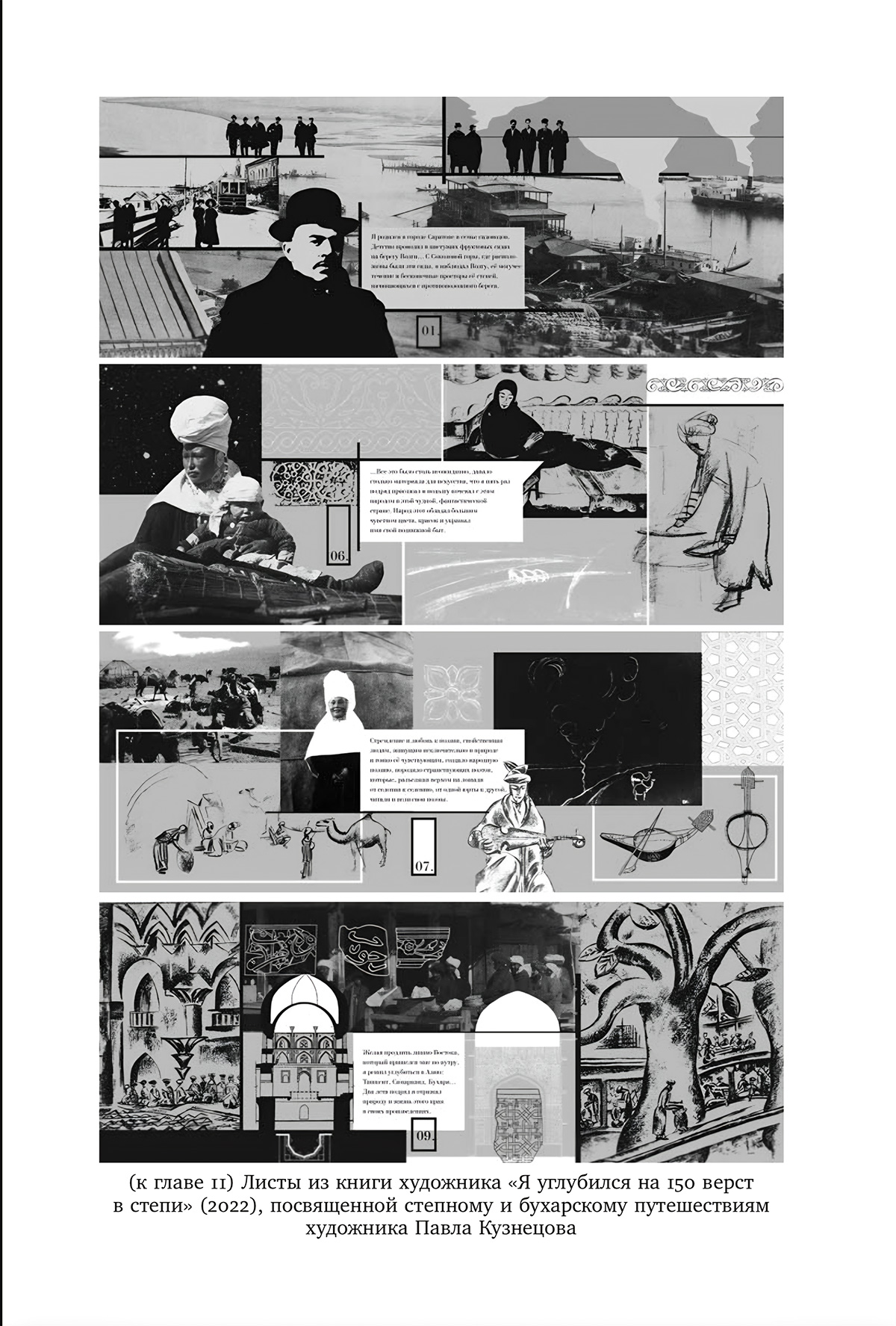
Well, besides scientists, the book, of course, also describes artists. Pavel Kuznetsov, who admired the Trans-Volga expanses opening from Sokolovaya Mountain in Saratov, was so much so that he went there with a sketchbook and reached all the way to Bukhara on this trip. I made several dedications to Pavel Kuznetsov in the genre of land art installations and books by the artist, as well as to another Volga traveler, an Astrakhan resident in the first years of his life, Velimir Khlebnikov. And speaking about Kuznetsov, I remembered his first teacher Hector Baracca, and the entire Saratov school of painting, right down to Valentin Yustitsky and Nikolai Gushchin. Ученики гущинских учеников — ныне работающие саратовские художники, с некоторыми я знаком.
Не прошел я и мимо Бориса Кустодиева, прославившегося не только «Русской Венерой», но и купчихами, приказчиками, извозчиками и прочими «волжскими типами». Как и волжскими видами, — иногда где-нибудь в Кинешме или в Романове-Борисоглебске узнаешь церковку или особняк с кустодиевского живописного полотна или рисунка.
Так что «Формула Волги» — это сумма самых разнообразных слагаемых, постоянных и переменных. Не формула в смысле рецепта ответа на какой-то вопрос, а скорее лишь обозначение множества вопросов. Чего стоит только тема волжских водохранилищ, в которые канула традиционная волжская культура — не только рыбные омуты и заливные луга, но расставленные по берегам села и города, ставшие ныне переулками распределенного по огромной территории рукотворного подводного Града-Китежа.
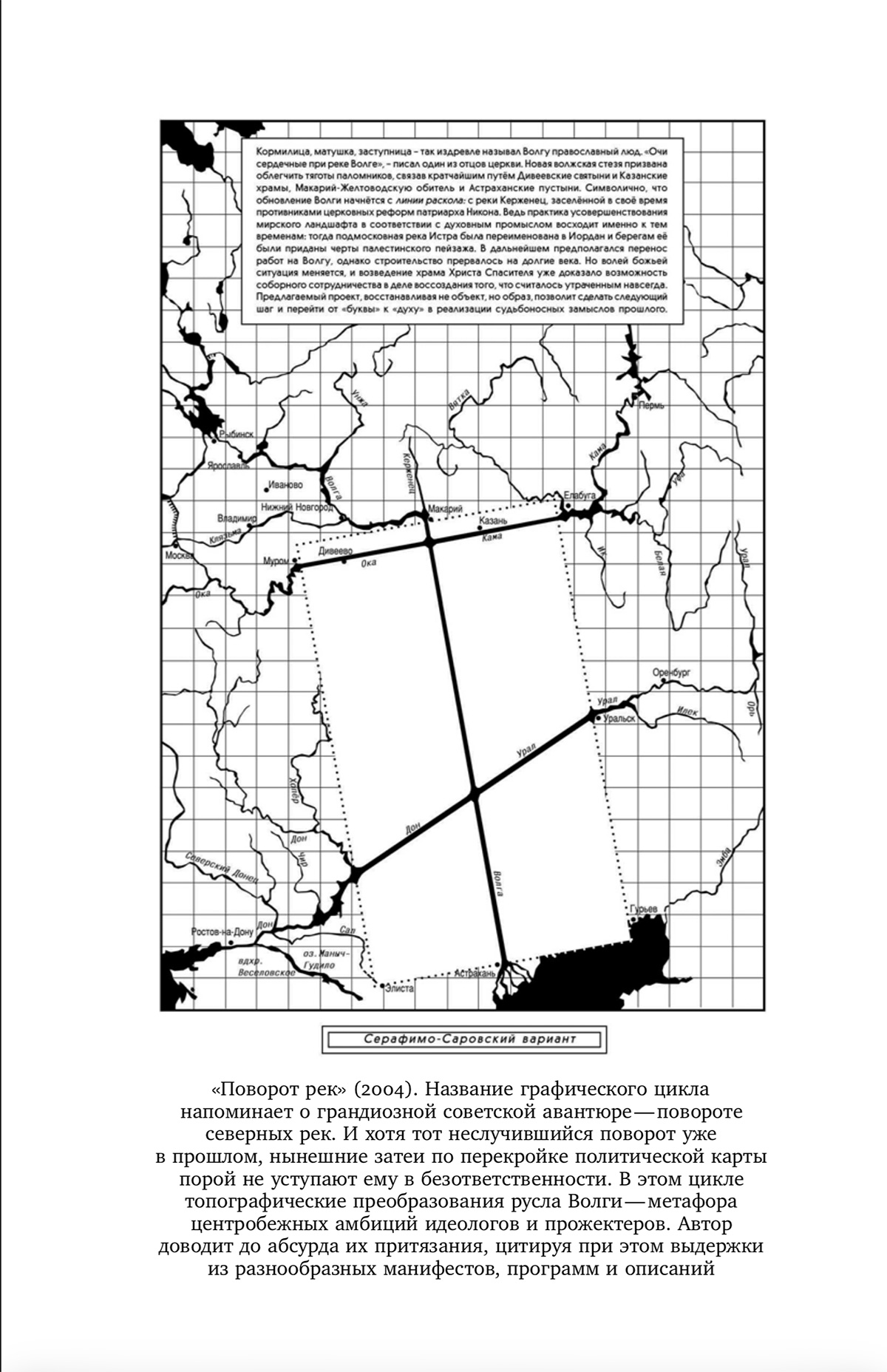
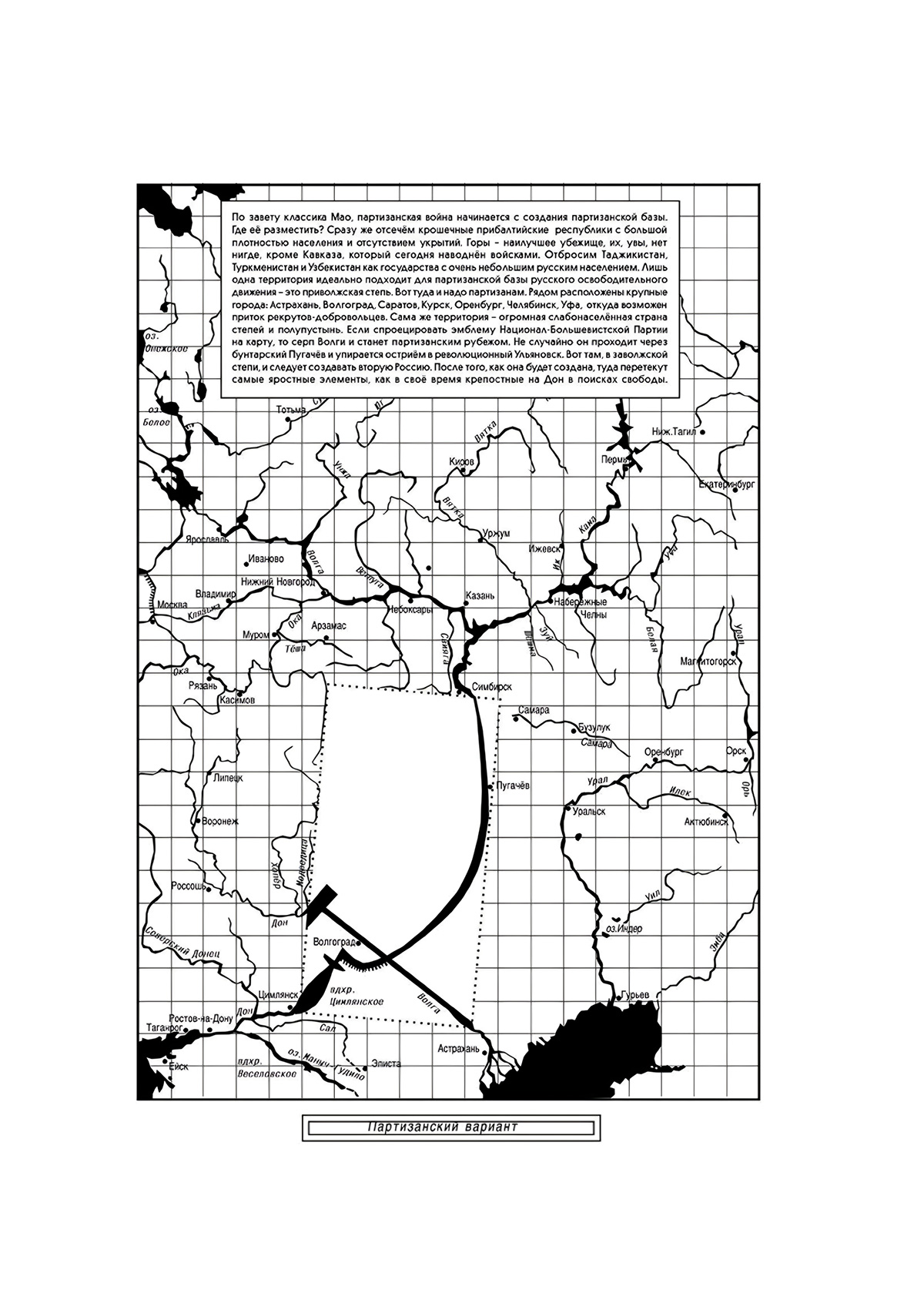
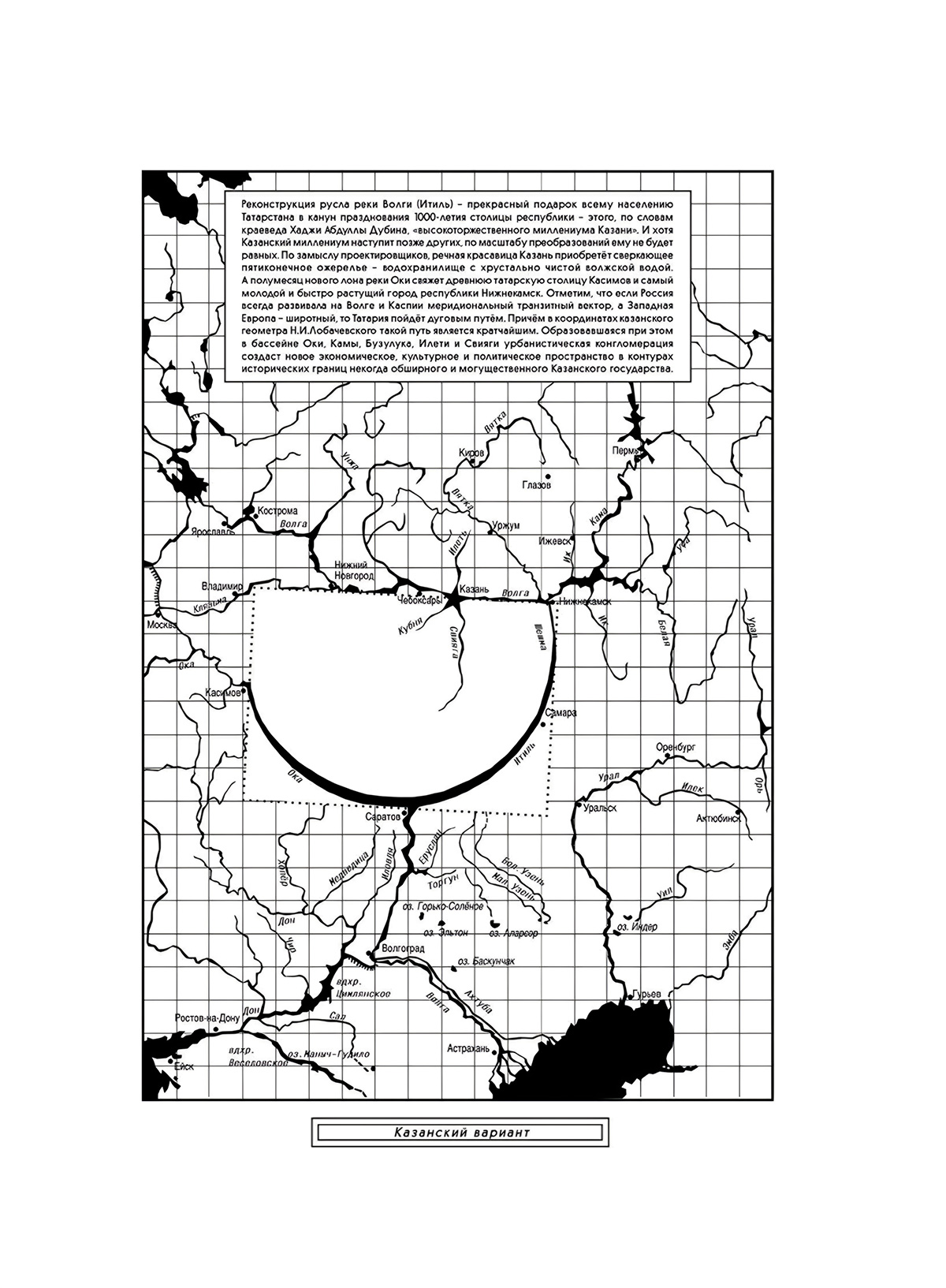
Окунувшись в волжскую тему как в реку, автор заметил, что, казалось бы, далекие друг от друга сюжеты сплетаются — как и сами волжские струи. Под верхневолжскими церковными фресками проступают контуры гравюр из Библии голландского издателя Иоганна Пискатора, а заезжий итальянский художник Гектор Баракки невзначай порождает знаменитую саратовскую живописную школу.
Все оказалось «связано и развязано, обобщено одним духом и одною питающею влагою… Волги», — как точно и при этом поэтично заметил Василий Розанов. Все вместе — судьбы героев книги, их труды и замыслы, победы и поражения — слагается в замысловатую и неоднозначную, непостоянную и текучую, завораживающую красотой и силой «формулу Волги».
— Скоро у вас выйдет поэтическая книга «Фигуры речи». В ваших стихах вы довольно откровенно развиваете разные поэтики из истории русской поэзии. Отчетливо видны и XVIII век, и ОБЭРИУ, и, например, Геннадий Айги. Что вас завораживает в них? Что вы черпаете в каждой из них? За какими поэтами вы следите сегодня?
— Да, все верно, и XVIII век мне интересен (Ломоносов), и обэриуты, и Геннадий Айги. И в чем-то его последователь Сергей Завьялов. И питерский поэт Олег Юрьев. И Саша Соколов, который больше числится по ведомству прозы, но у него есть чудесный поэтический «Триптих». Меня завораживают довольно разные авторы — Александр Введенский и, например, Борис Чичибабин .
Из современников внимательно слежу за тем же Завьяловым, за Львом Обориным, Михаилом Гронасом. С удовольствием читаю Даниила Да, Евгению Риц, Марию Степанову да и почти все, что издается «НЛО» в серии «Новая поэзия». Что-то ближе (как Николай Байтов или Сергей Круглов), что-то просто учитываю, отмечая находки автора. Что-то оставляет равнодушным, а чего-то очень хорошего наверняка просто не знаю — не попалось. Наверное, чему-то учусь и у современников, не только у Мандельштама с Заболоцким.
Мне нравятся формальная игра, свободные форматы, но без категорического отказа от рифмы, сознательный сбой размера, поэтические цитаты-инкрустации. Но главное все-таки, чтобы были осмысленность (не просто ученость) и искренний интерес автора к теме (а не просто следование модным трендам). Хорошей русской поэзии довольно много, как мне видится. Плохой, правда, тоже хватает.