
Translated material
What the hell?
Rostelecom is starting to register a new system. There is a temptation to again speculate about the threat from the intelligence services. But it's all really about the service.

Photo: Vedomosti / TASS
Rostelecom is starting to register the Leshiy Connect system, which should provide transparent and discreet management of clients’ routers. The solution, according to the initiators, should remove dependence on foreign products and protect users from cyber threats. Given the current context, it is tempting to start talking about freedom of speech and another threat from the intelligence services. But this story is really about service, safety and import substitution.
If you have ever contacted your Internet provider's support service, you probably know that most problems can be solved by rebooting the router. This seemingly simple action can cost millions of rubles, which includes your precious time while you wait for the operator to respond, and the salaries of numerous employees who ultimately give simple and understandable recommendations. But if you get access to client devices, you can do it automatically.
This generally obvious idea is called CPE WAN Management Protocol, which allows you to do a bunch of things with users’ routers from a central server. From changing certain parameters to updating devices, firmware also tends to become outdated. One of the leaders of such solutions is Axiros, whose services Rostelecom used until recently. But the sanctions did their job, which logically forced the company to develop its own products.
Apparently, titanic work is behind us. Western solutions have been developed for decades. Trying to set up the correct management of a custom zoo is another task. Look in the corner where that same box with light bulbs stands - sociology will most likely show that everyone will find something different.
Somewhere a fashionable and expensive router, somewhere a Chinese solution for three pennies. And if our developers managed to create a product that is at least somewhat competitive, we bow down.
All this works well only in one case - if the router is provided by the provider. If the device was purchased in a store nearby in the basement, perhaps everything will not be so smooth. But they are also trying to solve this issue by producing domestic devices. Electra routers are assembled in Moscow and, judging by the reviews, they are quite worthy. Production capacity is growing. And, perhaps, this progress can be a legitimate reason for joy. The country is large, there are many households, there is formally a market, and it is good that competitive products are appearing in some segments.
For users there are continuous advantages. Home Internet as a service made easy. Possible problems are resolved automatically. Despite all the controversial issues, the ecosystem is convenient. Not everyone has the opportunity or desire to assemble Lego. And so: I received the box from the operator - and everything works. If not, these are not your worries and problems, the existence of which the mass client has not the slightest idea.
In the current climate of 24/7 cyber attacks, home devices are a very popular target.
And no, no matter how much one would like to exaggerate one’s own Russian significance, hacking of such devices around the world occurs automatically: a robot walks through the network and stupidly tries to check what is happening at one point or another.
You've come across a leaky device - you can do something about it. Nothing personal. And so - all the worry is on the operator, and thanks to that very protocol, he can solve problems without your knowledge.
The overall picture looks good, but a deeper assessment is impossible without access to Rostelecom's internal processes. Considering that we are not on the board of directors and do not even manage a specialized department, it is difficult to judge the correctness of certain decisions. However, it is worth considering the scale of the telecommunications monster, one of the advantages of which is the right to make mistakes. Even if you spent more than necessary, or the effectiveness is questionable, it’s okay. They can afford it.
Somehow everything turns out very beautifully, and for the harmony of the genre this barrel of honey should be diluted. Given that there is not much data to analyze, we can only get to the bottom of mice, but it may be worth it.
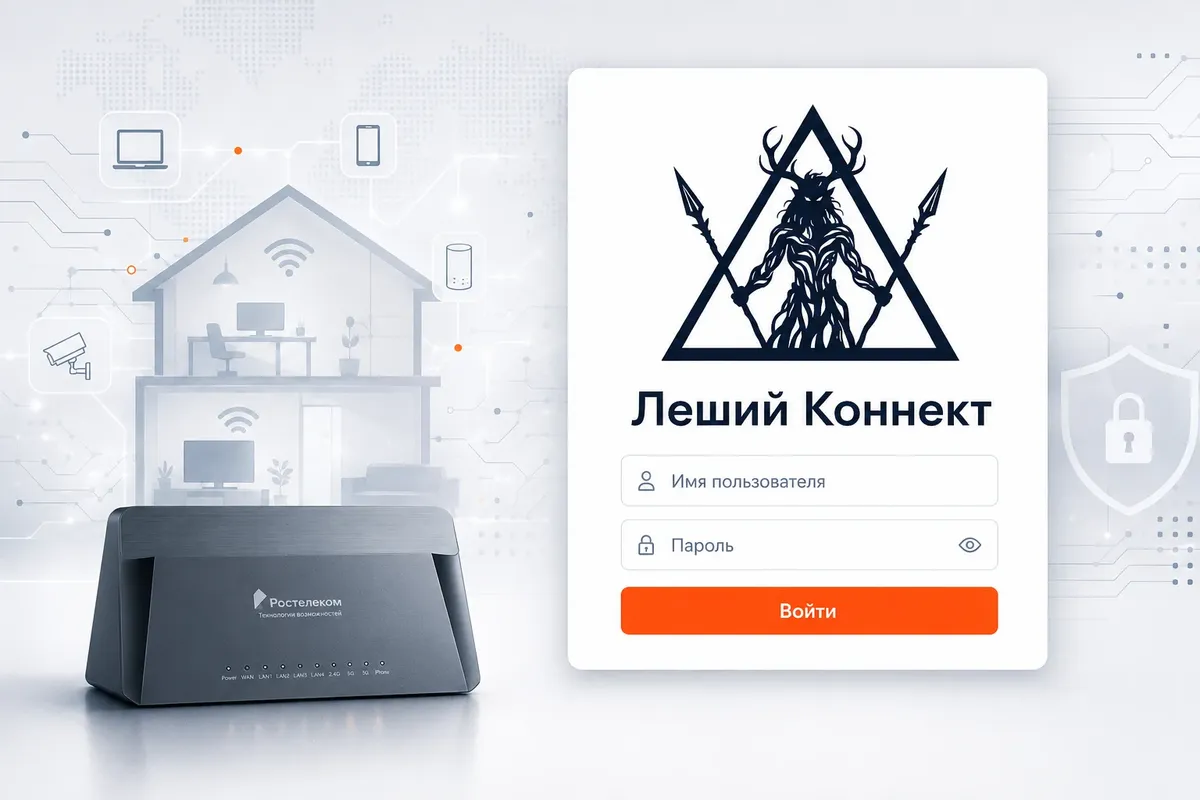
“Leshy Connect” is a bad name. Rostelecom clarifies: “In Slavic mythology, Leshy was represented as the owner of the forest, who kept order. To draw an analogy, just as a forest must remain resilient and resilient, client devices need to be regularly updated, maintained, and protected from threats.” Perhaps this line of thought seems logical to some, but it still sounds crooked, even for an internal product.
If a miracle suddenly happens and newly developed software finds its consumers abroad, the first thing that will have to be done is a new naming, since no one outside the area of Russian mythology will understand the name. The same goes for the logo.
Obviously, all the money was spent on development, and branding was carried out according to the residual principle, but, whatever one may say: a strange creature with deer antlers and spears in its hands not only does not reflect the essence of the product, but also deteriorates when scaled. On a small sticker, for example, it will look completely strange.
However, everyone is worried not about logos and names, but about the threat to privacy. Against the backdrop of surveillance and blocking, any technological solution, especially from a state-owned company, is viewed solely through the prism of possible danger.
At this point I would like to either reassure or disappoint the respectable public: this story is from another office and has nothing to do with digital repression - there are a lot of other devices and software solutions for this. In this sense, both “Leshy Connect” and the same “Electra” router are quite worthy solutions of the domestic industry, which can cause pride in the local telecommunications market, living in difficult conditions.

But if suddenly you are still worried about external interference in your home infrastructure, then most likely you know how to solve it. Both in advanced and not so advanced models, blocking the TR-069 protocol, which is responsible for remote control of the device, occurs in a couple of clicks.
Rostelecom says that by the end of 2027, Leshy will reach 7 million devices, each of which can be equated to a household - a rare apartment has several routers. On the one hand, compared to the total number of subscribers, this is not much. On the other hand, servicing client equipment is a significant expense item: an engineer’s visit, replacement, and so on. And if Rostelecom achieves its goals, it will probably return the investments spent on development and begin to save money, which is more than relevant in the current situation.
As a result, we get a rare example of import substitution, for which there is no shame: business counts money, software automates processes, and users get rid of the need to work as home system administrators. The infrastructure is maturing and becoming autonomous. And it doesn’t matter that “Leshy” is behind this, the main thing is that the connection works.