
Translated material
“Increase the size for old people”
Pakhom about the antics of Russian classics, literary swinging and the funeral of a book
Sergey Pakhomov (Pakhom) is an artist, musician and performer. On the Internet, he became a meme in connection with the role of “Riden” in the long-running film “The Green Elephant,” but his field of activity goes far beyond this image: Pakhom’s paintings were exhibited at the Saatchi Gallery in London and the Solomon Guggenheim Museum in New York; he gives lively concerts and lecture-performances, at which the energy of the subconscious is in full swing; worked as an art director for glossy magazines, starred in the TV show “Battle of Psychics,” collaborates with Valeria Gai-Germanika and plays in “Theater.doc” - the number of places where Pakhom uses his eccentric powers can be listed for a long time. “Gorky” talked to the artist about playful writers, reading as therapy, and with whom books are at war today.
What are your earliest memories of books?
This is an important point that is given and established - maybe even involuntarily given and involuntarily established, or even involuntarily given and involuntarily established. It is impossible to say in the light of today's reality that I am reading, that is, reading in the present tense. It is very important what exactly you read. If we talk about interaction with books - some kind of lyrical, sensual state - this is all in the past, it was precisely “reading”. Now I haven’t read books for many years. And in general, today this book thing is a little different. Rather, the book is like an image, like wisdom. And to directly move your pupils across the page - I personally haven’t done this for many years. Moreover, in the evening I can’t see well—even the physiological process of reading itself is quite strange.
What about audiobooks?
I don’t listen to audiobooks either, I don’t read electronic books. I’m so poisoned by the rottenness of triple and eightfold meanings that I can’t even read because I see some kind of crap. One thing is written, but I read something completely different. For example, on an airplane in an Aeroflot magazine in Mongolian I find more meaning (as it seems to me, because, of course, I am being deceived) than in any other. Or in some digests, short, clumsy texts. My consciousness is already very powerfully perverted. If we talk about childhood, like all children with big heads, I had a fantastic world of a book, a jump into a parallel reality, an expansion of consciousness, a psychedelic experience. I remember how the day went: I went to school, then ran home, cooked food for myself, with this food I read books avidly for several hours, then ran to art school, then read again. I was a pathological reader. I enjoyed reading.
With which authors did pathology begin?
Naturally, I liked ****** [show off]. Therefore, I demanded books that were not ranked, but in the library they said: you can’t have more. They didn't teach The Invisible Man when I was in second grade. In general, it was tempting to be obscene. Another point that probably also visited everyone is disappointment in authors who are outdated: Hemingway, Remarque and so on. Things that at fifteen years old seem to be the limit of perfection, reflection, clarity, turn out to be funny, inflated shells.
Do you remember what your parents read?
Mom always loved the classics. But it scared me. A teacher really scared me when I was a child—she said that she rereads Tolstoy every year. This is a counter: every year she reminds herself once again that she will die under the inhumane fence with that Tolstoy of hers. “Every year”, “I look at him in a new way” - this is this ***** [garbage], some kind of whirlpool with Tolstoy, classics, dogmas, all this ***** [garbage], where there is no book as such, but there are “images of Tolstoy”, “images of Pushkin”. They also re-read it every year, discover something else, something stirs in them about the soul, tenderness - all this is vile, which actually explains the stupidity of the Russian people. Stupidity as an aesthetic component doesn’t even work here - it’s stupidity in its purest form, abomination and meanness.
That is, school, like most, instilled in you an antipathy towards the classics.
Certainly!
Tolstoy, Dostoevsky...
No, Dostoevsky was pleasant. He has ******* [show off] a lot, ********* [show off] author. Same as Gogol, but this one is also musical. He has a musical ****** [show off], so he is more organic. Dostoevsky's ****** [show off] with fish bones, you just want to spit it out.
Who else is in the canon-****** [show off]?
The canon of ****** [show off] includes, of course, Zoshchenko - he also has ugly opuses. Chekhov is a monstrous read. These are all crooks. In general, the word is a vile thing. A vile space of words, with which you can somehow kill... You can kill with a word if you write a denunciation: so and so stole such and such, please shoot. This is what can kill you. In the Russian, Soviet and post-Soviet space, fakes about the greatness of the word are imposed. And it’s also a verbal dysfunction. I had a lot of experience - in Soviet times I worked as a graphic designer at a factory. The games with words there completely disavowed the concept of the word as such. When you write a word in capital letters, it takes on a new meaning, but in reality it remains the same ****** [garbage] that it was. Even small ones, even scratch them on a diamond.
Therefore, Russian literature, the word as such, is for the scientific tradition, which is developed in Europe. Facts about who went where, who gave it to whom, who sucked off whom, who wrote what. This is interesting to the English inquisitive academic consciousness. But I don’t. The word itself is not interesting: it is blurred, it has disappeared, but on the contrary, it is an antics.
That is, away from word-centrism?
Yes. I'm more interested in the wave, the states, the moments: the book, the hands, the ergonomics of the book, the book the size of a face, the size of a head - these important things. Hit by a book, sour books, prohibited, permitted. The book is like such a blotter. Well, in general, this is a comedy, ***** [damn]: read it - you will become smarter. Mockery.
Why?
Reading in search of wisdom is shameful. This is a ****** [trick]: read - you will become smarter, read - you will become thinner. The world consists of something else. From some telephone conversations: yes, yes, no, no. Just like in American films. There is no culture as such. Talking about culture ennobles the conversational environment, but in reality there is nothing there either. There is some kind of fart, oil, fat, discharge.
But it’s more interesting to talk about books than about farts.
Of course. But you can also talk about books as farts.
Where is the line between a book as a psychedelic experience and a fart book?
The line is blurred in time - that’s where it is. In this flow, where there is past, present and future, or rather, where none of this exists.
So, as you grow up, you become calloused and books stop working?
No, not you. It is not you who change, but the world around you. And you remain the same. Insignificance.
Let's go back to...
I can return it! I've had this formula for a long time: I treat reading as entertainment. If you are an intellectual, your entertainment is highly intellectual; if you are not an intellectual, it is non-intellectual, grassroots, folklore. I liked books that entertained. If you read it and laughed out loud, that’s good. If I don’t laugh out loud, that’s bad.
Why did you laugh at twenty years old?
Twenty from Akutagawa was very funny. I especially liked the story “Sweet Potato Porridge” about how the monk hovered his nose and squeezed lard out of it. Very good. At twenty-five, Mamleev made me laugh.
Don’t you want to re-read Mamleev now?
Not interesting now. Not because I'm a smug pig, but I really am a smug pig. But I’m not to blame for this - I’m a victim, a victim of the process of events, of life. Now you understand that the miracle has disappeared like gas through the earth. That's why we need to mourn books. Conduct book funerals. No wonder they look like gravestones.
Who knows, if Mamleev is included in the school curriculum, what if the miracle returns?
Maybe. It depends on the teacher. The research beginning is good: where the legs grow from, the Mamlei contexts. It's fun to learn. You dig through the samples - and suddenly it turns out that they are cooler in imagery, madness, integrity, quintessence of thought.
Were you interested in philosophers?
No, I didn't. Everything that others loved, I refused on principle. The only thing I liked was Benjamin: thoughts about the soul, a Moscow trip. And philosophers who are not philosophers at all, but writers: Camus, Sartre. Those who work with words and images. Well, there’s a buzz around yourself, which is also nice. But now books as reading do not exist for me. Unfortunately. Or maybe fortunately. Or no way.
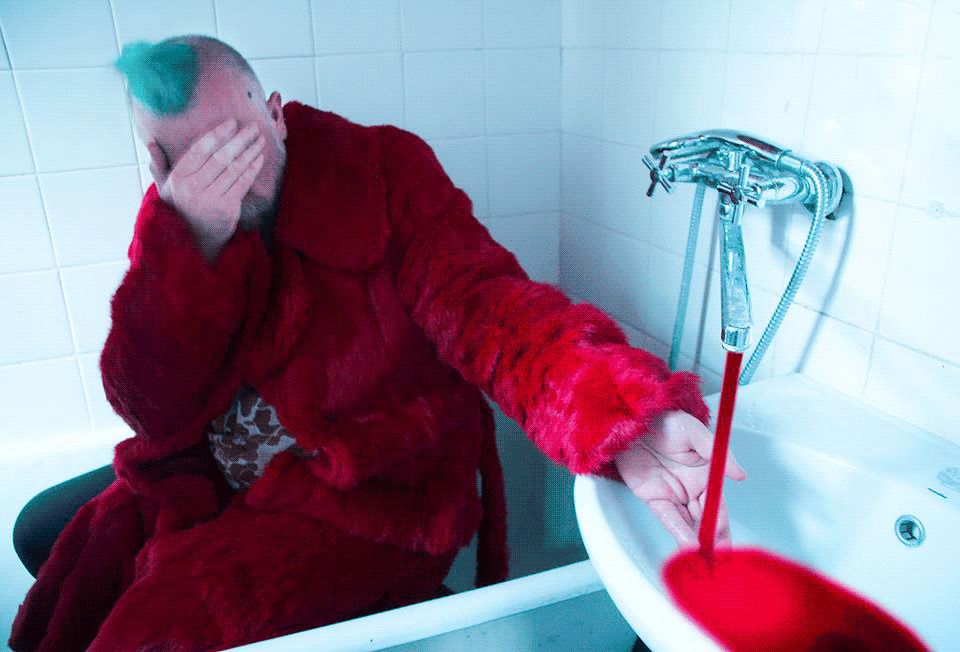
Photo: facebook.com/pahom.pahom
Would you like to live the life of a writer? A literary hero?
A hero, of course. It's like a trip, a trip is always interesting. But writing is a thankless task. Like any artist, he is a terrible egoist, a sufferer and sees all kinds of shit. This is the lot of a good writer. That's why the writer is so unpleasant. The deeper he digs, the deeper he becomes infected. Endless listening to yourself makes you a complete egoist. He no longer sees anything except his own asshole, its movements and comparisons of this asshole with flying cosmic bodies.
Which hero would you try as?
I would move between them. Only literary swinging. This is where the strength lies. This is explained by the fear of death: the more lives you live, the more you delay the final moment of your last station, where all the books will merge into one. Such jumping around between characters. There was an excellent book on this topic based on radio shows by Kreps and Mintz - “On the Wave of Famous Captains.” A very good project, correct, Semitic, penetrating into Soviet reality.
That is, it passed by itself: the world has aged, the books have aged, and you decided to exclude them from your life.
No, I'm not that decisive. It just happens. Maybe there will be a return. But this has already become a habit, alas: lack of books, time. Somehow time has changed. I treated the book as salvation. I remember sitting alone, useless to anyone in New York, and then there was some book - the same Mamleev, the Third Way publishing house, or something. You read and it becomes easier. The book is like therapy - I enjoy it. Like food. And I hate spirituality, all this ***** [bullshit]. I love physiology, putrefaction - it seems real to me. Old age, flabbiness, that's all.
If books stopped working as therapy, what replaced them?
This is a moment of critical consciousness. If you turn it off, the book is gone. And sometimes you turn on your critical consciousness - and you see that it is imperfect, it could have been better, Pepperstein didn’t do something right here, he didn’t sit enough, he should have sat a little longer. Therefore, now the therapy is more physiological: walks, muttering. Right now I’m generally going through a period of stupidity, a simplification of Tolstoy, pre-Tolstoy, proto-Tolstoy. There is no longer any critical discourse for me. The training has passed, there is no need to compare yourself with anyone. Loads and obligations fell away. Very happy.
But books can still provide therapy until old age. Let's say Cioran hid in attics until he was eighty and did nothing but read...
Borges is on his heels!
... so taking a book as a therapist is just a good way to avoid turning out to be that teacher who was poking around at Tolstoy.
Or “Mendel the Book Writer” you can remember. Merging with a book is like merging with mastery. The cabinetmaker becomes fused with the veneer, the reader turns into a bookworm. It all depends on which egregor you give your strength to. What I'm getting at is that this stereotype needs to be destroyed. Although, of course, no one needs or should have anything. I don’t like to say “should”. But there is a stereotype - the sacralization of a book - which turns into a dummy, an emptiness. There is a theory of units: one spoon, one fork, one pillow - and one book. You open the book - and there is always something different. But she is alone. This point is very important. The moment of receiving beneficial information, or maybe not receiving information, but falling into a trance state.
One can, of course, assume that books are alive. Just like grandma’s billion cats from “Little Mook,” there are a billion books. This, that, librarianship, physiology associated with volatile particles, leather bindings. But the book cliché is gone. In Soviet times, a book was a marker of inaccessibility: some kind of subscriptions, waste paper, I was worried about this fuss around books. And fortunately, I read the love of a Russian person and became smarter - this is ***** [garbage]. Like the story about Rasputin, who put notes under his pillow about which ministers to remove, and in the morning they were removed automatically. Faith in a miracle, on a stove around the world in eighty days with Ivanushka. It’s the same with a book: I’ll run to the bookstore, buy a book, and there I’ll see everything - worlds of illusions! This makes it even sadder: there are some worlds, and even illusions.
But illusions are wonderful, without them it would be more boring.
Well, sadness, sadness from this.
Okay, the book needs to be - or not necessary, but can be - desacralized. But the 21st century has already desacralized everything. They read not books, but memes. Or, let’s say, in the West, publishing houses monitor e-reader users. So many people did not read to such and such a chapter - the publishers will hint to the author to write the sequel more quickly. The book is no longer a gravestone - having gone online, it...
Dissolved! I’m already like this with her [ catches the air with his hand ]. Even talking about the book, we are now inside it.
Exactly. But this is a threatening situation.
Naturally. A sect of scribes arose, a community of book lovers - like a community of lovers of lute music. This is wonderful, this will also exist - well, that’s good. It looks like the Old Believers. For them, a book is their main accessory. If you go to an Old Believer, he has everything in his books. Even if he ***** [nothing] understands neither the Old Believers nor the books. I observed several people from the upper class: when they became Old Believers, they immediately began to have books. But the curiosity itself is gone, and now it is replaced by blurriness and watercolors. Perhaps we should forcibly capture people and burn books on their backs. Of course, there's a big battle going on right now for the book. You need to take a side and fight.
Whose side are you on? You can’t just throw away memes in this fight. They also have their own wisdom and therapeutic potential.
Certainly. Based on communication with people, authors, readers, I can only say one thing: now it is difficult to write books and difficult to read. The situation is not cool, to put it bluntly. There is no euphoria that characterizes miracles. Writing a book is hard; during this time you can be much more productive in other forms. It’s a thankless thing: cutting down some Pushkin scholarship, sitting on your ass in Berlin, writing - hemorrhoids. It's hard. And it's hard to read too. The meme penetrates you much more easily—like a worm.
It’s not necessary to receive a Pushkin scholarship in Berlin, but according to some Bukowski’s prescription, in poverty.
But this is a huge mistake. Each writer is from his time. There is no longer and cannot be any Bukowski in our reality. Therefore, nothing is “possible” - everything in life happens spontaneously and beyond control.
Have you ever felt euphoric from writing?
In connection with the “Battle of Psychics,” they offered to write a book at the AST publishing house. Naturally, I made a book with a minimum of words. But I turned it into pleasure, joy, entertainment. A person should live an entertaining life. A stamp, of course, but still. Mozart's delusional joy must flow from any process. I am a former alcoholic with great experience, I remember this state of euphoria, it is close to me. Then they suggested writing a second one. Like a person who destroys the foundations, he immediately made a poetic, underground one, from fragments of texts, with a bunch of illustrations. AST said: what else is this, what have you done? In general, they refused to print it. Such a strange object fell into the media space of the non-strange. It's funny to me. But they got scared.
Do psychic skills require book knowledge?
Erudition is generally some kind of enemy. It’s funny now: whether you have erudition or not, what difference does it make? Of course, you need to understand what we are talking about. Know art history if you are an artist. On the other hand, if you don’t know the history of art, you look at everything like a ram at a new gate - and a new quality arises. Society even accepts you with this. The feeling of the wave is more important.
When you become president [Pakhom recently launched the 2018 presidential campaign—approx. ed.], what do you want to read? Or will you ban it?
I'll order Russian classics. And then I will ban it. And then I'll open it again. And then I’ll ban it again. Or I won't do anything. I'm a weak-willed president. Why weak-willed? Because I express the aspirations of the people. I don't have any of my own. I am so weak-willed that I am almost transparent, like a cloud. I am everything. This is godlikeness. Power comes from God. Therefore, I allow all processes to go as they go. When they ask what I will change, I say nothing. How can you change the greatness of existence? Perhaps the size would have been increased. Old people need to increase the size. [ sings ] Increase the size for the old people, ta-ra-ra-ta-ti-da, increase the size for the old people, ta-da-da, ta-ra-ram...