
Translated material
Dispositions of post-Soviet nutrition
This free study attempted to imitate an ethnological (structural-semiotic) method rather than a sociological one: for a long time the researcher did not realize that he had started an experiment, and his informants are still not aware that they are participants.
Post-Soviet (provincial) food discourse can be tentatively outlined as follows: the question of the benefits and “natural” (labor) origin of what is consumed collides with the discourse of the capitalist world, which in a new way reveals for the subject the problem of including alien and foreign things in the diet, as well as a specific modality for looking at food - recognition of a chemical substance. The dinner table is part of a larger space of transformation of our culture, the analysis of which more competent and conscientious researchers have undertaken and are currently undertaking. We will try to describe only a certain syntactic area of this transformation, which precedes the active derivation of deeper transformations, one of the characteristic bundles of dispositive “opinions” and “views” that reproduce themselves in this flow and at the same time have not yet had time to adopt new schemes for understanding everyday experience (that is, existing in “hybrid” models combining late Soviet and post-Soviet experience). We will not touch upon those nutrition discourses that emerged during the inculturation of subjects in the 90s and 00s in the framework of this study.
Let us agree: the following fragments are not a ridicule or caricature of any misconceptions. This is a kind of representation of the everyday system of myths through a generalizing hypertrophy of real statements that appear among different subjects in different places and at different times (therefore, many readers may here and there stumble upon precisely such literal statements, which will be further demonstrated in the text). We say myths, but we don't think about illusions. Any sign system, referring us to real functions, properties and things (it owes its appearance to them), nevertheless actively reproduces itself; it (through the subject) is concerned with its “self”: here its “mythologem” appears, that is, certain signifying amplifications, displacements, metaphorizations and combination schemes that allow us to somehow identify, isolate and recognize it, and for it to function and reproduce those very properties and things within a culture. Thus, in a way, we fulfill the will of Claude Lévi-Strauss, left by him in “Raw and Cooked”: “And perhaps it is worth going even further, abstracting from any subject and considering myths as, in a certain sense, thinking themselves” (Lévi-Strauss 2006).
We do not want to secretly glorify the achievements of the modern economic system and so-called technological progress, nor do we criticize gardening practices or the desire to eat “natural” (farm) products. A premonition of truth permeates every such statement. However, everyday (or any) thought, which is always and everywhere enclosed in a certain historically conditioned synchrony (and the discourse itself), cannot, in the process of its presentation, immediately establish its representation, carry out epistemological reflection or take a “view from a different angle” (which, as is usually the case, some critical thought synchronous with it allegedly tries to provide through an “objective view” or “other opinion”, unwittingly and unconsciously demonstrating a deeply related place in the discursive formations or general schematism of experience), from within which one can see not so much “past” exaggerations or understatements of meaning (this is what criticism deals with), but unique mixtures or distinctions that are constant for any human perception (habitus), that is, their syntax, which provides a specific structuring of discourse (the archeology of knowledge studies this). This representation, in fact, is not needed by the active subjects of the discourse; it, in the end, cannot appear to them due to the logical hitch and pause between the event of presentation (the utterance itself) and the event of representation (an analogy from a different state of the episteme, pointing to the act of utterance) - the subject can at the same time be only at one point of comprehension of the discourse (but not the “point of view” - he can change them within discourses as much as he likes, - and in a place or coordinate system that ensures the subject’s embeddedness in the episteme, that is, speech in general as such and any logical disjunction of it, all possible “points of view” or statements). It will be needed by subjects of other (analytical) dispositions of present and future synchrony (to which the researcher immediately included himself). It is precisely this representation of everyday thought that we will concern ourselves with.
Vegetable farming and dacha
This disposition is set by the late Soviet tradition of gardening, which took root in the form of “dacha ownership.” Initially, the economic transformation of the then reality had a strong symbolic echo in Soviet and post-Soviet cultures. This practice made it possible to spread and construct in the urban environment the concept of “healthy food” as food, the cultivation of which is primarily involved in the one who consumes it. Our perception, already inclined to overestimate the degree of subjective influence on this or that phenomenon, immediately clung to the proposed form: by investing its substance (“blood and sweat”) into the future product, the subject seems to fertilize with good intention his own food, which is now endowed with exclusively positive properties. Moreover, these properties are not established once and for all, but are revealed (one can be surprised by them) depending on the situation, where the stable element is the proposition itself [grown by myself = natural production = healthy food]: the product quickly spoiled ← there is no “chemistry” in it, because healthy (and in this case supposedly “honest”) products cannot be stored for a long time, fresh products are the healthiest; the product does not spoil for a long time ← it does not contain “chemicals” that kill everything “natural”, so the product is stored for a long time.
In the post-Soviet space, this “naturalness” additionally motivates the need to buy cheaper vegetables from “grandmothers,” that is, in food markets, from specific gardeners and on roadsides near villages. More often, this simply becomes a learned practice, that is, a self-caused action, regardless of the current price level in the city.
As a consequence of dacha farming, post-Soviet food culture has a phenomenon of “spinning” - vegetables grown on one’s own plot for future use are preserved for the winter. The twists began to signify the wealth of the family and the personal qualities of its members, because the more cans, the larger the harvest, and the larger the harvest, the better the family worked: physical labor and horticultural knowledge were effective, and everyone’s patience and discipline were demonstrated. Work as a virtue and food as a reward circulate in a circle: hard work in the garden → food from the garden → eat in the name (in gratitude) and to work → hard work; labor ≡ food. That is why many readers should not have been so angry with their parents at one time: they did not exploit you, but tried to include you in the symbolic system of family self-identification.
***
It is worth saying that this symbolic system absorbs not only plants, but also animals. Here we discover the specific nature of the naturalization of animal signifiers: a “healthy”, well-groomed chicken, that is, the “natural” appearance of such an animal is a fat and large chicken. Recognition of the animal itself is included in the function [labor ≡ nutrition], because a well-fed chicken is a chicken that has been fed and raised with the care and labor of its owner. Of course, chicken is one of the most ancient domesticated animals, so the food discourse in question here only borrows the “domestic animal” hinterland common in many cultures, which is contrasted with the “wild animal” hinterland (and in a broader context - domestication/feralization). In other words, a “domestic animal” is an animal torn from the surrounding (wild, non-human) environment and integrated into human society, which from now on justifies the “naturalness” of this species based on its “civilizational” tasks: the fatness of the animal → more food → even more well-fed individuals → even more food, when, as in a non-human habitat, this would mean the speedy death of the animal in the jaws a predator due to its sluggishness and exorbitant nutritional needs. We only note this specific distinction and do not seek to point out where any animal would exist most “naturally,” since “naturalness” is always and everywhere entirely permeated by the discursivity of the human.
By changing (but not losing sight of) the diachronic view that arose in our reasoning (“this animal was not originally here!”) to a synchronic one, in our consideration we can abandon one categorical approach in favor of another: that domestic chicken and wild birds are “natural” species outside the context of their adaptation (here we are also carried away by “evolution,” but from a different perspective), since a living creature is, first of all, not “where they adapt,” but “that which adapts.” By making this strange detour in our reasoning, we arrive in some way at the same thing as we saw in the modern farmer, but we avoided its confusion: he, unconsciously perceived synchrony “this animal is like this now,” immediately makes a diachronic judgment “therefore it will (should be) always be like this!” We conclude differently: an animal, moving from one environment to another, only changes one causality to another (of course, thereby changing the animal itself). It turns out that we applied Saussure's reasoning about the synchrony of language, which is self-sufficient at any point in its diachronic development.
There is no “natural beginning” for an animal, although it has an omnipresent end through which we imagine a beginning. “Where you were born, that’s where you came in handy” - this is not said about the real place of birth, but about a section of the family tree, which in an implicit dimension can produce an inversion of death/birth: “where your ancestors meet their death, that’s where you must make up for their absence in order to meet your end, that is, issue a symbolic loan to the next generation.”
This mental flourish may be valuable for our analytical stance in the future.
***
The dacha is a means of “releasing pressure”, a space of release from the influence of the mechanism of the bureaucratic and industrial systems of the city, an “estate” or “hacienda”. Garden beds are patterns of personal perseverance and individualism that produce material forms of industriousness and useful products for their owner. It is these six acres that allow the subject to introduce into his own life a reliable framework of “confidence” in his own life and health - twists, fresh vegetables, clean air on weekends. Due to its geographical location, the dacha becomes a channel for symbolic communication between the city and the agricultural region, as well as a kind of recreational resource. With the development of private property, private home ownership has become a new form of asserting self-sufficiency and confidence in what one consumes. The dachas were not immediately abandoned (at least due to the high cost of private home ownership), but were modified: second floors and communication systems appeared, and a full-fledged “cottage” was created.
Based on these premises, it becomes clear how gradually in such a food culture all those specific social traditions arose, reproduced by subjects with a certain “grandmother’s” persistence. A dacha or one's own vegetable garden, accumulating family efforts and aspirations for self-sufficiency, has become a node for creating an appropriate symbolic image of the family. Without breaking away from the “collectivity,” the dacha allowed people to self-determinate as individuals in the difficult task of collective efforts on a national scale. By devoting resources to gardening, users of their own plot or private household expect corresponding benefits that are not limited to the products themselves. Such products, as a clear example of the reification of family labor, are demonstrated in all social interactions: they become key ingredients of any holiday table, they are present when receiving guests, they are sent to relatives both to strengthen family ties and for the positive presentation of the family itself in this social network.
What is the key difference between products from the garden and store-bought products? This is, first of all, the presence of participation (or involvement, but I would like to emphasize the previous term, as a term borrowed from Lévy-Bruhl in his description of the magical practices of the natives) between the product and the consumer. Products from the garden are a referent not so much of “naturalness” itself, but of the system of consanguinity, which creates a synergistic effect for the naturalization of any product within itself. Therefore, it is not necessary that the production of a product be personally witnessed by the consumer, but a symbolic connection of the product to the social network of which the consumer is a member is necessary. Transmission from relatives has the same degree of “naturalness” as fruits from one’s own garden, regardless of the area or conditions in which these relatives live. What is important is not the technical conditions, but the moral assessment: how hardworking or hospitable they are. The grandmother in the market is a sign of naturalness and a means of naturalizing any product, since the “grandmother” is a familiar subject of a network of relatives.
Chemistry and supermarket
Home-produced products (here you can find a gradation from family-grown to local agricultural production) stand in strict opposition to “store-bought” products (as well as metropolitan, non-provincial ones) or, in the most antagonistic way, to foreign products. There is a spirit of foreign interference in the supermarket; here the buyer is in constant suspicion, because the nature of the assortment is mixed and unknown to him. The “packaging” itself compromises any product - the “composition” on the label signifies the inevitable “chemicals” or harmful artificiality, which you have to either put up with and minimize their share in the diet, or completely replace them with “dacha” products. Any advertising (that is, the very “spirit” of the supermarket) is a signifier of “capitalism,” that is, (for example) the corrupting influence of the West, interfering with the primary idyll of self-sufficiency, autarky, “originality.” The West is personified and thereby “shrinks” in comparison with the “Russian world”; it becomes a trickster who deals specifically with the family, with something local within the original “Russianness” or “Sovietness” (that’s why they joke on the Internet about “Obama personally shits in the entrances”).
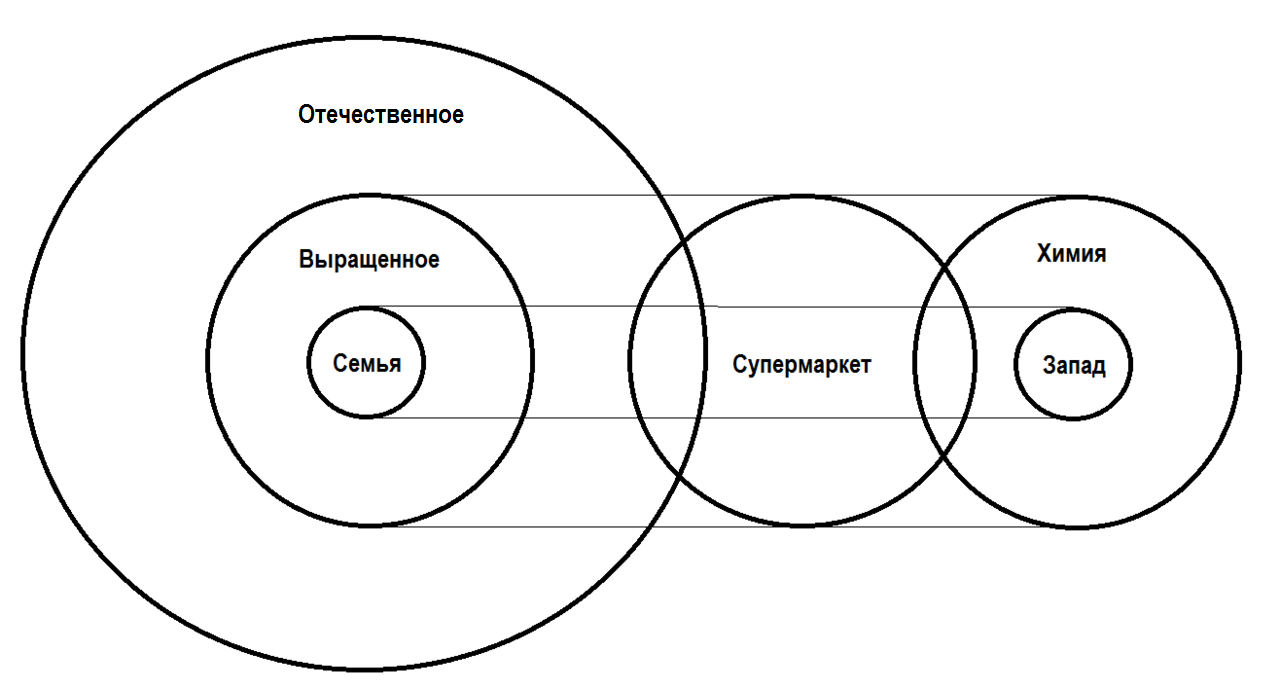
So, the space of the supermarket turns out to be a battlefield imposed on the Russian world with the West, which is personified on the scale of each family, in whose kitchen decisive measures are taken: final verdicts on foreign influence, production of healthy and normal food, legitimate categorization of “chemicals” and “healthy” (grown by the family itself, a grandmother from the street, local farmers) as opposed to advertising trickery. This petty swindler imposes capitalist space on the culture of the subject, which allows him (the West) to expand its influence on the minds of young people and seduce domestic producers into easy profits.
What is the nature of “chemistry” in such food discourse? First of all, these are the names listed in the “composition” on the product label that threaten with their alienated “scientific” nature. “Scientific” - because I remember chemistry lessons, where these unnatural verbal quirks, borrowed from an unfamiliar (foreign!) language, were first heard; This is where mistrust arises for the first time - they want to fool me with a fake, here they are being “clever,” that is, “fooling my brains.” Thanks to this mechanism of symbolically turning a product into “chemistry” through composition, the category of “chemicality” itself becomes a mobile signifier, capable of penetrating everywhere in the edible.
The dense substance in which industrial and laboratory miasma is enclosed was covered with a sweet and pleasant-tasting crust, that is, deception (“sweet lie”) - chips, cocktails, condensed milk, Snickers, juices, ..., nothing could resist. On the other hand, the table is threatened by GMOs. If “chemistry” penetrates into confectionery products, seasonings, candies, liquid substances (chemical solution, substances), then GMO undermines raw animal and plant products: meat, fish, vegetables and bread; in all this some unhealthy and disgusting mixture may be hidden. That is why everything is under suspicion: “chemistry” and GMOs are an infection or a virus, they are raw material that was not intended for human use at all (find out more about the mythologization of GMOs here ).
The supermarket, as a place of mass consumption, is associated with mass production: a conveyor belt, unfamiliar hands in gloves (the question is - maybe without them? - if the hands of a grandmother are sanctified by her love, then the hands of a stranger only attract damage), gloomy chimneys with coal smoke, coldness and arbitrariness that a prudent capitalist is capable of inflicting. The appearance of semi-finished products was immediately captured by a specific signified in the field of post-Soviet discourse: this is an attribute not of “business people” or women who have chosen a career, but, first of all, of lazy and irresponsible housewives who “feed artificial crap” and thereby allow the devaluation of the symbolic capital of their family throughout the family network (a reason for gossip and rumors), and secondly, of careless teenagers and bachelors whose consumption is such products are sometimes justified by their plight (the parents “overlooked”, were indifferent, in other words, the blame again falls on the woman who allowed the symbolic defilement of the semi-finished product to appear on the table). A semi-finished product is a betrayal of Nature itself (disruption of the natural course of food production), a betrayal of one’s ancestral network (damage to the image in the social network of food exchange, neglect of the help of relatives who are ready to send their pickles in order to help those in need and at the same time establish their symbolic capital or demonstrate it elsewhere) and denial of work ethics (labor ≢ nutrition, where the semi-finished product turns out to be a pause in such a mechanism, provoking further inaction).
“Chemistry” is formed where the subject is faced with his own alienation: the product is produced outside the usual social network, and the symbolism itself refers to something alien - a table of chemical elements, “design” (advertising) of packaging (that is, to trickery). The supermarket is not asleep and is trying to recreate a village, dacha or at least Soviet idyll inside the label - “Granny’s Products”, “Prostokvashino”, “Jolly Milkman”, “House in the Village”, “Green Village” and so on.
Foreign products and dishes
Foreign food is a sudden poisoning, deterioration of health, suspicious origin, unjustified high cost, artificiality, chemicals, GMOs. In this field, obviously, there are political and ideological opinions of the subjects, which determines this form of perception of everything foreign, which finds its place on the other side of private garden production, which in this regard means “domestic” and “natural.”
These attitudes also indirectly determine the subject’s behavior when directly encountering foreign food, which somehow (at a holiday, on occasion, after someone’s persuasion) ended up on his table: for example, a demonstrative disregard for the customs and traditions of eating it, if he has any. Feeling his “suspended” state with sushi or rolls, which are usually eaten with chopsticks, the subject avoids attempts to master a new cutlery, accompanied by irony at the native culture of the dish (“Oh, these Chinese,” “Am I narrow-eyed?”) and at the same time insisting on the “natural” efficiency of the cutlery familiar to him.
Однако при этом в диспозициях постсоветского питания оставляются некоторые лакуны, в пространстве которых могут легитимизировать не столько конкретные блюда или продукты других культур, сколько овеществленные стереотипы об их специфичных свойствах и формах, которые внутри экзотической кухни принято выделять, но которых не имеется в привычной субъекту пище. Это такие категории, как «восточные пряности», «немецкое пиво», «азербайджанские фрукты» и так далее. Нетрудно проследить исторический генезис таких установок, которые даны постсоветскому питанию советской культурой, вобравшей в себя традиции кухни восточных и среднеазиатских республик, а также восточноевропейских стран. Некоторое время побыв означающими достатка и потребительской ушлости (смекалки при поиске дефицитных продуктов), эти пищевые абстракции были поглощены повседневностью (добавить в салат ананас). Именно «советскость», данная этим генерализированным субстанциям историей, облегчает их котировку в советском и постсоветском пищевых дискурсах, а также благоволит конкретному и обыденному овеществлению: шаурма, осетинские пироги, корейская морковь, хычины и прочее. Испытывая давление из–за всё большего влияния новых блюд и пищевых традиций (например, распространение пиццерий и суши-баров), постсоветская кухня и в данный момент предпринимает попытки поглощения, встраивания или повторения своими средствами незнакомого пищевого феномена. Это переиначивание, опять же, совмещается с оправдательной риторикой, соответствующими текстами и символическим жестами: сделать «по-русски», то есть исправить недочет, допущенный и странным образом культивируемый иностранцами, при этом придать блюду истинную оригинальность и экзотичность. Обилие ярких примеров можно увидеть в известной интернет-рублике «карательная кулинария».
***
Пример выразительности (то есть и некоторого источника) структуры знака «иностранной пищи» и вообще всего «иностранного» предоставит нам советская народная киноклассика — «Иван Васильевич меняет профессию» (Леонид Гайдай, 1973).
В одной из сцен герой Феофан обходит стол с яствами для царской особы, перечисляя соответствующие статусу самодержавца блюда. Конечно же, контекст этой сцены изначально и явно отсылает нас к означающей составляющей любой пищи — над ней и будет произведена шутка. «Почки заячьи верченые, головы щучьи с чесноком, икра черная, красная… да! заморская икра… баклажанная!» (см. видео-отрывок ниже). Субъект «советскости» или «постсоветскости» при разворачивании этой синтагмы сначала натыкается на означающие богатого и добротного застолья. Традиционная русская дичь и рыба в виде зайца и щуки, а также привычное и понятное каждому морское сокровище — икра. Иначе говоря, перед нами возможные и легитимные элементы-изюминки праздничного стола, привычного культуре субъекта. Этот ряд подготавливает смещение внутри синтагмы, которое будет задействовать ещё и контекст, высвечиваемый понемногу как и в реальности сюжета фильма, так и в реальности зрителя — некий ажиотаж вокруг иностранной экзотики.
Феофан, как писарь Посольского приказа, то есть как представитель структуры, постоянно взаимодействующей с иностранцами и зарубежьем, устанавливает внутри фильма симметрию с другим персонажем — Антоном Семёновичем Шпаком, зажиточным советским интеллигентом, который, судя по убранству его квартиры (изобилие иностранной техники), тоже имеет доступ к зарубежью (и тем самым являет собой историческую параллель со знакомой зрителю интеллигенцией). Также Феофан стоит в исторической параллели с реальной царской и буржуазной аристократией, что уже образует семиотический квадрат, который мы и попытаемся рассмотреть далее. При его артикуляции происходит ещё одно семиотическое событие: персонаж Феофана пускает вектор биссектрисы между сюжетной симметрией и исторической параллелью, отсылая имплицитное сообщение зрителю, который тут же устанавливает коннотацию между этим персонажем и элементом противоположного угла структуры, высвеченным исторической параллелью Шпака: Феофан — это современники зрителю, то есть прозападные (либеральные) «интеллигентики» и вечно «суетящиеся» дельцы, у которых часто имеется дефицитный товар или какая-то редкая техника из зарубежья. Феофан восторгается заморскими деликатесами и чтобы подчеркнуть его восторг именно знаковостью этой пищи авторы помещают в её объект смехотворный для зрителя продукт — баклажанную икру. Здесь и происходит смещение, которое несет в себе семантический заряд: баклажанная икра, как то, что является для реальности субъекта объективно дешевым и распространенным товаром, именуется комическим персонажем как «деликатес», как то, что якобы может стоять в одном ряду с блюдами, признаваемыми субъектом пищевым достатком.
В свою очередь, Шпак организует похожую цепочку событий: между указанной ранее исторической параллелью с реальной советской интеллигенцией и внутренней симметрией с Феофаном, он пускает биссектрису с имплицитным сообщением в противоположный угол, которым является упомянутая реальная царская и буржуазная аристократия, которая известна советскому человеку как социальная группа, постоянно ориентированная на «западные ценности» (увлечение немцами, а далее французами, ныне — всем американским). Шпак — это символ буржуазной порчи советской действительности, которая всё ещё не изжита (но вот-вот сгниет из–за собственной глупости) и состоит в синхронной симметрии со своим историческим архетипом.
Структура начинает звучать: накопитель-Шпак (тень российской буржуазности в советском бытии), чьи означающие богатства смещаются при взломе квартиры обаятельным плутом Жоржем Милославским (эдакий Робин Гуд, который с помощью фантазии зрителя лишает буржуазию капитала) + Феофан на пиру, то есть настоящие интеллигенты и поклонники западной культуры, которым теперь вменяется восторг «баклажанной икрой» или чем-то переоцененным лишь по причине его иностранного происхождения (историческая параллель с былым русским дворянством, а также коннотация с современниками зрителя, эксплицитной карикатурой которых является Шпак). Это звучание оформляется в конкретную мелодию: в конце концов пресловутая баклажанная икра, вместе с царскими регалиям и означающими пищевой роскоши вообще (былая синтагма праздничного стала тут сплющивается до единого знака буржуазного излишества), — что тоже символично — пренебрежительно, — угодили в физиономии преследователей, а Шпак оказался обворованным Жоржем, которому даруют некоторое символическое прощение, не обижая при этом и милиционеров — они раскрывает его, но их линию обрывают без однозначной концовки (будет интересным заметить, что была снята сцена, где его ловят, однако её решили не использовали при окончательном монтаже).
Эту семиотическую структуру можно изобразить на следующей схеме:
Итак, мы видим, что означающие структуры протянулись сквозь культурную текстуру, цепляя, помимо самой повседневности, ещё и кино, так как кино не может игнорировать ту реальность, репрезентацией которого оно старается быть. И именно в подобных инсценировках бытности «советских» людей можно наблюдать наиболее наглядную (как оказалось — даже схематичную) ипостась интересующего нас дискурса при его же образовании.
Столовая и ресторан
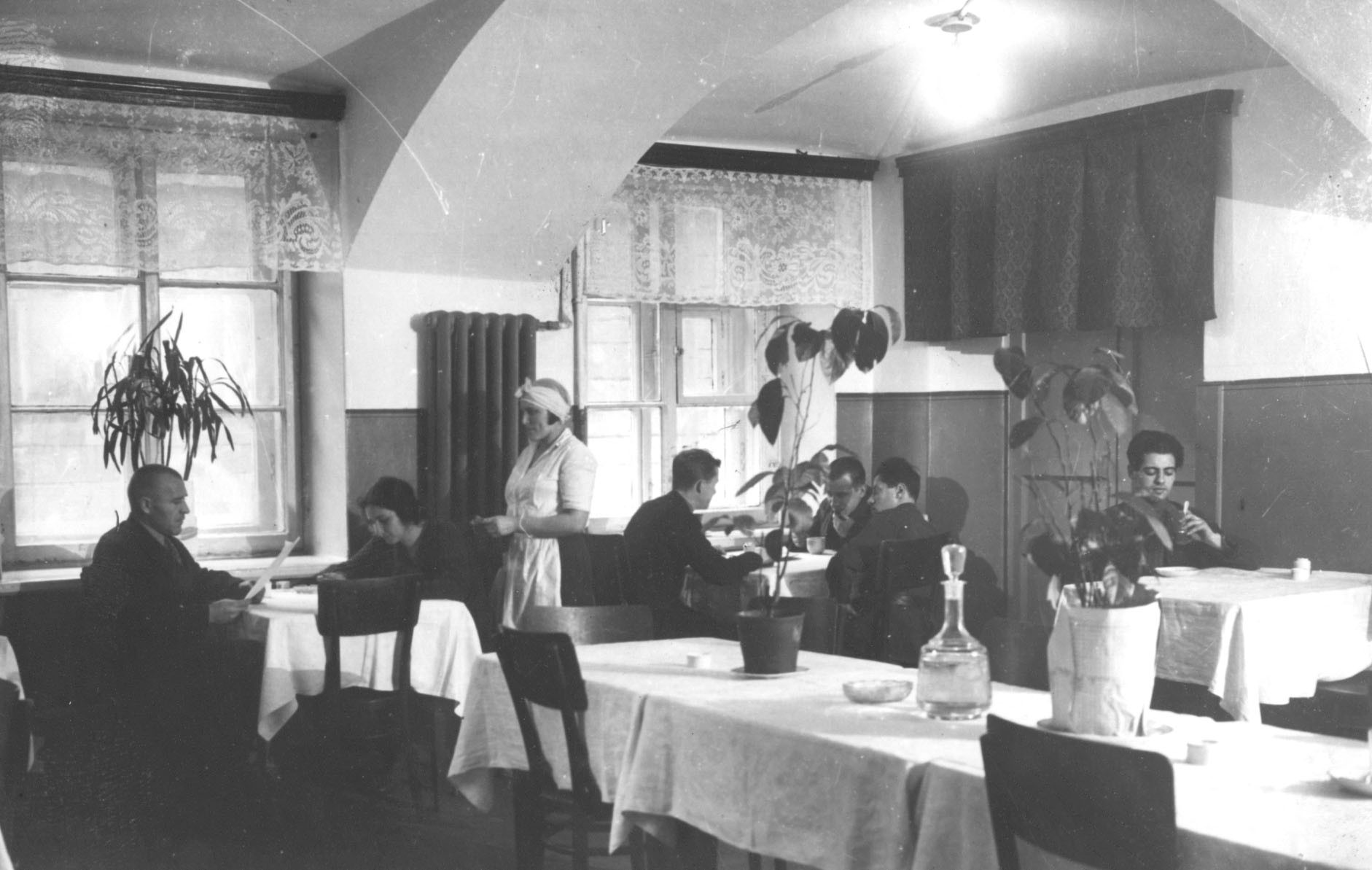
Столовая возникла как часть утопии об освобождении женщины от домашнего труда. Конечно, оказалась так, что проект эмансипации стал обслуживать не столько самих женщин, сколько экономическую систему, которая пожелала мобилизовать весь человеческий ресурс страны, не размениваясь на традиционные культурные (гендерные) модели, но создавая новые. Происходила бурная реструктуризация самой повседневности, централизация её плана в государственных институциях, а не в произвольности традиционного уклада.
При этом от семейной модели как таковой не отказались, что не удивительно, учитывая её символический потенциал, но переориентировали таковую в границах государственной машины. Избегая ловушки «капиталистического отчуждения», пищевое производство начали индустриализировать (превращать в «промышленность»), покрывая потребление пролетарскими означающими, в глубине своей содержащими всю ту же родовую сеть, но воображаемую внутри Пролетариата. Средства производства принадлежат народу (как огромной семье) = продукт не марается хладнокровными помыслами капиталиста, спешащего за наживой во вред качеству товара, иными словами, продукт создается такими же, как и потребитель, участниками социалистического проекта. Эти, казалось бы, ультимативные, броские и поэтому туманные идеологические высказывания стали тем магнитом, вокруг которого начинал после революционной разрухи и дезориентации НЭПа заново структурироваться пищевой дискурс.
В постсоветском дискурсе былое идеологические единение было включено в восставшую систему родовых отношений. Произошло специфичное наложение: советское питание, изменив и переориентировав традиционную (аграрную) культуру питания, упразднилось и тут же стало элементом репрезентации той самой культуры, став теперь её составной частью. Смещения и смешения, благодаря которым «как в столовой» стало, наконец и как планировали идеологи, метонимией «как дома». В сущности, постсоветский дискурс заимел структуру советского питания, приспособив её в новых капиталистических условиях и при этом идеологически обратившись к традиционализму (его репрезентации: в дореволюционной России, конечно же, никакой «идеи традиционализма» не было — лишь оправдываемая неизбежность). Заметим ещё раз, что советское питание было своеобразной интерпретацией аграрно-родового потребления в новой экономической системе с идеологическим ядром, обращенным в новое будущее. Это указывает на некоторую «заминку» между идеологическим, эксплицитным содержанием культуры питания и её текущим имплицитным, структурным воспроизведением: пролетарская кухня, создавая новую модель питания, пользуется ресурсом старой системы означаемых, но полноценно (то есть и в противовес чему-то иному) существовать в этой модели суждено не самому советскому человеку, а его постсоветскую наследнику, который сменит идеологический курс и воспользуется означающими традиционной кухни, которую, казалось бы, окончательно затемнили. Вместо воображаемого пролетариата появилась реальность «нашего поколения» (противопоставляющееся «поколению пепси»), которое отстаивает свою честь перед западными веяниями по всем фронтам: домашняя кухня упраздняет супермаркет, а столовая зарубежный «фастфуд».
Определенной абсорбции не избежало и пространство ресторана. Оно, конечно же, обречено стать местом демонстрации символического капитала сугубо в границах родовой сети (остерегаясь безмерно индивидуалистического удовольствия и траты лишь для себя), что можно легко увидеть при праздновании свадьбы. Ресторан, как ритуальное жерло потлача, поглощает ресурсы семьи, решивший сделать символический вклад в своё потомство. Ассортимент ресторана, по причине всё той же абсорбции, обогащается «домашней кухней» и стандартизирует некоторые компромиссы между экзотичностью и естественностью быта: салат Цезарь, селедка под шубой, шашлык, фаршированные яйца, плов, бутерброды с икрой, свиная шейка с овощами, буженина,…, «парадная» репрезентация семейного праздничного стола для всей родовой сети, где ресторан оказывается удобным местом для воспроизведения «родственности» во всем её мыслимом масштабе (здесь все — не находящийся здесь либо имеет вескую причину на то, либо оказываться по ту сторону семьи). Нередко эти застолья в честь свадьбы организуют в столовых предприятий и школ, что в некотором роде замыкает в себе такой пищевой дискурс, являющимся плотью самой постсоветской культуры. Как я пытался показать в этом тексте, это история не совсем об «эгоистичной статусности» (что, возможно, имеет отношение к более поздним адаптациям советской бытности в капиталистических условиях), но о характере значимости родственных связей: сегодня я закатил торжество (вложил ресурсы и силы, провел время в заботах), а завтра пойду, например, на празднество к своему куму, где уже буду и сам отдыхать. Я получаю удовольствие от того, что «работает» вся система родства, а не только моя семья. Вкладываются не только в статус именно своей семьи, но и в сам «род»: именно здесь между собой договариваются о том, что потом мы оценим как «блат».
Несомненно, родовая сеть это совокупность, как принято говорить в социологии (в западной культуре, соответственно), «нуклеарных» семей, которые, конечно же, обладают определенной «самостью», через что и отражается любой «родовой акт». Так или иначе каждая семья силится стать репрезентацией всего рода, как его наилучшего отражения. Мы можешь легко припомнить, как наши родственники переламывали кому-то косточки за то, что некто их не поздравил с какой-то датой (годовщина, день рождение). Однако это всё ещё не есть разговор о той самой ограниченной эгоистичности. Озабоченность тем, в скольких семьях отразилась собственная значимость — проверка того, в каком состоянии находится вся сеть в целом (мы в неё выкладываемся и следим за своим вкладом), ибо до и после такого, казалось бы, эгоистичного подсчета, следует скрупулезное планирование и запоминание дат, когда стоит поздравить других.
Used ( and recommended ) literature:
__________________________________________________________________________
Леви-Строс, К. Мифологики: Сырое и приготовленное // М.: ИД «Флюид», 2006. — 399 с.