
Translated material
Knowledge is fulfilled
Marina Israilova is a researcher, critic, curator, studying theater and performance, self-organizations in the field of culture. Member of the editorial board of the magazine K.R.A.P.I.V.A. , curatorial group of the “ Assembly ” project, teaches at the Laboratory of New Theater at St. Petersburg School of Science and Technology.
As part of the project “Political Dimensions of Cultural Practice and Knowledge Production,” we are publishing an essay in which Marina examines (and experiences) the performance of Anya Kravchenko, Valya Lutsenko and Marina Shamova “What is going on?” as an epistemological model and talks about the sets that are discovered in the process of executing knowledge.
More information about the project - https://syg.ma/@sygma/politichieskiie-izmierieniia-kulturnoi-praktiki-i-proizvodstva-znanii.
Text in English can be found here — https://syg.ma/@sygma/knowledge-is-being-performed
Part 1
I would like to connect the concepts of “knowledge”, “politics” and “performativity” through problematizing the dichotomy of internal and external. Each of these concepts can be considered on both a micro and macro scale: intrasubjective and planetary, intracorporeal and earthly, individualistic and social. How do knowledge and politics, through the performative, take place on opposite sides of the boundaries of internal and external, how do they shift and problematize these very boundaries? The body, the visible border of which is the surface of the skin, the body correlated through the gaze with the concept of the subject, the bearer of subjectivity, in my thinking is the field of revision of the border. The body always poses a problem for the purpose of internal and external, which Daria Yuriychuk writes a lot about [1]. In the realms of politics and knowledge, carried out in an institutional setting among many bodies , how, when zooming out, can we recognize the work of the political and the knowledge [2] within one body?
Subjectivity in this reflection is a disturbing, irremovable speck on the lens, a critical obstacle, the third meaning of my cinema of knowledge (“imaginary cinema” is shot by Nadezhda Ishkinyaeva, recording her experience of working with artists at PNI [3]).
I am writing this text while in the midst of many months of reflection on the performance of Anya Kravchenko, Valya Lutsenko and Marina Shamova “What is going on?” [4] I like this process and its slowness: from the first show in the summer of 2019 and several interviews and conversations to two more viewings and attempts at understanding in text and speech, which took shape in an article and a report for a conference - and now I can already say that at the moment this work alone is enough (and at the same time it is necessary ) for talking about performativity, politics, knowledge and subjectivity.
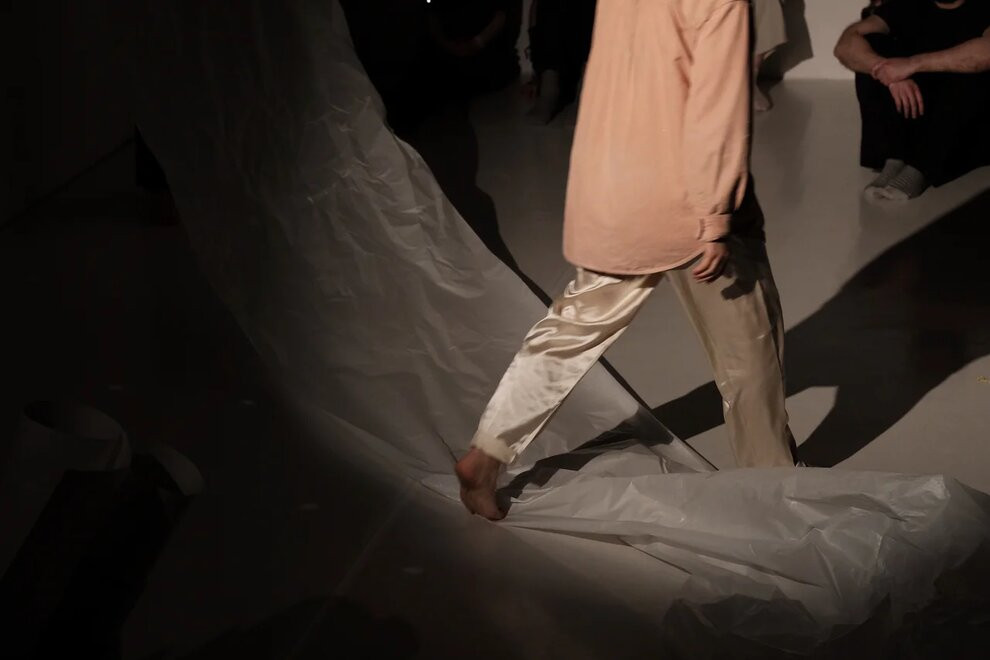
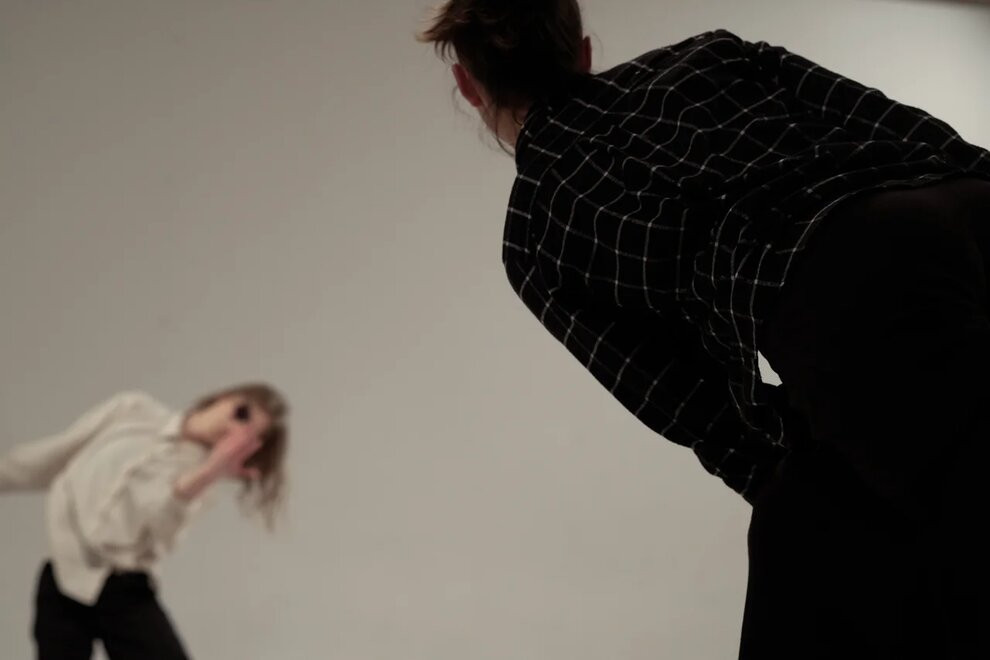
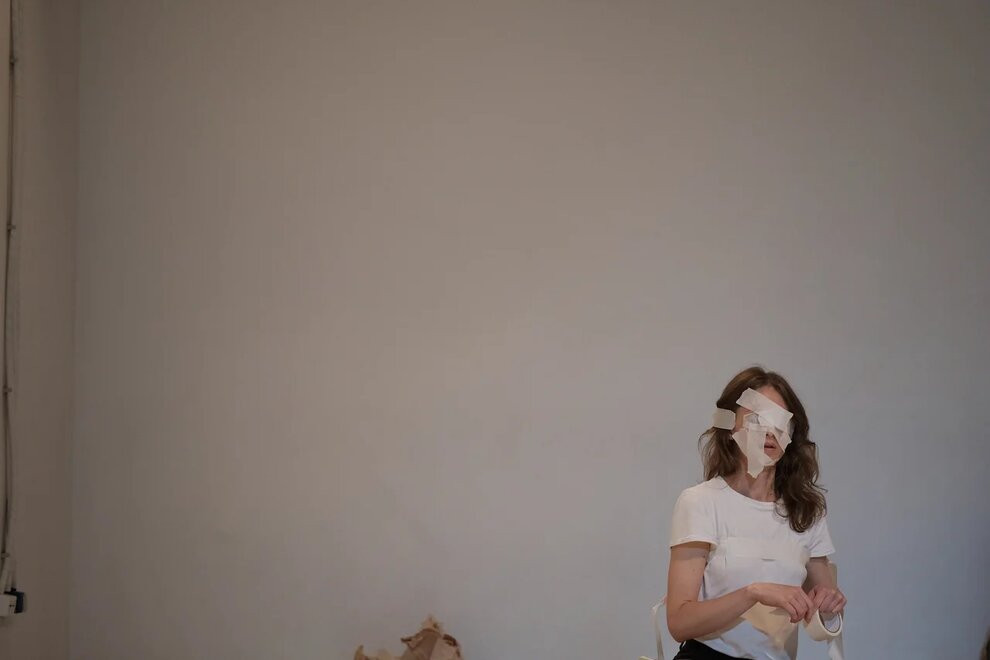
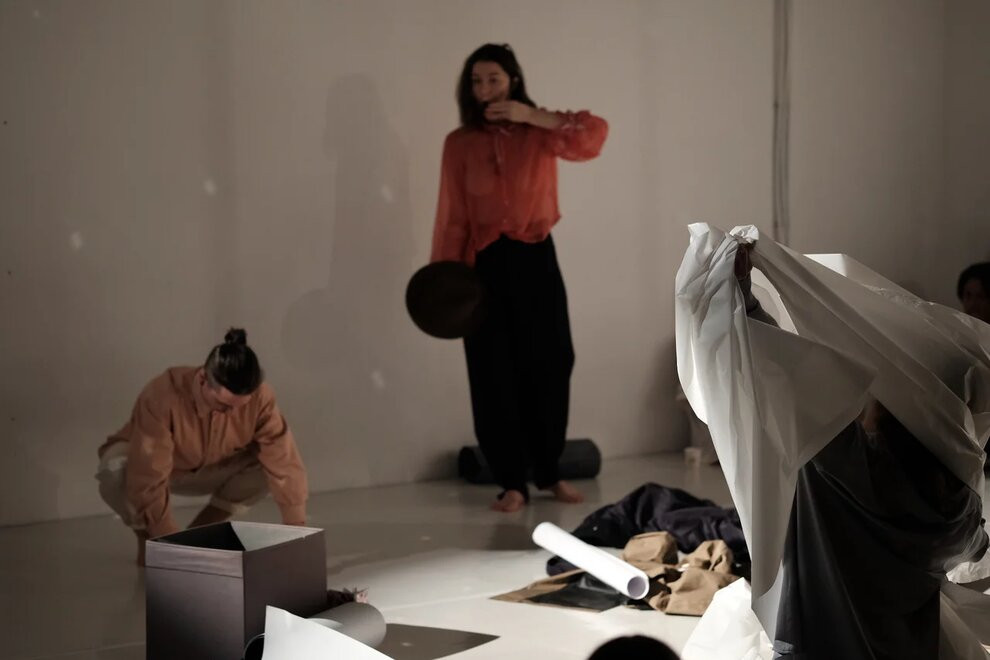
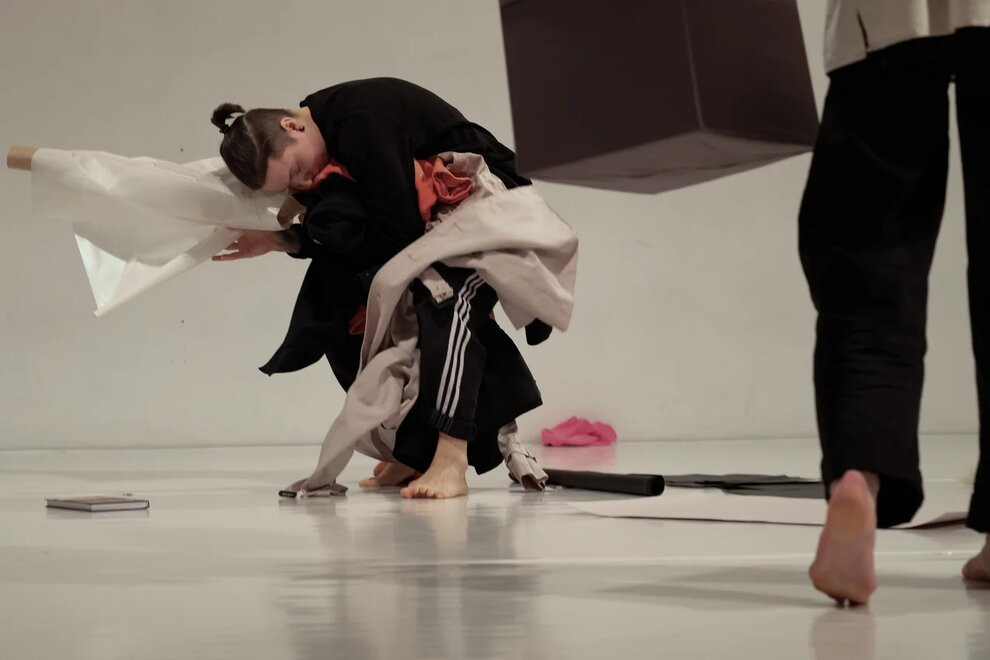
From the author’s description: “What’s going on anyway?” is a question that, once asked, does not require an answer. This is a performance in which three dance artists agree to spend time with each other, objects and philosophical texts. Read, dance, talk, sing and act with care and strange virtuosity - for no reason other than those that arise among and between the actors. <…> Here philosophy does not explain dance, and dance does not embody philosophy. Here the strange is aesthetically supported by software. Here traces left by the unconscious are captured with awareness and involvement. Here the helplessness of the general before its parts is practiced. Here objects interact with the spectral precision of the feeling and thinking."
When I write, I write from the effort of remembering the intonations during the interview, the words spoken, my bodily and affective reactions, the sense of hum from the density of meanings condensing during the performance, the rhythm of switches and interruptions of my attention, trust, curiosity, skepticism, attraction.
Part 2
The value of the performance “What is going on?” in terms of method - in overcoming the artificial division into different types of knowledge: philosophical (theoretical, academic) and bodily (sensual, movement, embodied, affective), pragmatic and utopian. This division is artificial, but legitimized in the institutional division of structures that produce knowledge, and within these institutions it is also supported by disciplinary boundaries. In the interview, Anya, Marina and Valya talk about their positions as dance artists, simultaneously passionate about philosophical knowledge, as marginal, peripheral, uncomfortable or strange.
Recognizing each other as being within this division (a separate story of reading traces, guessing, recognition and attraction) and as seeking ways to overcome it leads first to the idea of a reading group. And - whether thanks to this instinct of recognition - it almost immediately transforms into the idea of performance, where reading philosophical texts and dance coexist together.
The work is carried out in a laboratory format: external conditions that shape the space of experience are collectively created - time frames, principles of interaction with each other and objects, sounds, texts, processes, but every time what happens within these given conditions develops anew and differently. There are no rehearsals in the usual sense of the word: the performance, whether public or not, is performed in its entirety, archived in video recordings, studied and discussed.
These practices of viewing and discussion are themselves both a continuation of the work, the second stage of the laboratory process, and a special practice, which also seems to have its own conditions of flow and transformation. So, within it there is a place for the practice of making proposals - ways of interaction, new conditions, changes in the structure of work.
Attention focused on a process that has already happened (a show that happened, for example), collective sensitivity, isolating small somethings in what happened in it, form these proposals that are capable (although not always) of changing the course of work, becoming its new condition. As Marina describes it: “...we offer a way to be with something, to be in some tasks - for each other. This is probably a good format, because we don’t know each other, and we don’t know how to work. <…> This grasp, with which at some point we all agree, is introduced as a proposal or change. We didn’t grab something else today, but today we grabbed exactly this.”
This part of the work, hidden from the viewer, nevertheless leaves traces: the contours of this array of accumulated attention and joint effort are vaguely discernible, making the relationships between them special, mysterious, attractive and never fully accessible to either understanding or view. This sometimes rather painful experience of the limits of one’s own understanding, when the audience’s attention, even concentrated to the maximum, nevertheless inevitably does not have time to cover everything that is happening, is a separate important part of the dramaturgy of the work.
Someone else's thinking is unknowable. And being at the epicenter of the processes of thinking, cognition, movement, attention, distributed in a constant change of its trajectories between Marina, Anya, Valya, readable texts, sounds, space, objects, inside and outside dancing and perceiving bodies, I recognize these boundaries of understanding with gratitude. Giving up attempts to understand-in-order-to-appropriate, I get in return the opportunity to co-think: as Anya will say about this in an interview, “not to have this thinking, but to treat it responsibly.”
Part 3
Equally important and more intriguing to me personally is the ethics of relationships within work. The relationship between Anya, Marina and Valya, between them and the text/texts read by each and read by others, objects and space. When listening to recordings of interviews, I find myself having to stop and carefully listen to speech formulas, ways of speaking, the length of pauses and groping for the exact meaning. Or, which is almost more often, on the articulation of the fact that there cannot be an exact meaning here and that it is not needed here. Here are some of these formulas.
Anya (reading “The Fourfold Object” by Graham Harman):
this book is... a place where different streams... of thought... can meet
This also allows me, reading more and more into it, to resort to it when it seems most, or something... appropriate
how our collective thinking can unfold. how to not have this thinking, but treat it responsibly, continue to be responsible for it
it's just a part, but it's not for
to do something without falling into this experience that “this is mine”, “this belongs to me” or “this completely represents me”
We don’t make any promises to ourselves, but act on request
Marina (reading “The Logic of Sense” by Gilles Deleuze):
how can I at the same time notice what is happening now and still not part with the time preceding it?
thinking practice
literally: how to move this space to another place
switching - many possible options than to think about
I always never understand anything
and this question is not a question (what is going on?) - it’s... the body
it (“Logic of Sense”) is close to me, it’s like...a relative (laughs)
this book just exists and everything is like something that cannot be chosen anymore, I can no longer choose to read it or not, this is already part of the work, how will I choose? who am I to choose
an image of very small objects that constantly appear and do not have time to be named and maybe there is no need...
Valya is a medium for Hora, which I perceive
curiosity about what they are doing and what I am doing in relation to them and we are always not doing something that...
Valya (reads the essay “Chorus” by Jacques Derrida):
how philosophical texts become embodied
flickering of transition into the material, but not manifested in a thing. already material, but not yet captured
I like the way Marina presents Deleuze to me better
I don’t like Harman, but I like the way Anya messes with him
as Marina said: you don’t learn anything, but you become something
Hora is not infinity, it relates to what it gives place to
I look with my body or my eyes and see densities or rarefactions that I need to either occupy or...
calls of the place
subject ethics
when I say the words of the Choir many times, I will, of course, hear whole/hole/whore - as “whole”, “hole” and as “whore”
We devour these texts, we behave very animalistically. that is... you need to smell, and chew... and tear
What is expressed in a bodily-spatial-temporal form in a performance is spoken in words in an interview, heard in intonations and speech structures. I don’t think that performance and talking about it are in a complementarity relationship with each other; perhaps the metaphor of a second date would be best to clarify their connection? Is this related to my resistance to analyzing or explaining what was said in the interview? My desire to hide some of the topics discussed in them? But also to indicate their presence - that is, to communicate: we (between us) have a secret.
Part 4
"What's going on?" is also an attraction of scalability: knowledge, politics and subjectivity here can be felt from micro to macro and back. The problem of the separation of the rational and bodily spheres, the institutionalization of certain forms of knowledge, the ghosts of the disciplinarity of epistemological attitudes coexist with attentiveness to intracorporeal processes, affects, memory, patterns of movement and kinetic sensitivity. “The heart of this work and its value for me lies precisely in the physiology of thinking and in the constant diving into the unconscious and dancing from there. Externalization of the nervous system, physiological processes and then... reactive return... to thought, speech, listening,” says Valya in an interview.
The relationship between the participants in the performance and the space and objects in it can also be perceived at any level of abstraction. Each text participating in the performance is philosophy in general, philosophizing in general, and a materially embodied concrete object (book).
Like every movement of a dancer, and behind every spoken word and written text, with sufficient attention, a long story unfolds - development, school, other people's movements, searches, movement patterns, personal history, rejection, agreement, instinct, institutional patterns and ways to circumvent them, reinvent, unlearn.
As a spectator, I feel like a constantly shaking kaleidoscope combined with a spyglass. I see (feel) how patterns are assembled from the co-thinking [5] of Vali and Derrida, Ani and Harman, Marina and Deleuze, how their bodies think. The space in which nothing that can happen is predetermined embraces me too. Subjectivity, which feels dense, is stratified into layers and split into fragments, among which are recognized not mine, others [6], who have always already been there and are now ready to join, integrate or go on a tangent.
I am still surprised by my discovery: the knowledge that seemed to me to be fixed, defined, evaluated and structured, sanctified and prescribed, can in fact only be performed and performed only jointly. Only among different sets: inside a body, between bodies, between groups of bodies. This could probably be one of the answers to “What the hell is going on?” Knowledge is fulfilled.
Part 5
Among other things, this text is structured as an assemblage of my own subjectivity. Who am I? I am the sentimental voice of recognition. Embarrassment, shame and pleasure from shame: could it be that all my intonation, my cherished obsessions of falling in love with other people’s texts, with other people’s ways of thinking, is a way to let into the processes of cognition, writing, understanding, and giving meaning, the eroticism and intimacy, sensuality and attraction inherent in thinking that were once repressed by the attitude towards rationality and objectivity?
Could every footnote in an article be a coded message, a love letter? When thinking is engulfed by the pulsation of the erotic, when I let inside me your thoughts, and yours, and yours, the articulations of theories and the flow of logics - what happens to the inner and the outer? Is knowledge in general - and knowledge at every moment of time - inside me or outside? And what difference does it make if both bring pleasure?
How does the feeling of oneself work, what does it mean to practice oneself, what scheme [7] of subjectivity can be depicted (externalized)? The subject as a setting, as a recorder of intersections, a net of intonations, a wind rose, an assemblage point, a constellation of the alien. Although in such a configuration any other others also lose their clear outlines and boundaries, become blurred and dispersed in space.
Could this blurring and dispersal be what happens in performance? Xenoeroticism [8] of different types of knowledge, ways of thinking, co-existence with objects, mergers, voyeurism and exhibitionism of the thought processes of all participants - including spectators?
Part 6
Why is the inner intonation of all my texts the intonation of a hopelessly in love? Can epistemology be eroticized? Or is she just erotic? Being executed, knowledge reveals in itself such multitudes that are held together thanks to tensions, convergences, attractions, guessing, tracking, intuitions and premonitions. Thought processes can easily be described through the Lover's Speech Fragments, incorporated into or permeated by the speech. At the very least, such a project could become my fantasy.
Notes
[1] Yuriychuk D. Reassembling our borders: how taboos, photography and biomedical knowledge create human bodies // Knife
Yuriychuk D. How to dance politically? // HJ. - 2019. - No. 108.
[2] See the text by Anastasia Dmitrievskaya for an important metaphor of the knowledge monster: Dmitrievskaya A. Lecture-performance: staged knowledge // Theater. - 2017. - No. 29.
[3] Ishkinyaeva N. I don’t mind // K.R.A.P.I.V.A.
[4] From the project description on the SDVIG Studio website. — https://sdvig.space/what-is-actually-going-on.
[5] See the concept of “companion” from the poetic texts of Galina Rymbu, included in the “ Book of Decadence ”.
[6] Stolet J. Alien + alien: experience of communication in the year 3000 // Cyberfemzin 02.
[7] Schemes as one of the forms of knowledge production are used in her texts by the adjuster of entanglements Lika Kareva. See: Kareva L. Self-organization schemes // Syg.ma. — https://syg.ma/@lika-kareva/skhiemy-samoorghanizatsii
[8] A concept introduced into my lexicon through one of the hashtags on the VKontakte public page “ support function ”.