
Translated material
Breathe
Chapter from Alexis Pauline Gumbs' book Undrowned: Lessons from Black Feminism from Marine Mammals, published by AK Press on November 17, 2020. Translation: Furii. Published with encouraging permission from the author.
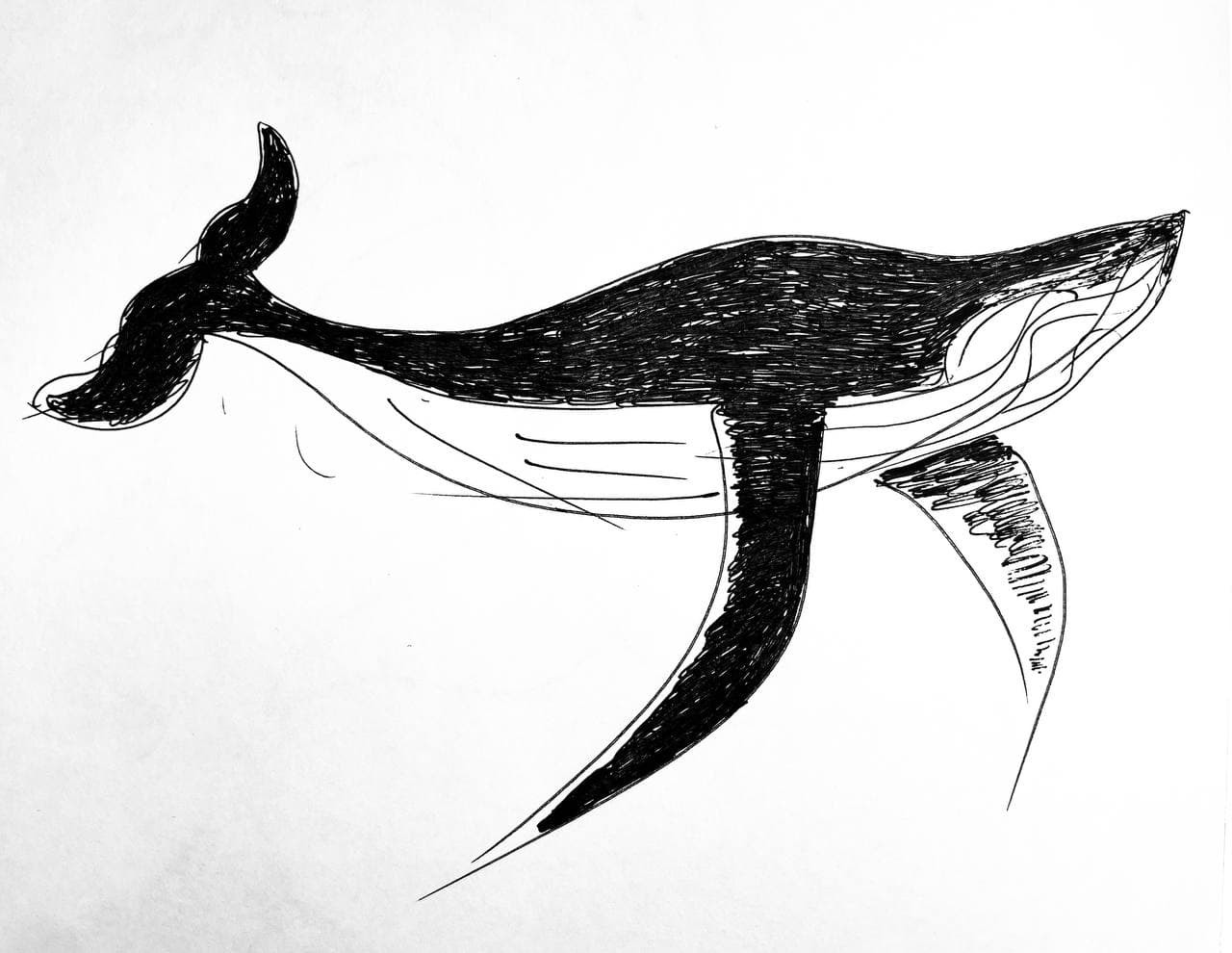
Breathing is the practice of presence. One of the physical characteristics that we share with marine mammals is that they interact with air in a similar way to us. Although they spend almost all their time in the water, they do not have gills. And we on land often have to exist in conditions in which it seems impossible to breathe, but we have to. The adaptations of the respiratory system that marine mammals have undergone are important for us not only as an example for survival in an atmosphere that we have polluted, on a planet where, through our fault, the world's oceans have overflowed its banks, but also for living in accordance with our values and beliefs, for our caring attitude towards each other.
This chapter includes meditations on the different ways in which narwhals, beluga whales, and polar whales breathe in the Arctic; how a baby seal learns to breathe as an infant; the relationship between the critically endangered northern right whale and my ancestors—enslaved Africans on one side and members of the indigenous Shinnecock people on the other; and even a surprise appearance by a Blacktip Reef Shark. This text offers a look at what blocks our breathing and the risks of a society that puts profit before breathing. And let our breath pave the way to non-violence.
***
In the Arctic you have to breathe differently. Ask narwhals, beluga whales and polar whales.
The beluga whale has evolved to the point of being visually indistinguishable from the ice itself; it transforms, gathers in small estuaries, and sings.
The narwhal remains in deeper waters, closer to the ice floes, grows a tusk to break its way, and changes color throughout its life. He doesn't need any other teeth. Only this one.
For the polar whale, bigger is better; this giant keeps to itself. He is strong enough to break through ice with his skull, and old enough to remember what happened before. Never stops growing.
And you? Maybe it's time to remember that there is more than one way to breathe in the icy depths of the summer heat? And thank your ancestors for evolving before you, despite the proximity of polar bears, harpoons and other threats. And think about what you want to change, how you want to grow, what you need to remember.
What about me? It's you I've always loved, not your elegant strategy. And now I will love you, even if you outgrow it. I will love you even more, no matter where time goes - forward or backward. Will the ice melt or will the water freeze? Whatever your next step is: protection, breakthrough, transformation or a combination of them. There are at least three ways to love you: as you were, as you are, and as you will be. I love you. So I choose all three.
***
The Weddell seal pup is not yet old enough to have its flippers. She's clumsy. She doesn't want to swim. She doesn't know that she can breathe underwater. No one told her about her blood's ability to store oxygen. She doesn't know that the milk her mother feeds her is one of the richest milks in the world. The southernmost mammal on the planet, she doesn't yet know the depths of what she's capable of. But her mother knows.
A Weddell seal mom pushes her baby into the water against her will, forcing the baby's head under the water as she coughs, spits, squirms and dodges. She's new here. She doesn't know that she can breathe underwater.
And then suddenly he finds out. And then everything will change. By the time breastfeeding ends, she will be able to dive to a depth of 760 meters. And stay there for an hour if he wants. And, returning after a twelve-kilometer swim, she finds a tiny hole in the ice that she made for air access. Move gracefully between frozen and liquid worlds. But she doesn't know that yet.
Is it really only me who is learning this lesson so hard - in coughing and sputtering, in an attempt to remain the creature that it seemed to me that I was; unaware of what evolution has already ingrained in me? It seems to me that I won’t succeed, but in reality - what do I know.
The Weddell seal's tough motherly love teaches us the difference between what's nice and what's needed. What is and what could be. I am grateful to my mothers—biological, chosen, ancestral, mammalian and otherwise (like the red-headed viper I met yesterday)—who stun me with knowledge of my abilities, teach me to trust my lungs more than I am accustomed to. Breathe like I couldn't before. To know my blood like I didn't know it.
The baby Weddell seal will grow up and shed its fur and become smooth. She will feel at home in the ocean. She will see and feel things that no other mammal has experienced or seen. But now she coughs and spits—and clings to the world she knows. She feels like she is drowning, but she truly gets to know herself for the first time in her life.
Love and gratitude to all my parents and the universe that pushed me forward and laughed at me. Thanks to all those who have already pushed themselves beyond the limits, even if these are the limits of earthly life. We can move between worlds. Thank you to all those who live and change: the vulnerability of your newness is an example for all of us.
Thank you to those who hold me accountable, who expect me to become who I need to become. Thank you for not paying attention to the lies I tell myself about myself. Even in my resistance, I am grateful to all of you. For the love that you teach me - Black [1], deep and complete. For caring, pushing and example. What have you learned from facing your death? What you learned while you were drowning was my breathing [2].
***
As soon as I was on the beach in Bridgehampton, a whale appeared above the water and exhaled. From where I stood on the occupied sacred land of the Shinnecock Nation, I couldn't tell if it was a fin whale or a humpback whale, but in the back of my mind I hoped that maybe, just maybe, it was a northern right whale. A right whale driven to near extinction when it was hunted to be used as fuel (literally) for the colonial project. Whale oil and light.
The right whale used to take a century of breath. This doesn't happen now. Rarely do they live past five years without being injured by boat propellers or industrial fishing nets. Not that it's necessary. Boats could easily change their course. Do you know what is needed? Breath. And theirs is even greater than ours. Yesterday I learned that the breath of whales is as important to our own respiration and the geochemical carbon cycle as the world's forests. Scientists say that if whale populations were to return to pre-commercial whaling levels, their enormous breath would absorb as much carbon as 110,000 hectares of forest—a forest the size of Rocky Mountain National Park.
Today and forever, the Shinnecock people, including some of my ancestors, have a sacred relationship with the northern right whale. They've been listening to whales for centuries. Once upon a time, the beaching of one whale was a gift to an entire community. Food and light. Shelter and warmth. But that day on the beach, poet Katie Engel told me that in all the sixty years she grew up on that beach, she had never seen a whale—until this summer. Did you call them with your letter? - she asked me in our online correspondence.
Yes. For all eternity I have been calling you. I call you with my blood and my breath. I remember what you gave us: everything. Light, home, each other. Love, warmth, ourselves. With my breath I sing your name. Thanks to you I can breathe. Do you have a century of breath left? And if not, then what remains for me?
Home is easy, but loss is hard. I can't live without you. And why would I want to live without you? Guardians of the century, air converters - I'm waiting for your message, waiting for the task. In debt and gratitude, in trust and tide. I see you. I hear you. I know. I dedicate my breath to the depth that you taught us. And you continue to teach.
***
"My pleasure"
That's what the Blacktip Reef Shark told me when it swam right up to the shore and accompanied me until the end of my walk.
“What are you doing here? - I asked her in response. “Everyone knows that I write about marine mammals, not sharks.” And do you really hang out here?
She took a deep breath underwater. I felt envious. Maybe I need gills too... But I didn’t say it out loud.
“First of all,” she said, “is this how you greet a gray shark? Do you know who my relatives are?” And that's true. Her family includes tiger sharks and other, even more bloodthirsty species. But by then she was already rolling her eyes, and I realized that this was not a threat on her part. So my assumption was wrong?
“Dear shark,” I finally said.
“Did I hear correctly? The waves are noisy, and my ears, you know, are hidden inside my head..."
“DEAR SHARK,” I repeated. “The esteemed shark is viviparous, can breathe underwater, and is born as a complete, sand-colored personality. Guardian of the reef with beautiful Black outlines. Willful and brilliant, brave even by the standards of sharks. Seeing you one day is a gift from heaven. Seeing you now is bigger than my wildest dreams. I'm at your disposal. I owe you. What can I do for you?
“That’s a different conversation. May you soon outgrow those boundaries that do not protect you and do not need you. And pass on my message to the others. My pleasure"
*
Three lies about sharks that people use to justify their cruelty and exclusion - and that sharks will no longer tolerate:
Sharks are loners. Read: Develop your sharp personality. (False! Blacktip reef sharks, for example, are very social and find protection in large groups. Strength is in community.)
Sharks are strong and efficient because they hide. Read: No one will love you all. (Wrong! For example, Blacktip sharks jump out of the water and turn around their axis four times even while hunting. You are beautiful and fierce from any angle.)
Sharks spend more time sharpening their teeth than opening their gills. (Anyone need clarification? Breathe!)
*
Addition from me:
When even sharks teach you non-violence, you know it's time for change. My contribution to our overall evolution is my willingness to give up a clear knowledge of who I am; from the cold weapons of words that filled my mouth; from the way I showed only part of myself when you needed all of me, all the time; from the lies that I allowed to exist in my name; from devaluing my breath.
I love each of you for the elasticity of your cartilage and the way you open your gills. Thank you for remembering and preserving the ancient rule of cyclicality. And what a blessing it is to realize that we don’t have to turn into monsters to survive. What a joy it is to allow ourselves to free ourselves from something that never really had power over us. Growing into our roles as brave guardians of vulnerability. We admired the sharpness of the teeth and glorified the utmost alienation. We have turned into a fetish what we feared most. And now we are ready to notice the miracle that has always been in sight. Gills: permeability force. Gills: life itself flows through you. Your breath. We need and it is important that you breathe [3].
Notes:
1) Following the author, in this translation the word “Black” is written with a capital letter, regardless of the meaning. As Alexis Pauline Gumbs explains in the introduction to this book: “I always capitalize the word Black. Thanks to decades of work by Black writers and editors, it is common today to use a capital letter when “Black” refers to Black people, and a lowercase letter when referring to color. But Blackness is more than human. And there is no descriptive or symbolic use of the word “Black” in our society that does not involve Black lives. So Black is Black, regardless of the word usage.” (Note per.)
2) #docjosephriseinpower (Author's note)
3) #nomammalsupremacy #oceaniclove #realsharkfriendsdroppingknowledge (Author’s note)
feminismF-letter Alexis Pauline Gumbs ecology sea ocean love sisters Furies Furii