
Translated material
Bataille and the Greeks
Georges Bataille wrote in an era not too far removed from our own. Like us, in his gaze there were more things that were incomprehensible than things that were understandable. In his era, metaphysics had already ended, but, unlike us, he still remembered something about it. They told him something about her in his youth, and he remembered it. One of those who spoke was Russian emigrant Lev Shestov. Bataille was impressed by Shestov and his sense of humor, and together they read Phaedo. Shestov helped Bataille read Plato with a certain mental emphasis: the connection between philosophy and death in the mouth of Socrates is not about keeping oneself in the markings of the Good in the face of death in order to enter into it without fear. This is about the eternal retention of philosophy in the face of death, where there is its only place, through which retention philosophy can only be properly marked and marked [1].
We know what strange things are. Things become incomprehensible when they are talked about a lot and persistently, interrupting interlocutors, from the screen. Bataille also writes about this: “If there is nothing on the other side of political action, human hunger falls only on emptiness” [2]. This is the incomprehensible thing that has not become clear since the time of Bataille. When strange things go on and on and we pretend that we know how to deal with them, citing unstable stock prices or the irrational, almost animalistic nature of aggressive fundamentalism, we wither away. “Monocephalic society arises from the free play of natural human laws, but each time, since it is a secondary formation, it represents atrophy (une atrophie) and the sterility of a depressing existence” [3]. Άτροφία is the absence of feeding, when the cut stream of food is released from a weak body that also needs feeding, and so on; this is the absence of the Nurse. Oedipus is disconnected from Jocasta as a mother and reconnected to her in the aura of power, on the royal bed. Now she is only wasting his strength. Now these are politics and words, words of love that a wife demands and a mother does not demand, these are words of friendship, which are used to write broken peace treaties, and words of threats addressed from high stands to terrorists who will never hear them. To escape from here, Oedipus needs a tragedy that would leave him in the radical solitude of irrelevance, but also in a strange community with his crime and, through it, with the Eumenides waiting for him in their grove. He meets them in death.
Tragedy, as Bataille thinks of it, acts in two directions at once. On the one hand, entering the space of tragedy means accepting the incomprehensibility of the world, realizing one’s own ignorance, when there is so much horror and madness that it is easier to gouge out your eyes; it means irrelevance among those who “get it” and “work.” On the other hand, this is the possibility of a new unity (“Life requires unity from people, and people are united only either by a leader or by tragedy” [4]), a new assembly, within which this incomprehensible world is comprehended by ignorance. The man of tragedy “knows that he is in the power of the absurdity of human relations, in the power of the absurdity of nature, but he himself affirms that very reality that leaves him no other choice but crime” [5]. The crime here is not the crime of a revolutionary or an executioner, there is no direct political action here; This is an element of inner experience, about which Blanchot says that it “opens an insignificant gap in a complete being, through which everything that is suddenly erupts and splashes out - by the force of a frenzied excess that has broken free” [6]. Crime makes room for tragedy, which itself is an inappropriate place, a gap.
Tragedy works in two directions. About internal experience, Bataille will say that if not for fatigue, anxiety would return again and again. Bataille here disputes Hegel’s anthropological machine: Hegel described everything correctly, but this mechanism, which actually existed in history, is what brought history to where it is now. The master in Hegel (and in the world) is never sovereign for any length of time. In a duel he meets death, but at the moment when death is defeated by vanity, there is no one to recognize the master: his opponent becomes a slave. This is Hegel's well-known incident today. Now the master has no choice but to wait for the slave to rebel; he can fill this time with debauchery, libations or collecting children's skulls in the basement of the castle of Tiffauges. The one-sidedness of the movement of domination is what Bataille is trying to overcome. The gentleman lacks a sense of humor, perhaps Shestov’s, when he can laugh at the collapse of his confession procedure, which will throw him away from the impending death (after a moment already frozen into an optical poetic or imperious image) and give him the opportunity, through the return of anxiety, to get closer to it again. But the warrior is not capable of this: “The most tragic spectacle it [a warrior’s existence] can imagine is a parade” [7], a petrified image of victory that is well suited for reproduction on postcards. Warrior is too appropriate. He does not even enter the gaping void of death; instead, he “dies the death of the brave,” falls, as if into an oubliette, into a topos already marked by power and words.
Irrelevance is achieved through ignorance. Ignorance is achieved through the transgression of knowledge (laughter, waste, sacrifice, eroticism). The rupture of discourse also leads to a rupture of the plane of existence, to a gap that reveals itself as a place. Bataille writes: “I fix a point (un point) in front of me and imagine this point as a geometric place (le lieu géométrique [it makes sense to pay attention to the definite article of place]) of all existence and everything united, all division and all anxiety, all unsatisfied desires and all possible deaths” [8]. Here Bataille writes no more or less about the impending death (real death, that is, nothing), to which, through the alternation of anxiety and laughter (in Kant’s definition), or, if you like, limit and transgression, he returns time after time. The position here is not so much holding as it is alternately sliding to one side or the other. Swinging back and forth like a battering ram (all sorts of erotic comparisons are also more than appropriate), Bataille captures “the movement of a painful message... which flows both from the inside out and from the outside in” [9].
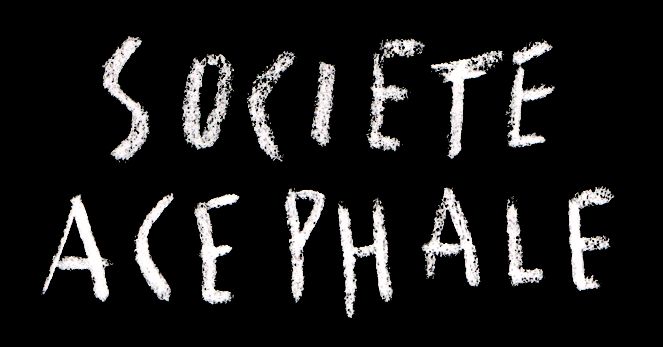
The message flowing out is what he, in a somewhat romantic manner, called “erotic tremors of the earth” [10]. Roughly speaking, this is feeding, energetic currents of excess matter, its unformed remainder. Does the soldier feel them? May be. The important thing is that the soldier can never throw them into the world. Only a community can transmit these currents, such as the community of Oedipus and Eumenides (Oedipus transmits these currents to Athens), where nothing becomes an image, but always returns. “Acephalus” is the same community, giving a place to erupting matter and itself becoming this place.
Bataille says that you need to become a wound. This, oddly enough, is understandable. It is like a hole in a camisole, where it is not clear whether learning is peeking out or stupidity is peeking in. There seems to be no hole: there is a camisole, there is learning, there is stupidity. But there is a hole, and it exists in such a way that without it everything else would not exist. How to become a wound is also understandable. One must face the Rana with a capital R and become like it. In the human dimension it will be death, but it seems - since we have overcome Christianity with its anthropocentrism - that death also imitates some greater wound. Here we find a bridge thrown from the Phaedo to the Timaeus. The hole is χώρα, which is both the Receiver and the Nurse, and which alone can satisfy Bataille’s desire “to reach that point where in Dionysian vertigo the high and the low are mixed, where the distance between everything and nothing is erased” [11], just as for Plato there was nothing else where the limit and the limitless, the identical and the other, the shaping and formalized.
And the sliding anxious presence in the face of nothingness, and the need not only to come close to it, but also to allow its currents to flow through oneself into the world - all this reminds us of the path that Plato previously indicated: this is a double movement of ascent to the Good and the necessary subsequent descent into the darkness of the cave. For Bataille, the Good no longer exists, but “with the death of God, his very place does not disappear” [12]: “C'est de cette place vide, que j'ai voulu parler,” he says in his late interview, which simultaneously means “I wanted to talk” both “about this place” and “from this place.” Freed from the God who occupied it, the place becomes empty, becomes truly a wound; but there is no invention in this, it is only a recollection of Plato’s chorus. And just as in Plato, the community is likened to the choir, just as death is likened to it - just as man and the polis are likened to the cosmos. Bataille's impossible community will be the same as Plato's dialogue, dialogue as an event of speech and meeting; such a community that exists only as long as speech is heard, bringing the speakers closer to the Good and itself building them in the Good, good. In all this there is no direct reliance on Plato; I think Bataille himself was not aware of this, although, as we have seen, Plato was the author who influenced him back in the 1920s, at the dawn of his philosophizing. It just turns out that Bataille, this quiet librarian, lover of looking into other people's anuses, possibly a murderer (he boasted about this somewhere in “Inner Experience”), turns out to be a consistent Platonist, if we accept this arrangement of emphasis in his and Plato’s thought. Bataille precisely recalled Plato’s paths (without distinguishing them, calling them a “labyrinth”), and followed them simply because otherwise it is impossible to move within the question posed in this way.
Notes
[1] Hart K. The dark gaze. Maurice Blanchot and the sacred. Chicago, 2004. P. 81.
[2] Bataille G. La conjuration sacrée // Acéphale. 1936. 24 June. N 1. P. 2.
[3] Bataille G. Propositions // Acéphale. 1937. 21 January. N 2. P. 18.
[4] Bataille G. Chronique nietzscheenne // Acéphale. 1937. Juillet. N¾. P. 22.
[5] Bataille J. Brotherhoods, orders, secret societies, churches // College of Sociology. St. Petersburg, 2004. P. 150.
[6] Blanchot M. Experience is the limit // Thanatography of Eros: Georges Bataille and French thought of the mid-twentieth century. St. Petersburg, 1994. P. 71.
[7] Bataille G. Chronique nietzscheenne. P. 20.
[8] Bataille G. La pratique de la joie devant la mort // Acéphale. 1939. Juin. N 5. P. 19.
[9] Bataille J. Inner experience. St. Petersburg, 1997. P. 221.
[10] Bataille J. Solar anus // Ultimate Bataille. St. Petersburg, 2006. P. 268.
[11] Leiris M. From Bataille's impossible to impossible Documents // Ultimate Bataille. P. 62.
[12] Evstropov M. N. Experiences of approaching the “other”: Bataille, Levinas, Blanchot. Tomsk, 2012. P. 107.