
Translated material
"oub"
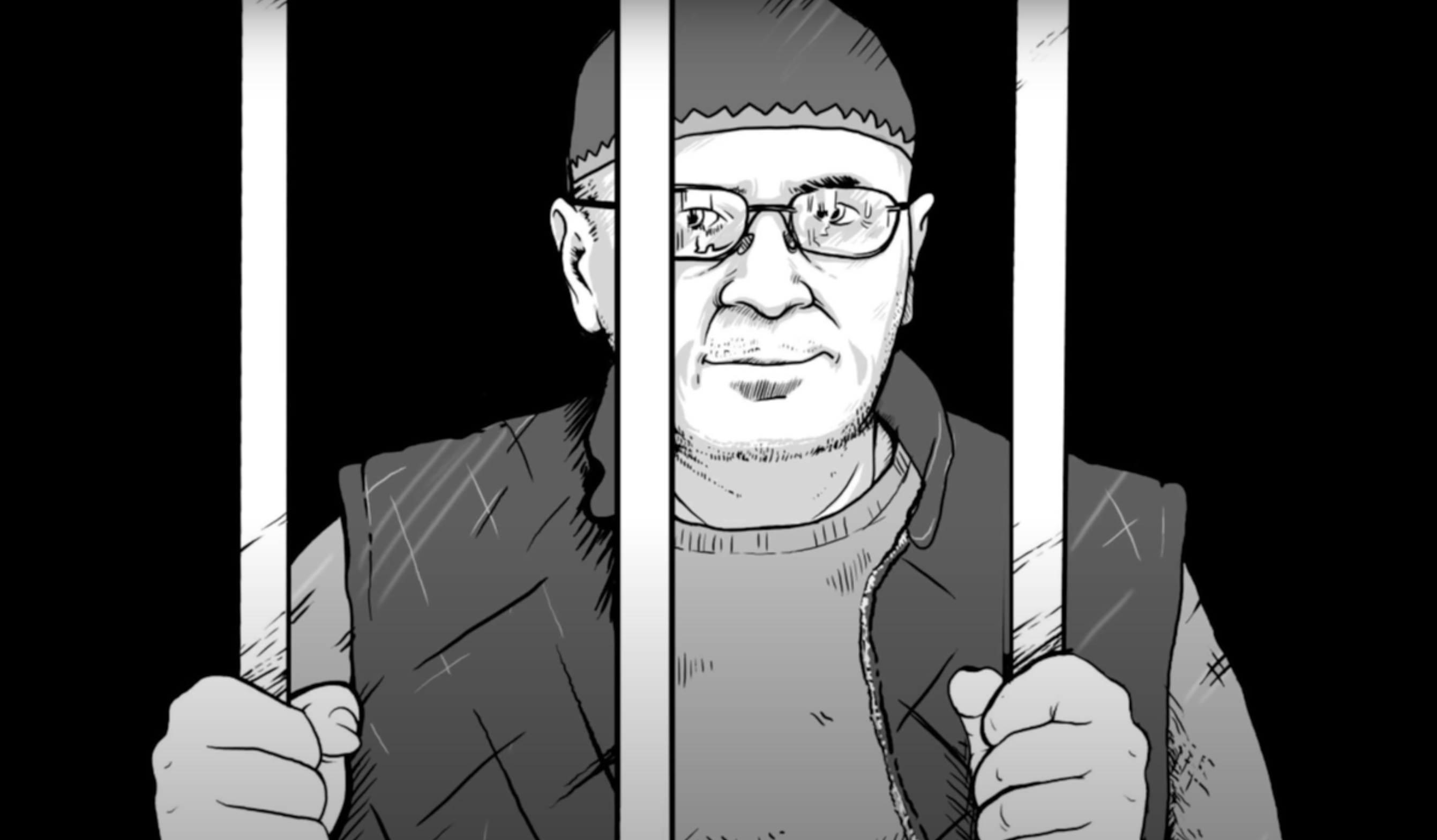
a documentary play about the Chechen human rights activist Oyuba Titiev, the head of the Grozny office of the Memorial human rights center, against whom Kadyrov’s occupation government fabricated a criminal case in order to stop the work of documenting Russia’s crimes in Chechnya and helping people living in the Akhmat concentration camp (what modern Chechnya is).
prologue
MAN 1. The unbelievers say: “This is just a lie that he made up with the help of other people.” Indeed, they do injustice and lie.
MAN 2. They say: “These are the legends of ancient peoples. He asked them to be written down, and they are read to him in the morning and afternoon.”
MAN 1. Say: “He sent it down, Who knows the secrets of the heavens and the earth.
MAN 2. He is Forgiving, Merciful.”
MAN 1. They said: “Who is this messenger? He eats food and goes to markets. Why was not an angel sent to him to warn with him?
MAN 2. Why was he not given the treasure? Why doesn’t he have a garden from which to eat?” The wrongdoers said: “Verily, you follow only a bewitched man.”
MAN 1. Look how they give you parables! They have fallen into error and cannot find the way.
MAN 2. “If you do good, then you do it for yourself, and if you do evil, then you do it for yourself.”
Chapter 1. man and women
I
WOMAN 1. I don’t know if HE likes zhizhik-galnash, but he definitely likes chicken. And zhizhik-galnash can be made with chicken too. For some reason, many people think that only with lamb or beef, but you can do it with chicken too. Need to:
WOMAN 2.
chicken (or lamb or beef) 700 g
egg 1 piece
water 2-3 glasses
flour 3 cups
salt half a teaspoon
allspice peas 3 pcs
bay leaf 1 piece
garlic 2 cloves
mixture of 5 peppers - to taste
greens - to taste
WOMAN 3. Boil the chicken with the addition of salt, allspice and bay leaves. Remove from the broth, cool and separate from the bones. Sift the flour into a heap onto the table, make a well at the top, break an egg into it, pour in warm water, add salt and knead into a stiff dough.
WOMAN 1. Place in a bag and let sit for 20 minutes. Then divide the dough into several parts. Roll each part into a sausage and cut into pieces. Roll each piece into flagella. Boil galnash in chicken broth.
WOMAN 2. Prepare the sauce: pass the garlic through a press. Pepper and pour hot chicken broth.
WOMAN 1. Place a cup of sauce on a wide dish, use a slotted spoon to catch the galnash and place pieces of chicken on top. We dip the galnash into the sauce and eat it with pleasure.
II
WOMAN 2. He played with the children all the time, he loved children very much, and the children love him too. Ours, others - everything was the same, there was no difference. He loved and respected children very much. He respected both the elder and the younger, especially - he respected women, and everyone respected him.
WOMAN 3. The fact that a woman, yes, Natasha Estemirova, was in charge, somehow did not bother him at all. He seems to be a very traditional person, but nothing like that, on the contrary, there is always such absolute loyalty, devotion, it just always amazed me, and I have said more than once that I am simply jealous that she has such an employee, such a comrade. He is generally a fantastically reliable person.
WOMAN 1. Reliability, devotion, these are some of his qualities that come to the fore, so to speak. Here. Well, he is stingy with any external expression, in general he almost never, very weakly expresses emotions, somewhere you can see that HE is doing something. Well, you can understand what he likes and dislikes, but it’s not always very visible.
WOMAN 2. I think that this attitude of his, this decision of his, was seriously influenced by the death of Natasha Estemirova. I can’t say exactly what kind of relationship they had in the distribution of roles, but it seems to me that he, who doesn’t care at all about any honor, any glory, none of this matters at all, he tried to stay in the shadows, and it seems to me that it happened that way, apparently, that he gave information, well, she, too, of course, got it, but she voiced it, she spoke with her, and this is the information that led to her death, apparently, because he told me “in her place I should was to be me."
WOMAN 3. As for sobriety and rationality in general, he is just a very sober, reasonable person. But there are all sorts of Chechen problems there, for example, regarding women. These are normal people, all of them, human rights activists, but as soon as we talk about something that concerns some kind of incorrect behavior of a woman - no, that’s it, it’s taboo. He may not agree one hundred percent, but he went and checked. For example, we had a terrible case when Svetlana Alekseevna received a call from a woman who, because of improper behavior, had been kept at home by some brother, to a radiator or handcuffed to something, and she somehow, I don’t remember, she called asking for help, beat her, in general, but as a result it was not possible to help her, because at some point it became clear that it was all over. he went to find out, talked to neighbors. I know most wouldn't do this
WOMAN 1. I observed, when I was with my relatives, he was surrounded by an atmosphere of adoration, his relatives and acquaintances adore him, he stands high, you can feel it, he stands high among them, so, of course, all his brothers defended him, that is, they had such a duty, but they had a kind of good position, his brother... was, he worked in the accounting chamber there, that is, he enjoyed the support of his relatives when he posed a threat to them, his activities.
III
MAN 1. In some Muslim cultures, the social structure was generally biased against women, and the true scholar had to struggle to introduce the Islamic values of justice and equality of all people into such a society.
MAN 2. One example of such a social structure is the virtual ban on Muslim women entering the mosque, and this despite the clear instructions of the Prophet Muhammad (peace and blessings be upon him):
“Do not prevent the female slaves of Allah from going to the mosques of Allah” (al-Bukhari),
and also despite the fact that the Prophet (peace and blessings be upon him) led prayers for men and women in his mosque.
MAN 1. Another modern example: in many Islamic countries, women are not allowed to drive cars, despite the fact that Muslim women have been doing this since the time of the Prophet's wife Aisha, who, in fact, fought an entire battle sitting on her camel (“battle of the camel,” mawki'at al-jamal). And many such examples can be given.
MAN 2. Likewise, it is important not to confuse Islam with the history of the Islamic world, which has known victories and defeats when it comes to women's rights.
We Muslims must admit that in the history of the Islamic world there has accumulated a considerable amount of truly anti-Islamic attitudes towards women from the point of view from which women's rights are mentioned in sacred texts and sources of Islamic law.
MAN 1. An example is honor killings, which still occur in some regions today. Sometimes “in the name of Islam” despite the fact that this custom is clearly contrary to Islam and has no precedent in Islamic law.
Moreover, it is important to distinguish between Islam and Muslim politics. Islam, as a way of life, naturally cannot but embrace both politics and leadership issues.
MAN 2. However, political positions, even if held on the basis of certain Islamic values, do not necessarily imply adherence to Islamic principles.
IV
WOMAN 2. And the first feeling was that we wouldn’t be able to work together: he’s not very smiling, he speaks a little through clenched teeth. How to work with such a person? Moreover, the work requires constant contact and at a very deep level of contact. But gradually, when HE realized that in general we were going to do serious business, a relationship gradually began to develop. Well, it became clear that, firstly, this is a person who is ready to help and very actively help, ready to intervene in the situation, and, secondly, he is, of course, a very reliable person, and with him you feel protected, and this is very necessary in the situation that we have. In general, I would say: you know that in the Caucasus there is a cult of men, if we talk about men, well... I don’t have much respect for this cult and generally don’t think that... There are a lot of women who are reliable and... in general, this is the ideal image of a man, in fact. It is precisely because of this sense of responsibility, reliability and some kind of external, in any case, calm and confidence. Here.
chapter 2. mercy
V
MAN 1. Praise be to Allah, the Beneficent and the Merciful, Who commanded people to be compassionate and merciful to each other and made this quality a sign of Iman.
MAN 2. We praise Allah for His gifts that He constantly bestows on us.
And we testify that there is no other deity worthy of worship besides Him, He has no partners or co-owners. We testify that our Prophet
MAN 1. Muhammad is a faithful servant of Allah, His messenger and leader of all mankind, who guided people on the straight path of truth.
We ask Allah to bless and send peace to our Prophet Muhammad, his family and all his companions, as well as all those who followed them doing good deeds, until the Day of Judgment.
Slaves of Allah! I exhort you and myself to fear God. Allah Almighty said: “Verily, Allah is with those who fear God and who do good.”
MAN 2. Allah also said: “Give joy to My servants who listen to words and follow the best of them.”
MAN 1. Also, Allah (Great and Glorified is He) threatened those who do not show compassion for people that He will deprive them of His mercy. The Prophet (peace and blessings of Allaah be upon him) said: “Whoever does not show mercy to people, Allah (Great and Glorified is He) will not show His mercy.”
MAN 2. He also said: “Only a lost man is deprived of mercy.”
Mutual kindness to each other is a quality implanted by the Almighty in the hearts of people from birth; it encourages a person to do good deeds to others, to be sensitive to people’s misfortunes, to feel their grief, not to remain indifferent to their misfortunes and try to protect them from this.
Mercy is a sign that there is life in the heart, it is a sign of the nobility of the soul.
VI
WOMAN 1. He asked to help a group of refugees that we didn’t even know about before. We believed that refugees from Chechnya are refugees who are there in Ingushetia, in Dagestan, in Russia, so to speak, in Moscow, and there was a group of internal refugees, as it were, who did not cross the border of Chechnya, well, that is, what is called ... (IDP?) But even IDP (?) in relation to Chechnya itself. These are people from mountain villages who fled during the second war. The specificity of the second war was that, unlike the first, mountain villages were also subjected to very severe shelling and bombing, many villages were simply destroyed, some were abandoned completely, which was not the case in the first war. During the first war, Grozny was mostly a plain, and people from the plain fled to the mountains. But here it’s the other way around, that is, there was movement, so to speak, in both directions. And the inhabitants of the mountain villages settled, these refugees settled on the plain; there were entire settlements just in the Gudermes region. So, he wanted us to visit these refugees and help. Here. And we went, he took us around these villages, and for the first time we... I didn’t immediately appreciate it... He, of course, is extremely reliable, very good as a comrade, because he is never late, he is generally absolutely ideal in all business relationships. It is impossible to imagine that you would ask him for something, he would not do it, he would forget, this cannot happen at all.
WOMAN 2. He knows everything about the first war, how everything happened, he knows absolutely all the events, he knows the names, he knows who paid how much in bribes for what, that is, it’s just in general. You can’t even talk about this, because a person with such a memory is dangerous.
WOMAN 3. When we worked in Gudermes, he had a car. Well, what kind of cars were they? These “kopek”, “four”, well, “six” at most. We didn’t have cars then, he had a car - they won’t let me lie, it’s so red. And so we all drove this car. Never refused anyone. He arrived there, parked the car - I got in and drove off. I arrived and delivered - he went. And there is only one traffic cop there in Gudermes, when he stopped me in this car - we knew each other - he says to me: “Listen, just tell me honestly: who is the owner of this car? I can’t understand who is the owner of this car...” That’s the kind of person he is: he would give up the car, and he would give up everything...
VII
MAN 1. The Koran contains instructions that prevent wealth from concentrating in the hands of individuals, and maintain a certain balance in society so that a separate social group or several people cannot concentrate in their hands all the economic levers affecting society: “The booty that Allah returned to His Messenger from the inhabitants of the villages belongs to Allah, the Messenger, the relatives of the Prophet, the orphans, the poor and travelers, so that it does not fall to the rich among you. So take what the Messenger has given you and avoid what he has forbidden you. Fear Allah, for Allah is severe in punishment.”
MAN 2. Haram zulmi is such haram, the commission of which causes harm to strangers except the one doing it. For example, theft. Anyone who has committed haram zulmi and vowed not to commit it in the future will be forgiven by Allah only if the victim forgives.
The category of “haram zulmi” includes:
- Scold or even insult the beggar
- To assist in the affairs of an unjust or tyrant.
VIII
WOMAN 3. And so lately it’s not so much that they may not trust us and so on, but that human rights activists came and looked for the family, from the family if someone spills the beans somewhere. “Human rights activists came to you, what did you talk about?” You can already inflict it, because they have more and more, the way they acted is precisely putting pressure on the family, because they can be intimidated, much easier, because the family has many more sons and brothers, nephews, uncles, and so on, and intimidating them by turning to human rights activists will be even worse. That’s why it’s been very difficult to work here lately.
WOMAN 1. People, at least, have this feeling that everywhere and everything is under control, it is already... because there, even for some correspondence in some groups, for some even a comment on social networks, for anything, for anything, here a person can write comments, it seems to be carried away, here a person wrote one, that is, there, you know, look for the same logic in this, I don’t know what they have, such as who will be lucky. Here he writes, it seems no one has seen it yet, but here he wrote alone, they saw it and everyone came for him.
MAN 1. The category of “haram zulmi” includes:
- To assist in the affairs of an unjust or tyrant.
WOMAN 2. It was about him that Ramzan Kadyrov in 2000... Which one? Probably in the tenth year, he said that yes, these are the men and women of the Memorial from Gudermes, yes, these are the enemies of the people.
Natasha was never the head of the office, she was the engine, whatever, the heart, but not the leader, and in terms of her qualities she was hardly suitable for the leader of any team.
He said that this was impossible, that suspending work would be almost a crime on our part, that we were obliged to resume work, while understanding the danger of resuming this work. Such demonstrative surveillance was installed on members of his family, which is even more terrible.
WOMAN 3. And gradually our work there narrowed, like shagreen leather, from that moment onwards, 2010, 11th, 12th. Our other offices were closed, for various reasons, but in general, in general, in Chechnya, I mean they were closed. We had offices in Sernovodsk, Urus-Martan and Gudermes, as I already said. They closed for various reasons, well, not necessarily directly, because there was an attack or threats, but people felt unsafe, felt that they were publicly or secretly receiving signals that this work was not acceptable to the authorities with all the ensuing consequences. And in Gudermes there was just an attack, yes, because...
WOMAN 1. And masked men burst in. Because they were women, they were scared, of course, they didn’t even pay attention to whether they were armed or not. Well, they didn’t have machine guns, at least it’s possible that they had pistols, I don’t know, but they were wearing masks.
WOMAN 2. That’s why after that we still had one office in Grozny, and he headed it. And our work narrowed like shagreen leather, not only because the offices... were destroyed, closed, but also because communication with applicants, because complaints to us, people’s appeals to us, the possibility of obtaining information decreased and decreased. Because at least people were afraid, they were already afraid, they were afraid for themselves, they were afraid to contact us. Well, first of all: you didn’t protect your Natasha, but how will you protect us? And besides, people knew that the work of the Memorial, public work, legal work on their cases, it could affect them themselves, that is, the same people who committed one crime against this family, for example, kidnapped a person, would come to them, and the same people would come and do something no less terrible, and maybe more terrible. They were directly told: “You have other children. - To the parents. - Why should you complain? Don't even think about it. Think about the other children." Here.
IX
MAN 2. The category of “haram zulmi” includes:
- Beat the servants.
- Shame and humiliate the poor for their situation.
- To elevate someone because of the presence of worldly wealth, thereby humiliating oneself.
- Burn, drown things you don’t need, without giving them to others.
- Rot, spoil goods or products without using them yourself or giving them to others.
- Beg for alms if you have food for one or two days.
- Breaking the bones of the dead.
Chapter 3. Betrayal
MAN 1. The category of “haram zulmi” includes:
- Cause harm to someone by deception.
- Report on an innocent person and blame him for his unexplained shortcomings to unjust leaders.
- Get in and sing along with each of the warring parties.
- Disrupt friendship between friends and promote their enmity.
X
WOMAN 3. And therefore the work became more and more difficult. And he, as a very responsible person, kept asking us: “Guys, here are the applicants, they came, they reported. Let's think about how to make sure we don't set them up. They give us information, we can give this information about something there, but we should not make sure that the source of the information is known. Or let’s say for now: well, come on, that’s good, we know about this, about this, about that, we inform you, let’s think three times, because God forbid we will be blamed for what happens next to the applicants. The applicant may now be in such a rush, embittered. Let me talk to him again, to the applicant. “Guys, for us the first thing is the safety of the applicant.”
WOMAN 1. He knew how to talk to people very well. You see, at the beginning of the Chechen war, strictly speaking, there was no problem in obtaining information. So we, Russians, accompanied by our Chechen colleagues, arrive in some village and talk there. They immediately begin to talk to us, inform us, they will lead us from one house to another, neighbors to neighbors, relatives to other relatives, and even what we don’t ask about, we find out. “But there was more, but on the other, I don’t know, there, at the end of the village, a man was kidnapped, he disappeared without a trace, but that man was in a filtration point, he was tortured, maybe he’ll tell you,” and the man told. It was like, I don’t know, it was a terrible time there, yes, 2000, when there were sweeps and filtration points where hundreds of people were taken, and people talked. And at that time he worked, actively worked, just like all of us under these conditions. But recently, in recent years, this situation has changed a lot. Nobody wants to tell anyone, and no one wants to tell anyone. They are afraid. Come, here I come, Russian, to the village, not only will they not talk to me, even when they see me, they will close the doors and, most likely, will not really want to let me into the house, because no one trusts anyone, because everyone is afraid of informers who have multiplied with terrible force, because everyone knows, and no one... Well, it’s like in Stalin’s time, no one knows who will say what about whom, and no one is guaranteed that he will not be taken away at night and he will not disappear without a trace. Here.
WOMAN 2. By the way, an interesting digression. After all, in fact, when at that time, in the early 2000s, these clean-up operations were carried out, to which we went together and with him, and then we were also surprised: what are they doing? They grab the first men they come across, take them to the filter points, and then we find out what they’re asking about. For example, like: where is Shamil Basayev? How does some, I don’t know, peasant know where Shamil Basayev is? They ask everyone, beat them and ask: who is the militant here and so on. Well, sometimes they asked completely stupid questions, for which a person knowingly given is unlikely to be able to obtain information. Somehow they worked very unselectively and very, well, it would seem, not creatively, stupidly and stupidly, grabbing everyone in a row and asking the stupidest questions, just the same questions, I don’t know: where is he hiding... we know that Shamil Basayev’s detachment came here, where is Shamil Basayev’s hiding place?
WOMAN 3. Here. In fact, we later realized that this was a meaningful, in its own way, reasonable tactics and even strategy. You see, they delivered these people, from whom they understood that they would receive the lion's share of information, they would not receive any information, but they broke them, and they simply broke some people and forced these people to report something. And, as far as I understand, even at the first stages they were not very interested in the veracity of the information. It doesn't matter! You reported, you reported on someone from your own village. This may be false, under torture you screamed someone’s name and said: “Yes, yes, he is a militant.” But after this, the person you reported on is taken away at night, he disappears, but after that you and your family become their hostage after that, because then they say: “Well, guy, you gave evidence against him, we can report this, and then the blood will fall not only on you, but on your entire family, think about your son, about your brother, about your nephews.” All. And thus, back then, back in the early 2000s, this network of informants was formed. For them, the federals saw Chechnya as such a black box, an alien environment, they don’t know anything, they can’t find anyone here, there are no informants. But in this way, by breaking people and forcing them to say at least something, they created this network.
WOMAN 1. And then, when they transferred the functions of illegal violence to these illegal armed groups they created, pro-Kremlin armed groups consisting of Chechens, I don’t know, there were several of them, competing, they changed the situation in the sense that by transferring to them their network of informants, and these were after all local Chechens, I mean these illegal armed groups are still local. They understand much more than any federal who came here, or even worked here for many years, and having this already created network of informants, they can create that atmosphere of fear. And in recent years, all this has created this absolutely terrifying atmosphere of fear in Chechnya, which is incomparable in fear to those times when thousands of people disappeared there every year. Nowadays, much less disappears, but there is more fear. Precisely because this is the system: both the system of denunciation and the system in which everyone thinks that the authorities know everything about him, you said in a whisper in the kitchen, and already there the boss knows what you said, so he had to work in this system recently.
XI
MAN 2. The category of “haram zulmi” includes:
- Make a promise if you don’t intend to keep it in your mind.
- Without permission to read someone else's letter, note.
- Refuse to testify when you are a true witness.
- Impersonate a witness and give false testimony.
- Give people harmful advice for the purpose of deception.
— By deception, in order to reveal other people’s secrets, have a sincere conversation with a person.
- To deceive, by encouraging and praising, show your friendship.
- Break your commitment, your word.
— Higher authorities and managers allow cruelty and injustice towards all subordinates.
MAN 1. It was extremely difficult for me to return to normal life. I was treated for a very long time. The psychologist and translator cried at every appointment. Also because of captivity I had memory problems. Every day the same thing was hammered into my head. They told me in detail how I carried out the terrorist attack, what I said, who was nearby, how I was dressed. So I started to doubt myself. There was a loss of reality. After all, I spent one month and ten days in solitary confinement with almost no light, with meager food. They were taken out from there only for torture, not even for interrogation. When they examined my head, they said that due to prolonged oxygen starvation, some cells in the brain had malfunctioned. And I lost consciousness due to suffocation countless times. You were suddenly strangled with a rope or a belt, you passed out, and then you were revived with water, or more often just with a kick in the stomach.
MAN 2. Evil irony: we fought against Russia, but the Russians didn’t lay a finger on me. I was detained, tortured, tried by Chechens. But this does not relieve Russian guilt. I will never understand what prevented me from reaching an agreement with Dzhokhar Dudayev, with Aslan Maskhadov, who agreed to both broad autonomy and a single ruble zone, just to stop this damned war. Why was it necessary to shed so much blood in order to then actually grant independence to Chechnya? Russian laws, of course, do not apply there, just as the age-old traditions of the Chechens, such as blood feud, do not apply. They force bloodlines to peace, hoping to save the skins of their loved ones. But someday the regime will fall, the powerless poor fellow will rush to the house of the offender, who will already be lying dead. And then ten more people will come running. And this is how Russia made Chechnya.
XII
WOMAN 2.
Chepalgash flatbreads
Tender flatbreads with curd filling are baked in a dry frying pan and soaked in melted butter.
Required ingredients:
Kefir (whey or curdled milk) – 800 ml
Baking soda - 1 tsp. (with top)
Wheat flour
Salt - 1 tsp. (with top)
Cottage cheese (homemade, not salted) - 800 g
Chicken egg - 2 pcs
Green onion - 1 bunch.
Butter - 400 g
WOMAN 3.
Preparation:
Sift flour into a large cup, make a funnel and pour 1 tsp. salt.
Add 1 tsp to warm kefir. soda with top, mix, then pour into flour and knead with your hand into a soft dough, which should be covered with a towel and left to rest for 20-30 minutes.
In the meantime, you can prepare the filling.
WOMAN 1. Cottage cheese (not salted or lightly salted; if the cottage cheese is salted, then you can pour warm boiled water over it and leave it for 1 hour or more, and then squeeze it out), grind it, add eggs, salt to taste and chopped green onions (the more onions, the tastier the filling).
Divide the dough into small balls - 10-12 pieces. Flatten to 1 cm thick, place 2.5 tbsp in the middle. fillings.
Seal the edges with a knot over the filling, forming a ball with the filling inside. Take a ball, roll it out with a rolling pin (it’s okay if the dough breaks), place it on a dry, heated frying pan and immediately cover with a lid. Make the fire medium.
WOMAN 3. Fry the tortillas for 2-2.5 minutes on one side. Remove the lid, turn the tortilla over to the other side and fry for another 2-2.5 minutes, but without the lid.
Place the finished flatbreads on a plate and cover with a towel. Can be placed in a saucepan with a lid.
When the last flatbread is fried, wash the pan, add water and put it back on the fire until the water becomes hot. Take a flatbread and dip it in hot water on both sides.
And place it on a tray greased with melted butter.
WOMAN 1. Grease the cake itself with 2-3 tbsp. butter and do the same with all the cakes.
Cut the finished flatbreads into segments. Serve hot with freshly brewed tea.
WOMAN 1. The flatbreads, after being coated with butter, turn out to be very soft and tender, a pleasure to eat.
“Esharsh Nokhchi”, a song of Chechen women, plays in the background.
Chapter 4. The Way of the Warrior, Holy War
XIII
MAN 1. In 1994, the mufti of the Chechen Republic Said-Akhmed Alsabekov renounced jihad, for which he was shot. Akhmat Kadyrov became acting mufti, after which he declared jihad against Russia as a spiritual leader.
MAN 2. “In 1995, on March 24, a congress was held with the participation of all Chechen generals - Yandarbiev, Basayev, Maskhadov, where I was offered to lead the spiritual line of the republic.
In April 1995, a congress of the Chechen people took place in Shatoi. There, in the name of Allah, I raised everyone to military action. Together with the people, he took an oath not to spare either himself or his fortune in this war. Stand until the end. This is how I established jihad.”
MAN 1. From Ilya Yashin’s report “Threat to National Security”:
On December 11, 1994, Russian President Boris Yeltsin signed a decree on the deployment of military units into the territory of Chechnya to restore constitutional order. In 1995, Akhmat Kadyrov declared a “holy war” on Russia—jihad—that is, he essentially called on Muslims to kill all infidels. Kadyrov Sr. said: “There are a million Chechens, and 150 million Russians. If every Chechen kills 150 Russians, we will win.” Ramzan Kadyrov admitted: “We don’t hide it, that we fought against Russia. I also fought in the first war, everyone knows about it. I first picked up a machine gun when I was not even seventeen years old” <a lie known to all Chechens>
WOMAN 2. I also have my opinion about why he started playing sports. That is, of course, like the Chechens, it is believed that one must generally keep oneself in shape, it is indecent if a man’s belly hangs, it is not civilized, it is not that it is ugly, it is uncivilized, it causes disdain. A collective farmer, they will say, is a collective farmer. In general, therefore, as it should be, they all work out, and he is a physical education teacher, so to speak, he always has something to do with this, but from a certain moment, but, of course, they didn’t always have them, now gyms appeared, there was a war, there were no gyms there. But I didn’t immediately start thinking about it.
WOMAN 3. In general, he is, of course, a very busy man, every day he travels from Kurchaloy to Grozny, then back, it’s generally not that close, he still goes to the gym every evening in the evening, he is 60 years old. Why is there such a need to swing like this? My version is that he was preparing. This was my opinion, we never discuss any personal issues, he has now pumped up very well, lately he has been coming just like that. For some time I was perplexed, because in any case, the forces are unequal, and the case for which he is preparing... he will not be able to defeat his opponents, because they are armed, they are young, there are many of them, and they are also in good physical shape. I thought - why?
WOMAN 1. And suddenly I remembered, one day our teacher, one of those teachers with whom we ... participants in our project, also a very pleasant person, once talked about some of his fellow villager, who was put into the trunk of a car by these, well, some kind of regular kidnapping, and he said: “They won’t put me in the trunk alive” - that is, it is more important for a person to avoid humiliation than death. It seems to me that it was for this case, precisely for trying to avoid humiliation, and not death, that he prepared himself in this way. I can't explain it otherwise.
WOMAN 3. His moral and ethical code is at its best: what is necessary, what is not necessary. It’s somehow difficult to even smoke in front of him, because he didn’t approve. I'm not even talking about drinking, which is generally not acceptable. If people of other nationalities are sitting there, he could be somehow tolerant. But if I sit at the same table and somehow do this, then there would be condemnation. He wouldn't say it, but he would show it with all his appearance.
XIV
MAN 1. Internal Jihad
The phrase "inner jihad" refers to the diligence of a believer in trying to live his life in accordance with the laws of the Muslim faith.
Muslims make great efforts to live in accordance with the instructions of Allah; following the laws of faith, devoting oneself to Allah, doing everything possible to help others.
For most, living by God's laws is largely a struggle. God has set high standards, and believers must struggle with their selfish desires to live up to those standards.
Five Pillars of Islam as Jihad
MAN 2. The five pillars of Islam in this sense form jihad, since by fulfilling them, a Muslim becomes closer to Allah.
Also, jihad for a Muslim can be expressed in the following:
• Studying the Koran, memorizing it, or practicing other religious sciences.
• Overcoming feelings such as anger, greed, hatred, pride or malice.
• Working for social justice.
• Forgiving those who have hurt them.
Controversy over "mainstream jihad"
The Prophet is said to have called internal jihad "the fundamental jihad."
Upon returning from the battle, the Prophet said: “We have finished with the lesser jihad, it is time to begin the big one.” He explained to his followers that fighting an external enemy is a lesser jihad, but fighting oneself is the main jihad.
MAN 1. War is not considered jihad if its goals are:
• Forcing other peoples to accept Islam.
• Conquest of other peoples with the aim of colonizing them.
• Conquest of territories for economic gain.
• Conflict resolution.
• Demonstration of the power of the ruler.
Acceptable reasons for military jihad:
• Self-defense.
• Strengthening Islam.
• Protecting the freedom of Muslims and their religion.
• Protecting Muslims from oppression, including the overthrow of a tyrannical ruler.
• Punishment of the enemy who violated the peace treaty.
• Fight injustice.
MAN 2. To be valid, military jihad must follow very strict rules.
• War must always be started by the enemy.
• The purpose of war should not be the seizure of territory.
• War must be in the name of good - everything that Allah approves of.
• Before resorting to war, it is necessary to try to solve the problem in any other possible way.
• You can't kill innocent people.
• Do not kill or harm children, women or the elderly.
• You can't rape women.
• Treat enemies fairly.
• Treat wounded enemy soldiers the same as your own.
• War must end as soon as the enemy asks for peace.
• Do not damage property.
• It is prohibited to poison wells. A modern analogy is the use of chemical or biological weapons.
MAN 1. Many suras of the Koran talk about struggle. Some of them are pro-peace, while others are very militant. The Bible displays a similar diversity of attitudes toward war.
“Fight in the path of Allah with those who fight against you, but do not transgress the boundaries of what is permitted. Verily, Allah does not love criminals.” (Quran sura 2: verse 190)
“Those who are attacked are allowed to fight to protect themselves from violence. Indeed, it is in the power of Allah to help them.” (Quran sura 22: verse 39)
“If the enemy is inclined towards peace, then meet him halfway and rely on Allah. He truly hears everything and knows everything.” (Quran sura 8: verse 61)
XV
WOMAN 3. If they had given him a gun, it would have looked much more real. And the drugs and HE... He knew so many people, and everyone knew that he couldn’t even stand smoke, it was so visual.
WOMAN 1. I think: well, they should take a gun. But they already have it down, they have a package lying around, one hundred and eighty grams, from the safe back and forth.
WOMAN 2. And he understood this whole prison kitchen. He always looked at the problem from the inside, from prison. Even if a person could not say something, could voice some short problem, while describing it, he described it to me from the inside, and what else might be involved. And he often has conflicts with the coordinator in Moscow - for example, because he sees that here it is necessary to react immediately. He can say something very briefly, but to the point. Because even the lawyer who visits prisons comes and goes. And he had the look of a prisoner.
WOMAN 3. It seems to me now - I’m even sure of this - it would be easier for him now if they told him that he killed a man, and not drugs. He would have taken it easier, in my opinion. They would tell him: “You killed a man,” but with drugs it’s very difficult for him.
WOMAN 1. Every year, starting from the 90th - every year, month, day, when it was, what happened on that day. If, say, someone was killed there... He literally remembered everything, I was simply amazed at his memory. The computer probably won’t remember as much as he does.
WOMAN 2. All the legendary figures - they were not some kind of mythical characters for him: they were role models for him.
WOMAN 3. Well, for example, from Chechen folklore, from Chechen history, anyone who rebelled could list the names. Anyone who rebelled openly against injustice, as I understand it, he consciously or unconsciously compared his actions with them.
WOMAN 1. His behavior was emphatically gentlemanly, emphatically aristocratic—this could not help but be noticed by these people. I’ll probably repeat: no one here instills these rules in anyone’s mind, but a person who somehow follows them enjoys the respect of people, and this respect is apparently contagious.
WOMAN 2. I saw how he cares about his workers at Memorial, his colleagues. There were cases when people walked under some kind of danger and, I assure you, I had to be near him at such moments: in no case did he think about himself in any way, but first of all he cared that his employees did not fall under some kind of threat, and about himself only in the last place. And we had this conversation with him when things got really tough - you probably know that there were some moments when he either had to leave somewhere, I don’t know - and we had this conversation. Many suggested that he leave this job, and when we were alone, he told me: “You know, if I leave, I don’t think Memorial will work here.”
WOMAN 3. “For Memorial to work, I need to stay there,” we had this conversation. Even when - you probably remember - 3-4 years ago he was forced to take his family out, even after that: he took his family out, and he himself returned here to work.
WOMAN 1. I can tell you: he had no doubts. He always knew: whatever the results, he would do what he could do. But what could the results be? Of course, there were some positive results. We must also remember that at the very beginning of his work, when he was not heading Memorial, they provided some kind of assistance to mountain villages and various educational institutions: he was of great benefit, people did good. And now - in recent years, when he was engaged in precisely these tough matters - the man simply believed that he was doing what he should do as a Chechen, as an honest person, as a believer.
WOMAN 2. The man was simply confident that he was doing the right thing and that’s all: there were no questions, he did not suffer from this. But I’ll tell you what he suffered from: from the fact that there was a gradual reassessment of values among all other people - not in relation to his work, but in relation to the authorities, who were and are holding on to blood. People somehow began to get used to this and everyone remained relatively calm until trouble knocked on his door, because of this... He suffered from the indifference that was increasingly manifested in our people, from indifference to each other, from indifference to the misfortune of others - this is what he really suffered from.
WOMAN 3. Yes. And he had a conscious faith, without fanaticism, so rather than in words he reminded his loved ones and acquaintances how to live, but rather he reminded them how to live their own lives, their actions. This, in my opinion, is the difference between fanaticism and real faith.
MAN 1. There are no words for “traitor” in the Chechen language—there is no such word in the language—and there is no word for “master.” Does this mean anything?
MAN 2. Yeah, and “hello” and “goodbye” - “come free”, “go free”
Chapter 5
XVI
WOMAN 3. Oyub Salmanovich Titiev was born in Kyrgyzstan on August 24, 1957, lives in the village of Kurchaloy, Chechen Republic, human rights activist, head of the Grozny representative office of the Human Rights Center (HC) “Memorial”.
MAN 1. Oyub Titiev was in custody from January 9, 2018 until March 18, 2019, until the announcement of his conviction for committing a crime under Part 2 of Art. 228 of the Criminal Code of the Russian Federation (“Illegal acquisition and storage of narcotic drugs committed on a large scale”).
WOMAN 2. Since 2000, Oyub Titiev has worked at the Memorial Human Rights Center and the Civic Assistance Committee.
MAN 2. Oyub Titiev monitored human rights violations and crimes committed during the so-called “counter-terrorist operations” in Chechnya, took part in social projects aimed at developing the mountainous regions of Chechnya and helping Chechen prisoners in Russian prisons.
WOMAN 1. Oyub Titiev became the head of the Grozny office of Memorial in 2010, replacing Natalya Estemirova, who was killed on July 15, 2009.
WOMAN 3. 2268 people have received help from Memorial over the past 8 years. We would like to tell you the names of each of them, but we cannot because we are afraid for them.
Chapter 6. Trial
XVII
The announcement of the verdict dragged on for the whole day. Judge Zainetdinova, as always in heels, in a tailored judge's robe, read the 180-page verdict in a folder, which she held at arm's length.
“The entire presentation of the state prosecution in the case, the investigation of which took eight months, was completed in 20 minutes of working time. The state prosecution spent more time talking about why drug possession is a dangerous crime that contributes to the growth of terrorism, rather than substantiating Titiev’s guilt.
Titiev claims that on January 9, 2018, his car was stopped twice. The first time he was brought to the territory of the Kurchaloevsky district police station, the head of the criminal investigation department, Denis Dzhabrailov, threatened him and insisted that Titiev sign a confession and self-incrimination. When Titiev refused to do this, he was again brought to the same place. Then an investigative team appeared, witnesses appeared, an inspection report was drawn up, and after that Titiev’s car drove into the territory of the police department for the second time.
The first question is whether this court should hear the present case at all. We raised this question at the very beginning, when the court had not yet begun to consider the case on its merits. The fact is that the leadership of the Chechen Republic, in particular Ramzan Kadyrov, made public statements that cannot be understood other than statements about Titiev’s guilt. “We caught a drug addict!” - he said about Oyub Titiev.
The defense expressed the conviction based on the results of our judicial investigation that it is possible - with all due respect to your honor - the judge presiding over the present case cannot feel completely free, since such statements are already a fait accompli, they were made, and the acquittal of Titiev, for which the court has every reason, can be perceived as a contradiction to the already expressed point of view of the head of the region.
I couldn’t find an explanation for why there were no traces of hands on the package. Not just traces of Titiev - no traces at all. There is no clear explanation why this could happen when the package was taken with bare hands.
How is it that traces of a narcotic substance were found on Titiev’s palms, but not under his nails?
This cannot be explained by common sense if he actually touched this powder. The stuff under your nails is always harder to get rid of than the stuff on your palms. You can wash your palms with soap once or twice, or at most three times - and you have already eliminated all traces.
We know that he was actually under guard, so that he could not go anywhere at his own discretion, he was taken to Grozny for an examination. He took tests, which revealed that he did not use drugs.
Why weren’t lawyer Telkhigov allowed into the police department?
All these points have not been clarified either by the results of the judicial investigation or by the results of the judicial debate by the prosecution. And these are important questions. They would be important in any case, not only in one that attracted such colossal attention, which set a record for Russia - this is really a record, I congratulate you on this, consider that we have already entered all textbooks - in terms of the number of witnesses in a single episode of the case: we have more than 100 people, 65 only from the prosecution.
The court is required to have a refined, chemically pure attitude towards the admissibility and reliability of evidence, so that flaws that can - or even not so much - be written off, one might say that this is a technical error, become grounds for excluding the most important evidence of the case.
But based on the intermediate solutions that we observed, I see the next level of standard - the “not excluded” standard. We heard directly from the court, we heard implicitly from the state prosecution, that evidence can be considered admissible if it is possible that it is admissible.
Yes, the protocol does not contain the necessary details, we see that the investigator wrote that he sealed the car on the spot, and the car arrived independently at the police department and was only sealed there, we see that it was not sealed according to the rules, that there are no signatures of witnesses in the places where they should be - but it is possible that the protocol was drawn up honestly! And I am afraid that this is “not excluded” on many points, not only according to the protocol from which it all began and which is the central document for our case - I am afraid that we will read such “not excluded” in the court’s verdict.
The prosecutor’s phrase “there can be no doubt about Titiev’s guilt” really struck me. This is very similar to trying to say “halva” in the hope that it will make it sweet. I admit that it’s subjective... Although honestly, no, I don’t admit it! I don’t believe that you have no doubts, dear state prosecution. You know the matter as well as we do, you know all the circumstances perfectly well, you know what a stretch this thesis of yours contains. I think that there is not a single person in this room who would believe you on this issue. And we are talking not only about this room now, about the composition in which the public has gathered for the court debate.
We talked about the defense witnesses who came here. These were very special witnesses - I mean Titiev’s neighbors. These were old people, for many of them the place of birth according to their passport is not the Chechen Republic, the village of Kurchaloy, but the Kirghiz SSR, Voroshilovsky district, like Oyub Salmanovich Titiev himself.
These are the “children of the Lentils” - the generation that they directly witnessed in early childhood or were born after the deportation. These people have lived a very difficult life, now they are all elderly, now they all - at least because of their age, even if we don’t know anything about their personal merits, simply because of who they are - enjoy a certain weight.
Their words are not just words, they are not gossip, not something said in passing - these are words that were spoken in court as evidence. Listen to what these people said here. Yes, of course, they said what is expected to be heard from defense witnesses - that we know Titiev as a good neighbor, a good Muslim, a decent person. But we asked them: do you believe the accusation? And we heard from them: no, we don’t believe it.
The falsifications that were committed in this case can only achieve their goals if the people who carry them out can be silenced. It is not necessary to force someone in a targeted manner, it is not necessary to come up and intimidate or threaten with something, or bribe. Simply by their reputation, by the fact that they know how they conduct their affairs, they can force anyone who disagrees with the accusation to remain silent about it - at least not to come to court and not declare their disagreement publicly.
The fact that 20 people, elderly people, old people, came and said that they did not believe Titiev’s accusation is, in a certain sense, a sentence, and a sentence even more severe than the one that the state prosecution is asking for Titiev. Because in fact you were accused and found guilty of lying. It is clear that no one specifically gave these people such powers, but I will look at whoever challenges these powers! And this verdict is absolutely not subject to any appeal, it cannot be reviewed and it cannot be canceled. The people of the Kurchaloevsky district, through the mouths of these elderly people, have already said what they think about this matter.
You are trying to protect them from the growth of terrorism caused by drug trafficking, and they tell you: we don’t believe you, Oyub Titiev could not do this, we have known him all his life.
Zarema Zaudinova
with the participation
Anna Volunteer
and Elena Gremina
2018 - 2019