Date
Author
Фонд поддержки современного искусства Винзавод
Source

Preserved copy
Translated material
Egor Sofronov. Spit in the dance
The text was written within the framework of the Laboratory of Art Criticism at the Winzavod Center for Contemporary Art
At What If They Went to Moscow, a two-day dance showcase in March, I saw a rather interesting and concentrated presentation of the latest in Russian dance performance as it was presented to a supposedly external foreign curatorial gaze. The latter imposed certain restrictions or expectations. The curator of this event, for many years, since 2012, who headed the performance at the ZIL Palace of Culture, Anastasia Proshutinskaya, based on the expectation that what was shown would be invited in the future on foreign tours, selected works that fit into a frame, a certain convention, viewing mode: directed attention and theatrical seating, enclosed in a proscenium and in a schedule of full viewing from beginning to end. Compliance or non-compliance with this convention, in my opinion, generated the main source of critical tension. For me, the question revolved around the reproduction of theatricality as a specific disposition of space and time. Around how artistic creativity depends on and fits into these parameters. The traditional preset requires the viewer to buy a ticket for the evening show, to be punctual, to remain motionless - do not rustle, do not look at the phone, do not talk - you must look from the darkness at the illuminated focus of the work. It is referred to in the jargon as a "black box": Claire Bishop describes it in the text of Fifty Shades of Gray, comparing and contrasting it with the white cube gallery mode in modern museums. It is characterized by long hours of work, at any moment of work, entry and exit into open space, free movement in which you can talk, take pictures with your phone, and come as close as you like. The boundary—temporal and spatial—is violated. Having been shaped by contemporary art, I am convinced of the value of the free-roaming gallery experience.
Many of the authors included in the program in previous years proposed experimental departures from this convention, involving not only spatial and temporal displacements, but also the involvement of the viewer. Since theatrical convention also presupposes the so-called fourth wall: the action is located in an idealized, distant plane, supported by the exclusion of the participation of the spectator - she is only a passive contemplator, even a disembodied eye. Whereas the spectator's various kinds of involvement and interaction highlight both the possible agency of the spectator becoming a participant and her embodiment, since her body is not only an eye. But at the ZIL Cultural Center, these experiments were presented only in the form of presentations, oral stories in very bad English, poorly understood by both the local audience and the foreign delegation. On the contrary, the main works were inscribed in a black box and supported it, and therefore did not carry an innovative charge. Those works that rethought it were the most productive. In dance, it is more important how the piece is placed than how well the arms and legs are moved.
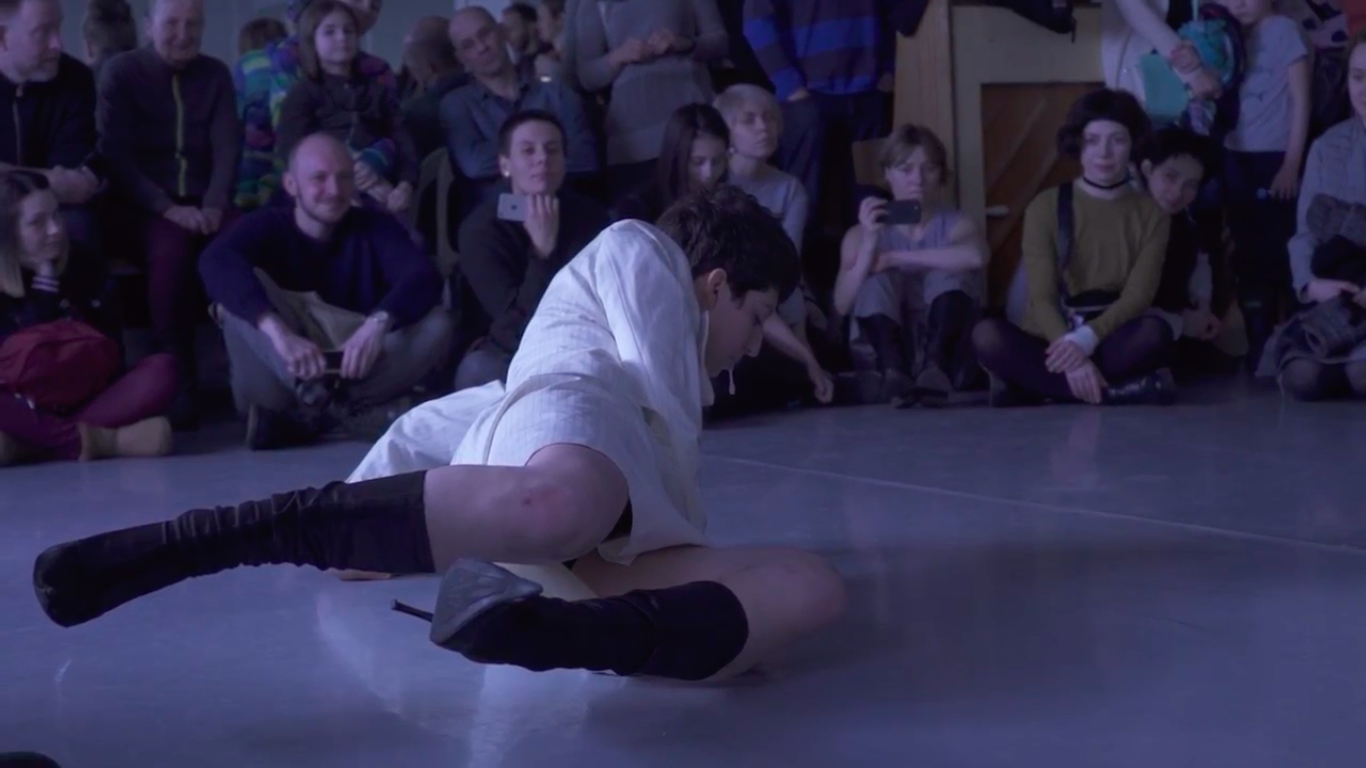
“Drool” (2019) by Asya Ashman is the most striking work in this regard. It can be assumed that it contains a moment of development of the findings of “The Garden” (2018) by the trio Volkova, Zhukova, Yuriychuk, which was also in the program and was a manifesto of regression in dance last fall and winter. Ashman, first, shifted the space by choosing a non-obvious location: a ballet room with a barbell and mirrors, where there was no predetermined seating arrangement, and the audience saw their own reflections. Secondly, she rejected the vertical position, moving to a horizontal, oral-anal axis, as opposed to the vertebral-phallic axis that dominated the choreographic tradition. Horizontalization, crawling and quasi-passive spreading, so widespread in the dance of recent years[1], are significant due to the protrusion of the oral-anal axis, the subversive power of which was discovered by Georges Bataille in his philosophy of base materialism. It's not just about changing the stance to all fours, but about the creative source in regression. In the case of Ashman - oral regression - and to fixation on saliva, a type of substance that introduces a non-distinction between internal and external, body and external environment, the performer and the objectivity beneath her. Regression, in its infantilizing aspect, not only provides a way to subvert viewer expectations and tradition. Known as a pioneer of the Brazilian neo-avant-garde, Ligia Clark in her late practice discovered the inexhaustible radicality and innovation of saliva as an artistic material, its generation and interaction with it as processes of anthropological, psychoanalytic, social research and construction, including for collectivity. During the same period in the 1960s, psychoanalyst and literary critic Julia Kristeva, developing Bataille, developed the concept of the “disgusting” into the rejection of bodily substances such as saliva, linking their devaluation to the repression of the maternal body and the taboo on female sexuality.
For a little less than nine minutes, Ashman crawled on all fours like a spider, successively spreading saliva from a pendulum stream that returned to her mouth, akin to the tongue of lizards, increasingly longer, to spittle that marked the perimeter of the proscenium. She stops the performance when it becomes clear that the next logical step should be spitting on the audience, but the artist interrupts her oral act of avant-garde provocation and walks away.
“The Garden” is also driven by a very strong moment of regression—anal regression to pelvic urges. (Its authors emphasize the pure pleasure of the infinitive “shaking asses.”) This is the source of the proprioceptive response. From this point of view, other conceptually consistent works - for example, I will turn to Udarnitsa (2019) by Tatyana Chizhikova and Anna Semenova-Gantz - do not have such a strong impact. Including due to the dependence on the convention of the show: despite the seating arrangement along the perimeter of the proscenium, the fourth wall still remains unshaken. The authors introduced into the solo dramaturgy interesting elements of the dancer’s rivalry with a self-propelled toy dinosaur, that is, the dialectic of living and inanimate, body and materialized goods, and her fight with a puff of smoke, where the ephemeral materiality of smoke became a partner in a duet. The “Udarnitsa” culminated in a furious scream at the top of her lungs. However, in the theater the main affect is boredom, in the production of which the impressions of prolongation, length, and collage-like arbitrariness of certain decisions play a role. In “Drool” and “Garden,” on the contrary, there seems to be a completely clear and, in a good sense, easy to understand concept that can be read instantly - this is achieved by eliminating arbitrariness in construction. This arbitrariness seems to come from a certain attitude of naive expression that continues to be suspended between the black box and anarchic deskilling of modern dance and the randomness of the readymade becoming a prop.
One of my companions drew my attention to aspects of fashion, to the way in which modern sensitivity in art is close to fashion, at the same time serving as a source of further microdeviations for commodifying appropriation, but also drawing from it the transient and fleeting symptoms of the current. Ashman wore a beige skirt suit, far from dancing, with a wide-shouldered jacket and pointed heels: the details of this outfit obviously echoed the latest haute couture styles. This is the look that in 1980s America was called a power suit, and which played off the impossibly wide jacket of David Byrne from Talking Heads. In “Sade” and “Udarnitsa” the performers are dressed athletically, as if for a workout, in short shorts and T-shirts. This reflects their desire to bring the inner and the private to the public: female homosexuality in conflict with the male gaze - in “The Garden”; the individuality and expression of the subject with her fears, aggression and the need to be desired - in “Udarnitsa”. In Drool, Ashman seems to have enacted a character, a feminist meme of the "strong and independent woman" identified with active autonomy, ensured by economic self-sufficiency and exercised in a manner of sovereign stewardship, but this identification with female empowerment is not a full embrace of a position of virile verticality. The character Ashman does not displace his Other in the form of childish, uncultured, female sexuality, attraction as such. On the contrary, it gains authority and renewed legitimacy precisely through the revision of these repressions, through the acceptance of regressive impulses by resignifying them in art. But this is not a perfect rehabilitation of base materiality and regressive orality. Rather, her operations involve an inexhaustible subversion of the conventions of choreography and art, the norms of patriarchy and all its consequences.
Notes:
[1] This attraction of the avant-garde dance to passivity and identification with thinghood was revealed back in the late 2000s and early 1900s. See A. Lepecki, Moving as a Thing: Choreographic Critiques of the Object, October 140 (Spring 2012). P. 75–90.