
Translated material
Beirut city
On August 4, an ammonium nitrate explosion occurred in the port of Beirut, killing more than 100 people and destroying a huge number of nearby buildings.
Artist Maxim Spivakov visited this city in 2015 and shares his essay about the impressions he had of the Lebanese capital then. This is a text about what Beirut was like before yesterday’s explosion, but after many others that were heard before during the fifteen-year war.
The city of Beirut is the trace of a fifteen-year war and twenty-five years of attempts to erase the trace of a fifteen-year war. The city also owes its Roman past to war. The capitals of the thermal baths stick out from under the buildings blown up by shells. During their mandate, the French divided the city into sectors and gave the streets numbers and names. On the enamel plates in French and Arabic white on blue: sector number, district name, street number, house number. Such a sign does not tell a Beirutian anything; the address is the presence of a Beiruti in the place, not the place on the map. Not the coordinates on the fixed plan of the city seen from above, but the movement scenario: after the market, left, right, straight.
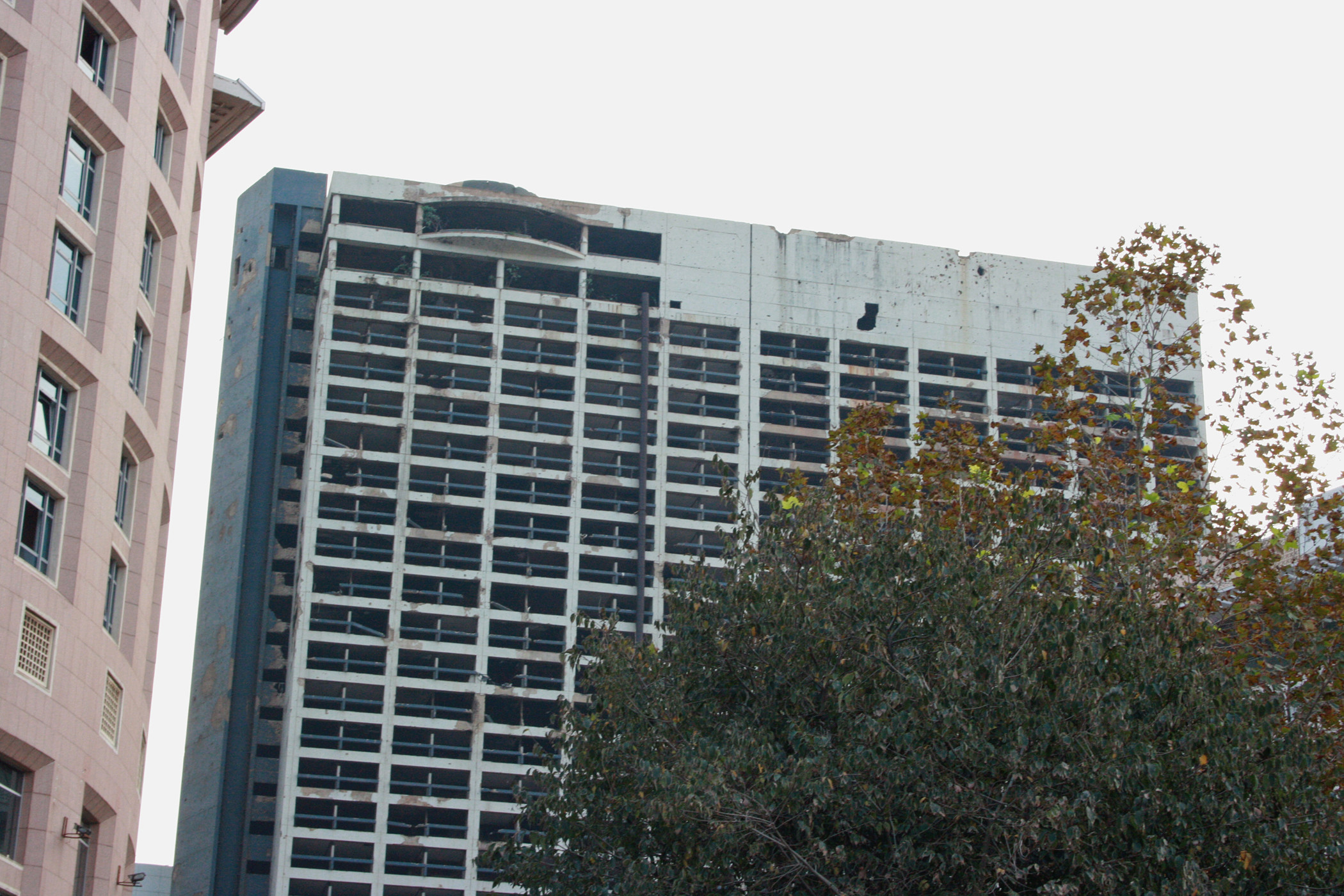
In honor of French-Lebanese friendship after the war, a stone from Fontainebleau was installed in Beirut. Franco-Lebanese friendship is rock-solid. Before and after the war, stronger than during. The war came to the city at the height of modernist construction. War-friendly architecture. Fights for unfinished hotels on the embankment: the builder managed to implement the architect's plan before the fork, where the room with a view differs from the firing point. Multi-storey concrete shadows and a loose pattern of shell holes along the regular concrete grid of the façade look out to the sea. Now, at the sites of battles and possible mass graves, another architecture is growing out of concrete. After the war, Beirut seems to be built as quickly as it was destroyed during it.
The city center before the war was a particularly dense knot of differences, during heavy fighting, and after fierce construction. The deserted Orientalist quarter of European clothing stores is a monument to the city's attempts to forget its war. Clearing central Beirut immediately after of the remains of buildings and their inhabitants, the owner of the largest development company, Rafik Hariri, profitably combined his share in the company with the post of prime minister of the country. During his second term as prime minister and on another occasion, the prime minister's motorcade was blown up. The war-torn facade of the hotel, next to which an explosion occurred, is covered by a banner with a slogan against the development company, which was transferred to the prime minister’s son after the death of the prime minister. One facade of the hotel was damaged by the war, the other two decades later - by the explosion of the prime minister's motorcade. After the death of the prime minister, the premier company lays claim to the land under the hotel and seeks its demolition.
In the Maronite eastern neighborhood of Beirut, old people gathered in a park to discuss a recent leaflet. Everyone has their own copy - they take it out of the inside pocket of their jacket, from the outside pocket of their jacket, from their bag. There is something to argue about. At the time of the massacre in Sabra and Shatila they were not forty, now they are seventy. The leaflets are probably about electricity and gas prices. Seventy years ago the Palestinians left Palestine, a hundred years ago the Armenians came from Turkey. The Armenian quarter of today's Beirut is separated from the Maronite quarter by the Beirut River (or simply "river"). Flowing into the Mediterranean Sea, it does not give it much - in the summer it is a muddy stream, in the spring it is a muddy stream in flood. Before the war, the Beirut-Damascus railway ran along the river. Twenty years between the war here and the war there. Now the Syrians are coming here from there, many of them coming to Shatila.
In the Sabra and Shatila camps, having expelled the Palestine Liberation Organization from occupied Lebanon, Israel, with the help of local Maronite militia, fought international terrorism. The concept of “international terrorism” was so new that many of the international terrorists killed in the camps - according to various estimates, from a thousand to three and a half killed within three days - were still breastfed. Breastfed, Raped and Murdered by International Terrorists. International terrorists pregnant with other international terrorists. The massacre in Sabra and Shatila cost the organizer of the operation, Ariel Sharon, the post of Israeli Defense Minister. Having lost the post of Minister of Defense, Ariel Sharon took over the post of Prime Minister of the same country.
It is unknown how many Palestinian refugees remain in Lebanon, with estimates varying by tens of thousands. The first to arrive in Lebanon were placed in Armenian camps. The first to reach Beirut were Christians, Christians were settled near the monastery of the prophet Elijah - Mar Elias - a Greek Orthodox monastery on the rather Muslim southern outskirts of the city. Following the Christians, Muslims came, new camps and illegal settlements arose. With every new Arab-Israeli war there is a new wave of refugees. Camps merge with one another, refugees migrate between camps. Migrating from a camp to a city, Lebanese or otherwise, is more difficult: physical and social mobility are controlled by the Lebanese army and Lebanese law. The legal work of refugees, and especially their naturalization, is limited or excluded. Lebanon maintains primacy among Arab countries in the lawlessness and poverty of its Palestinians. Refugees in Lebanon (those who survived the massacre in the Karantina, Sabra and Shatila camps and the “War of the Camps” had grandchildren and great-grandchildren born here) are legally citizens of a foreign state. The reason for the presence of Palestinian refugees in Lebanon - the disappearance of their (foreign) state - has no legal force.
After the war, in response to support for Saddam Hussein's PLO in Kuwait, several lines were added to the Arab League protocol defining member states' policies towards Palestinian refugees. Although in its original version it guaranteed vague rights for Palestinians at the supranational level, although it was rarely taken into account, after revision the protocol finally placed refugees at the disposal of the legislation of each of the League countries. The amendment allowed Lebanon not to apply the general amnesty law that marked the end of the war to the Palestinians. For Lebanese Palestinians, the war in Lebanon is not quite over.
The free layout of the old areas, not cleared out by the war and post-war improvement, differs from the spontaneous layout of the camp, it seems, only in density. In satellite images of Beirut, the camps are fractal pieces of the city folded inside themselves. Having exhausted its ability to grow in width, the camp begins to grow upward, closer to the satellite.
The exhibits of the National Museum of Beirut were obtained through double archeology - during the war, museum staff hid them, filling them with cement, so that after the war they could be removed from a new cultural layer. A round dance slowly runs along the platform from the temple of Eshmun. In these parts they have always been able and, it seems, loved to bury - but where is it different? Sarcophagi, funerary steles and golden masks. In the Republic, Plato complains about the Phoenicians for their love of money. Local coins with Phoenician, Greek, Latin and Arabic script. From right to left, then from left to right, from left to right and again from right to left. Here, in Phenicia, sound-letter writing began. The inscription on the lid of the sarcophagus of King Ahiram is the earliest surviving text compiled from signs indicating sounds. The history of phonetic writing opens with a curse; the son warns those who want to open his father’s sarcophagus: “Let the inscriptions about him be erased.” The text threatens future texts. The archaeological artifacts exported from the country during the war are considered to be thousands of tons. Excavations were carried out with bulldozers and jackhammers. The names of those who opened the sarcophagi, “the inscriptions about them,” remain erased.
A martyr is a key figure in the ideology machine of any direction. A monument was erected to the martyrs hanged by the Turkish Pasha for the anti-Ottoman plot in the central square (Martyrs), which was especially damaged during the war. Martyrs' Day on the calendar. There are different martyrs in different parts of the city, but everywhere there are martyrs. Portraits on posters, banners on the roads, black and white copies of photographs in the corner of the bus windshield. In the Maronite region, martyr Bachir Gemayel, leader of the Phalangist party and militia, was the country's short-lived president. Three weeks after taking office, Bashir Gemayel and twenty-six other Kataib members were bombed at the party's headquarters. Despite the fact that the murder was carried out by a Syrian Maronite, the explosion was avenged on Palestinian refugees in Sabra and Shatila. Martyrs of Sabra and Shatila. Gemayel's killer spent eight years in prison until control of the country passed from Israeli troops to Syrian ones. In a video message to visitors to Hezbollah’s museumized military camp, the organization’s leader, Hassan Nasrallah, calls Rafik Hariri, twice Prime Minister of Lebanon, the main developer of the post-war city, blown up along with his motorcade near Martyrs’ Square, a martyr. A special UN tribunal accused Hezbollah of the murder, Hezbollah - Israel, Israel - Syria, in its struggle with Israel to rule Lebanon. Syria blamed a specific Palestinian, but after mass unrest in Martyrs' Square that followed the assassination of Hariri, it withdrew its troops from the country. Now the Lebanese are becoming martyrs in Syria and on the outskirts of it. For the first time since the war, Hezbollah is not fighting with Israel and continues to bury its martyrs when possible.
Beirut, 2015
* * *
Crowdfunding campaigns have been organized to help those affected by the explosion in Beirut on August 4, but it is better to donate to trusted organizations. Lebanese-born but Berlin-based researcher and journalist Walid el-Khoury , who we trust, shared a list of local initiatives on his Facebook that help the country's most vulnerable communities.
You can also donate directly to the Red Cross in Lebanon at SupportLRC.app . If you know of other ways you can help organizations in Beirut, please contact hi@syg.ma .
Maxim Spivakov Beirut Lebanon War Israel Palestine Syria PLO Bashir Gemayel Kataib Hezbollah Hassan Nasrallah Ariel Sharon Rafik Hariri Sabra and Shatila