
Translated material
Colors of criticism
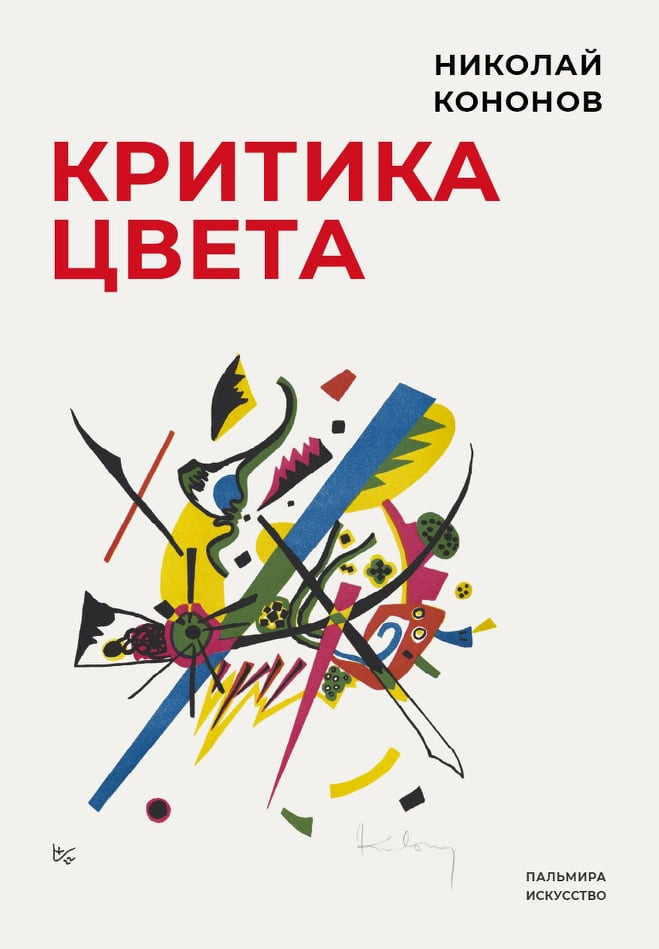
This book is being published as part of a grandiose project launched by the St. Petersburg “Palmira” - the publication of the collected works of the famous poet and prose writer Nikolai Kononov, who in this case is also an art critic. His cult novels “The Funeral of a Grasshopper” and “Tender Theatre”, the later “Flaneur”, “Parade” and “Hymns”, as well as the poetic “Vault” - a selection from the collections of 1981-2019 - have already been published. Three books of short stories (“Saratov,” “Bestiary,” “Scarcity”) and another collection of essays about art, “The Degree of Trembling,” are being prepared for publication.
At the very beginning of this book, namely “Critics of Color” by Nikolai Kononov, the author pronounces truths that are important not only for him, who realized them in his South Russian past, but, perhaps, for the entire history of art, philosophy of perception, the laws of the universe, finally. In essence, this is the age-old debate between “culture” and “civilization,” as well as “soilism” and “modernism.” “It turns out that there is no measure in the future,” the author clarifies. “The distances are not brought closer or further away, since they obviously cannot be reached.” Moreover, we add that in some cases they can even be neglected. Like descriptions of nature in a detective story. It is not for nothing, the author recalls, that Lydia Ginzburg believed that there was absolutely nothing to do with nature. With the Volga nature, as we immediately learn, there is nothing to do twice.
Thus, armed with such knowledge, and more seriously, endowed with a special vision, a “wide-format” perspective and an unblurred focus of attention, the author analyzes old and new fine art, while solving non-trivial issues. In principle, they set a horizon of “biographical” (author’s) expectations at the very beginning. What if life is anything other than “bucolic”? How does the subsequent chaos of the visible world become an essential condition of existence? What forces “push” the artist’s high manipulations into our world? How can we explain that instead of the “Volga” beauties, we, indignant and embarrassed, begin to love not only “installations” with “environments”, but also their fanciful interpretations. And finally, how does an impression, “captured” by art, change “nature” into “civilization” and become the form of the human spirit?
At the same time, the book of essays about Kononov’s art is not conservative, but quite the opposite: innovatively inventive, unusual, somewhat similar to how Russian formalists “implanted” literature into life, approaching a “non-Russian”, but in fact, a “European” view of life. Just like them, the author of “Critics of Color” does not appropriate knowledge, but invents his own “gay science” of interpretation - sincere, unbiased, sincere. “The main problem in contemplating my native territories is - let’s return to the “pedigree” of the genre - that they cannot be subjected to dissection into planes, because their coherence is much stronger than metaphorical corruption. It’s as if they are always visible to the eye—immediately, in their entirety, and from the inside out, and from the other side. It’s as if when you are flowing down the bed of a deep ravine or sliding down a dangerous slope, you are also sure (if you are not flowing) to fly above yourself. This is not an aporia, not a paradox, but perhaps a prolegomenon, for there is always a feeling that there will be something else, and more, and more..."
Kononov’s book itself is structured in the same way, who sometimes gives “doubting” titles to its sections, as if checking his personal correctness regarding the “official” line of genres. For example, “Imaginary”, where it is said, in particular, that “the rigidity and cruelty of cultural objects that we contemplate are obvious, if only because not everything we see becomes ours, not everything we can possess even in the most insignificant mythological, fantasy sense.” That is, if we have “culture” (“nature”, “speech”) by definition and from childhood - each, of course, his own - then we still have to appropriate “civilization”. And let the author be “helped” in this by eminent masters and humble philosophers, poets and artists with whom he discusses, now and then stumbling over the ruins of the “personal”, already St. Petersburg world and remembering the inglorious deeds of Blank-Lenin in the Soviet universe - he solves the mystery of Russian nature (and even the “soul”) himself. “Russian culture, burdened with the category of “spirituality,” has never shown us the coordinates of the deposits of this mysterious matter, called the soul, with which everything is joy and grace, fun and joy,” Kononov notes the next milestones on the path on which Giorgione and Cezanne, Pushkin and Blok, Freud and Benjamin are next to him. And also modern masters about whom he writes in his brilliant essays - Ilya Kabakov and Alexander Sokurov, Ilya Glazunov and Vadim Ovchinnikov, Vera Matyukh and Alexey Semichev.
And such a “personal” approach is not surprising, because, returning to the “biographicalism” of any story, the author reminds us that nature does not suffer without us. She does not need an analyst, but only a “total reader.” While “civilization” suffers: without an attentive interpreter, critic, guide, which is the author of this unusual book.