
Translated material
Space and burden
How to discover the local in the global, the real in the imaginary and vice versa: the exhibition “Metageography. Space - Image - Action", special project of the 6th Moscow Biennale of Contemporary Art. Tatyana Sokhareva comments on the exhibition.
Exhibition “Metageography. Space - Image - Action,” despite its external elegance and rich texture, is not one of those that you want to look at for a long time. Already the prologue to it is confusing with its rather crude figurative arithmetic. The corridor that greets the viewer, which the curators called the “Cartographer’s Office,” ends with a portrait of Stalin by Fyodor Reshetnikov, a picturesque synonym for the map “I.V. Stalin on the fronts of the civil war." Both of them cannot be called anything other than elements of cultural and historical kitsch.
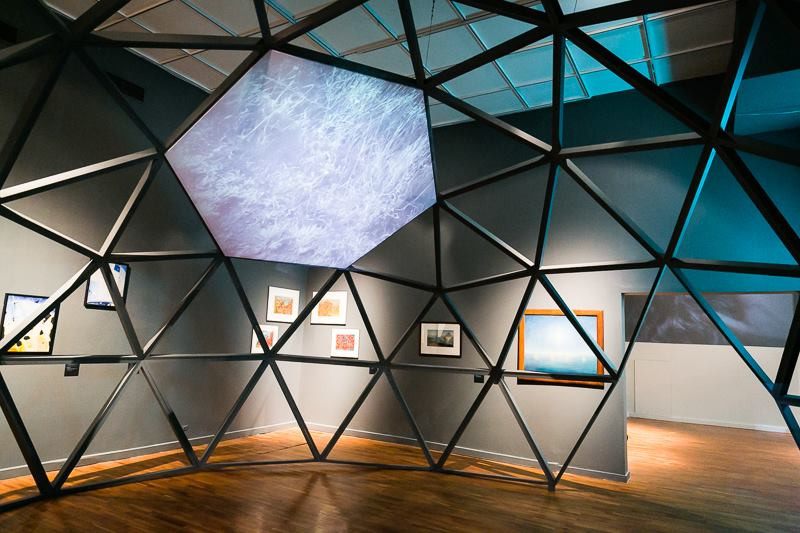
Behind the Generalissimo are three more halls, chock-full of art created mainly after the death of imperial phantasms. Together they gave birth to a complex space that affects the viewer on one level or another - literally. Some of the exhibits are deliberately lifted up to the ceiling, and you can only see them by climbing onto the platform sticking out in the middle of the hall. Part of it is completely hidden behind a geodesic dome, apparently representing a mountain. Everything together adds up to an extremely decorative cast of reality, an imitation of the natural landscape, reminiscent, however, of a theater props warehouse.
The intellectual content of the exhibition takes up much more than the visual part itself, which combined the collage of Georgy Kiesewalter with a measuring chain, and the ornamental “Cartography of Fear” by Dmitry Plavinsky with the virtuoso cartographs of the geographer and theorist Boris Rodoman (it must be said that these works are mounted together somehow).
Armed with science, curators Kirill Svetlyakov and Nikolai Smirnov decided to link, for example, the psychogeography invented in the middle of the last century by the Situationists (they destroyed the imposed system of urban coordinates, spontaneously wandering through the streets and documenting their fermentation) with the theory of space of the French philosopher and sociologist Henri Lefebvre - his fundamental work “The Production of Space” (1974) was just recently published by the Strelka publishing house.
Lefebvre was one of the first to come up with the idea that space is not a bunch of objects scattered on the ground, multiplied by a body of ideas and sociocultural constructs imposed on us. His famous “triad” incorporated the idea of space as it was designed by professionals (architects, urbanists, city planners), everyday experience and practices that connect design and implementation. That is, according to Lefebvre, by walking the dog or wandering randomly through the streets, we are already participating in the process of producing public space.
From this point of view, the podiums and platforms built by the architect Alexei Podkidyshev in the Tretyakov Gallery, the eye-catching turquoise color and the cartographer’s equipment are, of course, the path to fetishization, which the philosopher struggled with. Such an exhibition risks turning into a “passive container”, a reality in which everything is deciphered in advance.
And this would certainly have happened if not for a number of works whose authors turned to the abstract poetic nowhere.
Pavel Otdelnov, for example, paints gnawed-off typical buildings and industrial zones in post-apocalyptic tones, which he breaks into pieces with some acidic pixel that accidentally crashes into the picture. The post-industrial desert, as his landscapes always seem to be, begins to ripple and almost melt under the pressure of color. Sofia Gavrilova (by the way, a candidate of geographical sciences) mounts her video sculptures in a similar way, putting them together from pieces of landscapes that are constantly subject to destruction: either Ilyich will jump out on a pedestal in the middle of the beach, or an advertising billboard will grow on the lawn.
The experience of being in “nowhere” reaches its apotheosis in the work of Nikolai Onishchenko. He captures on video typical high-rise buildings monotonously peeking out from behind the bushes for six minutes. The objective world, cleared of personal perception, cultural codes and any dynamics, torments the viewer with an imposed feeling of eternal expectation. This is the territory of visual affect, smeared like chewing gum, the moment “here and now.”
In terms of the intensity of the tension of “empty action,” his work can only be rivaled by the documentation of Ganna Zubkova and Ekaterina Vasilyeva, who together dragged a heavy metal pipe across the whole of Moscow and called their action “Revolutionary Axis.” And this is perhaps the most radical antithesis to urban thinking, which has appointed man as the main unit of measurement of the urban environment.
Another problem is associated with a group of deeply intimate works that the Tretyakov persistently tries to force into the epic form of a blockbuster exhibition - like, say, the Siberian photo project about the Russian outback “Moles on the Map” by Valery Klamm, completely lost among the globes and massive installations. There are examples of such a discrepancy in scale in every room.
As a result, the exhibition about our way of seeing the surrounding space and being in it turns into a guide on how to survive in a world that is reflected only in the eyes of the beholder. This slightly voyeuristic subtext ensures a constant change of optics, due to which this heavy mechanism somehow works. The exhibition, like a layer cake, grows with volumes of information about a space that does not exist, due to the many tiny points of view, it becomes a sum of subjectivities. The process of looking turns into something like orienteering. And in this sense, the main principle - the movement from representation to the production of space - still worked. But the viewer is unlikely to be able to solve the proposed puzzle. The only way out is to complete your own route through the exhibition, putting together your own map of the world from the proposed details.