
Translated material
In the shadow of Rubens and van Dyck
The second of July marked the 424th anniversary of the birth of the Flemish painter Theodore Rombouts, whose name is known to few today. He studied with Abraham Janssens the Elder, who desperately competed with Rubens; Rombouts' portrait was painted by Van Dyck. Moreover, he created it in England during the same period as the portraits of King Charles I and Queen Henrietta Maria of France, and in the same house on the Blackfriars River where the royal couple so often visited him. Theodore Rombouts remains in the history of art as a Flemish painter, an adherent of historical, mythological and everyday themes. The Rombouts circle painting, stored in the ASG Large Collection of Fine Arts, belongs to the everyday genre.
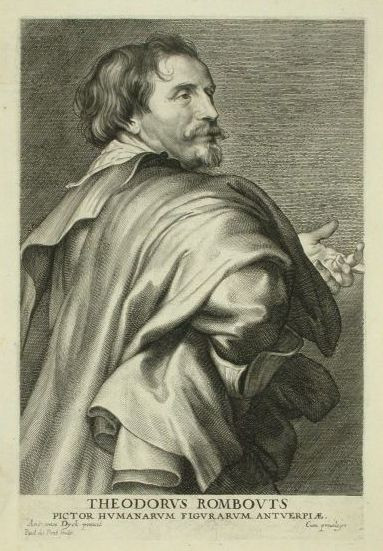
Rombouts was born in Antwerp and apprenticed first to Frans Lankveld and then to Abraham Janssens the Elder (1576-1632). At the beginning of the 17th century (Rombouts was born in 1597), painting in Flanders was experiencing a period of rapid prosperity. With the growing wealth of the country and the spread of fashion for painting in the most diverse social strata, the circle of customers is growing, and the number of artists and workshops is increasing. The largest customer is still the church, but now large altar images require not only an entertaining plot, but also a deep emotional impact on the viewer.
Another major customer is the nobility, who prefer to decorate their castles and palaces with huge panel paintings with religious and mythological subjects, landscape and allegorical scenes, paintings of hunting, etc. Artists tended to specialize in a particular genre, although in Flanders the “division of labor” was not as strict as in Holland. The artist-master of figure compositions was Rombouts' teacher Abraham Janssens. Janssens’s main “merit” was that during the era of Rubens’ undivided creative dominance, he managed to preserve his own identity; for some time he was even the only rival of the great painter.
At the same time, in the creative style of Janssens, the influence of Rubens can also be traced, but he managed to combine this with the traditions of the Dutch school and Caravaggism. Janssens studied with Martin de Vos, a prominent representative of late Mannerism, and in 1598 he traveled to Rome. It was here that he fell under the spell of Caravaggism with its fearlessness in addressing reality in its most brutal manifestations. Caravaggism revised the artistic principles of academicism in terms of composition, lighting, and image dynamics. Janssens brought these new ideas to Antwerp. Already in 1601, Jansens became a master, that is, he received the right to have his own workshop, and in 1606 he was elected dean of the Guild of St. Luke, he became the first artist of Antwerp, although not for long, since in 1608 Rubens returned from Italy.
Janssens was very prolific; in the years 1610-20, a huge number of paintings came out of his workshop. Against the backdrop of Rubensian sensuality, Janssens's paintings look too harsh and cold, but this does not prevent them from finding many fans. Most often, the master exploits his ability to depict the plastic authenticity of the human body from the most difficult angles.
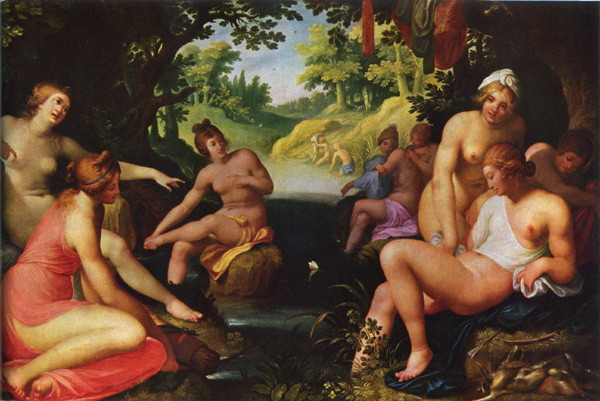
This is a picture that reproduces the cruel and fascinating myth of how Jupiter was inflamed with love for the nymph Callisto, just like her mistress Diana, who took a vow of celibacy. Realizing that Callisto’s devotion to Diana would not allow him to achieve his goal, and the nymph would rather turn into a tree or bush, like Daphne and Syringa, than yield to his advances, he appeared to her in the form of her beloved mistress, whose caresses she could not resist. Nine months later, the denouement of this story most struck Callisto herself.
Janssens depicts the climactic scene - Callisto's pregnancy is discovered when Diana takes her daily afternoon bath in a stream, to which nymphs who have lost their virginity were strictly forbidden to approach. On one bank, the artist depicts an angry Diana surrounded by two beauties contemplating the event, and on the other, in the foreground, Callisto, burning with shame, whose tunic, exposing her stomach, is lifted bather with a bandage on her hair. Before us is the complete apotheosis of bodily beauty, while the pose of each character reliably conveys his inner state: anger, modesty, acute curiosity... All the artist’s sympathies are clearly on the side of Callisto, which is emphasized by more careful writing and the very peach tone of her skin, which, against the background of Diana’s coldish marble body, emphasizes the triumph of the earthly over the heavenly.
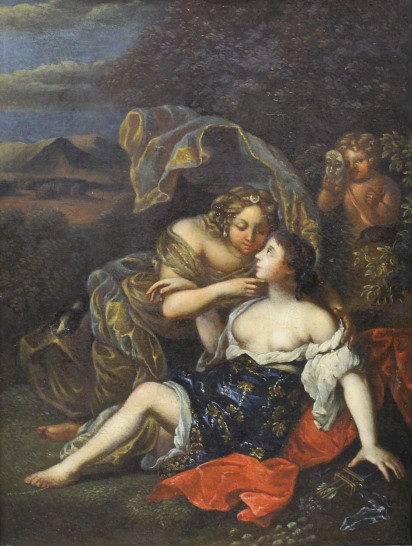
In the Great Collection of Fine Arts ASG there is a work on the same subject of the Dutch school, which was recently revealed in the process of art historical analysis, and its author is a follower of the famous Dutch portrait painter Caspar Netscher. You can find out more about it here.
Rombouts became a student of Janssens during a period of his acute jealousy of Rubens' fame. In the book “The World of Rubens,” K. Wedgwood describes how Janssens and Rubens competed, having received orders to decorate the interior of the city hall, in which Rubens had the advantage. He chose the plot of “The Adoration of the Magi,” which, against the backdrop of the allegorical image of Antwerp in the form of a beautiful nymph, was perceived as more understandable and emotional. Janssens did not accept defeat and threw out a contemptuous challenge to his opponent. He invited him to draw one picture for a given plot, presenting them later to the judgment of a dispassionate arbiter, who would not know the names of the authors. Such a judge, according to Janssens, would undoubtedly give preference to him. Rubens did not answer the challenge thrown at him, believing that by doing so he would harm not so much himself as his opponent. “What is this competition for? - he asked his fellow artist. “Neither one nor the other will jump above their heads anyway.”
It is not known whether Janssens involved his students in this rivalry. Rombouts most likely escaped this fate, which is indirectly proven by the fact of his collaboration with Ruben after the death of the teacher and by his age. At the time of Rubens's return from Italy, Theodore Rombouts was only eleven years old. Like Janssens and Rubens, he went to Rome and then Florence in 1617, working on orders from Cosimo II de' Medici, painting several historical paintings. Upon his return to Flanders in 1625, Rombouts was accepted as a master into the Antwerp Guild of St. Luke, in which he was a foreman in 1628-1630. In Antwerp in 1627 he married Anne van Thielen. The van Thielen family belonged to the minor nobility and was quite influential in the Spanish Netherlands.
Like Janssens, Rombouts imitated Michelangelo da Caravaggio. His works are almost always well composed, distinguished by faithfulness of design, carefully executed, but somewhat harsh in color. He painted historical and allegorical paintings, genre scenes, as well as imitations of Italian masters who depicted singers, card players and charlatans. The Hermitage contains two paintings by Rombouts: “Playing Cards” and “Kitchen”.
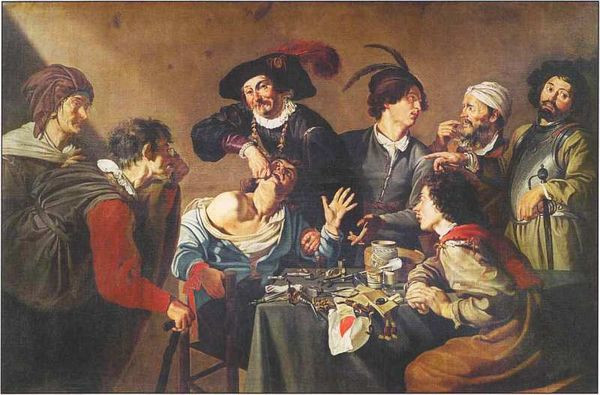
From Caravaggio, Rombouts adopted not only artistic techniques and his complex light and shadow modeling, but also used direct quotes from his works in the plots. An example of this is his painting “Tootheder”, where there are direct analogies in compositional structure, poses and
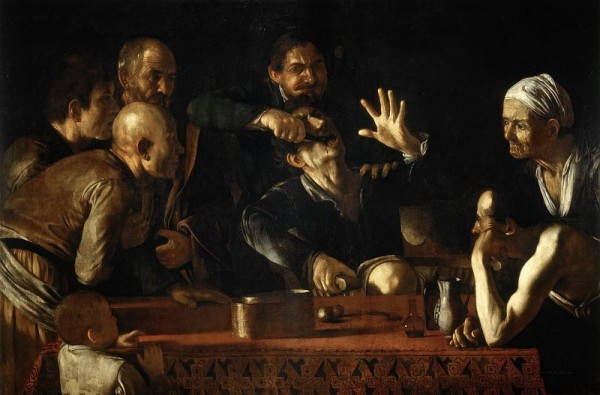
gestures of the characters from the work of the same name by Caravaggio, but it lacks deliberate naturalism and sarcasm. In this genre scene, each of those present, in their own manner, observes the suffering of the patient, some with sympathy or horror, others with curiosity, wondering what they would feel if they were in his place. Only one main character feels calm and confident. With his left hand, the dentist firmly holds the sufferer’s forearm; with his right hand, only one movement remains - and it will all be over. Unlike Caravaggio's work, Rombouts' painting is lighter and more colorful in color scheme.
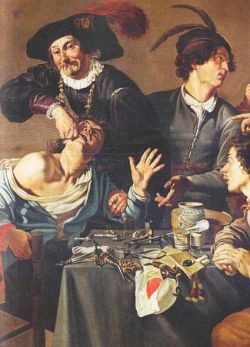
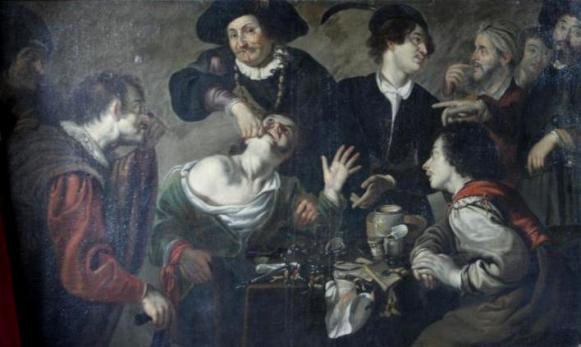
In the Great Collection of Fine Arts ASG there is a painting created by an artist from the circle of Theodore Rombouts. According to art critics of the International Institute of Antiques, the author of this work, unlike Rombouts, is an adherent of the Italianizing movement, in terms of coloristic solutions and brightness of lighting, he can rather be classified as a follower of the Rubensian school. This is indicated by a softer, cold coloring with an abundance of silvery tones, inherent in the Flemish painting tradition of this time, at the origins of which was Rubens.
Rombouts is often accused of taking the subjects and compositions of his paintings as an opportunity to experiment with a color palette and show off his technical skills. As a result of the use of cheap pigments, many of his works faded over time, especially the blue colors. As a rule, his paintings are large, horizontally deployed compositions with large half-figures placed in a shallow space. Under the influence of Rubens and Jordaens, the artist’s commitment to Caravaggism becomes less noticeable, thick shadows gradually disappear from Rombouts’s paintings, and his palette becomes lighter. An example is his painting “Allegory of the Five Senses”.
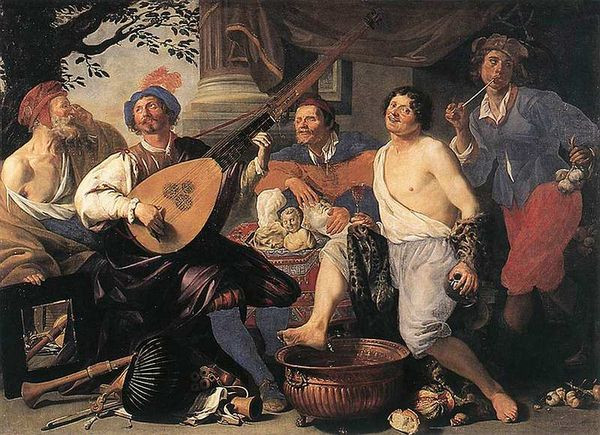
The presented painting was commissioned from the artist in 1632 by Bishop Anthony of Trieste of Ghent. Such allegorical images were extremely popular in the 16th-17th centuries. In this work, each character symbolizes a certain feeling and is equipped with its own attributes to facilitate identification by the viewer. An elegant young man with a pipe and garlic symbolizes Smell, a merry fellow with a glass of wine in his hand and food at his feet represents Taste, and the blind man in the center with fragments of sculptures in front of him is easily recognizable as Touch. The ear plays the theorbo, a bass type of lute, with wind and string instruments located next to it. Vision - an elderly man with glasses, leaning his right hand on a mirror in a black frame, in it the viewer sees a reflection of part of the instruments...
In 1635 (after the death of his teacher Janssens), Rombouts took part in the decoration of Antwerp for the ceremonial meeting of Cardinal Infanta Ferdinand, Rubens supervised this work.
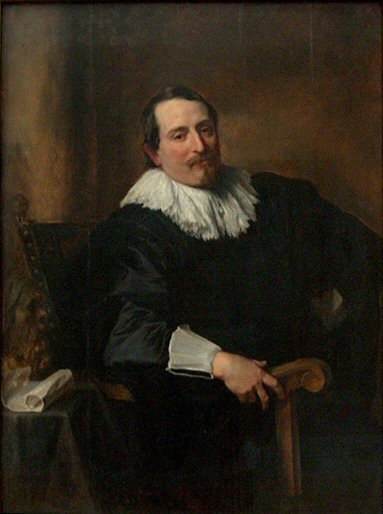
It is believed that his paintings tell the best story about an artist, but in the case of Rombouts everything is much more complicated. Rombouts's works are not distinguished by either originality of plot or absolutely individual style of writing; they are high-quality products of an average baroque master. And only the portrait of Theodore Rombouts by the brilliant van Dyck proves that the artist’s personality is much larger than his talent. An intelligent and, as they would say now, self-sufficient man looks at us from the portrait. An expensive suit with a rich collar, a sleek goatee, and a beautiful complexion indicate that this person does not need money. His pose is proud without arrogance, and his gaze is thoughtful and ironic. Rombouts's innate aristocracy and personal charm earned him authority in society and the favor of the best artists of his time.
This - the strength of personality - explains his many years of communication on equal terms with such titans as Rubens and van Dyck, maneuvering between irreconcilable rivals like Rubens and Janssens, marriage to a girl from a noble family who enjoyed the favor of the Spanish Habsburgs at a time when the position of the artist in society was no more significant than that of a simple artisan.
Svetlana BORODINA
Source: In the Shadow of Rubens and Van Dyck
Theodore Rombouts painting art Van Dyck