Translated material
Max Black
The Stanislavski Electrotheater showed Heiner Goebbels' production of Max Black and published Heiner Goebbels's book The Aesthetics of Absence. The performance also became a worthy finale of the Territory festival. Yes, the Electrotheater is completely autonomous and packs double punches. Along with the premiere, a book by the director is published by its own publishing house. This was the case with Terzopoulos, his “The Bacchae” and the book “The Return of Dionysus”, this happens with every performance - it is depicted in pictures and described in interviews and articles, books - without leaving the box office of the Electrotheater, so to speak. The newspaper “Sine Phantom Electro” eliminates the need for any third-party information about the processes, people and premieres of the Electrotheater. But we'll try.
The Electrotheater publishing house has published “The Aesthetics of Absence” in the “Theater and Its Diary” series, that is, it has collected articles and speeches by Heiner Goebbels from different years under one cover, in an excellent translation by theater scholar Olga Fedyanina. “The Aesthetics of Absence” is not only the title of a book, but the “name” of the most powerful school of thought in contemporary theater. From my point of view, this book is more important than the other two hits of theater studies - Erika Fischer-Lichte's Performative Aesthetics and Hans-Thies Lehmann's Postdramatic Theater. We'll try to figure it out next time why this is so.
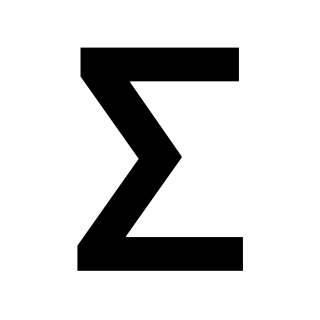
Heiner Goebbels is essentially a composer, and the absence of sound, attention to pauses and lacunae, after the works of John Cage, has become a commonplace in modern music. Likewise, the epicenter of the aesthetics of absence in the theater can only be one thing, the absence of the actor. However, “Max Black” and many other Goebbels productions are good precisely because of the presence of the actor or actors. But the activity of the actor in these productions, in a very specific sense, is identical to the complete absence of the conventionally understood acting activity. From the point of view of the ancient East, this is the application of “non-doing” in the Western theater, that is, the paradoxical actualization of the cornerstone principle of Taoism and Zen Buddhism, related in this matter. The book is dedicated to the study of this paradox, self-exploration, and observation of one’s own creativity. And in the performance you can directly observe the main, so to speak, theses of the aesthetics of the Heiner Goebbels Theater.
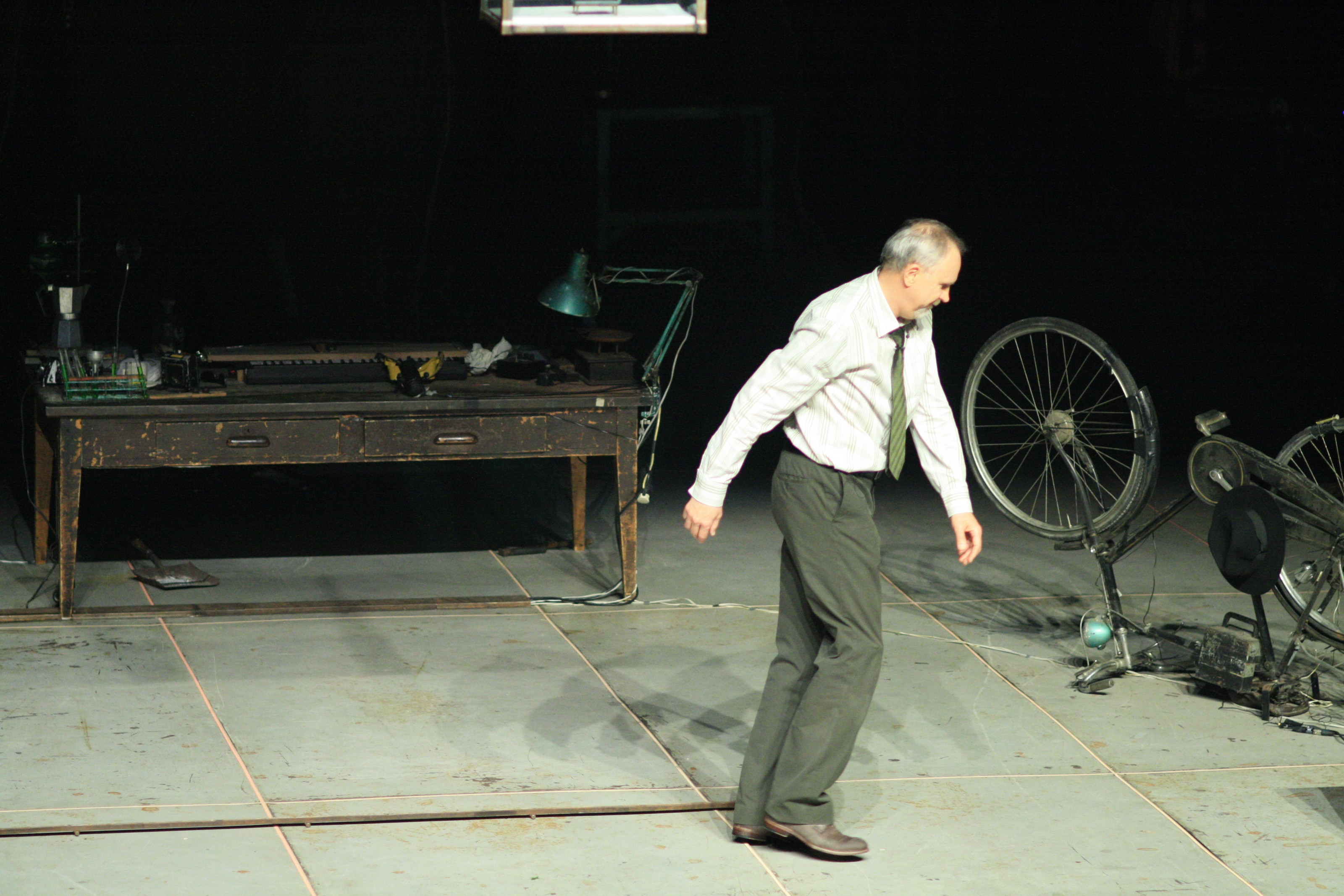
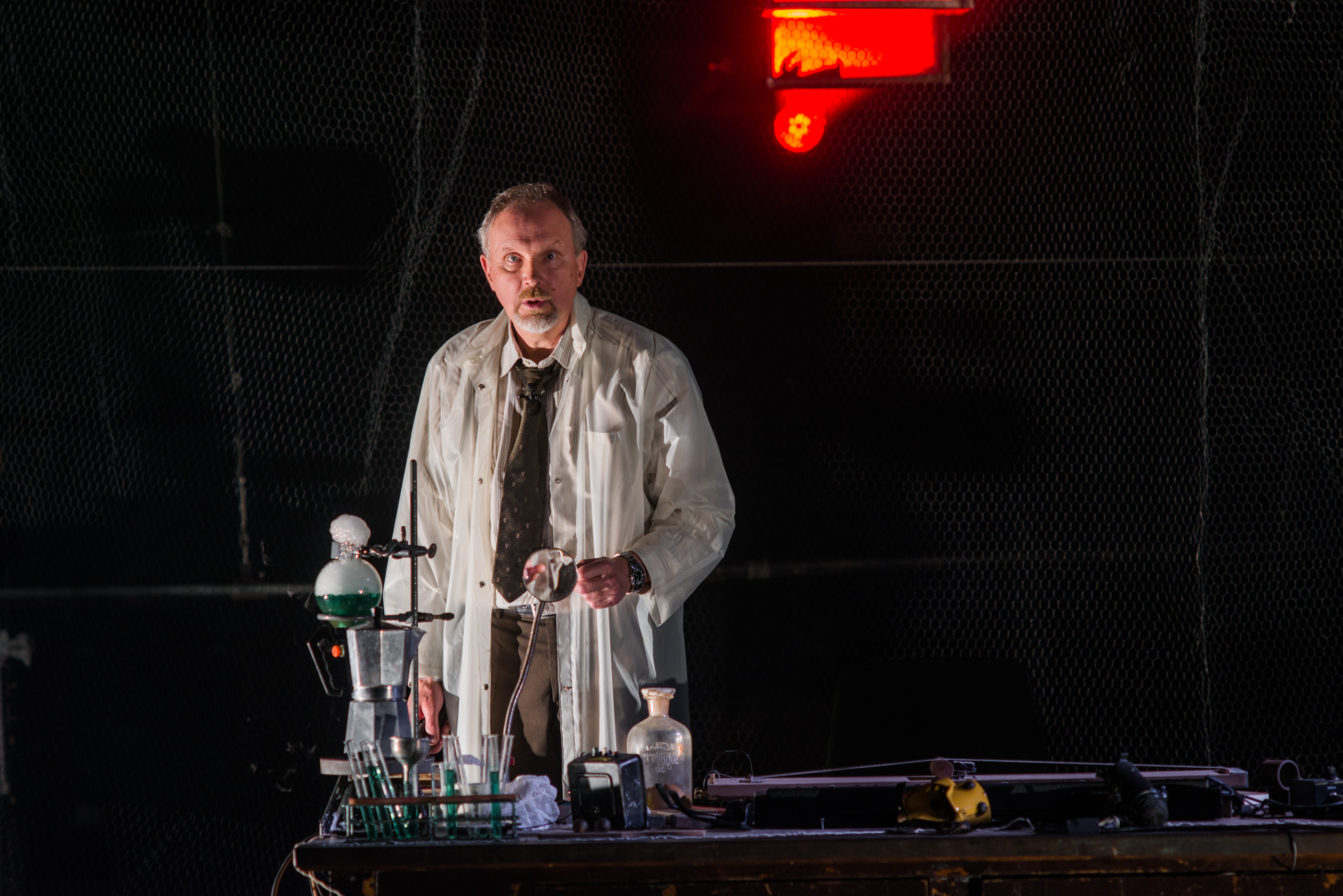
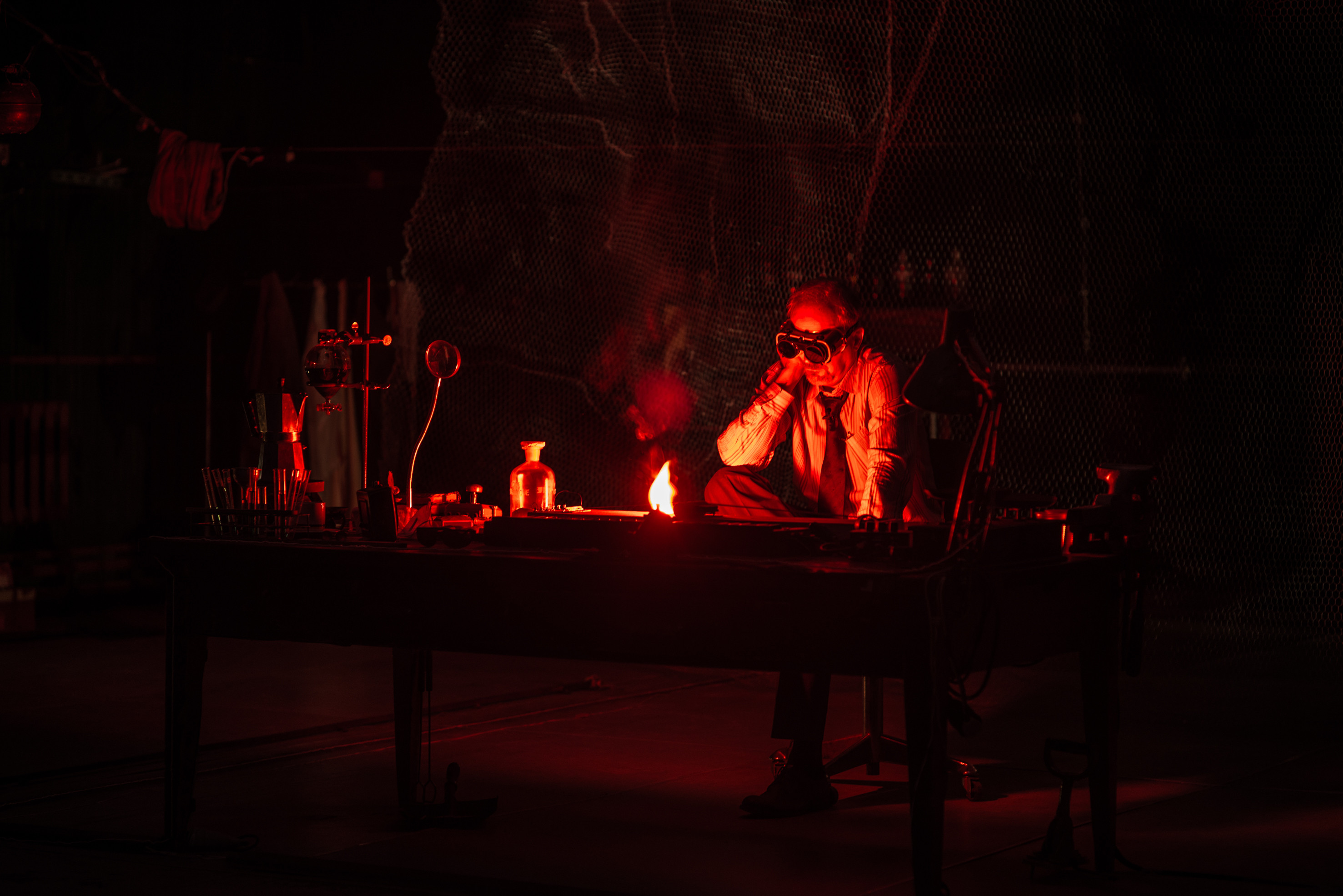
“ Max Black or 62 ways to support your head with your hand ” is a benefit performance by Alexander Panteleev , who is automatically identified in the process of perception with the image of a typical inventor, a Soviet doctor of technical sciences from a secret “box”, who knows how to do everything that is possible in an equipped laboratory. Everything is clear to the audience as soon as they enter the auditorium: this show is about science. The actor continuously, feverishly and thoughtfully talks, for starters, about factorials and other ways to count the number of possible options for seating spectators on plastic theater chairs. Then an extravaganza of flashes of the brightest light begins, and suddenly you understand that it’s not about mathematics, but about an attempt to tear the viewer away from the usual theatrical violence. Any actor on stage manages to force the viewer to perceive the matrix of the role, placing the viewer’s perception in a Procrustean bed of identification with the protagonist (aka antagonist, in this case).
But miracle, there is no identification with the hero. Why? By answering this question, we will recognize Goebbels' method. So, a bright flash of intense red flame on the laboratory table blinds the audience. I counted the time, this instant purple affected me for 10 minutes. There are, of course, fewer non-myopic people. The light impulse pushed my perception far. The thought of Goethe arose right in his eyes, because the additional color summoned, powerful green, replaced the completely red flame. Turning my gaze to the hero, I thought - if this green head of the hero does not exist, how can we talk about the science of light and color, about some kind of electromagnetic spectra, wavelengths, photons and magnons. Along the edges of Panteleev’s face filled with an unearthly violet, again it was replaced by blue, mutating into yellow. With the second flash, everything turned gray, because the green mixed with purple. And the thought rushed off. So I broke away from identification with the hero and, in general, from the theater of experiences.
A Goethenian thought flashed through: both the phenomenon of afterimage and simultaneous contrast illustrate the amazing and still inexplicable fact of the appearance in our eyes, when perceiving one color or another, at the same time of another, balancing it, an additional color, which, in the event of its real absence, is spontaneously generated in our consciousness. Which color is more real - a response in the eye or an external, inducing one. Or both are illusory, responding to invisible light. Goethe stood up to his full height, completely covering the stage Max Black. For me, the first 10 minutes of the performance was exclusively about Goethe, for whom light is invisible, and color is the suffering of light.
Johannes Itten writes in “Fundamentals of Color”: “In 1944 in Zurich, on the occasion of an exhibition at the Museum of Decorative Arts dedicated to the phenomenon of color, I read a report on colored shadows. I demonstrated that a white object illuminated in daylight with red light produces a green shadow. Green cast a red shadow, yellow cast a purple shadow, and purple cast a yellow shadow. Each colored light in daylight casts a shadow of its complementary color. I asked photography class leader Hans Finsler to photograph this phenomenon. Color photographs showed that the colored shadows were truly real and not the result of simultaneous contrast."
It turns out that our eyes also produce colored shadows? And how to photograph shadows in the eyes? The question arises: why do theater lighting specialists never do anything to magically see colored shadows? The answer is that for this, the directors had to read not “Faust”, but “The Doctrine of Color” by Goethe. An exception to the rule is Robert Wilson, about whom Goebbels writes in the chapter “In the Riddle of Signs,” admitting that it was he who revealed the mystery of light as an independent artistic form, that only Wilson’s shadows can inexplicably turn red.
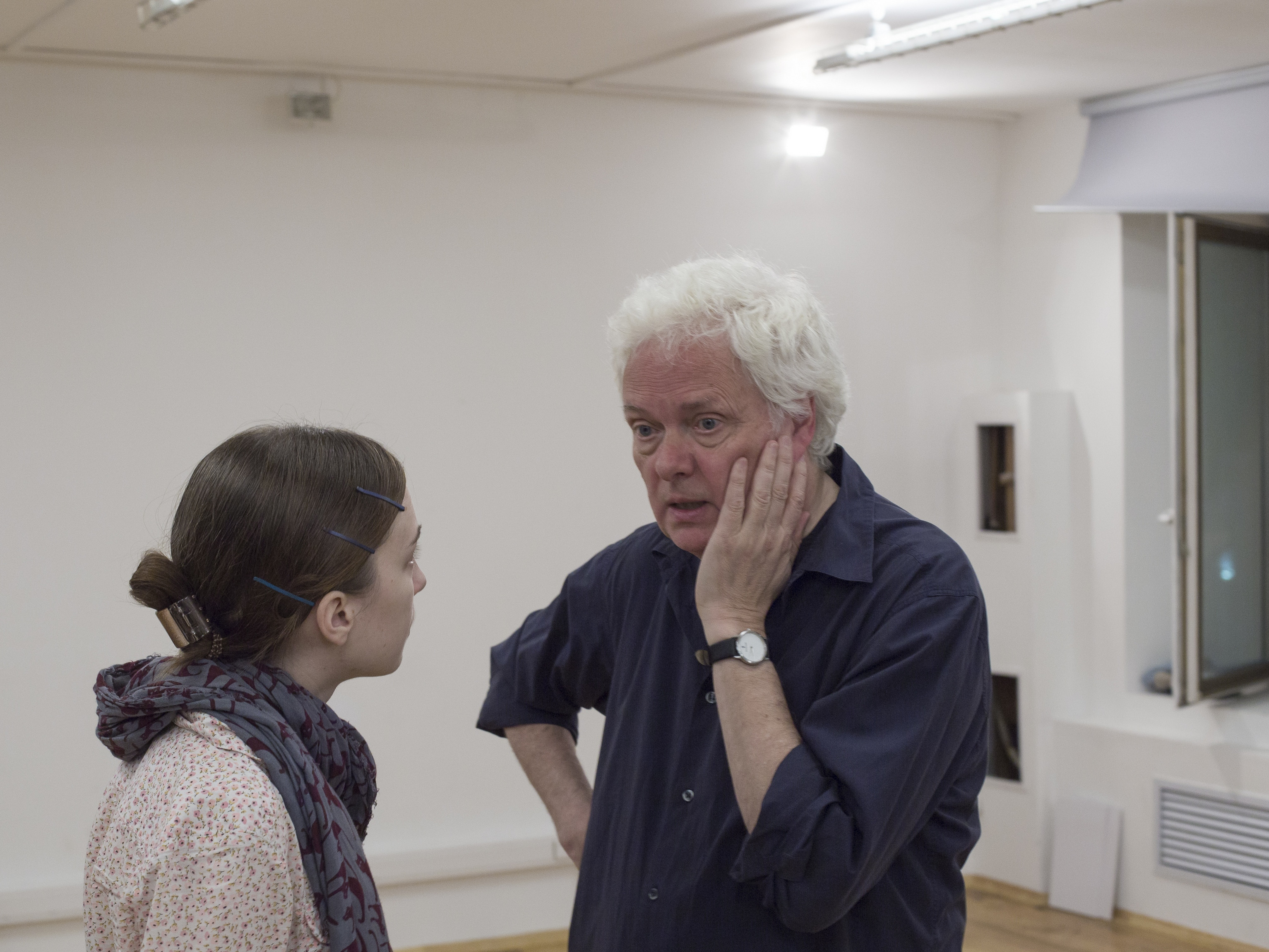
Let us give a powerful quote from the Cognitivist website about Edwin Herbert Land (1909-1991), who was born in the same year as Max Black. So the play could be called "Edwin Land". So what can we say about an inventor on the scale of Tesla, Edison and Jobs, the founder and scientific director of the Polaroid Corporation in Cambridge (Massachusetts), holder of 537 patents, a major expert in the nature of color vision, polarization, stereo cinema, a researcher in image formation processes, a professor at the Massachusetts Institute of Technology? At least this:
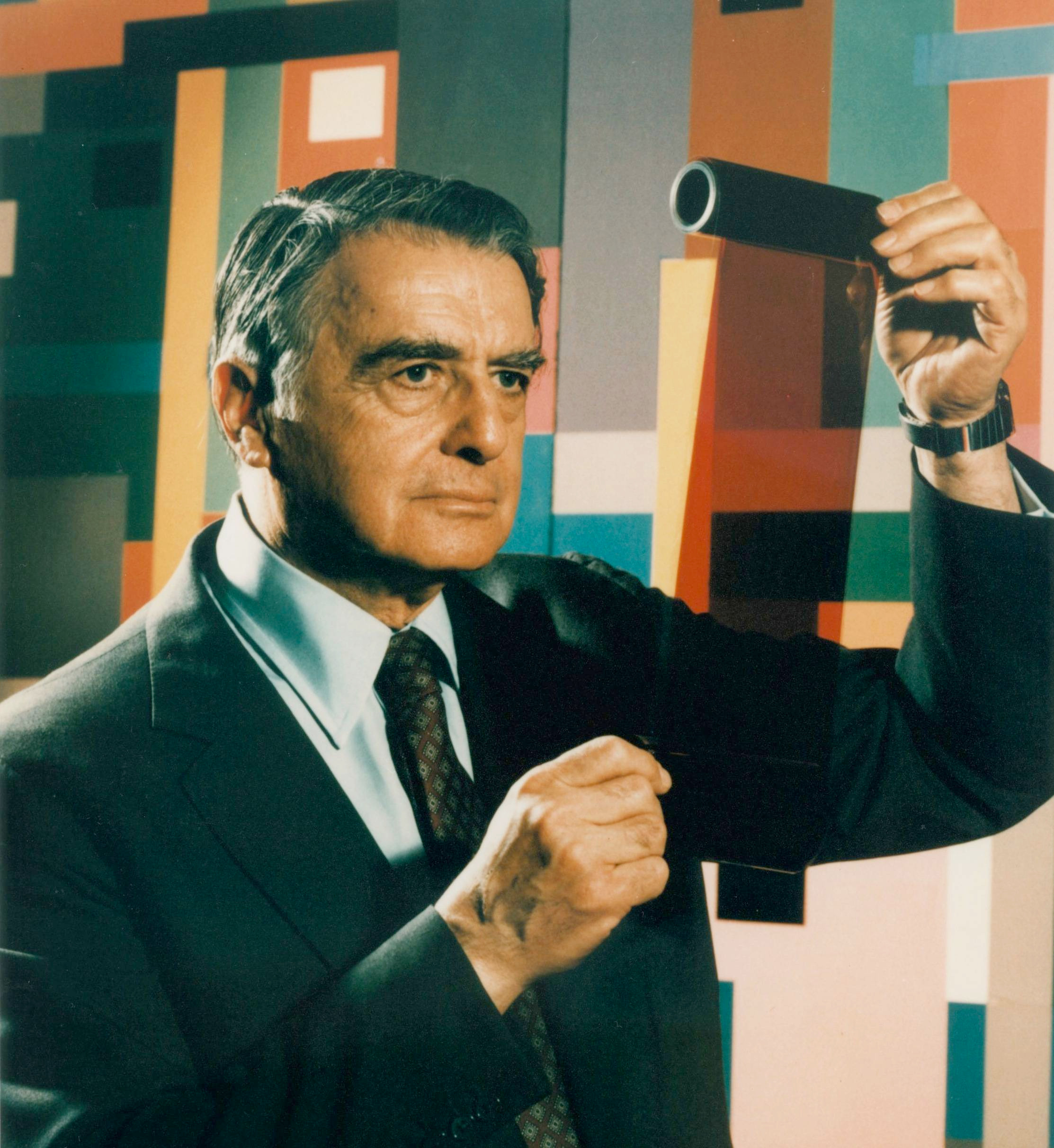
In the 50s, Edwin Land, fascinated by Goethe's theory and wanting to test it, conducted a series of experiments. In the simplest experiment, he made two black and white slides of the same painting, consisting of multi-colored squares. The first slide was made through a color filter that allowed only warm colors to pass through, the second through a filter that only passed through cool colors. He then combined the images of these black and white slides on the screen. To do this, he used two projectors, one of which shone white light on the slide photograph taken through a cold filter, and the second projector shone light through a warm filter onto the slide photograph taken through a warm filter. According to classical physics, the observer should have seen the painting in various shades of pink. However, instead the result was a color image of the painting appearing on the screen. This was not an illusion caused by habituation of the eyes - the effect occurred instantly, and was almost unaffected by the presence of background external light. It is curious that if we measured different points of the screen with some spectrometer, at any point we would obtain a spectrum corresponding to the pink color, as predicted by classical optics. But it turned out that the electromagnetic spectrum of the wave and the perceived color are related to each other in a completely different way than classical science imagined.
There is a theory about octave, like sound, color perception. That is, in principle, you can see color in any part of the spectrum, for example, in an altered state of consciousness. The most important altered state for us is creativity. Then the main question arises - what do we see in a dream, what light and color. The most important question is about the nature of creativity, because without the imago there are no creations. There is nothing without a living, thoroughly symbolic picture obtained along the path of internal perception. What is this path? We are talking about a “picture” seen by those who were not asleep at the moment of falling asleep, but held on to the edge of sleep in order to preserve the memory of what they saw and extremely realistic. Goethe's teaching on color is such that, if it does not prove it mathematically, it hints in natural philosophy about the complete non-distinction between subject and object in the process of perceiving color. It has always been known that the wildest fantasy can be deep realism. Moreover, only that imagination is creatively effective that is capable of bringing out and remembering its imaginative images from a lucid dream. But we digress.
Who is Max Black? He, a real (1909-1988) structuralist, linguist and philosopher, wrote under the influence of Ludwig Wittgenstein “A Companion to Wittgenstein's Tractatus” (1964), in addition “Language and Philosophy” (1949), “Models and Metaphors” (1962), “The Labyrinth of Language” (1968), and in 1937 he came up with the fuzzy logic, fuzzy logic, becoming more and more in demand by computerland every decade. Heiner Goebbels picked up a random book, abandoned his problems, glanced over the text, caught the word “logical uncertainty”, the name Max Black in a footnote - and the image of the performance was ready.
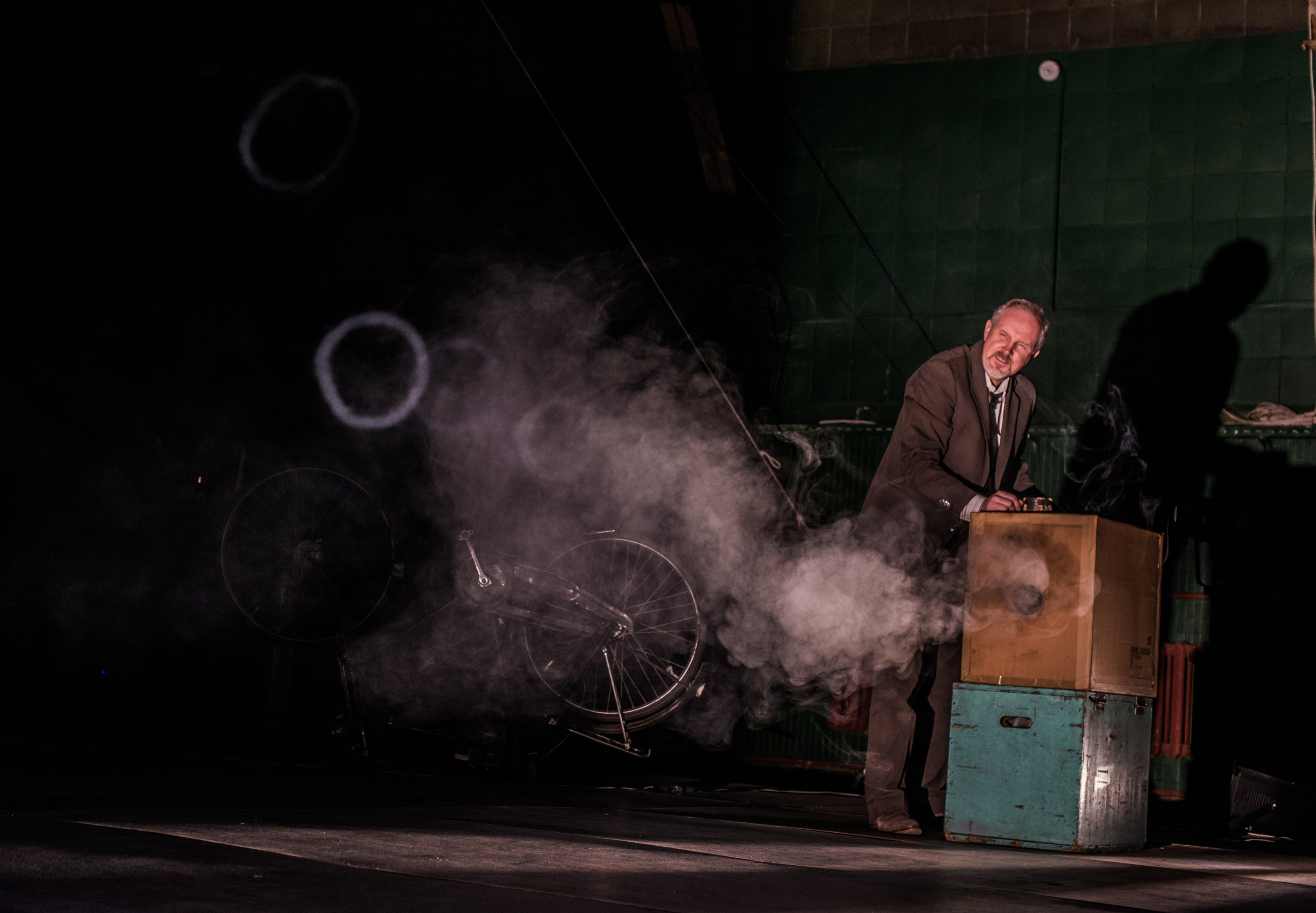
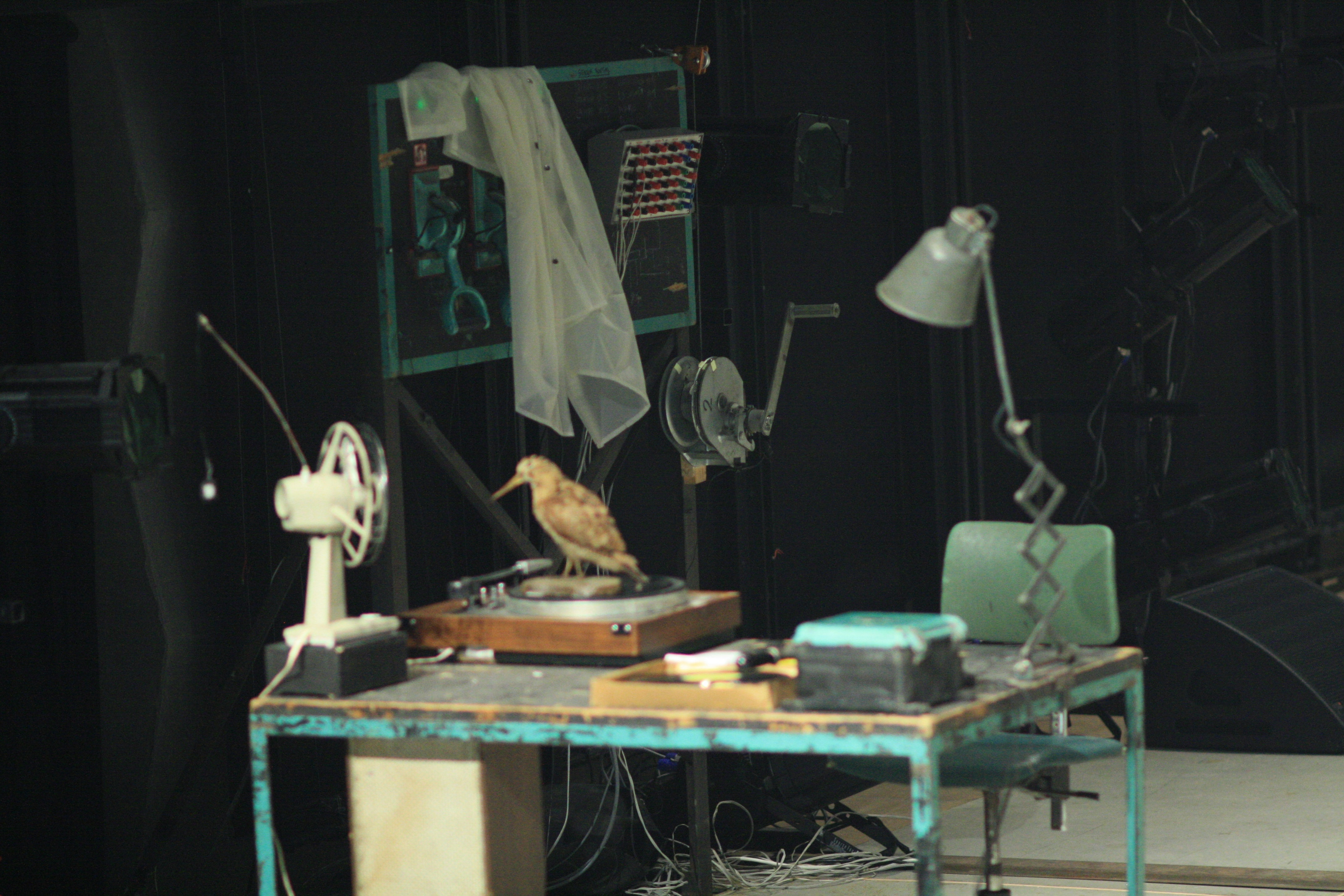
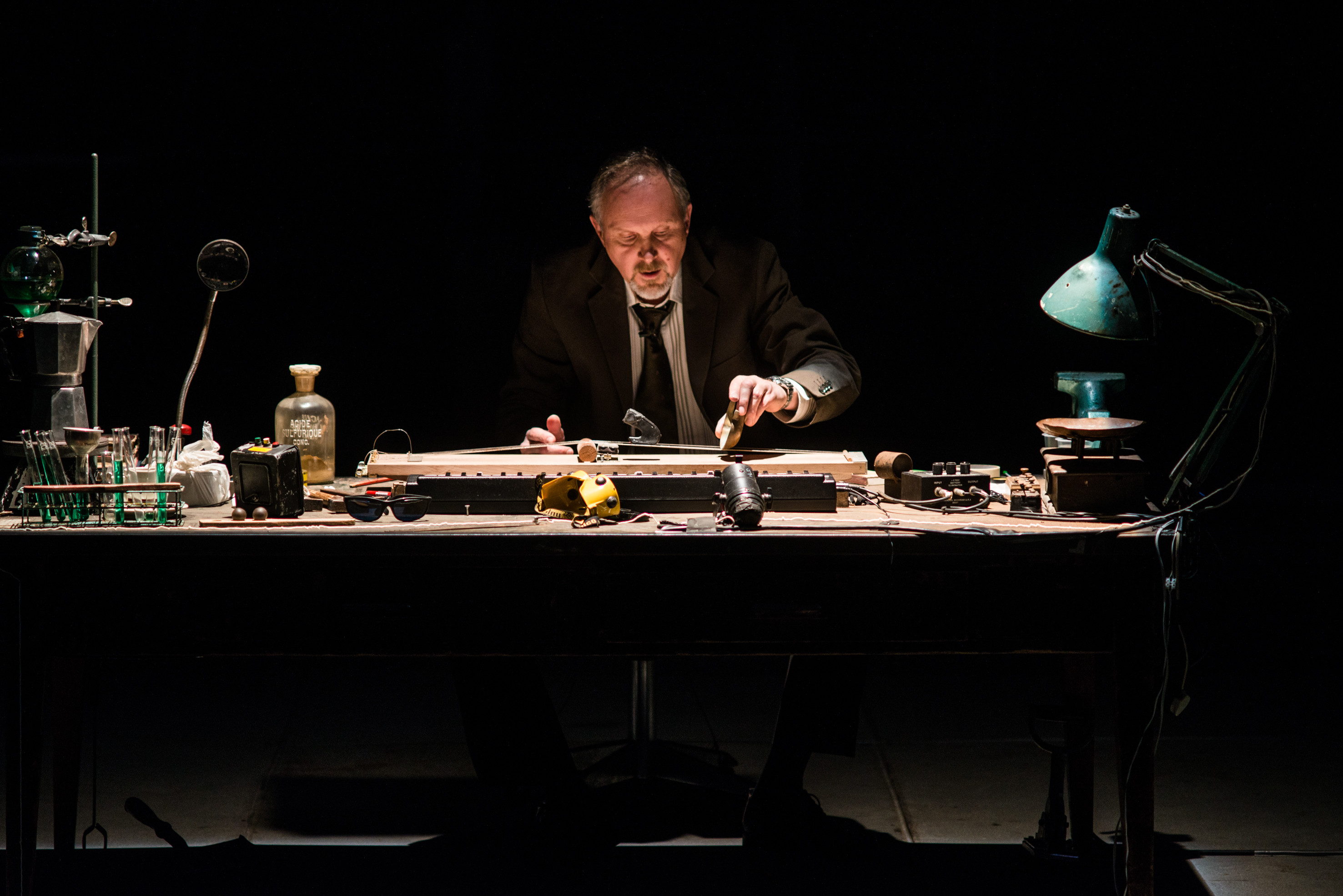
The performance is no less concentrated. Quotes from the diaries of Paul Valery, Max Black, Georg Christoph Lichtenberg and, of course, Ludwig Wittgenstein are served by Alexander Panteleev on a platter of feverish circular activity. He runs around, in turn, all three dozen strange scientific-like objects on the stage, shooting fire in a circle, launching firecrackers, a perpetual motion fan, a reel-to-reel tape recorder, sawing a vinyl record clamped in a vice with a bow. He utters the most bitter, abrupt words under hanging aquariums, one of which contains a stuffed bird. With the breakdown of all potential and disappointment in science, one feels the bottomless irony of the text, which plays a very independent role in the performance:
I'm nothing. I'm no good. I can't do anything. The great work never happened to me. The universe wasted its time on me. There was no increment, no new step was taken. I suffer more than you because I suffer better than you, because I suffer suffering and I am clearly aware of it.
In a strange way, the whole mood of the performance is similar to the internal theme of one of the best songs of the group “Auktsion”:
I'm in charge of everything
And all for one
And it's all because of me
Who's home? And I'm home!
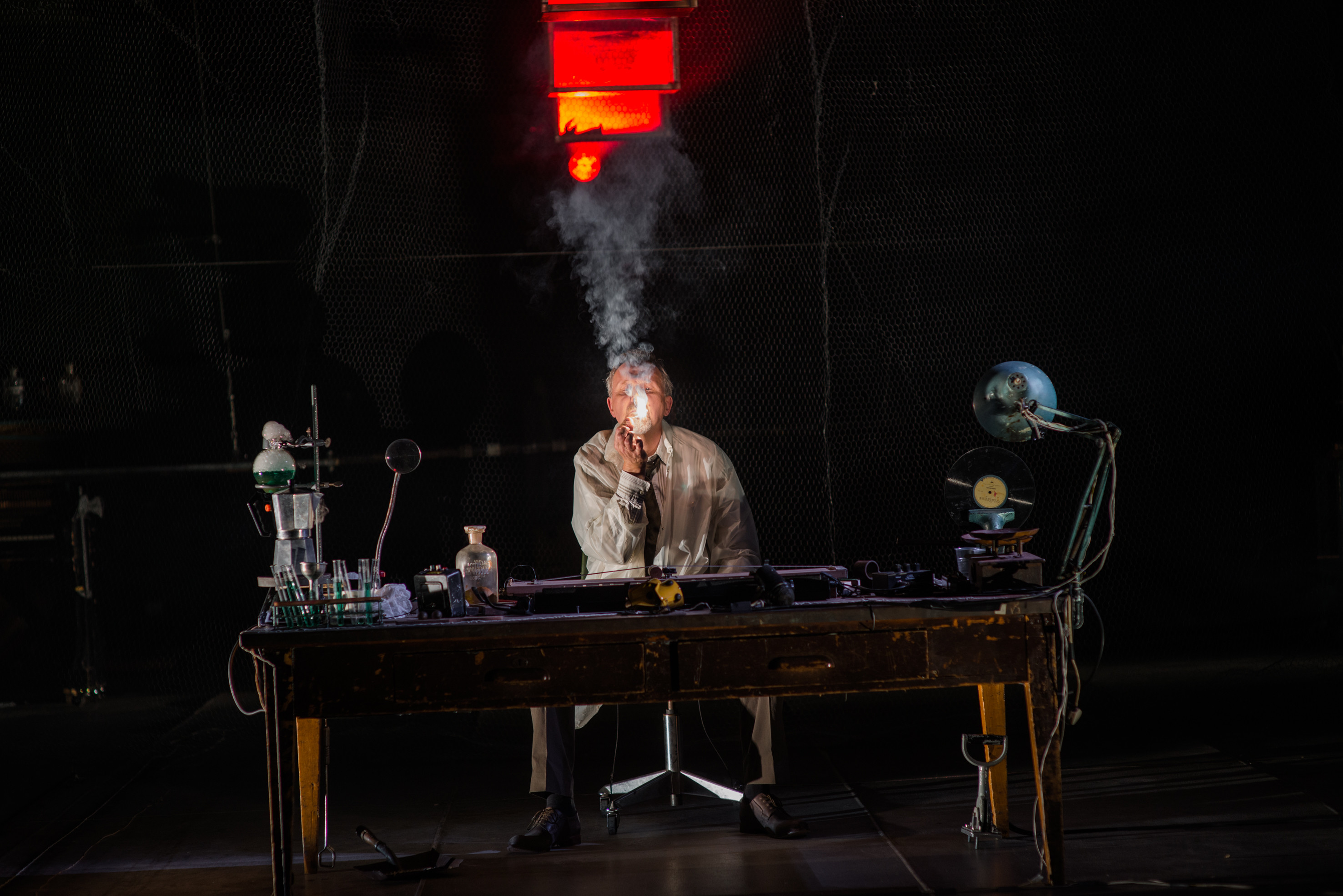
You notice something unusual for the theater - colored flashes, fanned out rays, live fire and an acrid sulfur smell - congruent with the sound score, consisting of sampled speech, a looped record on a turntable, the creaking of a bow on a bicycle wheel and vinyl, the rattling and ringing of strings under the pressure of unidentifiable objects. Why? Apparently, the sharp initiation of different feelings makes perception polymorphic and integral, but in a completely different way than the cause-and-effect plot of an ordinary play. The improviser, composer and implementer of the music for the play, Vladimir Gorlinsky, said that all the sounds were made by him in strict accordance with Goebbels’ score using a sampler, domestic synthesizers “Polivoks”, “Rhythm-2”, directional microphones and the ancient program “Liza”, which is responsible for connecting sound with equipment. The soundscape is played out without any reservations with the actor’s “musical” movements, so the audience is sure that Alexander Panteleev is a brilliant multi-instrumentalist.
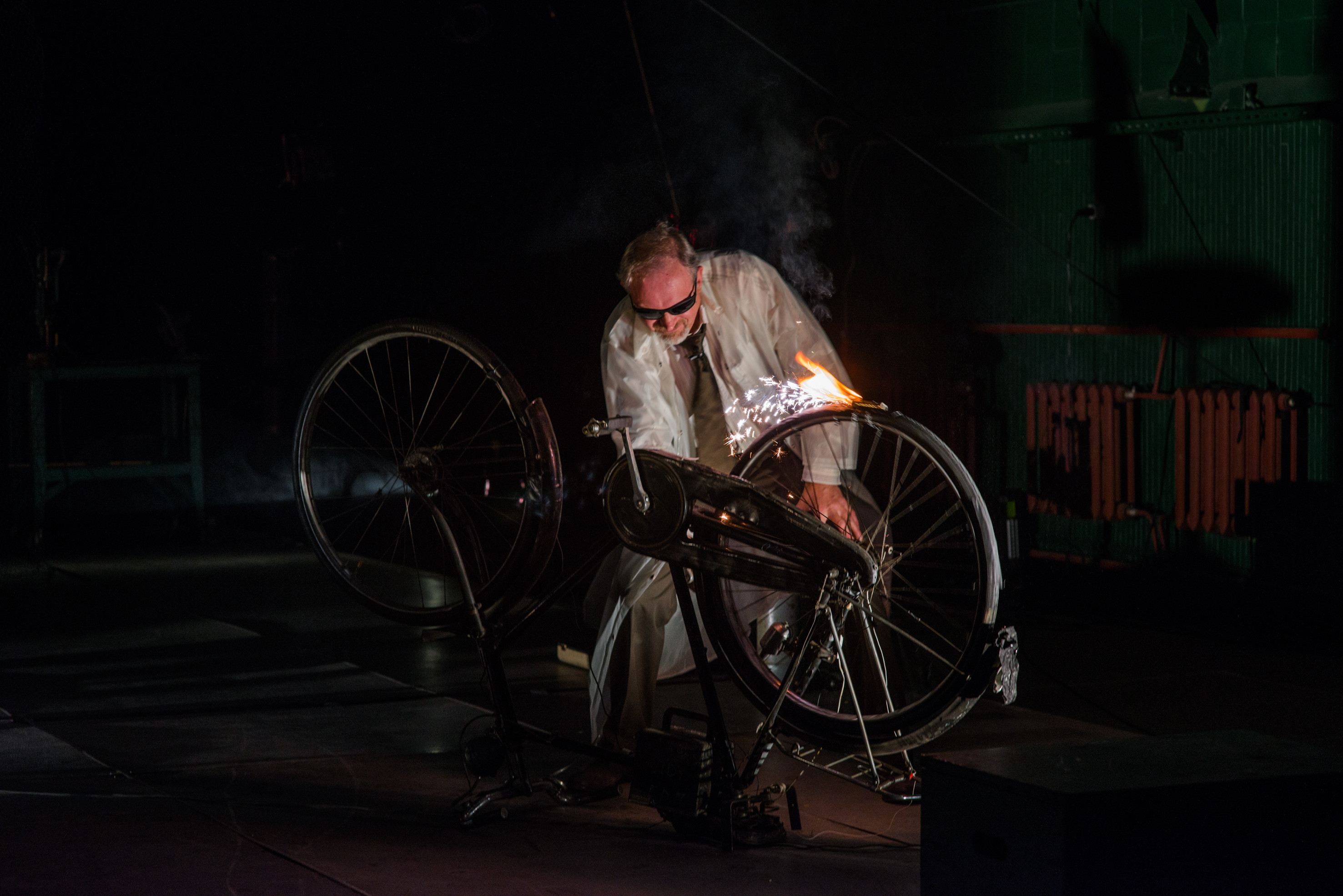
However, in a phenomenal and almost unconscious way, such a sound illusion dissociates the perception of sound and movement on stage. Which results in a feeling of independence of sound, light and movement, despite their apparent cohesion. Music as an illustration of the text is Goebbels’s main enemy, and once again he defeats this cliché. The presence of an actor as pressure is also exposed.
In some deep sense, this is a pure circus - the act is so mesmerizing that the performer is absent, but actively present. Not doing any type of illustrativeness. Reality does not double itself illusorily, as is usually done in all theaters, but declares its uniqueness. The circus box shoots out smoke twisted into columns, the audience smells the sulfur produced in the seething flask, Max Black vaguely, in accordance with his logic, crosses the light volumes, delicately built by the light set designer Klaus Grünberg. And he hides under a well-worn laboratory table in the final ignition. This is where you understand that the audience’s own thoughts are the main set designer and director. There is no thought of the perceiver, and there is no performance emanating. Complete freedom of personal choice is presence as the basis of the aesthetics of absence.