Translated material
Night visit
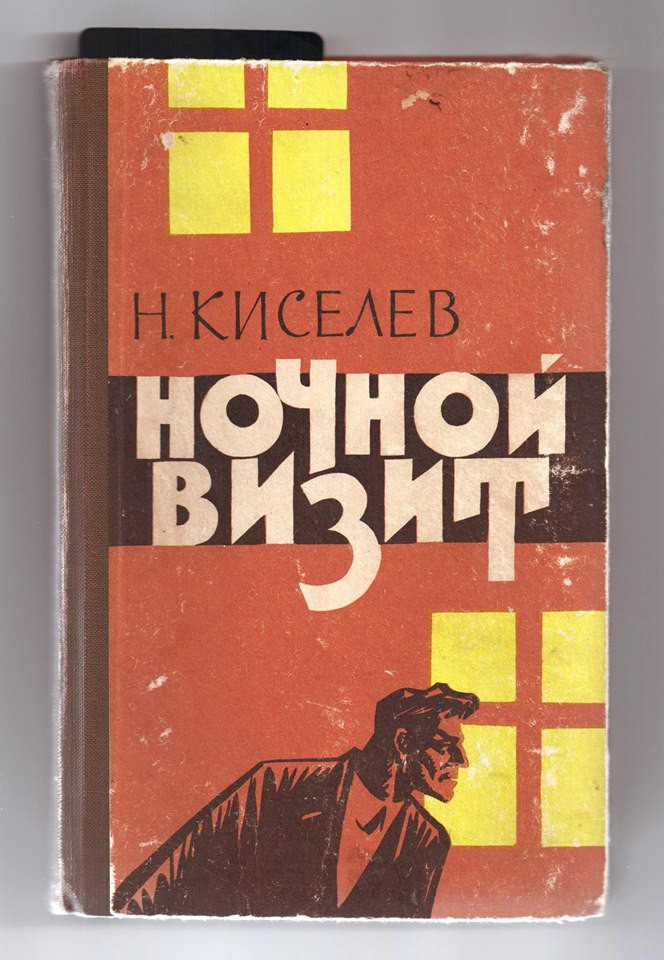
In the story by N.A. Kiselev’s “Night Visit” had several editions; the first, 1963, was published in the popular “Library of Adventure and Science Fiction” series. But the second one, the one I bought, was published in Tashkent in 1965. Before understanding these publications, I looked at the cover and tried to understand what the book was actually about. The cover showed a man at the window, the book was called “A Night Visit.” I wanted, of course, to imagine something disturbingly loving in the spirit of the American film “Forced Entry” (1973) . But the story was clearly about spies, i.e. speaking in modern language, a thriller about werewolves. A separate chapter was devoted to the night visit. The story takes place at the end of 1954, American intelligence drops three spies into Soviet territory. Two of them were the children of local assistants to Hitler’s army, and one was simply kidnapped and taken to Germany to recruit and instill a sense of malice towards the Motherland. It is the latter, having doubts about his mission, who goes to his mother, whom he has not seen for ten years. The scene of the meeting between the prodigal son, who became a traitor to his homeland, and the mother who is expecting her son, served as the title of the book.
It is worth considering what this scene is about in the context of literature and culture. The return of the dead is a persistent theme in both oral folk art and many literary works and cinematic adaptations. In this context, I will give several examples, which, it seems to me, will be quite sufficient. The first is a story about a father or brother returning from the war. A man suddenly returns from war, and a table is set in honor of his return. A child accidentally drops a fork or spoon and notices that his father (brother) has hooves instead of legs. The child runs into the barn and hides, and in the morning he discovers that the whole family has been strangled. This motive of recognizing someone else in oneself is more widely revealed in Jack Finney’s novel Invasion of the Body Snatchers . Also in the night visit scene, the son comes at night and leaves at dawn. He apologizes that he cannot show himself to people, he is embarrassed, he lies that he was in prison. From the previous pages it becomes clear to us that the son is no longer a son. Yes, from a biological point of view, he is a son, but from the point of view of the Motherland, he is a traitor, i.e. he is a werewolf, a living dead who appears at night to do evil. But the spy, son-not-son, is no longer only for the Motherland, but also for the mother, who rejoices at the collective farm, a bright life and electricity. It is no coincidence that Mother focuses on electricity, which is a persistent motif of enlightenment and the power of good in Soviet literature. As a contrast, she recalls how her son ran for kerosene as a child. This reveals another important point - the contrast between the dark past and the bright present. The spy son a priori belongs to the world of the past, a world where there is no light, i.e. literally to the world of darkness. That is why he is a night guest who is afraid of the dawn and this reveals him as a representative of demonic forces. After all, it is no coincidence that the story begins with a parachute landing of spies on a dark night. Spies literally fall from the sky. And if we recall popular ideas about evil spirits, which, falling from the sky, settle where they fell, the connotation with otherworldly forces will be even more complete.
Thus, it can be assumed that the title and chapter of the book are embedded in a widespread literary and cultural tradition of the perception of the dead. At the same time, in the Soviet text, devoid of any mystical background, it is precisely the mystical horror of meeting with an unfriendly dead man, a destroying dead man, that is implied.