
Translated material
Why you should read Springfield
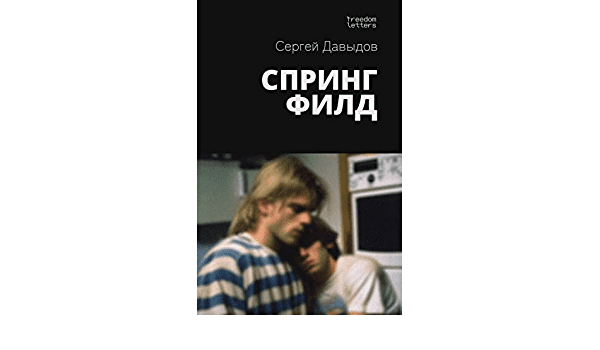
The new emigrant publishing house Freedom Letters published Sergei Davydov’s novel “Springfield” about the love of two guys from the Russian province. We have already published an interview with its author . Now let's tell you why you should read Springfield.
Andrey and Matvey are in their early twenties, they grew up in Togliatti, and now they rent an apartment in Koshelev. “ The Summer “Koshelev”, also known as the Samara microdistrict “Cool Keys”, is a Russian Springfield of three-story buildings outside the city and the railway line, with modern basketball courts and affordable housing, a tank, a fountain and an Airborne Forces day.” One works in a food court, the other as a system administrator, and both dream of escaping the tenacious embrace of a dying province. Andrei has a tense relationship with his mother, who, in an attempt to mold him into a copy of her unsuccessful career, forced him to enroll in an unloved economics department ( “I didn’t want to be any kind of director. I wanted to be Anna Politkovskaya, Kurt Cobain and Britney Spears at the same time.” ), and then fled to the village. Matvey lived for a long time in a family where his mother carried his alcoholic father on her shoulders, and learned from him stupid, stubborn helplessness. Andrei and Matvey met at university, and a few years later, it seems, they are already tired of each other and are holding on only to habit and anger.
One day, Andrei offers both of them to enroll in a master’s program in fiction at the Moscow Higher School - and they can leave without parting. For a portfolio of published works, the guys begin to write about what they see around them. This is how Andrey makes notes about queer Samara, “in which you want to live,” and this is how Matvey’s story about Beavis and Butt-head from reinforced concrete Tolyatti is born - a central insert story, an allegorical description of their own relationships and a simple fairy tale about the race for freedom, which for one turns into a hero’s journey, and for the other it drags through potholes.
“And in not a single book could I find a story that would explain to me how to live. Exactly for me. And probably because of this I started writing and drawing comics. I wanted to create, at least on paper, stories that would help me and, I hope, someone else cope with the fact that you are just some Mat from the dying city of Tolyatti. Writing stories saved my life."
All the events of Sergei Davydov’s debut novel develop in four planes. Two temporary ones: the acquaintance and birth of love between Andrei and Matvey four years ago, and their life with plans in the present; and two spatial-textual ones: rhythmic prose is continually interrupted by strong, masculine blank verse - the honest language of feelings and love of boys from the city outskirts. The characters enter the metaphorical stage, break the fourth wall and directly address the reader with poems that are similar to lengthy theatrical stage directions or Russian rap about youth in panels.
Davydov’s characters write, like the author himself, following the principle of own voices: tell what you know, describe the experience that you have experienced or could experience in a slightly changed Universe. He, just like his heroes, was born and raised in industrial Tolyatti, but went to Moscow, entered HSE and began writing dramas. He won competitions, was staged in theaters and gained a reputation as a daring and talented playwright. Davydov is from that generation whose birth and childhood were in the nineties, and whose formation was in the noughties, and his debut novel has exactly those features that are usually united under the umbrella of “prose of thirty-year-olds.” This is a frank, traumatic, honest story about disorder and the search for one’s destiny in the aggressive environment of a Russian city in the 2000s and 1900s, recognizable and personal to every thirty-year-old author. Whether it’s Volgograd in Vera Bogdanova’s “Season of Poisoned Fruits,” Nizhny Novgorod in Timur Valitov’s “The Corner Room,” or Yoshkar-Ola in Ilya Mamaev-Niles’ “The Year of Porn”—everywhere the city is both a background and a character, a vicious Greek chorus directing the heroes along the wrong paths. Davydov’s Togliatti is endowed with universally gloomy features inherent in almost any Russian city: “Togliatti was dying, we wasted away in it, we suffered in the stuffy tenth years and, together with the whole country, slowly became poorer.” The time in the novel is also universally mixed and all-encompassing: it reflects the 2000s with youth parties in abandoned buildings, the 1900s with the “Magnificent Century” on TV, Auchan and IKEA, and the early twenties with Ekaterina Shulman on YouTube.
On the one hand, fitting into the canon of prose of thirty-year-olds, on the other hand, “Springfield” follows the well-trodden paths of gay prose: it shows and describes the specific gay experience of love, friendship and intimacy. The characters go through public homophobia, through outing and coming out to their relatives, through the need to reinvent their own model of homosexual relationships, burdened by male socialization. Here Davydov echoes the prose of Edmund White (growing up as a gay man) and Dennis Cooper (survival in an unfriendly environment), but follows the path that Yaroslav Mogutin once paved in Russian, following Limonov (“It’s me, Eddie”). Mogutin has “America in my pants,” and Davydov himself is in Mogutin’s pants. Bold, arrogant, shamelessly breaking the rules, Mogutin’s prose influenced both the author of “Springfield” and his hero: “As a teenager, I read Palahniuk, Mogutin and other greyhounds and talented homosexuals and believed that one day I too would become cool in spite of everything.” Mogutin once influenced another Russian author of gay fiction, Andrei Ditzel, whose “Centaur VS Satyr” turned out to be stylistically and thematically close to Sergei Davydov’s novel, although it was published 14 years earlier. The same guys, the same hateful province, only instead of Tolyatti - Novosibirsk.
“Springfield” was published in a year when, due to homophobic laws, its publication in Russia was impossible, but it managed to be freely available as an online text for some time. However, the novel is far from online genre literature, just as it is far from commercial texts - monotonous, naive, colorless stories without a basis, without a core, without hard-won experience. Sergei Davydov manages to organically integrate into the powerful and recognizable stream of modern Russian literature and at the same time continue and develop the tradition of Russian gay prose, one of the best examples of which was the novel “Springfield”. With all the honesty of which his writing talent was capable, he constructs not just the recognizable life of a gay man in the Russian province, not just the thoughts and feelings of an outsider subjected to double stigma (poverty and homosexuality), but with amazing timeliness shows, using the example of two young guys, how the same starting conditions under environmental pressure can lead in completely different ways: through development and the future, or through stagnation and repeating the mistakes of their fathers.